• العربية
  • فارسی
Brand
  • Iran Insight
  • Politics
  • Economy
  • Analysis
  • Special Report
  • Opinion
  • Podcast
  • Iran Insight
  • Politics
  • Economy
  • Analysis
  • Special Report
  • Opinion
  • Podcast
  • Theme
  • Language
    • العربية
    • فارسی
  • Iran Insight
  • Politics
  • Economy
  • Analysis
  • Special Report
  • Opinion
  • Podcast
All rights reserved for Volant Media UK Limited
volant media logo

Iran tightens grip on Karaj hospitals after deadly clashes, witnesses say

Jan 14, 2026, 12:47 GMT+0
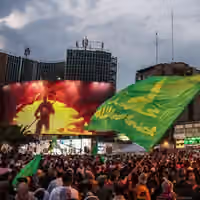
A scene of protests in Tehran

Armed security forces surrounded hospitals and government buildings in the city of Karaj after several days of deadly unrest and, in some cases, shot wounded protesters who could not move, witnesses and medical workers said.

Witnesses said security personnel entered medical centers, removed injured protesters for undisclosed locations and fired “finishing shots” at some of those left behind, describing scenes of bodies and wounded being loaded onto trucks without separation. Iran International could not independently verify the accounts.

Residents said the city fell into an uneasy calm on Monday after clashes on Thursday and Friday followed by two days of resistance by protesters over the weekend. Motorbike units and pickup trucks carrying security forces patrolled streets, while access to hospitals was heavily restricted, witnesses said.

A taxi driver who said he witnessed the violence near Gohardasht square on Thursday said security personnel loaded both dead and wounded protesters onto trucks. “The injured were not separated from the dead,” he said, adding that many were young people.

Families gathered outside hospitals including Kasra and Qassem Soleimani, where armed personnel blocked entrances and dispersed crowds, witnesses said.

At Behesht-e Sakineh cemetery, mourners reported restrictions on burials and said authorities halted the release of bodies to prevent public funerals.

Similar pressure on medical facilities was reported elsewhere.

In the northeastern city of Bojnourd, a nurse told Iran International that a local hospital had become heavily securitized, with normal shift schedules canceled and staff pressured to prioritize treatment for injured security personnel while protesters were turned away or left untreated.

Rights groups and media have reported security force raids on hospitals in other parts of Iran during the unrest, including incidents in the western city of Ilam.

Most Viewed

Iran negotiators ordered to return after internal rift over Islamabad talks
1
EXCLUSIVE

Iran negotiators ordered to return after internal rift over Islamabad talks

2
ANALYSIS

US blockade enters murky phase as tankers spoof signals and buyers hesitate

3
ANALYSIS

Why the $100 billion Hormuz toll revenue is a myth

4

US tightens financial squeeze on Iran, warns banks over oil money flows

5
ANALYSIS

US blockade targets Iran oil boom amid regional disruption

Banner
Banner

Spotlight

  • Hardliners push Hormuz ‘red line’ as US blockade tests Iran’s leverage
    INSIGHT

    Hardliners push Hormuz ‘red line’ as US blockade tests Iran’s leverage

  • Ideology may be fading in Iran, but not in Kashmir's ‘Mini Iran'
    INSIGHT

    Ideology may be fading in Iran, but not in Kashmir's ‘Mini Iran'

  • War damage amounts to $3,000 per Iranian, with blockade set to add to losses
    INSIGHT

    War damage amounts to $3,000 per Iranian, with blockade set to add to losses

  • Why the $100 billion Hormuz toll revenue is a myth
    ANALYSIS

    Why the $100 billion Hormuz toll revenue is a myth

  • US blockade targets Iran oil boom amid regional disruption
    ANALYSIS

    US blockade targets Iran oil boom amid regional disruption

  • Iran's digital economy battered by prolonged blackout
    INSIGHT

    Iran's digital economy battered by prolonged blackout

  • Security forces blocked blood donations, seized wounded protesters - paper

    Security forces blocked blood donations, seized wounded protesters - paper

•
•
•

More Stories

Iran’s internet kill switch project in final stages - sources

Jan 14, 2026, 10:40 GMT+0

Iranian authorities are moving quickly to launch a new project designed to make it possible to cut the country off from the global internet completely and for extended periods, according to information obtained by Iran International.

The project aims to build a national network on a Huawei-based platform, doing work similar to services provided by Iranian cloud firm ArvanCloud (Abr Arvan) but on a far larger scale, the information said.

It is intended to host widely used public services as well as banking and payment platforms and other critical infrastructure.

Huawei did not respond to Iran International’s request for comment.

According to the information, the project is in its final stages and is being brought online under ArvanCloud’s management, through a company called Ayandeh Afzay-e Karaneh.

The project is linked to individuals and companies under US sanctions, including Fanap and its CEO Shahab Javanmardi – sanctioned by the US Treasury in August over alleged ties to Iran’s intelligence ministry and the Revolutionary Guards.

Sources said Huawei supplied the required equipment covertly, and the company’s name does not appear in related documentation.

President Masoud Pezeshkian visited the construction site of the project in March 2025. According to the sources, China’s ambassador also visited the project.

Sources said the project is estimated to cost between $700 million and $1 billion, and that all equipment – supplied by Huawei in China – entered Iran after the 12-day war, shipped in 24 containers.

Sources said the data center would have capacity for about 400 server racks and would incorporate ArvanCloud, with much of the country’s core digital infrastructure eventually moved to the site.

They said the data center is located beneath Fanap’s administrative building in Pardis IT Town, about 20 kilometers northeast of Tehran, in a place designed to be difficult to strike by missile.

Blackout continues

Iran has remained under sweeping internet and phone disruptions as protests continue, limiting reporting on casualties, according to rights groups and internet monitors.

UN High Commissioner for Human Rights Volker Türk said he was deeply disturbed by reports of violence during nationwide protests and expressed concern about internet and communications shutdowns, calling on authorities to restore access.

NetBlocks said on Wednesday that Iran remained largely offline as the nationwide blackout passed its 132nd hour, adding that limited connectivity was obscuring the scale of casualties.

Fars news agency, which is affiliated with the IRGC, argued that internet restrictions should continue as protests persist, linking the limits to what it described as security concerns.

Iran International has reported that, amid the communications shutdown, particularly on January 7 and 8, at least 12,000 protesters were killed.

Iranian government spokesperson Fatemeh Mohajerani said decisions on internet and phone cuts were outside the control of government ministries in a security situation.

Iran’s crisis and the limits of sovereignty

Jan 14, 2026, 09:11 GMT+0
•
Shahram Kholdi

The events of the past two weeks in Iran point toward an openly regime-change movement, with protesters calling for the end of the Islamic Republic itself.

Revolutions differ from episodic unrest not by the scale of any single demonstration, but by their structure and direction. They are sustained rather than spontaneous; cumulative rather than cathartic. Their power lies in endurance, in the gradual erosion of legitimacy, authority, and administrative control, until the system itself becomes untenable.

Compared with past protest waves, the current unrest appears more nationally synchronised, socially broad, and symbolically convergent. Equally significant is the re-emergence of a shared national language of opposition that Tehran has long sought to crush through ideology, patronage, and repression.

This matters because revolutions do not target the security apparatus alone. They strike at the regime’s ability to govern routinely. A state under revolutionary pressure must deploy coercion continuously rather than episodically. That is costly, exhausting, and politically corrosive.

Iranian police have circulated text messages warning families to keep young people and teenagers at home, citing the alleged presence of “terrorist groups” and armed individuals at demonstrations and threatening decisive action. The author has independently verified these messages.

Such warnings are not merely informational; they are designed to shift responsibility for state violence onto families themselves.

Yet repression alone does not explain the regime’s present fragility. For much of its rule, governance in the Islamic Republic has been hollowed out by a deeply entrenched kleptocratic system, in which political authority, security power, and economic privilege are fused.

Years of sanctions, chronic inflation, currency collapse, and fiscal mismanagement have hollowed out state capacity. Recent military setbacks have compounded internal strain. The result is a regime increasingly reliant on force at a moment when its economic and institutional resilience is at its weakest.

Mass killing

Iran International reported on Tuesday that at least 12,000 people had been killed in the recent protests, describing the crackdown as “the largest killing in Iran’s contemporary history.”

The emerging scale of violence therefore places Iran’s crisis under increasing strain within the framework of the Responsibility to Protect doctrine (R2P). When a state is credibly accused of mass killing, collective punishment, and systematic efforts to conceal casualties, its claim to sovereign non-intervention comes under acute pressure.

R2P does not mandate automatic military action, but it does impose an obligation on the international community to consider diplomatic, economic, legal, and—if atrocities escalate further—coercive measures.

In this sense, the internationalisation of Iran’s crisis would be the consequence of Tehran's own conduct, not foreign imposition.

In 2011, the UN Security Council invoked the Responsibility to Protect in Libya when the Gaddafi regime threatened mass atrocities during the Arab Spring. Western alliances have acted to prevent large-scale civilian harm even in the absence of an explicit UN mandate.

From Bosnia and Kosovo during the wars of the former Yugoslavia to Sierra Leone and parts of the Sahel, the underlying logic has been consistent: when states engage in or enable mass violence against civilians, sovereignty ceases to function as an absolute shield.

Trump’s intervention

It is in this context that US President Donald Trump’s increasingly explicit warnings to the Islamic Republic should be understood.

Earlier today, Trump issued a direct message to Iranian protesters on Truth Social, urging them to “KEEP PROTESTING–TAKE OVER YOUR INSTITUTIONS,” announcing that he has cancelled all meetings with Iranian officials, and declaring that “HELP IS ON ITS WAY” if the killing of protesters does not stop.

This marks a notable escalation in both tone and signalling.

Trump has now repeatedly framed continued repression as a red line, stating that the United States will not tolerate mass killings of civilians.

It is unlikely that US planners would ignore the lessons of Israel’s recent 12-day campaign against Iran, a campaign in which American forces ultimately participated and which demonstrated both the reach and the limits of strikes narrowly focused on infrastructure.

Any strategy under consideration would likely be shaped less by symbolic targets than by the regime’s security architecture itself: the institutions, decision-making structures, and coercive networks that sustain repression.

Whether such pressure remains declaratory or translates into action, the signal is unmistakable: the regime’s own conduct has pushed the crisis beyond routine diplomacy and into active contingency planning.

Change in strategic terrain

The comparison most often drawn is with 2009. But the analogy is misleading.

The Green Movement was largely urban, middle-class, and procedural in its demands. It challenged an election outcome, not the foundational legitimacy of the system itself. The current movement contests the regime’s right to rule altogether.

Nor does this moment resemble many leaderless uprisings of the past century, which fractured under pressure or collapsed into ideological ambiguity. What distinguishes the present phase is the growing convergence around a figure and a direction.

Reza Pahlavi, the son of Iran’s last shah—whose reign ended in February 1979 following the revolution led by Ruhollah Khomeini—appears to be functioning, through popular recognition rather than formal appointment, as a focal point for disparate strands of opposition.

Whatever one’s view of monarchy, the presence of an identifiable political centre of gravity marks an important departure from previous cycles of unrest.

For now, the Islamic Republic retains formidable coercive capacity. Revolution does not guarantee swift collapse. What it does guarantee is a change in the strategic terrain.

The question is no longer whether the regime can suppress protests tonight, but whether it can sustain governance tomorrow, next month, or next year under unrelenting strain.

Iranians want a normal life and the ayatollah has no answer

Jan 14, 2026, 04:56 GMT+0
•
Mohamad Machine-Chian

What is unfolding in Iran is a clash between a state that treats isolation and sacrifice as strategic virtues, and a society no longer willing to bear the economic and human cost of the Islamic Republic’s ideological and regional ambitions.

In recent weeks, millions have taken part in an unprecedented challenge to the Islamic Republic — and under a nationwide communications blackout, at least 12,000 people have been shot dead in what amounts to the largest mass killing of Iran’s contemporary history.

The collapse of the rial may have ignited the protests, but this wave of defiance runs far deeper than exchange-rate volatility. It reflects a society exhausted by decades of strategic deprivation.

The poverty pushing millions to the brink is not simply the result of policy error or mismanagement. It is the by-product of a conscious political choice: a calculated trade-off.

Tehran and its defenders routinely blame sanctions. Western analysts point to corruption or incompetence. Both explanations miss the governing logic at work.

What defines the Islamic Republic’s decision-making is not a lack of alternatives, but a rigid hierarchy of priorities: ideological integrity and regional reach consistently outrank broad-based prosperity.

In this calculus, economic crisis is not an unintended detour from the leadership’s path; it is the terrain on which that path has been chosen.

Fear of external influence and so-called “cultural invasion” reinforces this worldview. Supreme Leader Ali Khamenei has repeatedly framed material prosperity and deep integration with global markets as vulnerabilities that erode faith and weaken resistance.

His much-touted “Resistance Economy” is not designed to escape sanctions, but to endure them. It promises resilience, not growth; survival, not transformation.

That trade-off cascades through policy. The drive for agricultural self-sufficiency, promoted as revolutionary virtue, has drained aquifers and destabilized rural livelihoods, as water-intensive crops and inefficient irrigation exhaust already scarce groundwater.

  • The bazaar finally breaks with the Islamic Republic

    The bazaar finally breaks with the Islamic Republic

Meanwhile, a maze of subsidies, multiple exchange rates, and import restrictions creates rents that enrich well-connected actors while suffocating independent enterprise. These distortions are tolerated—even sustained—because they preserve political control and reward loyalty over innovation.

Even when officials acknowledge the scale of failure, they remain bound by the same red lines that produced it.

The water crisis lays this contradiction bare. Faced with mounting shortages, authorities warn of “water bankruptcy” and champion desalination plants and transfer megaprojects as proof of resolve, while continuing to treat self-sufficiency in water-intensive crops as a strategic achievement rather than a structural mistake.

The result is improvisation without reform: capital flows to spectacular projects that buy time, while the incentives driving depletion and waste remain untouched.

In such a system, rising living standards are irrelevant. Economic pain does not trigger reform because reform risks undoing the political architecture that keeps the Islamic Republic intact.

On the streets today, that logic is meeting its reckoning. Protesters are not merely rejecting inflation or unemployment; they are rejecting the premise that their suffering serves a higher purpose.

In recent remarks, Khamenei praised young people who aspire to “meet their maker” and embrace sacrifice over material advancement. Yet the chants echoing across Iranian cities demand something else entirely: dignity over obedience, participation over submission, a future to build rather than one to forfeit.

Confronted with this unrest, the leadership retreats to its familiar narrative of foreign plots, dismissing protesters as agents of outside powers. That rhetoric cannot conceal the deeper confrontation underway: two visions of national purpose that cannot coexist within a single political order.

One demands a society willing to trade its welfare, opportunities, and youth for an ideological project. The other, facing bullets and batons, is signaling that this exchange—their lives for the regime’s vision—is no longer acceptable.

For a generation that refuses to be treated as collateral, the Islamic Republic and its leader have no answer.

As Iran goes dark, the state tightens its grip

Jan 13, 2026, 20:36 GMT+0
•
Behrouz Turani

It is the Islamic Republic as envisioned by Supreme Leader Ali Khamenei: no internet, no social media, hundreds of national and local newspapers shuttered, and mobile phones rendered largely useless.

The darkness is deliberate. It is enforced to prevent protesters from communicating and organizing—and to conceal the crimes committed to crush them when they do.

Iran International on Tuesday put the death toll from the crackdown at around 12,000, vowing in a statement that the mass killing “will not be buried in silence.”

With nearly all communication channels severed, Khamenei remains one of the few figures whose website continues to function. State television—a network of more than 30 channels—is still broadcasting the image he wants the world to see.

The same is true of a handful of state-aligned news agencies, including Fars, Tasnim, and Mehr, all controlled by the Revolutionary Guards or the Organization for Islamic Propagation.

Although Iran’s national intranet has partially resumed after several days of shutdown, even state television has struggled to maintain its broadcasts following the severing of international internet links.

Despite those limitations, state TV aired footage promoting a tightly stage-managed pro-government rally in one of Tehran’s smallest squares, a space that can barely hold 3,000 people.

Internet experts say a small number of X users inside Iran have been selectively allowed to post content supporting government narratives. Limited Starlink access also exists, but analysts warn that the sporadic signal means foreign media remain largely blind to developments across most of the country.

As of Tuesday evening in Tehran, the government had not responded to calls from the United Nations secretary-general and European Union officials urging it to restore communication lines.

Meanwhile, social media posts describe security forces raiding homes and confiscating Starlink terminals, satellite dishes, computers, and mobile phones — part of a broader effort to prevent Iranians from accessing independent reporting or sending information abroad.

With the blackout, censorship, and signal jamming, foreign-based Persian-language media—now the primary source of information for many Iranians—may be forced to revive shortwave radio broadcasting. It would represent a step backward in media technology, but perhaps the only way to move forward in reaching a silenced population.

Shukriya Bradost, an Iran analyst based in Washington, wrote on X on Tuesday that while protesters stand “empty-handed against a regime that answers them with bullets,” no significant defections appear to have occurred within the military.

“Starlink and outside reporting no longer have the impact they once did,” she wrote, because the world already knows what is happening in Iran. If any action is to be taken, she concluded, “the time is now, not later.”

How a flag became a rejection of Iran’s theocratic rule

Jan 13, 2026, 19:01 GMT+0
•
Hooman Abedi

Iran's historic Lion and Sun flag has had a resurgence with latest round of widespread protests after nearly half a century of absence from the country's official identity.

Carried by some demonstrators from the earliest days of the unrest, it served as a visual rejection of the Islamic Republic’s theocratic rule.

But after exiled Prince Reza Pahlavi called on Iranians abroad to replace the Islamic Republic’s flag at embassies and consulates, the Lion and Sun moved to the center of Iran’s political narrative.

Even before that call, an Iranian protester climbed the wall of Iran's embassy in London to replace the official flag with the Lion and Sun. The footage spread rapidly online and was even shared by US President Donald Trump.

The act was repeated the following day, turning the embassy into a symbolic battleground over national identity.

Similar actions followed in Canberra, Stockholm, Oslo, Rome, Munich, Hamburg, and Ljubljana, where Iranians replaced official symbols, installed flags at entrances, or painted the Lion and Sun emblem and protest slogans on diplomatic buildings.

Videos from several cities inside Iran showed protesters carrying or displaying the Lion and Sun during demonstrations–an instant visual marker that a local protest was part of a broader national movement.

For many, the flag is less about monarchism and more about distancing themselves from the Islamic Republic. Its power lies in clarity. In a single image, it communicates rejection of the regime and identification with an alternative vision of Iran.

That efficiency has made it one of the most repeated visual motifs of the current unrest.

And that is perhaps why X also decided to change its Iran flag icon to the Lion and Sun.

The endurance of the tricolor

Iran’s green, white, and red tricolor was formalized during the Constitutional Revolution of the early 20th century, when the idea of a modern Iranian nation-state first took shape. Over time, the colors acquired widely accepted meanings: green for vitality and land, white for peace and clarity, red for courage and sacrifice.

What makes the tricolor distinctive is its continuity. It has survived monarchies, coups, revolutions, and war with minimal dispute. Across political divisions, it remained one of the few symbols broadly viewed as “Iranian” rather than “governmental.”

The Lion and Sun emblem is among Iran’s oldest political symbols. Its formal use dates back to the Safavid era and was standardized under the Qajars and later the Pahlavis as a lion holding a sword beneath a radiant sun.

In Iranian symbolism, the lion represents power, guardianship, and independence; the sun conveys enlightenment, sovereignty, and renewal. Together, they evoke a civilizational memory that predates the Islamic Republic.

This layered meaning explains why many Iranians view the emblem as representing Iran itself rather than a specific political system.

After 1979: a symbolic rupture

After the 1979 revolution, the Islamic Republic removed the Lion and Sun and replaced it with a new emblem built from stylized Islamic inscriptions.

The post-revolutionary clerical government viewed the Lion and Sun symbol as representing the "oppressive Westernising monarchy."

Over four decades of its placement on ministry façades, military uniforms, public buildings, textbooks, and state media, the emblem increasingly became seen as the “flag of the Islamic Republic” – not the “flag of Iran.”

This symbolic rupture explains why the Lion and Sun resurfaces during moments of crisis – from 2009 to 2019 to 2022, and now again. Its return in 2026 is simply its most visible resurgence.

Many leftists, republicans, and nationalists avoided it, wary of monarchist associations. This year’s protests have altered that calculus. The scale of unrest and the need for a non-regime symbol have softened ideological boundaries.

Many Iranians with no attachment to monarchy now carry the Lion and Sun as a marker of resistance, not restoration, as a symbol of “Iran without the Islamic Republic.”

In a moment of complete digital blackout, censorship and repression, symbols have again become the language of the street – durable, replicable, and difficult to silence.

Whether the lion and sun becomes a temporary emblem of a protest movement or a lasting symbol of a future political order remains one of the most consequential questions emerging from this year’s unrest.