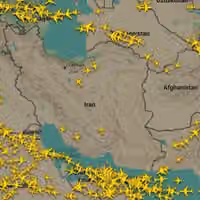
Flight-monitoring data from Flightradar24 indicate that US aviation sanctions have reduced Iran’s international flights by about half in one week. Almost all of Iran’s international flights over the past month have been operated by Iranian airlines, as foreign carriers have largely stopped flying to the country.
The latest restrictions reach beyond Iranian airlines themselves. Airports, fuel suppliers, ground handlers, ticket sellers and other companies providing services to sanctioned carriers can risk US penalties, giving businesses in third countries an incentive to stop handling Iranian flights.
Iranian-operated flights to the United Arab Emirates, Oman, Georgia and Azerbaijan have been suspended or sharply restricted, while Iranian carriers remain barred from Iraqi airports despite a limited resumption of services by Iraq’s national airline. Flights to China and Russia continue, while services to several other destinations, including Turkey and Afghanistan, have remained available.
For passengers trying to reach countries no longer served directly, that increasingly means flying through cities such as Istanbul, Islamabad, Kabul, Beijing, Dushanbe, Yerevan or Moscow before continuing to their destinations.
The detours can add hours or even days to journeys and substantially increase costs.
Turkey has become one of the most important remaining gateways. Iran Air flights between Tehran and Istanbul were still operating Monday, according to flight-tracking data, although Mahan Air has already suspended its Turkey services and Turkish Airlines has no Iran flights scheduled before March 2027.
Turkey Today reported Monday, citing two sources, that the remaining Iranian flights to Turkey were expected to be suspended in early October. No formal announcement of a complete suspension has yet been made.
Longer routes, higher costs
Mahan, a 42-year-old Iranian who has lived and worked in the United Arab Emirates for years and regularly travels to Tehran to visit her elderly mother, said her latest return journey to Dubai showed how quickly the restrictions were changing ordinary travel.
With direct options unavailable, she flew from Iran to Armenia on Sunday, spent the night at a hotel in Yerevan and continued to Dubai the following day.
Including the hotel and transportation in Armenia, she said the journey cost almost three times what she previously paid to travel between Iran and the UAE.
The trip was also more stressful, she said, because the hotel arranged for her was a considerable distance from the airport.
Other passengers she encountered had taken an even more difficult route. They told her they had traveled overland from Iran to the Armenian border and then continued roughly 400 kilometers by bus to Yerevan.
They described carrying luggage through crowded border areas and struggling to find transportation for the long journey from the crossing to the Armenian capital.
Najaf becomes test case
Iraq has emerged as one of the clearest examples of the complications created by Washington’s aviation pressure because of the volume of religious and family travel between the two countries.
Baghdad airport stopped accepting flights operated by Iranian airlines on September 22. Iranian aviation authorities initially sought to redirect some Baghdad-bound services to Najaf, one of Shiite Islam’s most important pilgrimage centers.
Najaf airport then suspended all flights to and from Iran on September 25, cutting off the alternative route and affecting large numbers of Iranian pilgrims traveling to Najaf and nearby Karbala.
The Iraqi government subsequently opened direct talks with Washington for exemptions from US Treasury measures. Prime Minister Ali al-Zaidi’s office said it was seeking exemptions allowing travel for medical treatment, education, religious visits and other civilian purposes.
Reuters reported Monday that the Trump administration was preparing a one-month waiver allowing Iraqi Airways to carry Shia pilgrims between Najaf and Iran, with a more permanent exemption potentially following. The proposed waiver applies specifically to the Iraqi national carrier.
Iraq’s state news agency later reported that Iraqi Airways had resumed flights between Najaf and Iranian airports.
Iran, however, disputed reports that Iran-Najaf flights had broadly resumed. Civil Aviation Organization spokesman Majid Akhavan said Tehran had received no official communication authorizing a resumption and said Iranian airlines remained unable to restart the route.
The two accounts refer to different operators: the Iraqi announcement concerned Iraqi Airways, while the Iranian statement addressed the ability of Iranian carriers to return to Najaf. Iraqi media also reported Monday that the ban on Iranian airlines remained in force even as Iraqi Airways resumed flights to Iranian airports.
The distinction gives Baghdad a way to restore at least some pilgrimage traffic without immediately reopening its airports to sanctioned Iranian carriers.
The disruption had already created political pressure in Iraq. Demonstrations were held in Baghdad and Najaf against the suspension, while Iranian officials warned that restrictions on air links could affect the broader relationship between the two neighbors.
Alaeddin Boroujerdi, a member of Iran’s parliamentary National Security Committee, pointed to Iraq’s reliance on Iranian electricity and gas and warned that policies obstructing bilateral ties could have consequences in other areas.
Iranian website Rouydad24 described the flight dispute as a test of relations between Tehran and Baghdad, noting Iran’s role in Iraq’s energy supplies and its past support in the fight against Islamic State.
Tehran warns its neighbors
The aviation restrictions have also produced increasingly sharp warnings from Iranian political figures toward governments cooperating with Washington.
Mohsen Rezaei, secretary of Iran’s Supreme National Security Council, warned regional countries last week that if Iranian aircraft were prevented from flying, airports elsewhere in the region could also be unable to operate.
The council’s secretariat later sought to distance itself from interpretations that Iran was threatening military attacks on regional airports, saying military retaliation over the flight restrictions was not on the agenda.
Mohammad Mokhber, an adviser to Supreme Leader Mojtaba Khamenei, nevertheless issued a separate warning Friday.
“Alignment with America in implementing hostile policies will remain in the memory of the Iranian people,” Mokhber wrote on X.
“Flights in the region are either free for everyone or for no one,” he added. “If Iran cannot fly or receive airport services, no country in the region will have this possibility either.”
The remarks prompted support from some hardline social-media users, including calls for Tehran to impose a no-fly zone over the Persian Gulf or threaten airlines serving neighboring countries.
Others criticized the approach. Amir Abbasi, an X user, compared the aviation warnings with previous Iranian threats to prevent other countries from exporting oil if Tehran was unable to do so.
“Perhaps these threats have a domestic use, but a crisis cannot be solved with slogans,” he wrote.