Serkan Eren, founder of the Stuttgart-based humanitarian organization STELP.
A German-based humanitarian worker has been sentenced to 10 years in prison in Iran after entering the country to help vulnerable Iranians, in a case rights experts say is the latest example of Tehran using foreign detainees as political leverage.
A German-based humanitarian worker has been sentenced to 10 years in prison in Iran after entering the country to help vulnerable Iranians, Stuttgart-based aid organization STELP said.
Serkan Eren, the 42-year-old founder of STELP, was convicted over alleged contacts with a country Iran considers hostile, according to the organization. STELP has not identified the country or disclosed further details, citing concerns for Eren and others involved.
Eren, a Turkish citizen and longtime resident of Germany, has been in Iranian custody for more than a year.
He entered Iran in late June 2025 as the 12-day war was drawing to a close. Five days later, after a ceasefire had taken effect, he headed toward the Iraqi border to leave the country. He never made it out.
STELP called the verdict unjustified and said the sentence did not reflect the circumstances of his case.
“The ten-year prison sentence given to Serkan Eren is not about what he has done. It is about what the Islamic Republic wants,” Shahin Milani, executive director of the Iran Human Rights Documentation Center, told Iran International.
Milani said Eren's charitable work offered little protection from what he described as Tehran's established practice of using foreign detainees as political leverage.
“Even working for a charitable organization does not protect foreign nationals,” he said.
Contemporaneous German reporting provides a detailed account of why Eren went to Iran and the precautions he took before entering.
German-Iranians had approached STELP seeking help for relatives inside the country, according to the Stuttgarter Zeitung. Eren said he was in contact with seven elderly Iranians, some of them ill, whom he hoped to help reach Turkey. He also intended to bring food into Tehran.
The risks were apparent before he crossed the border.
Eren deliberately left behind a satellite phone, bulletproof vest and helmet, fearing such equipment could cause Iranian authorities to mistake him for an agent or saboteur. Instead, he crossed from Turkey into Iran on foot with little more than a backpack.
Once inside, those concerns intensified. Eren later described armed checkpoints on his route to Tehran where he was forced to strip naked during searches.
More than a year later, an Islamic Republic court convicted him over alleged contacts with a hostile country.
Human rights lawyer Gissou Nia said humanitarian status has not historically insulated either foreign aid workers or Iranian charities from pressure by the authorities.
“Unfortunately, being a humanitarian aid worker is not a shield when it comes to the Islamic Republic detaining and arbitrarily imprisoning individuals,” Nia told Iran International.
She cited the case of Belgian humanitarian worker Olivier Vandecasteele, who was detained in Iran in 2022 and later sentenced to a lengthy prison term before being released in 2023 in a prisoner exchange involving Assadollah Assadi, an Iranian diplomat imprisoned in Belgium over a foiled bomb plot.
“This is a pattern that we've seen before,” Nia said.
Nia also pointed to the treatment of humanitarian organizations operating inside Iran. The Imam Ali Popular Students Relief Society, a prominent independent charity that worked with impoverished families and vulnerable children, was dissolved following years of pressure from Iranian authorities.
The Center for Human Rights in Iran reported in 2022 that an appeals court upheld an order dissolving the organization after authorities arrested several of its members and accused its founder of offenses including insulting Iran's leadership and acting against national security.
The case, Nia said, illustrates how work designed to remain outside politics can itself become politically charged in Iran.
“Even the sort of non-politicized work of humanitarian aid organizations has been politicized in some ways,” she said.
Eren's Turkish citizenship adds another layer to efforts to secure his release.
Despite living in Germany and running a Stuttgart-based organization, Eren does not hold German citizenship. Germany's Foreign Office has said it is aware of his case but that responsibility rests with Turkish authorities because he is a Turkish national. STELP says it has been working closely with Ankara since his detention.
Nia said his ties to Germany nevertheless give Berlin reason to remain engaged.
“I anticipate that Germany will raise the case, especially because he was working for a German-based organization,” she said. “And the Turkish government will probably be involved as well, because he is a Turkish citizen.”
The sentence has already drawn calls for Eren's release in Germany. Baden-Württemberg Minister-President Cem Özdemir said he would continue pushing for Eren to be freed immediately.
Eren has spent years working in humanitarian crises. He began aid work during Europe's 2015 refugee crisis and received Germany's Federal Order of Merit in 2023 for his humanitarian service.
Before entering Iran, he openly questioned whether authorities would allow him into the country at all.
“It’s arbitrary,” Eren told the Stuttgarter Zeitung at the time.
He nevertheless hoped his status as a humanitarian worker would help protect him.
A designated terrorist organization has written to American voters. Iran's Revolutionary Guards sent a 26-page letter to US scholars, students and media describing a government in decline and telling Americans they have the power to change it at the ballot box in November.
The letter, published by Iranian media on Tuesday in English and Persian, presents the Islamic Revolutionary Guard Corps as a force for the people, portrays Iran as victorious and the United States as a power in decline, and returns repeatedly to a single instruction: that Americans turn against the politicians they elected.
The Guards and their Basij volunteer force led the suppression of nationwide protests in January, in which security forces killed tens of thousands of people in two days. A UN fact-finding mission said this month that the crackdown involved crimes against humanity.
Signs of 'decline'
"Tyranny, an excessive tendency to behave violently and murderously, relying on and promoting falsehoods, giving precedence to the vulgar elements of society over the wiser elements in occupying positions of power, and an inordinate preoccupation with inessential matters at the expense of society's essential affairs" are the signs of a state in decline, the letter says.
"The United States government today exemplifies all of these flaws."
The United States designates the Guards as a foreign terrorist organization. The letter rejects the label.
"There is not a single verifiable instance where the IRGC has committed an act of violence against civilians," it says. "In fact, it would not be an overstatement to assert that the Guards are the world's most effective organization in combating terrorism."
Amnesty International said this month that Iranian authorities carried out a systematic campaign of killings, torture and sexual violence to crush the Woman, Life, Freedom uprising of 2022. It named 87 officials, including senior Guards and police commanders, whom it said should be investigated for crimes against humanity, and documented 377 protest-related deaths, 56 of them children.
The UN fact-finding mission's report on the January 2026 crackdown cited unlawful killings, torture, arbitrary detention and enforced disappearances, and said the scale of the violence was a sharp escalation from earlier repression.
The Guards' Quds Force arms and funds Hezbollah in Lebanon, the Houthis in Yemen and militias in Iraq. Since the war began in February, Guards naval forces have attacked commercial shipping in the Strait of Hormuz.
The letter tells Americans they are responsible for their government.
"You are the ones who empower, with your votes, the government and allow it to do what it does," it says. "Although American politicians often win your votes through deception and false promises, as Trump did, you can change the makeup of the government."
"The United States of America is a great nation," it adds. "To allow vulgar and immoral individuals to continue steering your politics and policies will only further humiliate and undermine the US. Take back control."
In Iran, candidates for president and parliament are vetted by the Guardian Council, an unelected body, before they can stand. The supreme leader is not elected by voters. Official turnout in the 2024 presidential election was about 40 percent.
The letter also explains the slogan "Death to America." "The true meaning of 'Death to America' is 'Death to the crimes perpetrated by the American elite,'" it says. "It is, in a word, not an expression of ill will toward the American people."
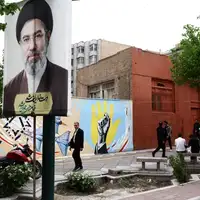
The slogan is chanted at state-organized rallies and Friday prayers across Iran and appears on murals maintained by the state in central Tehran, including on the walls of the former US embassy.
The letter attacks Donald Trump and tells Americans their economy is failing.
"The US economy is on the precipice of collapse, and yet he keeps on telling Americans that the economy is booming and the prices will soon start coming down," it says. "This is, perhaps, his biggest lie. Soon, the dam will break, and the economy will implode, causing, unfortunately, great pain for Americans for many many years."
"The US economy will be hit by a massive economic earthquake that will affect the lives of all Americans," it adds. "You, the American people, have the power to forestall this grim fate."
On the day the letter circulated, the dollar traded above 2.5 million rials on Iran's open market. Iran's minimum monthly wage of 166 million rials is worth about $66 at that rate.
'We can live together'
The letter closes by asking Americans to press Washington to distance itself from Israel.
"We can live together in peaceful coexistence," it says. "Remove from power the evil, deceitful, and violent politicians who are responsible for America's current state. Entrust your affairs to the wise, not the wily. Make sure your politicians understand that the world has changed."
Prisoners at an Iran prison face severe overcrowding, infectious diseases and shortages of food, medicine and medical care, according to accounts obtained by Iran International.
The accounts from Dastgerd Prison in the central city of Isfahan describe crowded wards, poor sanitation and severe obstacles to treatment, with several people familiar with conditions there describing the spread of meningitis and other infections.
“Meningitis and colds are rampant in the prison, and there are no pills or medicine,” a former prisoner told Iran International.
Around 10,000 people are being held at Dastgerd, compared with a standard capacity of about 4,000 to 5,000, according to information.
Food shortages compound overcrowding
Nutrition is so poor that many prisoners have become physically weak and more vulnerable to illness.
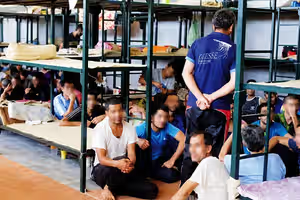
File photo of the inside of Isfahan’s Dastgerd Prison, published by rights groups. Image enhanced using AI.
Breakfast is not distributed on some days, and lunch and dinner are rationed. Food can also be difficult to obtain from the prison shop, even as cigarettes remain consistently available and various drugs are easily accessible inside.
Some wards hold between 1,300 and 1,500 prisoners, another person familiar with conditions at Dastgerd said. The combination of overcrowding and inadequate sanitation has helped diseases spread.
Prisoners, particularly political ones, in some cases deprived of phone calls, treatment, medicine, adequate food, sanitation, correspondence and some judicial rights.
Iran International reported on July 21 that prisoners must register to visit the medical center. In rooms housing around 40 people, only two are allowed to seek medical attention each week.
Meningitis spreads as prisoner deaths mount
Several accounts received in recent months point to the spread of meningitis at Dastgerd. Iran International previously reported that the disease had reached several wards and that a number of prisoners were transferred to hospital.
Two prisoners had meningitis when one former inmate arrived at Dastgerd. One suffered a seizure in the admissions section and died, while the other died after being transferred to hospital.
The former inmate said prisoners had in previous years received meningitis and tetanus vaccines upon arrival, but the vaccinations were no longer being administered during the person's recent detention.
More than 70 prisoners have died from illnesses over roughly the past five months, according to another person familiar with conditions at the prison. At least 15 of those who had died by September 21 were from a single ward.
Prisoners suspected of having meningitis have in some cases been sent to hospitals for spinal fluid testing. Some were returned to Dastgerd before completing treatment and recovering.
File photo of the inside of Isfahan’s Dastgerd Prison, published by rights groups. Image enhanced using AI.
The prison is also infested with bedbugs and other pests, according to accounts. Recent Iran International coverage documented bedbugs, fleas and ticks alongside increasing skin conditions and infections in the wards.
Blankets and bedding are heavily contaminated, one former prisoner said, with some inmates developing serious eye infections that leave them unable to open their eyes in the morning.
The person needed nearly two months of treatment after being released on bail, including regular injections and intravenous fluids during the first two weeks.
Fever, chills, body aches and infections of the lungs, throat, eyes and ears were widespread. Some prisoners contracted several illnesses at once, leaving them severely weakened.
Medicine shortages restrict treatment
Severe medicine shortages have compounded the health problems, while political prisoners can face particular difficulties gaining access to the prison clinic.
Denial of treatment has in some cases been used to exert pressure on political prisoners, according to one former inmate.
Prison authorities told inmates that the clinic had burned down, that medicine was unavailable and that there was no budget to buy supplies.
One prisoner offered to deposit 500 million rials into a prison account to pay for medicine. The offer was accepted, but most of the supplies subsequently purchased were acetaminophen and basic cold remedies, with insufficient antibiotics available for serious infections.
Families have also tried to bring necessary medication into the prison, only for authorities in some cases to refuse delivery or confiscate part of the medicine during inspections.
Sedatives, sleeping pills and drugs, by contrast, are widely available among prisoners, according to the former inmate.
Iran International has obtained exclusive information and documents indicating that Mostafa Ahadi, a senior official in the IRGC Intelligence Organization, runs the organization’s corruption network in the sale of Iran’s oil.
Over the past two months, Iran International has published three separate reports naming the trustees — oil brokers trusted by the Islamic Republic to sell Iran’s sanctioned oil — who have failed to return billions of dollars in oil proceeds to the country.
On September 28, Judiciary Chief Gholamhossein Mohseni-Ejei criticized delays in handling cases involving trustees with outstanding debts and called for swift rulings. Iran International has obtained a confidential Supreme National Security Council document in which the council’s deputy for economic affairs confirms that oversight bodies alter the trustees’ debt figures according to their own interests, inflating some debts and understating others.
The council’s deputy has asked the Ministry of Intelligence and the IRGC Intelligence Organization to report on the missing funds. The letter makes it easier for IRGC Intelligence, the principal organization implicated in the corruption surrounding oil sales, to gain access to the case.
Trustees’ case returns to IRGC Intelligence
Two informed sources in the Oil Ministry and an oversight body told Iran International that the Supreme Audit Court and the General Inspection Organization are currently pursuing the trustees’ cases. But through the maneuvering of a senior security official and an order from the Supreme National Security Council, the case has effectively returned to the IRGC Intelligence Organization.
That senior security official, whose photograph Iran International is publishing for the first time, is Mostafa Ahadi. He is now deputy head of Unit 600 of the IRGC Intelligence Organization, having previously served as its deputy for economic affairs. Through his positions in IRGC Intelligence and the Supreme National Security Council over the past decade, Ahadi has had a firm grip on Iran’s oil sales.
Several months ago, Brigadier General Mehdi Sayyari appointed Ahadi deputy head of Unit 600. Sayyari served for years as deputy head of the IRGC Intelligence Organization and became acting head of one of the country’s most important security organizations following the killing of Majid Khademi.
In the late 2010s, when responsibility for selling oil under sanctions was assigned to the Supreme National Security Council, Ahadi joined the council as deputy for economic affairs. Without his security background becoming known to international organizations, he attended two BRICS summits, in Russia and Brazil.
His involvement in Iran’s oil trade is so extensive that he even accompanies Oil Ministry officials on visits to oil terminals on Kharg Island.
While serving on the Supreme National Security Council, Ahadi sent his former deputy, Mohammad Javad Bavand, to the council’s cover committee as a representative of IRGC Intelligence, ostensibly to oversee sanctioned oil sales. His principal responsibility, however, was to secure profits from corruption in the oil trade for the IRGC Intelligence network.
Bavand, who served as a special assistant to the oil minister for oil sales during Ebrahim Raisi’s administration, returned to the role about four months ago. According to a General Inspection Organization document first published by Iran International, he assigned the sale of a large 86-million-barrel oil consignment to four trustees with outstanding debts, including Mohammad Hadi Momenin.
Bavand’s close ties to Mohammad Hadi Momenin
Iran International has obtained exclusive information indicating that the relationship between the two extends well beyond this corruption case.
A General Inspection Organization document published by Iran International revealed that the sale of 86 million barrels of Iran’s oil had been assigned to four trustees with outstanding debts.
Six years ago, Mohammad Hadi Momenin was arrested on suspicion of disrupting the foreign exchange system. He had received hundreds of millions of dollars in preferential foreign currency to import machinery for the paper industry and had failed to return the funds. At the time, Mohammad Javad Bavand used his influence to have the case closed. Momenin, who was a shareholder in Mahan Industries and Mines Development Holding, then appointed Bavand to a management position as his representative. Gardeshgari Bank is the holding company’s principal shareholder.
On Monday, September 28, Hadi Ghavami, the parliamentary representative for Esfarayen, told a plenary session: “The trustees who took oil out of the country also stole $300 million, equivalent to 69 trillion tomans, from Gardeshgari Bank, and under these circumstances, the Central Bank has given them a credit line with a 45 percent penalty.”
In June 2020, Momenin was arrested again on allegations of financial corruption and disrupting the foreign exchange system, but his case was once more closed with Bavand’s help. An investigator’s report quoted Momenin as saying that he had used his employees to register numerous shell companies in China, Taiwan, Singapore and the United Arab Emirates. The companies existed for between three and 14 months.
Another part of the case revealed that Momenin’s holding company had received large loans from Mellat Bank, Refah Bank, Karafarin Bank, Bank of Industry and Mine, Saman Bank and Middle East Bank, yet none of the banks had filed a complaint against him.
In July, the Central Bank published a list of major bank debtors showing that Mohammad Hadi Momenin owed Karafarin Bank 743 billion tomans.
Two informed sources in the Oil Ministry and an oversight body told Iran International that Ahmad Baharvandi, who became Karafarin Bank’s chief executive five years ago, was in fact an associate of Bavand within IRGC Intelligence. Both men studied at Imam Sadiq University. Mostafa Ahadi also studied there and was a member of the university’s student Basij organization.
At Bavand’s request, Baharvandi did not pursue Momenin’s 743-billion-toman debt. In turn, Momenin took Bavand on a trip to China.
Mohammad Hadi Momenin was a member of the Ministry of Intelligence’s oil sales corruption network known as Shayan, which failed to return $2 billion in oil proceeds.
Secret IRGC meeting held to counter reporting on trustee corruption
After Bavand returned to the Oil Ministry, Momenin became his trusted trustee for oil sales despite a warning from the General Inspection Organization. Over the past month, following the publication of investigative reports, Momenin and Bavand have found themselves back in the headlines against their wishes.
Mostafa Ahadi, the godfather of the IRGC Intelligence corruption network, used his new position to address the problem. Two informed sources in the Oil Ministry and an oversight body told Iran International that a secret meeting was held two weeks ago at the IRGC’s media headquarters. Those present included Abdullah Zeighami, also known as Brigadier General Moshfegh, Bavand and Ahadi.
The meeting’s objective was to prevent media coverage of trustee corruption. One result was the removal of reports about the scandal from Mehr News Agency, which is affiliated with the Islamic Propagation Organization, and Hamshahri, a newspaper owned by Tehran Municipality.
At the same time, Ahadi used the Supreme National Security Council to return responsibility for the trustees’ cases to IRGC Intelligence so that the security organization’s cycle of profits from oil sales would continue.
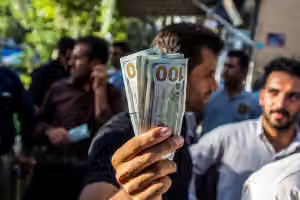
A man displays US dollar banknotes on a street in Tehran, Iran.
Iran’s rial fell to another record low on Monday, with the dollar reaching 2.45 million rials as economic and military pressures persisted and efforts took shape for possible new indirect talks with the United States.
Mediators are expected to hold separate talks with the United States and Iran on Monday or Tuesday over an amended version of a seven-day proposal Tehran presented on the sidelines of the UN General Assembly, sources briefed on the negotiations told Reuters.
Iranian Foreign Minister Abbas Araghchi and Qatari mediators remained in the United States for the discussions, an official briefed on the negotiations said.
The diplomatic effort comes with divisions visible inside Iran over negotiations and the country’s nuclear policy, while military officials continue to warn about another confrontation with Washington.
Diplomacy meets resistance at home
A group of serving and former Iranian officials called Monday for an immediate halt to cooperation under the Nuclear Non-Proliferation Treaty and withdrawal from the pact “as soon as possible.”
“Continued membership in this treaty is not in the country’s interest, and we call for withdrawal from it as a strategic necessity,” the signatories said.
Former intelligence minister Heydar Moslehi and other former officials from the administrations of Ebrahim Raisi and Mahmoud Ahmadinejad signed the statement alongside serving lawmakers.
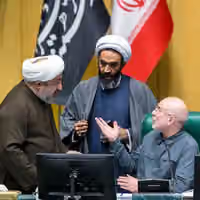
Hardline newspaper Kayhan also criticized Iran’s diplomatic approach, saying officials had shown excessive enthusiasm for negotiations during President Masoud Pezeshkian’s visit to New York and sent Washington “a signal of weakness.”
Supreme Leader Mojtaba Khamenei, meanwhile, emphasized Iran’s military position, describing the country as the “world’s top power” according to what he called “divine calculations” and saying enemy forces had been pushed back from waters near Iran.
Military pressure centers on Hormuz
Iranian officials continued to point to the Strait of Hormuz in their warnings to Washington.
“We are acting with authority in the northern Arabian Sea and east of the Strait of Hormuz, and we will not let anyone pass. On the other side, our IRGC brothers are also standing firm,” army deputy coordinator Habibollah Sayyari said.
Lawmaker Salar Velayatmadar said Iran could close the Strait of Hormuz and Bab al-Mandab if the United States launched another attack.
Rial falls under trade and oil pressure
The economic backdrop to the negotiations has also deteriorated, with the US dollar listed at 2.45 million rials on Iran’s open market Monday.
Iranian businesses are facing higher costs in trade with neighboring Iraq as banks tighten checks and anti-money-laundering requirements, head of the Iran-Iraq Joint Chamber of Commerce, said.
The main danger was not a complete halt in trade but a gradual loss of Iran’s share of the Iraqi market, Jahangbakhsh Sanjabi Shirazi, said.
Washington is also seeking to restrict Iran’s oil income more. Iran could have “nothing left to trade for anything” within two weeks after completing its remaining oil deliveries to China, US Treasury Secretary Scott Bessent said Sunday.
About 15 million barrels remained out for delivery, Bessent estimated.
Pressure on Iranian financial operations extends into Europe. Italy’s central bank told Iran International on Monday that the Rome branch of Iran’s Bank Sepah has remained under special administration since October 2025 following the European Union’s adoption of restrictive measures against Iran.
The weakening rial and growing obstacles to trade are adding to Iran’s economic pressure, while warnings over Hormuz and recent military exchanges keep the risk of renewed conflict hanging over the country and the region.
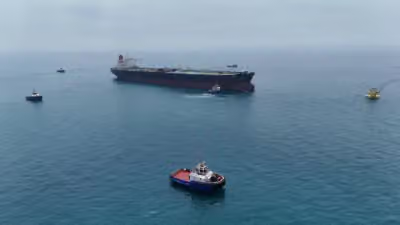
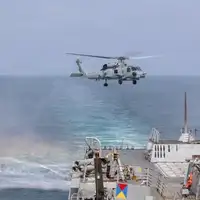
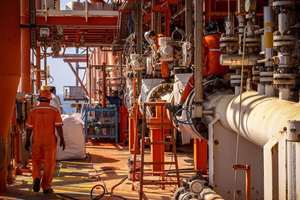
Vessels at the Strait of Hormuz, as seen from Musandam, Oman, on September 23, 2026.
Oil flows through the Strait of Hormuz have climbed despite the conflict, with Washington pointing to rising exports as Iran warns shipping companies against unauthorized passage and threatens US forces with retaliation if fighting resumes.
US Energy Secretary Chris Wright said on Sunday that oil flows through the strait were averaging nearly 13 million barrels a day, with shipments exceeding pre-conflict levels on at least one day last week.
“There was a day just this last week where over 20 million barrels of oil, more than pre-conflict levels, flowed out of the strait,” Wright told Fox News. The current average was “almost 13 million barrels a day,” he added.
Wright attributed pressure on energy prices more to limited refining capacity than to the volume of oil moving through Hormuz.
Iran warns shipping companies
Iran, meanwhile, portrayed the strait as a closely controlled corridor where vessels must comply with rules set by its authorities.
Iran’s Persian Gulf Strait Authority warned charterers against directing ships through routes it considers unauthorized, saying companies that do so could be placed on a non-compliance list and vessels associated with them could face restrictions.
The authority also published a letter it said came from the owners of an unnamed vessel apologizing for an unauthorized transit. According to the letter, the charterer instructed the ship to proceed without completing required declarations and approvals, putting the master under commercial pressure to comply.
The warnings were accompanied by threats from Iranian military officials. Armed forces spokesman Abolfazl Shekarchi said the United States would be “slapped” if it intervened in Hormuz.
A Revolutionary Guards Navy official challenged US President Donald Trump to send a warship near the strait if Washington believed it controlled the waterway, threatening US warships as far away as the Indian Ocean if fighting resumed.
Iranian army chief Amir Hatami also said the war was not over and that the military must remain prepared for further fighting.
Regional calls for safe passage
The dispute has drawn responses from countries concerned about commercial shipping and energy supplies.
Oman’s Foreign Minister Badr Albusaidi told the UN General Assembly that Muscat would continue working to safeguard navigation through Hormuz, urging restraint, dialogue and political solutions.
US Ambassador to the UN Mike Waltz said 146 countries had condemned Iran over attacks on civilian shipping, describing the Islamic Republic as increasingly isolated.
The rising oil flows point to increased movement through one of the world’s most important energy corridors, but warnings to shipping companies and threats of renewed military action show that control and security in Hormuz remain central to the conflict.