Iran cuts living allowances for many people with disabilities
File photo shows a healthcare worker assisting a woman using a wheelchair up a ramp at a medical facility in Iran.
Many Iranians with disabilities have lost their living allowances after the State Welfare Organization halted payments from June citing a budget shortfall, the labor-focused news agency ILNA reported on Monday, adding that caregiver and hygiene subsidies have also been delayed.
The cuts, the outlet said, reflected the Islamic Republic's failure to support people covered by the welfare system, particularly those with disabilities, during a deepening economic crisis.
“For me, the question is why they cut my living allowance when even they say my disability is severe and I have developed pressure sores,” 44-year-old Hossein, whose payments stopped last month, told ILNA.
Hossein said the State Welfare Organization also provides no meaningful assistance with medication costs and refused to reimburse expenses from a surgery because it was performed during the past year.
The worsening economic situation, he added, had also reduced the ability of charities to support people with disabilities.
Rising costs deepen hardship
Many people with disabilities, ILNA said, are unable to work and depend largely on modest welfare stipends and subsidies for their livelihoods.
The report argued that deteriorating conditions stem from ineffective state policies and a lack of equal social, economic and political opportunities, warning that services become even more limited outside the capital.
The economic downturn, coupled with sharply higher healthcare and medicine costs, has placed additional strain on people with disabilities, many of whom require continuous medical treatment, rehabilitation services and specialized equipment.
In May, Khabar Online news outlet reported that rising prices for hygiene and medical supplies had affected around 45,000 people living with spinal cord injuries. Prices for essential items including sterile dressings, catheters, catheter bags, syringes and medicines for pressure sores had increased two- to three-fold.
Subsidies cover only days of expenses
Raheleh, a 45-year-old woman with a spinal cord injury, told that the monthly hygiene subsidy of 15 million rials ($8.2) was far below what was needed.
Silhouettes of people with disabilities gather inside a public building in Iran.
“I have to use disposable catheters every day, and this amount only covers one week or 10 days. It cannot cover the whole month ... I have never had the opportunity to work, so in these conditions of inflation I have no salary,” she said.
She described the monthly caregiver allowance of 42 million rials ($23) as “close to nothing” given her medical expenses, adding that doctor visits, diagnostic tests and transportation costs leave her unable to meet basic needs by the middle of each month.
Fatemeh Abbasi, deputy head of rehabilitation at the State Welfare Organization, said in May that the agency had requested an 80% to 90% increase in caregiver allowances, but implementation depends on government approval.
US President Donald Trump attends an event in the Oval Office at the White House in Washington, DC, on July 13, 2026.
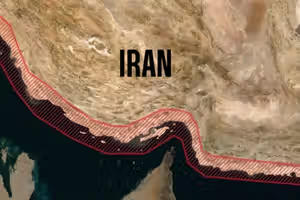
US President Donald Trump said on Monday that the United States would take control of the Strait of Hormuz, continue military operations against Iran and seek compensation from regional countries for securing the strategic waterway.
"We're taking over the strait. They've got nothing," Trump said in a phone interview with Fox News.
Trump said the United States would assume responsibility for protecting shipping through the strait and expected other Middle Eastern countries to pay for the mission.
"And we're going to keep the strait, and we'll probably run it. We'll become the guardian of the strait. Maybe we'll call it the 'guardian angel of the strait.' And we should be reimbursed for that. When we do that, we're going to be reimbursed because the other nations are very wealthy, they're on our side."
He later elaborated on the proposal in a Truth Social post, saying Washington would restore a blockade targeting Iranian shipping while allowing all other commercial traffic to pass.
"The Hormuz strait is open, and will remain open, with or without Iran. We are reinstating the Iranian blockade, so named because it is only stopping Iran's ships or customers from entering or leaving. All other countries will have fair and open use of the strait," he said.
"The U.S.A. will be, from this point forward, known as 'the guardian of the Hormuz strait,'" Trump added.
He also said the United States would charge countries using the waterway a fee equal to 20% of the value of cargo shipped to cover "any and all costs necessary to do the job of providing safety and security to this very volatile section of the World." It was not immediately clear whether US allies had agreed to such an arrangement.
Trump said his administration had believed it had reached a lasting understanding with Tehran before deciding Iran had violated it.
"What nobody knows, we had a deal. It was a done deal, and then they broke it. They always break it. We've had 10 deals with these people, and so we're just going to hit them very hard."
The remarks came after the United States carried out another round of strikes against Iran following Iranian attacks on US facilities across the Persian Gulf and Tehran's renewed declaration that the Strait of Hormuz was closed.
The exchange has effectively collapsed the interim memorandum of understanding reached in June, which had aimed to reopen the waterway and provide a framework for further negotiations.
Iran says it charges less
Iranian Foreign Minister Abbas Araghchi rejected Trump's statement that Washington would become the strait's guardian.
"POTUS is absolutely right. Whoever provides secure and safe passage of commercial vessels through the Strait of Hormuz should be compensated for this service," he said. "Iran has always been the guardian of the Strait and will remain so forever. 20% is of course too much. We will be fair."
New attacks on nuclear sites
Trump also said on Monday that Iran's Pickaxe Mountain nuclear site could soon become a US target.
Speaking to conservative radio host Hugh Hewitt, Trump said the United States was closely monitoring the deeply buried facility.
"A nice big fat shot right in the front door," Trump said, adding the United States would "probably give Pickaxe a shot relatively soon."
Trump also indicated further military action was imminent.
"It was a test. We didn't know," he said of the memorandum of understanding with Iran. "Memorandums of understanding, when you're dealing with sleazebags, don't mean much. It was sort of a test, and they weren't there. They didn't honor the test."
The renewed campaign has also reignited opposition in Congress.
Democratic Senator Adam Schiff said he would introduce a new War Powers Resolution this week to force another Senate vote on ending US military involvement in Iran, while Senate Democratic leader Chuck Schumer said Trump's "so-called understanding" with Iran had collapsed.
"Enough is enough. End the war," Schumer wrote on X.
Critics from both parties also argued the administration was stretching its legal authority. "The president can't just wish away months of war he said would last only four to six weeks," a senior Democratic aide in the House of Representatives told Reuters.
Meanwhile, the US military operation has continued alongside Trump's remarks. US Central Command said American forces have struck more than 300 Iranian military targets over the past week and announced additional attacks on Monday.
"These strikes will continue imposing a heavy cost on Iranian forces and degrade their ability to attack innocent civilians and commercial shipping in the Strait of Hormuz," CENTCOM said.
Mahmoud Ahmadinejad, seen here in 2024, is said to have learned English and tried to improve his image after falling out with the Iranian regime. Photograph: Majid Asgaripour/Reuters
The alleged recruitment of Mahmoud Ahmadinejad by Mossad reads like a spy thriller and has been denied by his office. But it has renewed interest in Iran's most controversial president—and the ruthless infighting that turned a Leader’s darling into a political outcast.
On Monday, The New York Times and Haaretz alleged that Mossad cultivated Ahmadinejad as an intelligence asset and even considered him for a role leading Iran if the Islamic Republic collapsed.
The office of the former president swiftly dismissed the reports as Hollywood material that was hardly worth denying.
For those who followed Ahmadinejad's trajectory after leaving office, however, the allegation itself is less surprising than the path that may have led to it.
"He certainly was very ambitious and wanted power. And it was clear that there was no way he could get to power so long as Khamenei and the regime were in charge," historian and author Arash Azizi, who remained in contact with Ahmadinejad for years after he left office, told Iran International.
Whether Ahmadinejad was ever a credible candidate to lead Iran is a separate question. So, too, is why an alleged intelligence relationship of such sensitivity is now being described publicly in remarkable detail.
"If Ahmadinejad was their person indeed... you burn this stuff 20 years later. What's the insistence on doing it right now?" Azizi said.
From president to political outsider
Ahmadinejad served as Iran's president from 2005 to 2013, rising to power with the backing of Ali Khamenei and becoming one of the Islamic Republic's most recognizable figures. His presidency was marked by Holocaust denial, calls for Israel's destruction and the violent crackdown that followed the disputed 2009 presidential election.
But his relationship with the political establishment that brought him to power steadily deteriorated.
Meir Javedanfar, an Iran lecturer at Reichman University who co-authored a biography of Ahmadinejad, said Ahmadinejad increasingly believed he deserved more authority than Iran's political system allowed him.
"He believed that he had the intellectual capability and charisma and public support to have much more authority and much more power than the regime was giving him," Javedanfar told Iran International.
That frustration became visible in 2011, when Ahmadinejad boycotted official duties for 11 days after Khamenei overruled his attempt to dismiss intelligence minister Heydar Moslehi — one of the most public challenges to the supreme leader by a sitting president.
The rupture accelerated after he left office. Close allies, including Esfandiar Rahim Mashaei, were arrested, while Ahmadinejad himself was repeatedly barred from returning to the presidential race.
"After he left office, this frustration was supplemented by anger towards the regime," Javedanfar said.
"And this is why I think he would have been open to recruitment by foreign intelligence agencies... because of the tremendous anger he had towards the regime."
The New York Times reported a similar trajectory. According to the report, Ahmadinejad eventually concluded he could not return to power while the existing political system remained in place.
An associate told the newspaper Ahmadinejad envisioned returning to power with foreign backing and, if successful, would recognize Israel and normalize relations under the Abraham Accords.
Mahmoud Ahmadinejad, seen here in 2005, was frequently condemned by Human Rights Watch for his treatment of Iranian protesters. Photograph: Ho New/Reuters
A transformation seen up close
Azizi began speaking regularly with Ahmadinejad and members of his circle after the former president left office. By then, he said, Ahmadinejad's faction had begun drifting away from the conservative establishment. His circle appeared less Islamist and more nationalist while reaching out to journalists and political figures outside the Islamic Republic's traditional orbit.
"What I saw in Ahmadinejad all these years was someone who was very ambitious, who wanted power, who understood Iranian public sentiments very well, almost masterfully," Azizi said.
He also appeared increasingly aware that his record on Israel would complicate any political comeback. Azizi recalled arranging an interview between Ahmadinejad and an Israeli journalist and said the former president repeatedly expressed an interest in discussing Jewish history and Israel.
"He seemed to be open to normalization with Israel," Azizi said.
Azizi said Ahmadinejad became noticeably more secluded around 2024 — roughly the same period The New York Times reported that his contacts with Israeli intelligence intensified.
The alleged recruitment
It remains unclear exactly when Israeli intelligence first approached Ahmadinejad.
The New York Times reported that Iranian officials traced at least some of Ahmadinejad's contacts with Israeli intelligence to a 2023 trip to Guatemala. The following year, he traveled to Budapest to attend a climate conference at Ludovika University of Public Service.
According to the newspaper, the conference served as cover for meetings with Israeli intelligence operatives. Former US officials cited by the newspaper said then-Mossad director David Barnea personally traveled to Budapest to meet Ahmadinejad and that Mossad later informed the CIA it was in contact with him.
The newspaper also reported that Israel paid for some of Ahmadinejad's travel and accommodation and that operatives met him abroad on several occasions.
Haaretz, meanwhile, reported that Ahmadinejad formed part of a broader Israeli plan to destabilize the Islamic Republic. The plan reportedly combined influence operations inside Iran, support for Kurdish forces in Iraq and efforts to activate pressure on the government from multiple directions.
Ahmadinejad was envisioned as one possible political figure who could emerge if the system collapsed.
But the newspaper said the proposal faced considerable skepticism within Israel's own security establishment. Senior Military Intelligence officials reportedly judged the plan unlikely to succeed, while National Security Adviser Tzachi Hanegbi is said to have dismissed parts of it as resembling "science fiction."
Cabinet ministers also questioned why Israel would seek to replace the Islamic Republic with one of its best-known former hardliners. According to Haaretz, Mossad argued that Ahmadinejad's years of conflict with the leadership had transformed him into an opposition figure.
Recruitable does not mean viable
Jason Brodsky, policy director at United Against Nuclear Iran, said it was plausible that Ahmadinejad attracted the attention of foreign intelligence services after becoming estranged from Iran's leadership.
"Do I think Ahmadinejad was a person of interest to certain foreign intelligence organizations because of his status as someone who has been burned by the Iranian leadership? Yes," Brodsky told Iran International.
"Do I believe that Mossad and other intelligence agencies were interested in talking with him? Yeah, I do."
But Brodsky drew a distinction between cultivating Ahmadinejad as a potential intelligence source and building a broader regime-change strategy around him.
"Does that mean that he was the grand Israeli regime change strategy for the Islamic Republic? Not necessarily," he said.
Brodsky argued that Ahmadinejad lacked one critical ingredient for any successful transition: support inside Iran's security establishment capable of triggering defections.
"Defections would be part of any regime change strategy," he said.
The plan falls apart
According to The New York Times, the operation reached its most dramatic point on Feb. 28, when an Israeli strike hit Ahmadinejad's compound, targeting a building used by his bodyguards and his armored vehicle.
The newspaper reported that a black Peugeot arrived shortly afterwards and that Mossad operatives extracted Ahmadinejad from the scene, transporting him to a safe house inside Iran.
US and Iranian officials cited by the newspaper said Ahmadinejad later became disillusioned with the plan to return him to power and eventually left the safe house under circumstances that remain unclear.
The broader regime-change strategy likewise failed to unfold as envisioned. According to Haaretz, plans to combine internal unrest with armed pressure from outside Iran never materialized.
Ahmadinejad resurfaced last week at Khamenei's funeral after weeks out of public view. The New York Times, citing four senior Iranian officials, reported that he is now under house arrest after Iranian authorities uncovered much of his alleged interaction with Israel. His current status has not been independently confirmed.
Why reveal it now?
The reports raise one final question: why reveal such an alleged intelligence relationship now?
"There's always a motive in this," Azizi said. "Why are they so eager to burn Ahmadinejad?"
Brodsky suggested the answer may lie partly inside Israel, pointing to rivalries between Mossad and Military Intelligence, divisions within Mossad itself and the increasingly charged political atmosphere ahead of October's elections.
Whether the allegations are ultimately borne out or not, Ahmadinejad's political trajectory is no longer in dispute. Over more than a decade he moved from one of the Islamic Republic's most loyal servants to one of its most isolated former presidents.
The question now is whether Israeli intelligence merely sought to exploit that rupture—or whether those behind the reported operation fundamentally overestimated what Ahmadinejad could ultimately deliver.
Iran's former supreme leader Ali Khamenei (left) and then-president Mahmoud Ahmadinejad
Israel’s Mossad recruited former Iranian President Mahmoud Ahmadinejad and chose him to lead Iran after a planned operation to overthrow the Islamic Republic, Haaretz reported Monday, citing more than 30 political, defense, diplomatic and foreign sources.
The relationship began taking shape in 2022 after the Mossad gathered intelligence indicating shifts in Ahmadinejad’s views, the report said.
Israel focused on his belief that Iran could not continue under sanctions and that its nuclear program had become a burden rather than an asset.
A team of Mossad agents continued a mission involving Ahmadinejad after landing abroad on October 7, 2023, and learning of the Hamas attack on Israel, according to the report.
Then-Mossad chief David Barnea personally oversaw the operation and at one point skipped a security consultation with Prime Minister Benjamin Netanyahu to focus on developments involving Ahmadinejad, the report said.
By early 2026, Ahmadinejad had become one of Israel’s most significant assets and was chosen to take power after “Operation Puss in Boots,” which was intended to overthrow Iran’s government, end its pursuit of nuclear weapons and install a new leadership.
According to the report, the wider plan included influence operations inside Iran, arming and training Kurdish forces in Iraq, mobilizing minorities, recruiting collaborators and creating a land corridor for militia movements. Israel also sought to draw Azerbaijan into the war.
The plan faced opposition from Military Intelligence chief Shlomi Binder, Research Division head Ofir Mizrahi Rosen and then-national security adviser Tzachi Hanegbi, the report said.
Three days before H-hour, the disagreements reached such a boiling point that IDF Chief of Staff Eyal Zamir ordered everything halted. Nevertheless, Prime Minister Benjamin Netanyahu decided to proceed.
The plan collapsed before Kurdish forces fired a single shot, the report said.
Ahmadinejad, a hardline conservative known for fiercely anti-Israel rhetoric, was Iran’s president from 2005 to 2013. During his two terms, he allegedly denied the Holocaust, advocated Israel’s destruction and suggested Tehran could develop nuclear weapons if it decided to do so.
After leaving office, he was repeatedly barred from standing in presidential elections. Over time, Ahmadinejad distanced himself from the political establishment and criticized the system under Ali Khamenei, accusing senior figures of corruption, mismanagement and failing the public.
He also adopted a softer public image, portraying himself as a defender of ordinary Iranians and their economic and social concerns.
Ahmadinejad’s current status is unclear. Last week, he attended a state-run funeral for slain Supreme Leader Ali Khamenei in Tehran, months after an alleged airstrike on his residence which, reportedly set him free from a house arrest.
Britain said on Monday it would designate Iran's Islamic Revolutionary Guard Corps and two other groups under new state threats legislation, making it a criminal offense to support or assist them if the measure is approved by parliament later this week.
The IRGC, the Iran-linked Islamic Movement of Companions of the Right and Russia's GRU Volunteer Corps would become the first organizations designated under the National Security (State Threats) Act 2026, which received royal assent last week.
The British government said people who support or assist the groups after they are designated could face up to 14 years in prison, while those carrying out sabotage, including arson, on their behalf could receive life sentences.
The designation is separate from proscription under Britain's terrorism legislation and is aimed at foreign state-backed activity including espionage, interference, sabotage and physical attacks.
The new powers would also allow prosecutors in some cases to bring charges without having to prove a direct connection to a foreign state, making it easier to prosecute people acting for designated organizations, the government said in a statement.
Prime Minister Keir Starmer said on Monday his government “will never let Britain be a playground for states who want to spread fear, division and violence on our streets.”
“We have already taken tough action against the Iranian regime and those linked to it, and against Russian operatives and networks targeting our country,” he said. “These new powers will make it easier to prosecute and lock up anyone carrying out their dirty work here in Britain.”
The government said the Islamic Movement of Companions of the Right had publicly claimed responsibility for seven attacks this year on locations linked to Jewish and Israeli communities and Persian-language media in Britain.
The attacks included an antisemitic arson attack that damaged four Hatzola ambulances in Golders Green, north London, on March 23.
It said members of the IRGC's Quds Force were behind the organization and had “almost certainly” directed the group's attacks across Europe.
Britain's domestic intelligence agency, MI5, identified at least 20 potentially lethal Iranian-backed plots against people in the country over a one-year period, according to the government.
“Iran and Russia are using proxies and thugs to do their dirty work on our shores,” Home Secretary Shabana Mahmood said, adding that those working for the groups would be tracked down and imprisoned.
The government also plans to designate the GRU Volunteer Corps, which it described as a group controlled by Russia's military intelligence agency and used to recruit people online to carry out hostile acts including sabotage, arson and harassment.
Foreign Secretary Yvette Cooper called Iran and Russia’s use of proxy groups to conduct state-backed activity on British soil “reprehensible.”
“Their malign behaviour, and anyone who acts on their behalf, must be held to account,” she said. “We will take all measures necessary to protect the British people, at home and abroad.”
Plastic bags, bottles and other household waste cover the bank of a river in Iran.
Plastic waste has become a major environmental challenge in Iran, with poor enforcement of waste management regulations allowing single-use plastics to pollute natural areas and water resources, the country's environment chief said on Sunday.
More than two decades after Iran adopted its Waste Management Law in 2004, large parts of the legislation remain unenforced, leaving serious shortcomings in the management of household, medical, agricultural and industrial waste, Department of Environment chief Shina Ansari said.
“Plastic waste, particularly single-use plastics, has become a serious problem for nature, coastlines, tourist areas and water resources,” Ansari said. “Studies show that microplastics are entering the food chain, water resources and even drinking water, posing a serious threat to human health and the environment.”
Plastic consumption has become a growing environmental concern in Iran, driven largely by the widespread use of shopping bags, disposable tableware, drink bottles and food packaging. A 2024 review of municipal waste found that plastics account for about 7% of Iran’s waste stream by weight.
Enforcement gaps persist
Regulations governing waste disposal and recycling exist, Ansari said, but have only been implemented sporadically, leaving many environmental problems unresolved.
A 2022 regulation intended to reduce plastic bag consumption required manufacturers to phase out bags thinner than 25 microns and imposed obligations on large retailers. Ansari said the measures, like many environmental regulations, have not been properly enforced.
Plastic waste washes ashore along a beach on Iran's coastline, highlighting persistent marine pollution caused by mismanaged waste and plastic debris entering coastal waters.
Many countries, she added, have introduced taxes, restrictions or bans on single-use plastic bags even before negotiations on a global plastics treaty are completed.
Short-lived use, long-term pollution
Around 95% of plastic bags in Iran are used only once, typically for between 12 and 20 minutes, before being discarded.
The problem is compounded by weak waste separation and recycling systems. Research on Iran’s plastic-waste sector points to gaps in regulation, enforcement, funding and technology, while informal collectors continue to play a major role in recovering valuable materials. As a result, much plastic waste is buried, openly dumped or left uncollected rather than being processed through an effective circular recycling system.
The bags can remain in the environment for 400 to 500 years before decomposing, contributing to long-term pollution of land and waterways, Ansari said.
The environmental effects are also increasingly visible. Researchers have detected microplastics in landfill areas, along Iran’s Caspian coast and in seawater, sediment and fish from the Persian Gulf.