• العربية
  • فارسی
Brand
  • Iran Insight
  • Politics
  • Economy
  • Analysis
  • Special Report
  • Opinion
  • Podcast
  • Live TV
  • Iran Insight
  • Politics
  • Economy
  • Analysis
  • Special Report
  • Opinion
  • Podcast
  • Live TV
  • Theme
  • Language
    • العربية
    • فارسی
  • Iran Insight
  • Politics
  • Economy
  • Analysis
  • Special Report
  • Opinion
  • Podcast
  • Live TV
All rights reserved for Volant Media UK Limited
volant media logo

Iran wrong to expect midterms to restrain Trump, former US official says

Kambiz Tavana
Kambiz Tavana

Iran International

Sep 26, 2026, 19:20 GMT+1

Tehran is making a “total miscalculation” if it believes the US midterm elections will constrain President Donald Trump’s actions against Iran, former senior US official Morgan Ortagus told Iran International.

Ortagus pointed to Trump’s first term, when Democrats took control of the House in the 2018 midterms but his administration continued its “maximum pressure” campaign against Tehran and ordered the 2020 killing of Qasem Soleimani.

“Any fallacy that they have that President Trump is going to limit his decision-making authority… based off a change in the Congress is a miscalculation by a regime who still fundamentally does not understand this president.”

Congressional debate over war powers was “healthy for our democracy,” Ortagus said, but did not change the president’s authority “to take any action against Iran that he deems necessary for the safety and the security of the American people.”

Ortagus, who held senior roles in both Trump administrations, said the United States has been in a conflict with the Islamic Republic “not for seven months, but for 47 years,” and argued that economic pressure alone would not have prevented the current military confrontation.

She described Trump’s first-term maximum pressure campaign as “incredibly effective,” but said it was interrupted during Joe Biden’s presidency and has amounted to less than four years in total.

“Sanctions are not a silver bullet,” she said. “Sanctions are a tactic. They’re a way in which you pursue a larger strategy.”

That strategy, she said, should prevent Iran from obtaining a nuclear weapon, cut funding to its proxy groups and stop Tehran from becoming “the next North Korea,” with missiles capable of threatening US bases, regional states and the American homeland.

Ortagus said Trump ordered military action beginning in June last year because Iran was “intransigent” in negotiations and “weeks away from getting a nuclear weapon.” The president had given Tehran a deadline, she said, and Iranian leaders may have believed he was bluffing.

“They learned pretty quickly that he wasn’t.”

Asked whether the campaign would have happened without a closely aligned Israeli government, Ortagus said it would have. Israeli operations had “complemented” US action, she said, but “these have been American decisions and American decisions alone.”

She cited Trump’s decision to order the killing of Soleimani in 2020 as an example of an action he took “by himself.”

On diplomacy, Ortagus said Trump had “always… extended the hand of diplomacy” during both administrations.

“It’s the regime that keeps rejecting that hand.”

She was skeptical that an agreement signed with Iranian officials in New York would hold if the real decision-makers remained in Tehran, echoing Secretary of State Marco Rubio’s doubts about the authority of Iran’s UN delegation.

“What you have to do is to make the thugs in the IRGC understand that everything, their livelihoods, everything that they possess, is going to be put at risk,” Ortagus said.

Trust was not the issue, she added. The question was what mechanisms Washington would establish “so they know… if you backtrack on this, there actually will be a consequence.”

She said she did not see how any future arrangement could work “without some sort of American verification process.”

Hezbollah and Lebanon

Ortagus rejected the argument that Hezbollah should be accepted as part of Lebanon’s social and political fabric.

“Bullshit,” she said.

She said the group was led by the Islamic Revolutionary Guard Corps, had been “indoctrinated, trained, equipped and brainwashed” by Tehran and had dragged Lebanon into “perpetual war,” with Shia communities among the main victims.

President Joseph Aoun and Prime Minister Nawaf Salam had been “very clear,” she said, that Hezbollah must be disarmed and that Lebanon cannot have “a parallel state within a state.”

Dismantling that structure would take time, Ortagus added.

“It wasn’t created overnight, and it won’t be expunged overnight.”

Ortagus said the Abraham Accords had endured the turmoil since October 7, pointing to a meeting of Accords countries on the sidelines of the UN General Assembly this week.

By contrast, she said a Mecca-centered regional alignment “looks pretty weak right now,” after Houthi attacks on Saudi Arabia, including toward holy sites, drew no meaningful response from its signatories.

“Anybody who does that and says they speak in the name of Islam are the worst hypocrites imaginable,” she said.

She declined to discuss current private exchanges between Riyadh and Washington but warned against seeking security through accommodation with Tehran.

“Pacifying this regime is not going to protect you in the long run,” she said. “It will buy you time. It might be a temporary salve, but it won’t heal the wound.”

Ortagus also described the current blockade of Iran as a harder form of enforcement than previous sanctions.

“Nothing’s coming in, and nothing’s going out.”

Asked about the broader US endgame, she listed four goals: preventing Iran from obtaining a nuclear weapon; curbing its ballistic missiles, drones and conventional arms; cutting funding to proxy groups; and supporting the Iranian people.

A final conversation about Iran

Ortagus closed the interview by recounting an unpublished story about the late Senator Lindsey Graham.

In January, she said, she had “Make Iran Great Again” hats overnighted to Graham at Mar-a-Lago so he could give one to Trump on the golf course.

She said she spoke to Graham an hour or two before his death, and that their last conversation was about Iran.

“He never stopped believing in the people of Iran,” she said.

Most Viewed

Iran rules out nuclear concessions even if US accepts Hormuz proposal
1

Iran rules out nuclear concessions even if US accepts Hormuz proposal

2
INSIGHT

Pezeshkian straddles Iran’s divide at UN as US talks test balance

3

Saudi Arabia, UAE urge Trump to maintain pressure on Iran - WSJ

4
ANALYSIS

US and Iran want a deal, but neither wants to move first

5

Iran threatens regional air travel as US sanctions cut its flight links

Banner
Banner
•
•
•

Spotlight

  • US and Iran want a deal, but neither wants to move first
    ANALYSIS

    US and Iran want a deal, but neither wants to move first

  • Rushdie returns to the fatwa that nearly cost him his life

    Rushdie returns to the fatwa that nearly cost him his life

  • Iranians report SIM cards blocked over political posts and likes
    VOICES FROM IRAN

    Iranians report SIM cards blocked over political posts and likes

  • Pezeshkian straddles Iran’s divide at UN as US talks test balance
    INSIGHT

    Pezeshkian straddles Iran’s divide at UN as US talks test balance

  • 'Bully at home, victim abroad': Iranians on Pezeshkian's UN speech
    VOICES FROM IRAN

    'Bully at home, victim abroad': Iranians on Pezeshkian's UN speech

  • War deepens Iran’s energy crunch ahead of winter
    ANALYSIS

    War deepens Iran’s energy crunch ahead of winter

Banner
Banner

More Stories

Pezeshkian’s Fox News nuclear overture draws hardline backlash

Sep 26, 2026, 00:15 GMT+1
•
Maryam Sinaiee
100%

Iranian hardliners have intensified attacks on President Masoud Pezeshkian after he signalled nuclear flexibility and backed negotiations with Washington in a Fox News interview.

Conservative officials and media outlets had largely welcomed Pezeshkian’s speech to the UN General Assembly on Wednesday, but his comments to Fox News a day later provoked a sharp backlash from hardliners.

Pezeshkian said Iran was prepared to reduce its level of uranium enrichment, dilute its existing stockpile of uranium enriched to 60% and allow international verification as part of efforts to ease tensions over its nuclear program.

He also said Tehran wanted a possible agreement before the US midterm elections in November and denied that Iran had a plan to assassinate US President Donald Trump.

The contrasting reactions underscored a problem confronting Pezeshkian and Foreign Minister Abbas Araghchi: declarations of defiance can command broad support within Iran’s political establishment, but the concessions involved in actually reaching an agreement with Washington are proving considerably more contentious.

“Mr. Pezeshkian, don't spout nonsense about nuclear matters and uranium!” wrote hardline activist Mohammad-Hossein Chavoshi.

“We supported you when you spoke the truth, and we'll do it again; but if you step out of line, we'll deal with you accordingly. We will not give up the nuclear issue.”

But some defended Pezeshkian’s position.

“Did he say we should abandon the nuclear program?” one user wrote. “He is talking about 60% enrichment. Should we have constant war, remain under siege and have no money?

“Go to a large pharmacy and see what the shortage of medicine is like, not to mention the state of businesses and the market. Nobody is saying we should surrender. We can move forward thoughtfully.”

Araghchi’s plan

The backlash has not been confined to Pezeshkian. Foreign Minister Abbas Araghchi has faced sustained attacks from hardliners since presenting an Iranian proposal to the US through intermediaries on Tuesday.

The proposal sets out a phased, one-week process for implementing commitments, after which direct or indirect talks on a broader agreement could resume, according to Araghchi.

He said at a press conference on the sidelines of the UN General Assembly that Iran was ready to begin implementing the plan as soon as Washington agreed to it and that negotiations on the nuclear issue would resume after the Strait of Hormuz was reopened at the end of the seventh day.

According to Araghchi, one of the conditions is US agreement on a maritime passage arrangement through the Strait of Hormuz that has been agreed between Iran and Oman.

Although Mohsen Rezaei, secretary of Iran’s Supreme National Security Council, confirmed in a television interview on Saturday that Araghchi had been authorized to convey Iran’s conditions to the US through intermediaries in New York, criticism of the foreign minister has continued.

On Wednesday, hardline parliamentarian Amir-Hossein Sabeti said he had registered an impeachment motion against Araghchi through parliament’s system.

Warnings of wider conflict

At the same time, political and military figures have stepped up warnings of escalation if US pressure continues.

Ahmad Alamolhoda, the Friday prayer leader in Mashhad, said Friday that Iran had new weapons that would be used in the event of another US attack. He said Iran could expand the geographical range of attacks against US forces as far as the Indian Ocean.

IRGC spokesman Hossein Mohebbi similarly said Iran was prepared to enter new stages of confrontation with the US and could respond to another attack by “changing the geography of the conflict, using new equipment and weapons, and selecting different targets.”

The warnings have increasingly extended to neighboring countries as restrictions on Iranian aviation have tightened. Iranian flights to Najaf, Iraq, were cancelled Friday, further narrowing the country’s remaining international connections.

Rezaei warned regional countries earlier this week that if they barred Iranian flights in cooperation with Washington, flights from their own airports could also be stopped.

Mohammad Mokhber, an adviser and aide to Supreme Leader Mojtaba Khamenei, sharpened that warning Friday.

“Flights in the region are either free for everyone or for no one,” he wrote on X. “If Iran is unable to fly and receive airport services, no country in the region will have this possibility either.”

The competing messages highlight the difficulty facing Tehran as contacts with Washington resume: Pezeshkian and Araghchi are outlining the concessions and sequencing that a negotiated settlement could require, while hardline political and security figures emphasize Iran’s ability to widen the confrontation.

Iran rules out nuclear concessions even if US accepts Hormuz proposal

Sep 25, 2026, 18:56 GMT+1
100%
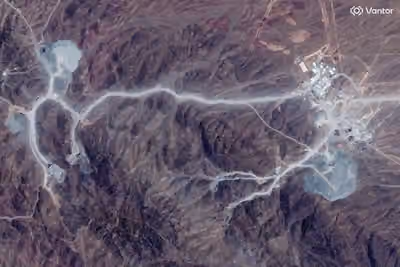
FILE PHOTO: A satellite view shows tunnel entrances at Pickaxe Mountain, of the Natanz nuclear facility, near Natanz, Iran, June 30, 2026.

Iran will not make concessions over its nuclear program even if the United States accepts Tehran’s proposal for reopening the Strait of Hormuz, Reuters reported Friday citing a senior Iranian official.


The official, who spoke on condition of anonymity, said Hormuz would remain closed until Washington met all of Iran’s conditions, including lifting its naval blockade of Iranian ports.

The position adds a significant caveat to a proposal outlined by Foreign Minister Abbas Araghchi in New York this week, under which Iran has offered to reopen the strait within seven days if the United States meets a series of demands.

Those include ending the blockade of Iranian ports, waiving sanctions on Iranian oil sales, releasing frozen Iranian funds and ending hostilities on other fronts, including Lebanon. Nuclear negotiations could then resume as part of efforts toward a broader settlement.

President Masoud Pezeshkian said Thursday that Iran was prepared to relinquish its stockpile of uranium enriched to 60% within the framework of international law and its obligations under the Nuclear Non-Proliferation Treaty.

The distinction could reflect the different questions being addressed: Pezeshkian spoke about Iran’s existing highly enriched uranium stockpile, while the senior official ruled out broader flexibility over the nuclear program.

Iran has long maintained that its nuclear program is entirely peaceful and that it does not seek an atomic weapon.

But senior officials have recently signalled that the attacks on Iran could prompt a reassessment, with Supreme National Security Council Secretary Mohsen Rezaei asking publicly why Iran should not pursue nuclear weapons itself.

The United States and Israel struck the Natanz and Fordow enrichment facilities and the Isfahan nuclear complex during the 2025 conflict, while the fate of Iran’s stockpile of uranium enriched to 60% has remained uncertain.

Natanz was targeted again after the current war began on Feb. 28.

The confrontation follows the collapse of the 2015 nuclear agreement, known as the JCPOA, under which Iran accepted restrictions on its nuclear activities in return for sanctions relief.

Trump withdrew the United States from the agreement in 2018 and reimposed sanctions.

President Donald Trump has made preventing Iran from obtaining a nuclear weapon a central US objective in the current conflict.

In his UN General Assembly address this week, he threatened further military action if an agreement was not reached while predicting that a deal could come after November’s US midterm elections.

From Hormuz to Indian Ocean: Iran threatens to redraw the map of the war

Sep 24, 2026, 17:48 GMT+1
•
Behrouz Turani
100%
An undated file photo shows Diego Garcia, the largest island in the Chagos archipelago, in the middle of the Indian Ocean, which hosts a joint military facility operated by the United States and the United Kingdom

Tehran is signalling that its response to US pressure may be to widen the conflict, turning restrictions on its shipping and aviation into risks for airports and waterways stretching from the Persian Gulf to the Red Sea and potentially the Indian Ocean.

The emerging pattern is one of horizontal escalation: rather than confining its response to the point of pressure, Iranian officials are increasingly warning that action in one arena could produce retaliation elsewhere.

IRGC spokesman Hossein Mohebbi made that logic explicit on September 23, declaring that “Iran will certainly change the geography of the war” and adding that “our targets will no longer necessarily be the same as before”.

A day later, Yahya Rahim Safavi, military adviser to Iranian Supreme Leader Mojtaba Khamenei, gave the clearest indication yet of how far that geography might extend.

In a video released by the IRGC-linked Fars News Agency, Safavi said the front could expand further in response to continued warfare, “reaching the Indian Ocean and perhaps beyond”.

He added that linking Hormuz and Bab el-Mandeb “will change the battlefield”.

Fars noted that it was the first time an adviser to Khamenei had explicitly mentioned the Indian Ocean, home to the US-British base at Diego Garcia, nearly 4,000 kilometres from Iran.

In an earlier interview reported by Fararu, Safavi said Houthi advances mean the United States now faces a new challenge at Bab el-Mandeb and in the Red Sea.

IRGC Aerospace Force commander Majid Mousavi warned that “if you make the sacred Strait of Hormuz unsafe, we will turn the entire region into hell for you from across Iran”.

From shipping to aviation

The same logic has increasingly appeared outside the maritime arena.

Secretary of the Supreme National Security Council Mohsen Rezaei addressed Iran’s neighbouring Arab states in an interview with state broadcaster IRINN on September 23, saying: “If you stand with America, we will not just watch you.”

He warned that if Iranian flights were banned with their cooperation, “their airports will have no flights”. He did not specify any country, airport or method of disruption.

Rezaei linked the warning to the Hormuz standoff.

He also said Foreign Minister Abbas Araghchi was due to convey Iran’s seven conditions through mediators and that, until they were met, neither the strait would reopen nor negotiations resume.

Tehran had given the Americans “four to five days” to meet the conditions, he asserted.

A widening map of pressure

The statements suggest Tehran is increasingly answering different elements of Washington’s pressure campaign with threats or measures in corresponding domains.

Safavi’s framing of Hormuz and Bab el-Mandeb as a connected theatre suggests Tehran increasingly sees pressure around the two strategic chokepoints as interconnected.

The most immediate audience for many of these warnings is Iran’s Arab neighbours, whose airports, ports and territory are exposed to the consequences of US-Iran escalation.

Rezaei’s remarks appear designed to raise the potential cost for those states of cooperating with Washington’s pressure campaign.

Iran has already demonstrated a willingness during the conflict to target regional aviation infrastructure, repeatedly striking Kuwait International Airport and damaging terminals and a radar system.

The Indian Ocean references extend this widening map further.

For now, the shift is clearest at the level of rhetoric: none of the statements reviewed sets out a specific Iranian plan for operations there.

But combined with threats against regional airports and repeated references to Bab el-Mandeb, they point to an increasingly explicit message from Tehran that further US pressure could carry risks well beyond the Strait of Hormuz.

Iranian hardliners talk up nuclear weapons before Pezeshkian's UN trip

Sep 22, 2026, 13:56 GMT+1
•
Behrouz Turani
100%
President Masoud Pezeshkian waves as he boards his plane in Tehran before departing for New York on September 22, 2026.

Iranian hardliners spent the day before President Masoud Pezeshkian left for the UN General Assembly talking publicly about nuclear weapons, leaving the treaty that restrains them, and preparing for a long war with the United States.

The statements came within hours of each other, from MPs, a Tehran city council official and military figures, and they map the mood in the hardline camp on the eve of the president's departure.

It came as Donald Trump said he was willing to meet Pezeshkian in New York while warning that "something big" could happen to Iran.

Kamran Ghazanfari, a hardline MP, told Didban Iran that if the existence of the Islamic Republic came under serious threat, the new supreme leader could reconsider the question of nuclear weapons. Some MPs favor a nuclear deterrent to end the recurring threats against Iran, he said, though any decision would rest with senior officials and the Supreme National Security Council.

Parviz Sarvari, deputy chairman of Tehran city council, said he would welcome news that Iran had moved toward building nuclear weapons for deterrence. Membership of the Non-Proliferation Treaty had brought Iran no benefit, he said, while its adversaries threatened it from a position of nuclear superiority.

The push has gone beyond words. Hossein-Ali Haji-Deligani, an MP, submitted a triple-urgency bill for Iran's withdrawal from the NPT, arguing that membership had become more costly since the IAEA Board of Governors referred Iran to the UN Security Council. Similar proposals have circulated for months and the leadership of parliament has kept them off the floor. Haji-Deligani said the presidium has now acknowledged receipt of this one.

Military figures spoke the same day. Army commander Amir Hatami said the armed forces were at full readiness. Esmail Kowsari, of parliament's national security committee, said Iran's growing capabilities would eventually push American forces out of the region.

Revolutionary Guards spokesman Hossein Mohebbi said the war with the United States and Israel was not over and that the Guards had prepared for a long one, citing assessments that Washington may be considering fresh strikes.

What the day was for

Three things were happening at once.

The first is the argument about the last war. The ceasefire that ended the 12-day conflict left hardliners needing it not to look like a defeat at home, and insisting the war is unfinished keeps the account open.

The second is pressure on Pezeshkian. The NPT bill and the nuclear talk arrived alongside renewed parliamentary criticism of his government for allowing IAEA inspectors access, in a dispute over how far Iran should engage Washington and the monitors.

The third is the IAEA referral and the threat of snapback sanctions, which is the immediate cause of the NPT bill and the reason the timing is not a coincidence.

The language stayed inside limits. Ghazanfari attached any reconsideration of weapons to an existential threat. Sarvari's endorsement was of a hypothetical. Neither said Iran should build a bomb now, and neither Mojtaba Khamenei nor the Supreme National Security Council has said anything on the question.

The risk is how it reads elsewhere. Open parliamentary discussion of leaving the NPT and of nuclear contingencies is the kind of material Washington and Israel have previously cited as evidence that Iran is moving toward a weapon, and the United States struck Iranian nuclear sites during the last war. On the same day, the Guards said they expected it to happen again.

Trump weighs Iran options; Tehran signals Hormuz leverage

Sep 20, 2026, 20:11 GMT+1
100%
Commercial vessels in the Strait of Hormuz

US President Donald Trump weighed military action, economic pressure and a possible deal with Iran, while Iranian leaders paired diplomatic overtures with warnings over the Strait of Hormuz on Sunday.

Trump told Fox News he was in a “deciding mode” over Iran and expected “very big things” soon. The network described the options under consideration as military action, allowing economic pressure to continue or reaching an agreement.

“My question is, if and when, do I blow the entire nation up? They better behave,” Trump told Fox News.

Trump also said he would probably be open to meeting Iranian President Masoud Pezeshkian during the UN General Assembly, leaving diplomacy on the table despite his warnings.

Hormuz remains central

Iranian officials continued to present the Strait of Hormuz as a source of leverage. Parliament Speaker Mohammad Bagher Ghalibaf responded to a September 17 JPMorgan oil-market report that said the bank no longer had a baseline view for how the conflict would end.

“This endgame cannot be modeled. It will be opened, and Iran's hand is already on the lever,” Ghalibaf wrote on X.

JPMorgan said assumptions underlying its earlier outlook had been overtaken by events and that it could no longer confidently model an endgame.

“For the first time since the start of the Iran conflict, we don't have a baseline view. We simply don't know how to model the endgame,” the report said.

Pressure around the waterway was also visible in maritime traffic. US Central Command said its forces had redirected 109 commercial vessels to ensure compliance by September 20.

A separate maritime security update from the UKMTO-linked Joint Maritime Information Center recorded four tankers involved in attacks or suspicious activity near the Strait over the past week. Two cases were recorded on September 17 and another two on September 18.

The economic consequences remain significant for Persian Gulf producers. QatarEnergy chief executive Saad al-Kaabi said normal gas operations could resume within weeks of the Strait reopening, but warned that disruption to shipments of critical equipment could delay the country’s expansion plans.

Iran keeps diplomatic channel open

Iranian officials also emphasized their willingness to negotiate. President Masoud Pezeshkian said Iran did not want war and considered conflict harmful to both the country and the wider world, but would not yield to force or intimidation.

“We do not want war and conflict and consider them harmful not only to the people of our country but to the world. At the same time, we will in no way yield to force and bullying,” Pezeshkian said.

Meanwhile, Foreign Minister Abbas Araghchi left for New York with a diplomatic delegation to attend the UN General Assembly, state media reported. Araghchi made a brief stop in Qatar before continuing to New York.