CENTCOM says 55 vessels redirected under Iran blockade
US Central Command said that as of August 9, US forces had redirected 55 commercial vessels, disabled two and boarded two others to enforce compliance.
The command account on X posted images of US sailors standing watch aboard the guided-missile destroyer USS Ross, one of the vessels deployed to the region.
CENTCOM said more than 20 US warships are deployed to the Middle East in support of military operations, including enforcement of Washington's blockade against Iran.
A man looks at the packaging of red meat at a supermarket in Iran, undated file photo
Soaring food prices are reshaping what Iranian families eat, with new figures showing a steep decline in dairy consumption alongside a longer retreat from red meat as household purchasing power erodes.
Annual dairy consumption has fallen from around 130 kilograms per person in 2010 to just 40 kilograms today, according to Ali Ehsan Zafari, head of Iran's Dairy Cooperatives Union.
According to the latest figures from the Statistical Center of Iran, dairy products in July cost around 147 percent more than a year earlier.
The fall in consumption leaves Iran well below both international and regional levels. Global dairy consumption averages roughly 117–119 kilograms per person annually, according to the UN Food and Agriculture Organization (FAO), while neighboring Turkey consumes more than 250 kilograms per capita.
At 40 kilograms, Iran's consumption is now roughly one-third of the global average.
Meat disappears
The retreat from dairy follows a longer change in Iranian diets as years of inflation and declining purchasing power have pushed households away from more expensive sources of animal protein.
FAO data show Iran's red meat supply fell to approximately 623,000 metric tons last year, around 20 percent lower than in 2024 and nearly 39 percent below its 2010 level.
Over much of that period, poultry offered families a cheaper alternative. Per capita poultry consumption has risen by roughly 40 percent since 2010, suggesting households have increasingly substituted chicken for more expensive beef and lamb.
The comparison with Turkey illustrates how differently consumption has developed across the two neighboring countries.
Poultry consumption in Turkey also rose by about 40 percent over the same period, but red meat consumption increased by 146 percent. FAO estimates put per capita red meat consumption in Turkey at roughly 3.9 times the Iranian level.
The figures do not by themselves explain the reasons for the divergence, but Iran's shift toward cheaper poultry has taken place during a prolonged erosion of household purchasing power and repeated surges in food prices.
Fewer alternatives
That substitution is becoming harder as inflation spreads across virtually every source of animal protein.
Prices of beef, lamb and chicken were all around 149 percent higher in July than a year earlier, according to the Statistical Center of Iran. Dairy prices rose by a similar 147 percent.
The latest increases follow the recent war, which added to existing inflationary pressures and accelerated price rises across basic goods.
For years, households unable to afford beef and lamb could turn to chicken. The sharp increase in poultry prices now threatens that fallback, while the collapse in dairy consumption suggests even relatively basic sources of animal protein are becoming harder for many families to afford.
The consequences are potentially significant, particularly for lower-income households and children whose diets depend on affordable sources of protein and calcium.
But the figures also point to a broader change in Iranian living standards: families are not simply paying more for the same food. They are changing what they eat, and increasingly giving up foods that were once ordinary parts of the household diet.
After years of substituting cheaper foods for more expensive ones, the narrowing range of affordable alternatives raises a more immediate question: what is left to substitute?
Mohsen Rezaei was appointed as Supreme Leader Mojtaba Khamenei’s representative on Iran’s Supreme National Security Council on Sunday, before being named secretary of the powerful security body.
“In view of your valuable experience, I hereby appoint you ... as my representative on the Supreme National Security Council,” Khamenei said in a decree, describing Rezaei as a veteran of the 1980–1988 Iran-Iraq War.
Rezaei commanded the Islamic Revolutionary Guard Corps from 1981 to 1997, including through much of the war. He also serves as a senior military adviser to Khamenei and is a member of the Expediency Council.
Khamenei’s decree also thanked Mohammad Bagher Zolghadr, who had been SNSC secretary and one of the Supreme Leader’s representatives on the council, for his “tireless efforts day and night.” The decree did not say he was stepping down as SNSC secretary.
Shortly after the announcement, IRGC-affiliated Tasnim News reported, citing the president’s office, that President Masoud Pezeshkian had appointed Rezaei as SNSC secretary.
“Following Mohammad Bagher Zolghadr’s resignation as secretary of the Supreme National Security Council and his acceptance of a new responsibility, Mohsen Rezaei has been appointed secretary of the Supreme National Security Council by decree of President Masoud Pezeshkian,” said Tabatabaei, deputy for communications and information at the president’s office.
The SNSC is Iran’s top national security body, coordinating security and foreign policy and bringing together senior political, military and intelligence officials. The president chairs the council, while the Supreme Leader appoints two representatives to it.
Zolghadr, a former senior IRGC commander, took over as SNSC secretary in March, a week after Ali Larijani was killed in US-Israeli strikes. Larijani had returned to the post in August 2025 after previously serving as secretary from 2005 to 2007 and as parliament speaker from 2008 to 2020.
Zolghadr’s resignation
The appointments followed days of reports about Zolghadr’s position.
Earlier on Sunday, Tasnim removed a report announcing Rezaei’s appointment as Khamenei’s representative on the council. The outlet did not explain the deletion. The report had said Rezaei and Saeed Jalili would serve as the Supreme Leader’s two representatives on the SNSC.
Reformist newspaper Sazandegi reported on Friday that Zolghadr had offered his resignation but Pezeshkian had asked him to remain.
A day later, Pezeshkian did not deny that Zolghadr had offered to resign, saying there were “some differences that we are trying to resolve.”
Senior cleric and Khamenei relative Mohammad Bagher Kharrazi had also said on Monday that Rezaei was set to replace Zolghadr.
AI-generated image: A woman holds her wallet at a pharmacy counter as a pharmacist retrieves medicine, illustrating the growing financial burden of healthcare and medication costs in Iran.
Iranians are struggling to afford medicines and medical care, with some foregoing treatment as prices rise, drug shortages spread and insurance coverage falls short, according to accounts from patients.
Messages sent to Iran International on described medical bills consuming much or all of a typical monthly income, even for people covered by Iran’s Social Security Organization, the country’s main state-run social insurer.
One person undergoing tests for an abdominal and pelvic mass said CT and MRI scans, with and without contrast, cost 210 million rials ($113) despite having Social Security insurance.
“How are we supposed to pay these costs with such meager incomes?” the citizen said.
Many Iranian workers earn around 200 million to 250 million rials ($108-$134) a month, meaning the scans alone can cost roughly a month’s income. The rial trades at around 1.86 million to the dollar on the free market.
Another said an echocardiogram, electrocardiogram and clinic appointment cost 120 million rials ($65), with the medical provider requiring payment upfront rather than accepting Social Security insurance.
The patient was given documents to seek reimbursement from the insurer but said the process involved extensive bureaucracy and could result in only around half the money being returned.
A 33-year-old said the cost of dental treatment had left him without half his teeth.
“I feel like I’m 60,” he said. “The bitter part is that this humiliating way of life has become normal for me.”
A pharmacy in Iran
Another worker earning 10 million rials ($5.40) a day said an appointment with an ear, nose and throat doctor cost 5 million rials ($2.70), followed by 8.6 million rials ($4.60) for medicine.
“We really cannot afford to live anymore,” the worker said.
Lawmaker says shortages could worsen
The accounts echo comments from Salman Es’haghi, spokesman for parliament’s Health and Treatment Committee, who said shortages and rising prices were already causing some patients to stop treatment.
Around 43 medicines are in “critical shortage” and nearly 1,000 pharmaceutical products face some degree of shortage, Es’haghi told the Tabnak news website in an interview published Saturday.
Prices for chemotherapy drugs and medicines used by patients with cancer, hemophilia and thalassemia have risen enough to reduce consumption, with some patients stopping treatment because they cannot afford it, he said.
Es’haghi said patients now pay more than 70% of their healthcare expenses themselves, despite policies intended to leave individuals covering around 30% and the government and insurers paying the remainder.
Some hospitals and pharmacies are also refusing to provide certain services or medicines because insurers have delayed reimbursements or failed to pay them in full, he added.
The difficulties described by Iran International’s audience reflected those problems. One viewer said a packet of Sertraline tablets that previously cost 500,000 rials had risen to 8 million rials, a sixteen-fold increase.
Another said the cost of healthcare had left the family worried about something as routine as a child catching a cold during the winter.
“We’re stressed about where we would get the money for treatment if, God forbid, we or our children even catch a cold,” the audience said.
Drug subsidy faces uncertain future
The pressure could intensify if the government removes preferential foreign currency for medicines and medical equipment from the budget for the Iranian year beginning in March 2027, Es’haghi warned.
Iran has used preferential exchange rates to lower the rial cost of importing medicines, pharmaceutical ingredients and medical supplies. Removing that support can expose producers and importers to much higher exchange rates and ultimately increase prices for patients.
Discussions about eliminating the preferential rate have been under way since late 2025, with the government viewing the change as a possible way to address corruption and preferential access to subsidized foreign currency, Es’haghi said.
“If the currency allocated to medicines and medical equipment is removed from next year’s budget, it could become a ‘year of patient slaughter,’” Es’haghi said.
Iran International reported in April that prices for some domestically produced insulin had risen by as much as 212% compared with before the Persian New Year in March, while some imported varieties had increased by as much as 271%.
Pharmaceutical industry figures have attributed rising production costs to a combination of exchange-rate changes, the rial’s depreciation, more expensive raw materials and packaging, higher wages and financing costs, and disruption to supply chains from war.
Es’haghi said more than 70% of medicines had increased in price and argued that authorities should tackle corruption through closer oversight of the pharmaceutical supply chain rather than eliminating subsidized currency.
For patients confronting medical bills comparable to their monthly earnings, however, the pressure is already being measured in delayed care, abandoned treatment and anxiety over whether they can afford the next illness.
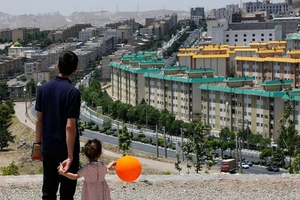
Residential apartment blocks on the outskirts of Tehran.
Average advertised monthly rent in Tehran has climbed above 720 million rials, roughly three times the earnings of many Iranian workers, exposing a widening affordability gap as some tenants face increases of up to 100%, market data showed in late July.
Tindex, an Iran-focused economic data platform tracking housing listings and other market indicators, put average advertised monthly apartment rent in Tehran at about 723 million rials, or roughly $389 at an open-market exchange rate of 1.86 million rials to the dollar, in its late-July data.
The figure is based on advertised properties rather than completed rental agreements, but provides a snapshot of prices confronting tenants searching for homes in the capital.
Monthly salaries for many Iranian workers are commonly put at around 200 million to 250 million rials, equivalent to roughly $108 to $134 at the same exchange rate. That means the average advertised rent can approach three times the upper end of that monthly salary range.
Rent increases reach 100%
The pressure becomes greater when tenants seek to renew their leases.
Rokna News reported on Sunday that rents have risen by 70% to 100% in parts of Tehran, far exceeding the 25% ceiling set for the capital by the Supreme Housing Council.
Prospective tenants look at property listings displayed at a real estate agency in Tehran, Iran.
The findings point to a wide divide between restrictions imposed by authorities and the increases some landlords demand from tenants.
A member of parliament’s construction committee also acknowledged that government rent restrictions are widely disregarded.
“The 25% rent increase is clearly not being observed, and in practice landlords do not implement it,” Alireza Novin said.
Some landlords justify increases of more than 50% by pointing to inflation of around 60%, but rents should not simply rise at the same rate as broader prices, Novin said.
Weak government oversight has left the housing market largely unchecked, according to Novin, who called for stronger enforcement against those who disregard the restrictions.
“If we identify 10 violators and close their places of business, others will also understand that the law must be implemented,” Novin said.
Tenants can file complaints against landlords who breach the ceiling, but pursuing a case can lead to legal proceedings and uncertainty over whether the landlord and tenant can subsequently reach an agreement, according to Novin.
Housing costs reshape how Iranians live
Iran has been grappling with a prolonged housing affordability crisis as property prices and rents have risen faster than wages. Years of high inflation, currency depreciation and rising construction costs have pushed homeownership beyond the reach of many ordinary Iranians while increasing pressure on renters.
The pressure is particularly acute in Tehran, where roughly half of residents are renters.
Buying a home presents an even greater obstacle. Tindex put the average advertised value of a Tehran home at more than 240 billion rials, or about $129,000 at the open-market exchange rate, in late July, placing ownership far beyond the purchasing power of households dependent on ordinary salaries.
The widening gap between incomes and housing costs has also changed how some Iranians live. Tenants have moved from Tehran to cheaper cities or peripheral areas, returned to their parents’ homes or begun sharing smaller apartments with others to divide housing costs.
Housing experts have warned that continued movement toward cheaper areas on the outskirts of major cities could contribute to further expansion of informal settlements.
A view of residential buildings in central Tehran.
The government has sought to ease the burden through rent ceilings, deposit loans and measures intended to protect tenants. But the increases documented in Tehran show how difficult those policies are to enforce when housing costs continue to outrun earnings.
For workers earning around 200 million to 250 million rials a month, an average advertised Tehran rent above 720 million rials amounts to roughly three months of individual pay – before food, transport and other basic household expenses are considered.
Commercial vessels are seen in waters near the Strait of Hormuz amid ongoing negotiations over shipping arrangements and the reopening of the waterway.
Iran says the Strait of Hormuz will not reopen until the United States meets its conditions, even as Tehran and Oman move closer to an agreement on a temporary shipping route.
Mohammad-Bagher Zolghadr, secretary of Iran’s Supreme National Security Council, said Saturday that the waterway would remain closed until Washington “corrects its behavior,” spelling out the conditions in a written message.
“Correcting its behavior means that Iran must never again be threatened or humiliated, aggression against Iran and its allies must end permanently, the naval blockade must be lifted, US naval and air forces must withdraw from around Iran, war damages must be compensated, sanctions must be lifted and Iran’s frozen assets must be released,” Zolghadr said.
“The Supreme National Security Council will never back down, whether in war or in negotiations,” he added.
The demands came even as Iran and Oman moved closer to an agreement on a temporary shipping route through the strait.
Foreign Minister Abbas Araghchi said Saturday that the two countries were “very close” to completing negotiations on the route, which is intended as an interim arrangement while technical and legal work continues on a new permanent Traffic Separation Scheme, or TSS.
Araghchi said an agreement with Oman on the route “does not necessarily mean the reopening of the Strait of Hormuz.”
He said reopening remained subject to separate conditions, including the United States compensating for what Tehran considers violations of the Islamabad memorandum of understanding.
The IRGC reinforced that distinction earlier Saturday, saying the Iran-Oman negotiations and a decision to reopen the strait were separate issues.
“Whenever America accepts Iran’s conditions, the Strait of Hormuz will certainly reopen,” IRGC spokesperson Hossein Mohebi said.
Oman, which has been negotiating the shipping arrangements with Tehran, described the talks as proceeding in a “positive and constructive” atmosphere. Its Foreign Ministry also condemned repeated attacks on vessels transiting the strait and urged all sides to avoid actions that could undermine progress in the negotiations.
From Washington, Vice President JD Vance said Iran had told the United States it had no plans to impose tolls in the Strait of Hormuz and that Tehran and Persian Gulf states, particularly Oman, were discussing arrangements for safe passage.
Vance said those discussions included demining and a commitment from Iran not to fire on commercial vessels. Washington expected oil and gas flows from the Persian Gulf to return to pre-conflict levels, he said, but would judge Tehran by its actions.
“We don’t trust, we verify,” Vance said in an interview aired by Fox News Saturday.
US officials have also linked relief from Washington’s pressure campaign to the restoration of shipping. The Wall Street Journal reported Friday that Washington had told mediators it would not accept Iranian restrictions or tolls and that the Trump administration would lift its blockade on Iranian ports if Tehran reopened the waterway without impediments.
President Masoud Pezeshkian, meanwhile, called the United States “untrustworthy” but said Saturday that now was the “best time” to reach an agreement. He said Tehran was discussing diplomacy almost daily in an effort to move Iran out of a state of “neither war nor peace.”
“You cannot fight forever; at some point, it has to be brought to an end,” Pezeshkian said.
The negotiations with Oman may therefore settle how vessels would move through the Strait of Hormuz, but Iranian officials say the decision to reopen it remains contingent on Washington meeting broader demands set by Tehran.