• العربية
  • فارسی
Brand
  • Iran Insight
  • Politics
  • Economy
  • Analysis
  • Special Report
  • Opinion
  • Podcast
  • Iran Insight
  • Politics
  • Economy
  • Analysis
  • Special Report
  • Opinion
  • Podcast
  • Theme
  • Language
    • العربية
    • فارسی
  • Iran Insight
  • Politics
  • Economy
  • Analysis
  • Special Report
  • Opinion
  • Podcast
All rights reserved for Volant Media UK Limited
volant media logo

Shared housing spreads in Iran’s deepening rent crisis

May 17, 2026, 11:53 GMT+1
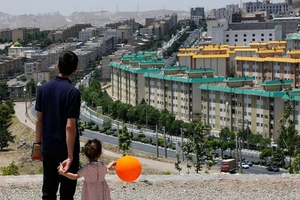
Two men overlook Tehran in this undated file photo illustrating Iran’s housing and rent crisis.

Pressure on Iran’s housing market is pushing a rise in shared living arrangements in small urban apartments, with landlords and tenants increasingly dividing limited space to cope with rising rents and mortgage costs, according to local media.

A report by Peyam-e Ma documents a growing trend in which 40–60 square meter apartments are being split between unrelated occupants as rent levels outpace incomes and turn standard tenancy into negotiated cohabitation.

Conditions reshape tenancy norms

In one case cited by the report, a landlord in a central district of Tehran asked for a deposit of 1,000,000,000 rials (about $550) and monthly rent of 50,000,000 rials ($28) for a shared arrangement, alongside strict conditions including limited visitors, full-time employment, and no pets.

The minimum wage in Iran is currently around $90 per month.

Another listing involved a 50-square-meter apartment where the owner offered reduced rent in exchange for domestic work. The monthly payment was set at 70,000,000 rials ($39), down from 120,000,000 rials ($67) if cooking duties were included.

A separate case involved a duplex property being partially rented out for a deposit of 3,000,000,000 rials ($1,667) and monthly rent of 150,000,000 rials ($83), with cohabitation offered to another couple.

From coping mechanism to structural pressure

A deputy head of Iran’s real estate brokers’ association told Peyam-e Ma that shared housing can be understood as a lifestyle choice seen in other countries, noting its historical presence in Iran as well.

But the report highlights a widening gap between that framing and current conditions, with landlords increasingly using cohabitation models to cover mortgage payments and living costs, while tenants accept reduced privacy in exchange for affordability.

File photo of Tehran amid rising housing and property prices in Iran.
100%
File photo of Tehran amid rising housing and property prices in Iran.

Exit from Tehran’s rental market

Brokers interviewed for the report say some tenants are leaving the capital altogether or returning to smaller cities as rents rise beyond sustainable thresholds. Others, particularly single occupants, are moving back into parental homes.

One housing expert quoted in the report warns that continued displacement from urban centres could accelerate informal settlement growth around major cities, describing it as an emerging phase of housing exclusion rather than a temporary adjustment.

Another analyst argues that prolonged multigenerational living has masked underlying demand for independent housing, particularly among younger Iranians delaying marriage or household formation due to cost barriers.

This suppressed demand, he said, is becoming more visible as household structures shift and single-person living increases, exposing shortages in affordable rental stock.

Rising pressure on tenants

Data referenced in the report from Iran’s statistics authority indicates that roughly 51 percent of Tehran residents are renters, underscoring the city’s dependence on the private rental sector.

With average monthly rents for standard apartments ranging between 180,000,000 and 270,000,000 rials ($100–$150), costs now far exceed minimum wages reported at around 166,000,000 rials ($92).

Inflation in rent prices is recorded at 31.1 percent year-on-year, but market participants in the report say this figure reflects affordability limits rather than easing pressure, as tenants are unable to absorb further increases.

Poverty exposure among renters

Refering to a parliamentary research, the report says that around 27 percent of renting households fall below the poverty line under conventional measures, rising to roughly 40 percent when housing costs are included.

It also adds that the majority of low-income renters are concentrated in the bottom income deciles, with Tehran accounting for the largest share.

The spread of shared housing is therefore presented not as an isolated social shift, but as part of a broader tightening of access to independent accommodation in Iran’s largest urban centre.

Most Viewed

Tehran media sees rising risk of war as US talks stall
1
INSIGHT

Tehran media sees rising risk of war as US talks stall

2
ANALYSIS

China’s Iran balancing act grows more costly

3
INSIGHT

Iran’s café culture buckles as everyday life contracts

4
INSIGHT

Hormuz gives battered Iran room to wait out Trump, experts say

5

Iran says Quran 'memorization' schools to expand

Banner
Banner

Spotlight

  • Iran’s café culture buckles as everyday life contracts
    INSIGHT

    Iran’s café culture buckles as everyday life contracts

  • China’s Iran balancing act grows more costly
    ANALYSIS

    China’s Iran balancing act grows more costly

  • Tehran media sees rising risk of war as US talks stall
    INSIGHT

    Tehran media sees rising risk of war as US talks stall

  • Xi may help Trump on Iran, but at a price
    ANALYSIS

    Xi may help Trump on Iran, but at a price

  • How one Tehran hospital became a window into Iran’s January massacre
    SPECIAL REPORT

    How one Tehran hospital became a window into Iran’s January massacre

  • Tehran residents face eviction from hotels after war damage

    Tehran residents face eviction from hotels after war damage

  • Skyrocketing rents push Iranians back to parents’ homes, shared housing

    Skyrocketing rents push Iranians back to parents’ homes, shared housing

•
•
•

More Stories

Shortage of opium syrup threatens addiction treatment in Iran

May 17, 2026, 09:22 GMT+1

Severe shortages of opium syrup are disrupting addiction treatment across Iran, Shargh daily reported on Sunday, raising fears that thousands of recovering drug users could return to narcotics use as clinics struggle to secure supplies of a key maintenance medication.

The shortages follow repeated disruptions in the production and distribution chain of opium syrup, a drug widely used in Iran’s maintenance treatment programs for patients who cannot easily switch to alternatives such as methadone because of physical dependence or medical complications.

Experts and addiction treatment activists warned the shortages are no longer only a clinical problem but a broader social crisis with potential consequences for public health, crime and family stability.

“These medications are essential for patients and stopping access does not mean they stop using drugs,” addiction expert Habib Bahrami told Shargh. “In many cases they return directly to narcotics use, bringing social, economic and family consequences.”

  • Drug prices jump up to 400% as shortages strain Iranian pharmacies

    Drug prices jump up to 400% as shortages strain Iranian pharmacies

Some clinics, according to the report, have seen supplies fall so sharply that only one out of every 100 eligible patients can obtain opium syrup.

Patients pushed back toward illicit drugs

Bahrami said shortages had already emerged before the recent regional conflicts and economic pressures intensified.

“Before the war we were already seeing reduced supplies,” he said. “In some medical universities, opium syrup distribution was nearly halted before the Persian New Year (late March) without explanation.”

Patients unable to obtain the medication, he said, often return to street narcotics markets to avoid severe withdrawal symptoms, undermining years of treatment and increasing pressure on healthcare.

Methadone syrup continues to be distributed more consistently, Bahrami said, but many patients cannot easily transition to substitute medications.

Supply chain problems deepen shortages

Activists and treatment providers offered differing explanations for the shortages, with some blaming administrative restrictions and others pointing to shortages of raw materials used in production.

File photo of patients at an addiction treatment center in Iran.
100%
File photo of patients at an addiction treatment center in Iran.

Abbas Deilamizadeh, head of the addiction recovery NGO Tavallod-e Dobareh (Rebirth Society), said insufficient access to raw opium materials has sharply reduced production and fueled the emergence of a black market.

“The shortage of raw materials has caused shortages in the market and created serious problems for patients,” Deilamizadeh told Shargh.

He argued that tighter state oversight of legal cultivation could provide a long-term solution.

“The only solution, in my view, is government-supervised poppy cultivation to supply the raw materials needed for this treatment method,” he said.

Addiction centers face mounting pressure

Treatment providers also warned that financial pressures and recent regional conflict have weakened addiction recovery services more broadly.

Deilamizadeh said many residential treatment centers are struggling with unrealistic state tariffs that fail to cover operational costs amid high inflation.

  • Iranians question official inaction over opium epidemic

    Iranians question official inaction over opium epidemic

“For a 30-day stay, less than 100 million rials ($55) is allocated per patient,” he said. “That amount does not realistically cover accommodation, utilities, staff and treatment standards.”

He also said voluntary admissions to treatment centers have dropped sharply in recent months because of insecurity and public anxiety linked to regional military escalation.

“Based on our experience, voluntary admissions have fallen by around 40 percent,” he said.

Bahrami said some centers discharged patients during periods of heightened military tension and avoided taking new admissions because of security concerns.

“When society is overwhelmed by war-related fears, vulnerable groups are pushed further to the margins,” he said.

Can Iran’s economy survive a twin squeeze from blockade and blackout?

May 16, 2026, 22:03 GMT+1
•
Mohamad Machine-Chian

Iran’s internet blackout and the US blockade are pushing the country toward a deeper economic crisis, experts told the Eye for Iran podcast, warning that Tehran is compounding foreign pressure with a self-inflicted assault on its own digital economy.

More than 75 days after Iran imposed sweeping internet restrictions, tens of millions of Iranians remain cut off from the outside world. The blackout has severed ordinary communications, disrupted online businesses and deepened the sense of isolation inside a country already battered by war, sanctions, inflation and a growing shortage of hard currency.

Holly Dagres, a senior fellow at the Washington Institute, says she found in a 2022 report that around 11 million Iranians had online businesses, including many women seeking financial independence through handicrafts, catering, Instagram sales or influencer work.

“This internet shutdown has gravely impacted people,” she told the Eye for Iran podcast, adding that Iranian officials themselves have said 20% of the country’s 30 million-strong workforce has been affected.

Iranian e-commerce platforms, ride-hailing services, streaming platforms and online retailers have all been hit, she said, with hundreds of jobs lost as a result of the blackout.

Dagres said the shutdown also reflects Tehran’s effort to control the information space, not only its stated security concerns. “It’s really not about national security. It’s about who you decide gets control of the internet,” she said.

A self-inflicted economic wound

Siamak Javadi, an Associate Professor of Finance at the University of Texas, said the blackout is not just a political tool but an economic shock inflicted by the state on an already fragile economy.

“The Iranian economy was already in shambles, and you’re inflicting even more damage to the economy by shutting down the internet,” he told the podcast.

Javadi put the economic damage in starker terms. Citing Iranian estimates, he said each minute of internet shutdown costs the economy around $1.5 million in direct losses, or about $80 million a day.

But he said the indirect costs are even more damaging.

“It kills jobs. It kills opportunities. It kills planning,” he said. “If there was any project that they were thinking about undertaking, those projects are going to basically shut down.”

For a developing economy, Javadi said, small and medium-sized enterprises are the backbone of economic life. Shutting down the internet in the middle of a currency crisis and wartime economic shock, he said, amounts to “deliberately killing the economy.”

“It’s like a deliberate, sober decision to kill the economy and basically keep people to fight for their basic necessities,” he said.

The blockade clock

While the internet blackout is damaging the economy from within, Javadi said the US blockade is squeezing the Islamic Republic from the outside by limiting access to oil revenue and foreign currency.

He said Iran’s economy was already weakened before the war by structural problems including corruption, fiscal deficits, capital flight, money-printing and a long-running depreciation of the rial.

The war, he said, added a major supply-side shock and sharply reduced Tehran’s ability to rely on oil income to defend its currency or finance the state.

“What happened during the war, on top of all of these preexisting conditions, is that basically overnight, Iran’s access to oil revenue kind of evaporated,” Javadi said.

He said the blockade is costing Iran an estimated $450 million a day, which he rounded to roughly $12 billion to $15 billion a month.

“That’s substantial for an economy that is like between $350 billion to $400 billion GDP,” he said.

Javadi argued that the Islamic Republic is “definitely on the clock,” especially as oil exports become more limited, more costly and less efficient. With reduced access to oil revenue, limited tax income and small businesses crippled by the blackout, he said the government may eventually struggle to finance even its security apparatus.

“They may not be able to even pay their own security forces and their institution of suppression,” he said.

Still, he warned that the regime does not operate like a normal government. It may allow ordinary economic life to collapse so long as it can preserve the core institutions needed to stay in power.

“They may run out of money to run a business in a normal way. But it doesn’t matter to them,” Javadi said. “As long as they can finance their security forces, they will hold on to power.”

He said that could mean cutting back pensions or leaving ordinary people unable to afford basic necessities while the state prioritizes its coercive machinery.

But the question is not only how long Tehran can keep funding the state under blockade. It is also what kind of economy Iranians are being forced into: one more isolated, more monitored and increasingly cut off from the outside world.

Permanent isolation

Dagres warned that the internet shutdown may be moving Iran toward a more permanent model of isolation.

She said Iran’s domestic internet infrastructure is already functioning in parts of daily life, including banking, ride-hailing and local messaging apps. But those services are monitored, she said, and cannot replace access to the outside world.

“It’s not really hyperbolic anymore” for Iranians to compare the situation to North Korea, Dagres said.

“This seems like this might become the new normal, where only an elite few will have access to the outside world, and everybody else will be living behind this digital wall,” she said.

That wall, she added, is devastating not only psychologically but economically.

For both experts, the crisis facing Iran is therefore not simply the result of outside pressure. The US blockade may be choking off state revenue, but Tehran’s own blackout is choking the businesses, workers and families the state claims to protect.

Iran’s café culture buckles as everyday life contracts

May 16, 2026, 08:37 GMT+1
•
Maryam Sinaiee

Iran’s deepening economic crisis is pushing cafés and coffee culture toward collapse, as soaring prices and falling incomes force both businesses and customers to cut back.

Mohsen Mobarra, head of the union overseeing coffee shops in Tehran, told economic daily Donya-e-Eqtesad that café operating costs have more than doubled while customer numbers have fallen by as much as 50 percent in recent months, with up to 40 percent of cafés shutting down.

“Continuing operations does not mean profitability,” he said. “The profits of these businesses are steadily shrinking. As a result, cafés that rent their locations or lack strong financial backing are heading toward closure.”

Over the past two decades, cafés became an important part of urban life in Iran, taking root in Tehran before spreading across the country.

With affordable entertainment options limited, they emerged as some of the few accessible spaces where young Iranians could socialize, work and spend time outside the home.

Many evolved into more than places to drink coffee or eat light meals. They hosted poetry nights, small music performances, photography exhibitions and informal gatherings, becoming rare spaces for social interaction at a time when few other public spaces remained accessible.

Until a few months ago, Tehran alone had around 6,000 cafés of different sizes in operation. But the collapse in consumers’ purchasing power has hit the industry hard.

Sanaz, a 28-year-old receptionist at a private company, said she and her friends used to visit cafés several times a week. But now, with sharp increases in the costs of food, transportation and housing, even such small pleasures require careful calculation.

“I have to calculate every expense, even this simple form of entertainment, just to make it to the end of the month — assuming I don’t lose my job,” she said.

“If I lose my job, after years of financial independence, I’ll have to move back to my parents’ home in my hometown.”

The closures and downsizing have also eliminated jobs for many workers, most of them young people and women.

Shana, 26, completed professional barista training before finding work at one of the branches of the well-known Saedi Nia café chain.

In January, the chain’s branches were abruptly shut down after the owner voiced support for opposition protesters. Shortly afterward, war broke out.

“Even cafés that have survived the economic downturn are not hiring new staff anymore,” she said. “Many are actually laying off existing employees.”

“I have no hope that even by learning new skills like cooking or other work, I’ll be able to find a job. The economy keeps getting worse every day, and the job market is shrinking.”

Coffee itself is also becoming a luxury.

Tea remains Iran’s dominant traditional drink, but coffee consumption expanded rapidly in recent years. Now, however, the sharp rise in foreign currency prices and disruptions to imports have pushed coffee prices so high that many households are cutting consumption or abandoning it altogether.

Although global coffee prices have declined, the cost of coffee beans in Iran — largely imported through the United Arab Emirates before the war — has nearly doubled compared to pre-war levels.

The increase has directly affected café prices. With rents and other expenses also rising, the price of a cup of coffee in some cafés has climbed by as much as four times.

One café owner told Donya-e-Eqtesad that even cafés specializing in basic coffee drinks are seeing falling demand because many people can no longer justify going out even for coffee.

Tara, the manager of an advertising company with ten employees, said coffee has become so expensive that even buying it for office use is increasingly difficult.

“For the first time in the past twenty years, I’ve had to stop buying coffee for the office kitchen, where it was always available for employees alongside tea,” she said.

“It’s not just about coffee prices. Since last summer’s war, work has effectively been frozen. Clients have even canceled half-finished projects, and everyone knows the company is taking its last breaths.”

“If this situation continues, we’ll have no choice but to shut down.”

Iran says Quran 'memorization' schools to expand

May 16, 2026, 03:43 GMT+1

Iran’s Education Ministry said Quran-related activities and prayer programs are continuing online as schools remain virtual, with 200 school for memorising Qur'an set to open this year.

Mikail Bagheri, director general for Quran, Etrat and Prayer Affairs at the ministry, told ILNA news agency that Quran instruction is continuing through online platforms alongside other school subjects.

He said Quran classes in primary schools are taught by general teachers, while specialized Quran instructors handle the subject in secondary education.

Bagheri also said Iran launched around 200 official Quran memorization schools across the country last year and plans to expand the program further.

China’s Iran balancing act grows more costly

May 16, 2026, 03:28 GMT+1
•
Dalga Khatinoglu

China is showing growing unease over the economic and strategic costs of Iran’s confrontation with the United States, even as it continues to shield Tehran diplomatically at the United Nations.

US President Donald Trump said during his recent visit to Beijing that Chinese President Xi Jinping stressed the importance of keeping the Strait of Hormuz open.

China’s foreign ministry has also repeatedly called for the Strait of Hormuz to reopen “as soon as possible” and urged a “comprehensive and lasting ceasefire” between Iran and the United States.

Before the closure of the Strait of Hormuz, roughly 45 percent of China’s oil imports passed through the strategic waterway.

As Brent crude futures surged to $117 per barrel and physical oil cargoes traded at prices as high as $150, China responded by cutting oil imports by 20 percent last month and raising domestic gasoline and diesel prices on May 9.

Reuters reported that China’s producer prices climbed to a 45-month high in April, while consumer inflation also accelerated.

But the damage to China’s economy goes far beyond energy supplies.

Although Beijing has yet to release customs data for April, March figures already point to a sharp collapse in Chinese exports to the region.

According to Chinese customs statistics, exports to Persian Gulf countries fell to just $5.7 billion during March—the first month of Iran’s blockade of the Strait of Hormuz—down from $13.2 billion the previous month.

In other words, Chinese exports to the Persian Gulf region plunged by 57 percent within a single month.

These figures represent only part of the economic fallout facing China. Chinese companies implemented or invested in approximately $39.4 billion worth of projects across the Middle East last year.

But with the region sliding deeper into conflict and Iran launching extensive attacks against its Arab neighbours, many of Beijing’s regional investments are facing growing uncertainty.

Expectations among those states that China should pressure Tehran should not be underestimated. China exported roughly $340 billion worth of goods to Iran’s Arab neighbours. That’s roughly equivalent to the entire size of Iran’s economy.

Beijing cannot simply ignore the concerns of its wealthy regional partners.

One potential lever available to China may be reducing purchases of Iranian crude. Data from Kpler shows that despite strong demand, China cut imports of Iranian oil by nearly one-third in April compared to March, reducing purchases to 1.16 million barrels per day.

China also remains Iran’s largest non-oil trading partner.

Beijing has nevertheless continued to back Tehran diplomatically. China and Russia opposed recent US-backed UN resolutions on the Strait of Hormuz, arguing the measures were one-sided and risked fueling further escalation.

China’s UN envoy Fu Gong said the proposed resolution was “not helpful” and argued that both its timing and content were wrong.

Still, Iran continues to serve as an important strategic card for Beijing in its broader rivalry with the West. But despite the growing economic costs, China is unlikely to support any outcome that would leave Tehran strategically defeated by Washington.