File photo shows inmates sitting inside an overcrowded prison ward in Iran.
January protesters held in Greater Tehran Penitentiary are being kept in severely overcrowded and unsanitary conditions without adequate medical care, clean drinking water or sufficient food, according to multiple inmates and eyewitnesses who spoke to Iran International.
Several security prisoners held in Wards 1, 2 and 4 of Unit 6 described conditions that they said have worsened in recent months as authorities transferred growing numbers of detainees arrested during the January protests to the prison.
“Bedbugs crawl all over prisoners, and everyone is exposed to disease,” one inmate said. “Because of the overcrowding, if one person gets sick, the entire ward becomes ill.”
Overcrowding doubles prison capacity
According to the prisoners, each ward contains 15 rooms equipped with 15 beds, providing space for about 210 inmates after accounting for shared storage areas.
Authorities are housing roughly 500 prisoners in the same space, they said, forcing about half the inmates to sleep on floors or in corridors.
The overcrowding has contributed to infestations of bedbugs and lice and accelerated the spread of infectious illnesses, inmates said.
Former prisoners have previously described similar conditions at Greater Tehran Penitentiary, warning of severe overcrowding, inadequate healthcare and shortages of medical staff.
One former inmate said families often supply medicines because the prison clinic provides little treatment.
“The clinic does nothing,” the former prisoner said. “Only when someone is close to death are they transferred for medical care.”
Water, food and hygiene shortages
Prisoners said they have no reliable access to clean drinking water and must purchase bottled water from the prison store.
During the current summer period, however, the store has at times gone up to three days without bottled water, forcing inmates to drink tap water that they believe is unsafe.
Several inmates also described prison food as poor quality and said meals are occasionally not served, with one or two meals sometimes skipped every few days.
Political prisoners in Ward 6 also reported earlier this month that water supplies had been cut, air conditioning switched off and showers closed, which they said was intended to increase pressure on detainees. They also said weekly family visits had been suspended.
Cold showers, blocked toilets
Prisoners told Iran International that hot water is unavailable in prison showers throughout the year.
When inmates complain, prison officials tell them they cannot provide hot water and that prisoners must accept the conditions, according to the witnesses.
They also described blocked toilets that sometimes remain unusable for days, as well as shortages of cleaning supplies.
Dirty bedding, carpets and shared facilities have contributed to outbreaks of scabies and other contagious skin diseases, prisoners said.
Outdoor confinement in extreme heat
Witnesses also described mandatory outdoor exercise under direct sunlight during summer temperatures approaching 40 degrees Celsius.
Prisoners are required to remain in an uncovered yard for at least two hours each day and are not permitted to return indoors before the allotted time.
“The same happens in winter,” one inmate said. “Even if you were freezing, they would not allow you back inside.”
Protest detainees held alongside other prisoners
According to inmates, conditions deteriorated after authorities transferred large numbers of January protesters to Greater Tehran Penitentiary as prisons in the capital filled beyond capacity.
Some detainees said protest prisoners were placed in wards previously occupied by inmates convicted of theft and drug-related offenses.
Unlike Tehran's Evin Prison, where political prisoners often manage their own wards, Unit 6 at Greater Tehran Penitentiary is overseen by inmates convicted of ordinary crimes.
Several witnesses said that some of those inmates verbally abused protest detainees, encouraged confrontations and, in some cases, carried out violent attacks with the acquiescence of prison guards.
One witness said two protesters were stabbed during a confrontation, leaving one with severe hand injuries.
Several inmates said many of those arrested during the January protests are young adults, adding that the conditions inside the prison have left them in severe psychological distress while many remain in detention awaiting trial without being granted temporary release on bail.
File photo shows a shopkeeper using a gas-powered lantern inside a darkened store during a power outage in Iran.
Power and water outages have returned to several parts of Iran, residents across the country told Iran International on Friday, describing hours-long blackouts during intense summer heat despite official assurances the electricity network remains stable.
The complaints came as the energy ministry called for consumers to reduce electricity use by at least 10%, warning that high temperatures are expected to push demand above 75,500 megawatts in the coming days.
"Electricity has been out since 2 a.m. and it's now 5 a.m. We still don't have power," one resident in Islamshahr, near Tehran wrote.
Average temperatures, the ministry said, are forecast to reach around 41 degrees Celsius between July 14 and July 18 and remain unusually high through the following week. It urged households to set air conditioners to 25 degrees Celsius, switch off unnecessary electrical appliances and move heavy electricity use outside peak hours to preserve grid stability.
The outages come against the backdrop of a widening structural energy deficit. The latest Statistical Review of World Energy by the Energy Institute found Iran's electricity generation increased by only 1% last year and natural gas production by 1.3%, a sharp slowdown from the previous decade and well below the pace needed to meet rising demand.
Years of underinvestment, delayed infrastructure projects and international sanctions have left the country increasingly unable to meet its own energy needs despite holding some of the world's largest oil and gas reserves.
Residents report outages across Iran
Accounts shared pointed to repeated outages in Tehran province, Alborz, Khuzestan and Fars, with many residents saying electricity was cut for two to three hours at a time.
"Power in Fardis of Karaj went out twice on Thursday – first from 7 a.m. to 7:50 a.m. and then again from 10 until 12:10 p.m.," one resident wrote.
Another in Shiraz said electricity was cut shortly after 1 a.m. on Thursday, while residents in Karaj, in the vicinity of Tehran, also reported another evening blackout.
Several messages came from the southern Khuzestan province, where temperatures regularly climb well above 40 degrees Celsius during the summer.
"They've started the two-hour power cuts again in this unbearable heat," one citizen wrote. "Then they ask what we're supposed to do if power plants are hit."
Another resident questioned why shortages persist despite the province's energy resources.
"With this intense heat in Khuzestan, why should a country this rich suffer shortages of water and electricity?" the resident wrote. "They've started cutting both for at least three hours a day again. Inflation has already broken people's backs."
One person in Masjed Soleyman, Khuzestan province, described losing both electricity and water for three hours, ending the message with a call for public protests.
Food, water and daily life affected
Several said the outages were disrupting everyday life beyond the inconvenience of losing air conditioning.
File photo shows a patient lying on a hospital stretcher during a power outage at a medical facility in Iran.
"I went through so much hardship and debt to buy meat and fish," one resident wrote. "By the time I got home, the electricity went out and we've been without power for three hours. The meat I struggled to buy is spoiling."
Another wrote: "Every day it's either the water or the electricity, or they dig up the streets and take forever to fix them. We live in a city with abundant oil, yet there's poverty and unemployment."
The energy ministry said climate studies show the southern provinces of Hormozgan, Bushehr, Khuzestan, Sistan and Baluchestan and Ilam experience the country's longest periods of extreme heat, placing the greatest strain on the electricity network during the summer.
Officials said reducing air-conditioner settings by one degree and improving energy efficiency could significantly lower demand, urging consumers to conserve electricity to help maintain supplies during the prolonged heatwave.
Messages from Shiraz and Mashhad also described overnight or daytime power cuts, while another resident complained that either electricity or water was being interrupted almost daily.
Officials say prolonged high temperatures have sharply increased electricity demand, particularly in southern provinces, where cooling accounts for a large share of consumption.
Energy experts cited by state media say raising air-conditioner settings by one degree Celsius could reduce cooling demand by roughly 2.5%, while improving the efficiency of cooling equipment and buildings could further lower electricity consumption.
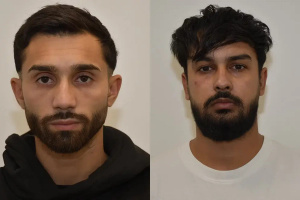
Iran summoned the British ambassador in Tehran on Thursday, two days after Britain called in Iran's most senior diplomat in London following the conviction of two Romanian men over the stabbing of an Iran International journalist.
Iran's foreign ministry said it handed the ambassador a protest note rejecting what it called "groundless and false" British statements that Tehran had sought to carry out security-related activities in the United Kingdom.
Britain summoned Iran's chargé d'affaires on Tuesday after George Stana and Nandito Badea were sentenced to 12 years and eight years in prison, respectively, for their role in the 2024 attack on Pouria Zeraati, an Iranian-British journalist who works for Iran International.
Zeraati was stabbed three times in the leg near his home in southwest London in March 2024.
British prosecutors said the two Romanian nationals were acting as proxies for the Iranian government. They had pleaded not guilty to wounding with intent but were convicted at London's Woolwich Crown Court.
Judge links attack to Iranian state
The British Foreign Office said the judge had concluded that the attack was carried out "in the interests of, and on behalf of, the Iranian state."
According to a police statement, the judge ruled that the "foreign power condition" under Britain's National Security Act was met in Stana's case because of "extensive planning and his lengthy involvement in the plot", indicating that he knew, or at least should have known, of the connection to the Iranian state.
The police statement said the condition was not met in Badea's case because he was not aware of the Iran connection as the reason for the attack.
Tehran rejects British move
Iran's foreign ministry rejected Britain's statements as "groundless and false" and said they amounted to an attempt to divert attention from Britain's own conduct.
Britain's Foreign Office said the case followed "a longstanding pattern of hostile activity by the Iranian intelligence services on UK soil" and said Iran must stop such activity immediately. Iran's embassy in London has rejected what it called "unfounded, politically motivated and hostile allegations."
Iran's foreign ministry also called on Britain to stop hosting media outlets that Tehran said were "funded and directed by the Israeli regime." It said Britain should end such activity "as soon as possible."
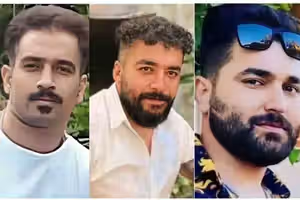
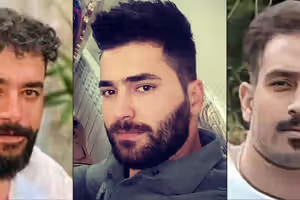
Twelve protesters in Isfahan face imminent execution after Iran’s Supreme Court upheld death sentences in a case built around the alleged killing of four Basij members, a lawyer familiar with the case told Iran International.
The case stems from protests on January 8 at Alikhani Square in Isfahan, where authorities said four Basij members were killed.
According to the lawyer, 59 people were initially arrested after the incident.
The lawyer said 23 of those detained were sentenced to between five and 10 years in prison, even though they were not accused of directly taking part in the deaths and appeared to have been added to the case to strengthen the prosecution’s broader narrative.
Twelve others were sentenced to death.
The lawyer said the Supreme Court upheld the death sentences on July 5 and the case has now been sent to the sentence enforcement branch of the Isfahan Revolutionary Court, raising fears that the executions could be carried out soon.
The prosecutor in the case is Mohammad Nakhjavan, according to the information received. The judges are Mohammad Barati-Dorcheh and Mohammad Tavakoli, also known as Vakili.
Tavakoli previously served as a judge in the “Khaneh Isfahan” (Isfahan House) case, another protest-linked case in Isfahan that ended with the execution of Saleh Mirhashemi, Majid Kazemi and Saeed Yaghoubi in May 2023.
The lawyer said the defendants in the Alikhani Square case were denied access to independent lawyers during the trial stage and were represented by court-appointed attorneys.
The lawyer also said the court blocked defense lawyers from accessing the full case files.
The 12 protesters sentenced to death are mostly very young men. Three were born in 2007 and were around 17 or 18 at the time of the January 2026 protests. Several others were born between 2004 and 2006, and one is an Afghan national. Two brothers are among those facing execution.
The judiciary has not publicly responded to the allegations about denial of access to independent counsel and case files.
The case fits a pattern seen in several protest-linked capital cases in Iran, where the reported deaths of security personnel or pro-government forces have been followed by broad arrests, charges carrying the death penalty and claims by families, lawyers and rights groups that defendants were denied fair trial guarantees.
Rights groups have warned that Iran’s use of death sentences in protest cases has become a tool of intimidation, particularly after periods of unrest, with executions used to send a message far beyond the individual defendants.
Amnesty International said in February that at least 30 people were facing the death penalty over alleged offences linked to the January 2026 protests, including eight people sentenced to death after expedited and “grossly unfair” trials.
The Center for Human Rights in Iran said in April that at least 22 political prisoners had been executed in six weeks, including 10 people detained during the January protests, in cases it said were marked by secretive proceedings, torture, forced confessions and lack of due process.
Human Rights Watch said the January unrest was met with mass killings, arbitrary arrests and severe communications restrictions, with thousands of protesters and bystanders believed to have been killed after protests escalated on January 8.
The new Isfahan case raises the number of protest-linked prisoners facing imminent execution and adds to fears that Iran’s judiciary is accelerating capital punishment in cases tied to the January uprising.