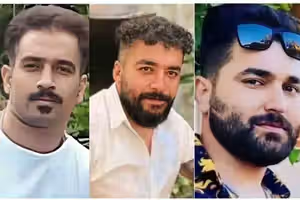
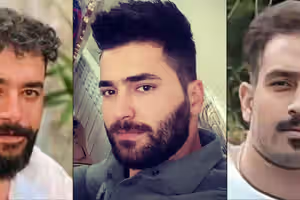
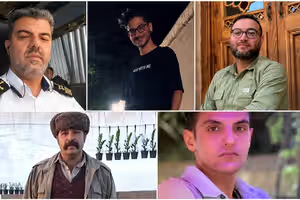
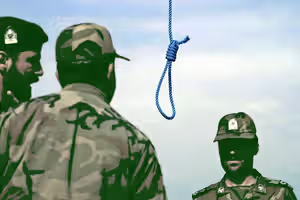
Twelve prisoners at risk of execution in Isfahan protest case, lawyer says
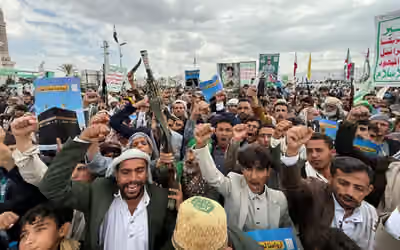
Twelve protesters in Isfahan face imminent execution after Iran’s Supreme Court upheld death sentences in a case built around the alleged killing of four Basij members, a lawyer familiar with the case told Iran International.
The case stems from protests on January 8 at Alikhani Square in Isfahan, where authorities said four Basij members were killed.
According to the lawyer, 59 people were initially arrested after the incident.
The lawyer said 23 of those detained were sentenced to between five and 10 years in prison, even though they were not accused of directly taking part in the deaths and appeared to have been added to the case to strengthen the prosecution’s broader narrative.
Twelve others were sentenced to death.
The lawyer said the Supreme Court upheld the death sentences on July 5 and the case has now been sent to the sentence enforcement branch of the Isfahan Revolutionary Court, raising fears that the executions could be carried out soon.
The prosecutor in the case is Mohammad Nakhjavan, according to the information received. The judges are Mohammad Barati-Dorcheh and Mohammad Tavakoli, also known as Vakili.
Tavakoli previously served as a judge in the “Khaneh Isfahan” (Isfahan House) case, another protest-linked case in Isfahan that ended with the execution of Saleh Mirhashemi, Majid Kazemi and Saeed Yaghoubi in May 2023.
The lawyer said the defendants in the Alikhani Square case were denied access to independent lawyers during the trial stage and were represented by court-appointed attorneys.
The lawyer also said the court blocked defense lawyers from accessing the full case files.
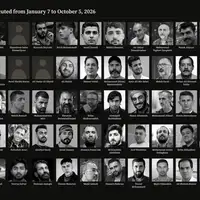
The 12 protesters sentenced to death are mostly very young men. Three were born in 2007 and were around 17 or 18 at the time of the January 2026 protests. Several others were born between 2004 and 2006, and one is an Afghan national. Two brothers are among those facing execution.
The judiciary has not publicly responded to the allegations about denial of access to independent counsel and case files.
The case fits a pattern seen in several protest-linked capital cases in Iran, where the reported deaths of security personnel or pro-government forces have been followed by broad arrests, charges carrying the death penalty and claims by families, lawyers and rights groups that defendants were denied fair trial guarantees.
Rights groups have warned that Iran’s use of death sentences in protest cases has become a tool of intimidation, particularly after periods of unrest, with executions used to send a message far beyond the individual defendants.
Amnesty International said in February that at least 30 people were facing the death penalty over alleged offences linked to the January 2026 protests, including eight people sentenced to death after expedited and “grossly unfair” trials.
The Center for Human Rights in Iran said in April that at least 22 political prisoners had been executed in six weeks, including 10 people detained during the January protests, in cases it said were marked by secretive proceedings, torture, forced confessions and lack of due process.
Human Rights Watch said the January unrest was met with mass killings, arbitrary arrests and severe communications restrictions, with thousands of protesters and bystanders believed to have been killed after protests escalated on January 8.
The new Isfahan case raises the number of protest-linked prisoners facing imminent execution and adds to fears that Iran’s judiciary is accelerating capital punishment in cases tied to the January uprising.
A screen grab from Hassan Namazee’s interview with Iran International
Hassan Nemazee inherited one of Iran’s best-known charitable legacies, lost his family’s fortune to the 1979 revolution and later found a new cause inside a US prison: justice reform.
A businessman, philanthropist and Democratic fundraiser, Nemazee told Iran International that the revolution, the confiscation of his family’s assets and his years in prison reshaped how he thinks about Iran, freedom and justice.
In Shiraz, the name Namazi Hospital remains more than the name of a medical center. It is a reminder of a philanthropic legacy built decades before the Islamic Republic, when Nemazee’s father used his fortune to create institutions that served the public.
“My father made his fortune outside of Iran and he repatriated that fortune to Iran,” Nemazee said. “He built the first modern hospital, the first modern nursing school, the first modern orphanage, and the first modern medical school.”
He said his father also built the country’s first piped water system, both to provide clean water for the hospital and to help finance free medical care for local residents.
“What he did was unique,” Nemazee said. “Most Iranians of that time and afterwards made their money in Iran and took it out. Philanthropy was an unknown process at that time.”
A legacy in Shiraz
Born in Washington, DC, and educated in the United States, Nemazee returned to Iran at 22 after his father’s death. He said he saw no other choice.
“There was no choice for me to do anything other than return to Iran when my father passed away,” he said.
Continuing his father’s work in Shiraz, he added, gave him “the greatest satisfaction” of his life.
Nemazee became chairman of the board of Namazi Hospital, the nursing school and the Shiraz Waterworks, and also oversaw the family’s broader charitable institutions through Bonyad Iran.
At the same time, he entered business during what he described as Iran’s “golden years” of rapid economic growth before the revolution. He invested in insurance, banking and real estate, including joint ventures with major American institutions.
That life ended abruptly when he left Iran in December 1978 for what he expected to be a short business trip to the United States.
“I left Iran on what I thought would be a two-week business trip,” Nemazee said. “The Shah left in January of 1979. Khomeini returned in February of 1979. And in March, the Iranian government nationalized 51 families. We were one of the 51 families.”
He said the confiscation covered nearly everything he owned in Iran.
“Everything that I owned in Iran, my house, my possessions, horses, dogs, bank accounts, land, factories, everything was confiscated,” he said.
Nemazee said many people initially believed the revolution would target only the Shah and those closest to him, but its reach quickly widened.
“The revolutionaries had an agenda, and the agenda was to completely eradicate a certain level of people within the Iranian society,” he said.
The entrance of Namazi Hospital in Shiraz
Politics after exile
After returning to the United States, Nemazee rebuilt his life in business, philanthropy and politics.
He became a prominent Democratic fundraiser and developed close ties with Bill and Hillary Clinton, as well as other senior Democrats including John Kerry, Al Gore, Joe Biden and Barack Obama.
He said his entry into American politics was partly shaped by the lesson he drew from Iran.
“I decided that I didn’t want to make the same mistake that I believe I had made in Iran, and that was abdicating any political responsibility for the country in which I lived,” he said.
President Bill Clinton later nominated Nemazee to serve as US ambassador to Argentina, but the nomination was blocked in the Senate. Nemazee summed up the reason in one word: “Politics.”
Years later, his life took another dramatic turn.
Nemazee pleaded guilty in the United States to inflating assets in loan documents, but said the banks did not lose money and that his punishment was excessive.
“The truth of the matter is that those assets were inflated,” he said. “The truth of the matter is as well that the banks never lost any money.”
He was sentenced to 12 years in prison and entered prison on August 27, 2010. He served nine years before being released in 2019 under the First Step Act, a criminal justice reform law signed by President Donald Trump.
A longtime Democrat, Nemazee said he remains grateful to Trump for signing the law that allowed his early release.
“You have to give credit where credit is due,” he said. “It is ironic but true that Donald Trump was responsible for my coming home early.”
A prison sentence becomes a cause
Nemazee said prison changed the course of his life. While incarcerated, he read 2,651 books, wrote two books, taught GED classes and mentored hundreds of fellow inmates.
He said a friend had advised him before prison not to see the sentence only as lost time, but as “a gift of time” to write, teach, exercise, read and mentor others.
After his release, Nemazee turned much of his attention to criminal justice reform and helping former prisoners rebuild their lives.
He now serves on the board of the Fortune Society, a New York-based organization that supports former inmates with housing, education, employment and reintegration.
Nemazee said the United States has failed by imprisoning too many people for too long.
“The United States has 5% of the world’s population, yet it has 25% of the world’s prisoners,” he said. “That’s a statistic that is not only morally wrong, it’s economically unfeasible.”
He said many former prisoners face basic barriers after release, including difficulty opening bank accounts, finding housing and securing jobs.
“How can you begin to put your life back together if you don’t have the fundamental rights that every other human being has?” he said.
Despite the upheavals in his own life, Nemazee said he still hopes to return one day to Shiraz.
“I would love to be able to return to Shiraz. I would like to return to Iran,” he said. “It’s been 46 long years. It’s time for Iran to be able to turn the page and for all Iranians to have the freedoms that they so richly deserve.”
Asked what he would have done if the revolution had not happened, Nemazee said he would probably have continued the life he was building in December 1978: running businesses while expanding the hospital, nursing school, vocational schools and orphanages linked to his family’s legacy.
“Iran is a country of magnificent talent and opportunities,” he said. “It’s unfortunate that it’s taken this moment in history during our lifetimes to not allow the people of Iran to progress in the ways that they deserve to progress.”
His is a story of loss and reinvention, but also of Iran itself: what was built, what was lost, and what future the country may still choose.
British nationals Craig and Lindsay Foreman remain on hunger strike in Tehran’s Evin prison and have been denied adequate medical care, essential medicine and family phone calls, US-based rights group HRANA reported on Monday.
The report said Lindsay Foreman had not received a medical checkup for about 10 days and was suffering from dizziness, body tremors, severe weakness and more than 14 kg of weight loss. Craig Foreman had lost about 16 kilograms, it added.
HRANA cited an informed source as saying the couple had recently been allowed phone contact with their lawyer but remained barred from speaking to their family, children and each other.
The source said pressure on the couple intensified after interviews with BBC World in which they discussed executions in Iran.
Craig and Lindsay Foreman were sentenced to 10 years in prison in February on espionage charges, which they deny.
The couple were first detained in the southeastern city of Kerman, where they spent 30 days in solitary confinement before being transferred to Tehran, the family has said, adding that, they had entered Iran with valid visas, a licensed guide and a cleared itinerary.
Gholamhossein Mohseni Ejei was recently reappointed as judiciary chief for another five-year term, reinforcing the Islamic Republic’s security-focused judicial system and offering an early indication of how Supreme Leader Mojtaba Khamenei intends to manage power.
The appointment, issued under Article 157 of Iran’s constitution, leaves one of the Islamic Republic’s longest-serving judicial and intelligence figures at the head of an institution that has played a central role in prosecuting dissent, overseeing political cases and implementing the state’s domestic security policies.
Mohseni Ejei, 69, has spent more than four decades moving between the Revolutionary Courts, the Intelligence Ministry and the judiciary, making him one of the few senior officials with experience across all three pillars of Iran’s security establishment.
Unlike many first-generation clerics who rose through purely religious institutions, Mohseni Ejei also earned a master's degree in private international law. That legal education, however, has done little to shape his public image, which has instead been defined by security cases, political prosecutions and harsh judicial policies.
His rise began during the 1980s, when he served as an investigator in the case against Mehdi Hashemi, the brother-in-law of the late Grand Ayatollah Hossein Ali Montazeri. The prosecution helped weaken Montazeri's political standing before he was removed as the designated successor to the Islamic Republic's founder, Ruhollah Khomeini.
That early role established Mohseni Ejei as an official closely associated with politically sensitive investigations, forced confessions and cases that blurred the boundary between judicial procedure and national security.
Security insider
Official biographies highlight his studies at the Haqqani Seminary and his involvement in prominent corruption prosecutions during the 1990s, including cases involving businessman Fazel Khodadad and former Tehran mayor Gholamhossein Karbaschi.
His career expanded further when he became intelligence minister under President Mahmoud Ahmadinejad before being dismissed in 2009. He was subsequently appointed prosecutor general, later became first deputy judiciary chief and assumed the judiciary's top post in 2021.
The combination of intelligence, prosecutorial and judicial experience has made Mohseni Ejei one of the Islamic Republic's most trusted officials for handling politically sensitive files involving opposition figures, corruption allegations and national security matters.
Supporters portray him as an experienced administrator familiar with every layer of Iran's judicial system. Critics argue his career reflects the increasing integration of intelligence agencies and the courts, turning judicial institutions into instruments for enforcing political control.
Mohseni Ejei has also maintained an unusually low public profile outside official duties. Unlike many senior Iranian politicians, he rarely projects a personal image or family life through the media, appearing primarily in court proceedings, official meetings and state broadcasts.
'The man who bites'
Among many Iranians, Mohseni Ejei's public reputation extends beyond his judicial decisions.
One of the most enduring stories surrounding him dates to 2004, when journalist Isa Saharkhiz accused Mohseni Ejei of throwing a cube-sugar bowl and biting his shoulder during a dispute at a meeting of Iran's Press Supervisory Board. The account became one of the defining anecdotes associated with his public image.
His international profile, however, has been shaped more by human rights concerns than by personal controversies.
The United States Department of the Treasury sanctioned Mohseni Ejei in September 2010 over his role in serious human rights abuses following Iran's disputed 2009 presidential election. The sanctions placed him alongside other senior Iranian security officials accused of involvement in post-election repression.
The European Union also imposed human rights sanctions on him, citing his role in unfair trials and severe prison and death sentences against political activists and protesters.
Judiciary under scrutiny
During his first term as judiciary chief, Mohseni Ejei said wants to promote themes including judicial reform, anti-corruption efforts and reducing court delays.
Judiciary Chief Gholamhossein Mohseni Ejei, recently appointed to a new five-year term, attends a ceremony alongside President Masoud Pezeshkian (left) and Parliament Speaker Mohammad Bagher Ghalibaf (center).
Human rights organizations, however, have argued the judiciary became more deeply involved in suppressing political opposition, particularly following the 2022 Woman, Life, Freedom protests triggered by the death of Mahsa Amini in morality police custody.
Mohseni Ejei publicly defended death sentences imposed on some protesters after those demonstrations.
Amnesty International said in September 2025 that Iran had executed more than 1,000 people that year, describing it as the highest annual total recorded by the organization in at least 15 years. The group said authorities had increasingly relied on capital punishment following the Woman, Life, Freedom protests.
The Iran Human Rights annual report recorded at least 1,639 executions during 2025, saying more than 93% were never officially announced and that Revolutionary Courts handed down 852 execution sentences during the year.
Following the recent conflict involving Israel and the United States, rights groups have also accused Iranian authorities of accelerating political prosecutions under wartime conditions.
Amnesty International said in May 2026 that Iranian authorities had intensified mass arrests, expedited trials and politically motivated executions, documenting at least 42 executions on political charges since late February after proceedings it described as unfair.
Mohseni Ejei's reappointment follows days of speculation that Iran's new leadership might replace him to demonstrate a change of direction. Instead, retaining him suggests continuity rather than restructuring at the judiciary.
The decision shows that, at least in the early phase of Mojtaba Khamenei's leadership, judicial authority will remain closely aligned with Iran's security institutions, reinforcing a model in which the courts continue to play a central role in maintaining political control rather than signaling a broader opening of the country's legal system.
A view from Tehran’s Mosalla where Ali Khamenei’s week-long funeral ceremonies started on July 4, 2026
Iranian authorities are preparing for the possibility that Ali Khamenei’s week-long funeral ceremonies could leave between 1,500 and 3,000 people dead, Germany’s WELT reported, citing a classified document and municipal sources in Tehran.
The report, written from Tehran by an anonymous author whose identity is known to WELT’s editors, said officials have drawn up contingency plans for a possible mass-casualty disaster during the processions for the slain former Supreme Leader.
According to WELT, a classified letter from the Iranian Red Crescent and the national crisis management organization to First Vice President Mohammad-Reza Aref projected between 1,500 and 3,000 possible deaths.
The report said a special unit had been set up to handle the dead and missing, while thousands of new graves had been prepared at Tehran’s Behesht-e Zahra cemetery.
One Tehran municipality employee, identified under a pseudonym for security reasons, told WELT that colleagues in the city’s crisis headquarters had confirmed the preparations.
“The prepared graves really exist,” she was quoted as saying. “Those responsible were told that up to 3,000 dead would be okay. With such a large crowd and this extreme heat, no one knows what will happen.”
The claims have not been independently confirmed.
Khamenei’s funeral ceremonies began in Tehran on Saturday and are expected to continue through Qom, the Iraqi cities of Najaf and Karbala, and finally Mashhad, where he is due to be buried on Thursday.
WELT said the authorities were planning a sweeping security and logistical operation in Tehran, including movement restrictions, possible disruption to air travel, thousands of buses, temporary kitchens and the use of schools and mosques to house participants.
The report said officials had spoken of as many as 20 million people attending, a figure that is difficult to verify and is often used by Iranian authorities to portray state ceremonies as displays of mass support.
According to WELT, Tehran Municipality, led by hardline mayor Alireza Zakani, is playing a central role in the preparations, deploying 11,000 buses and keeping metro and bus rapid transit lines free and operating around the clock.
Municipal employees told the newspaper that each Tehran district had been allocated the equivalent of around 500,000 to 650,000 euros for the three days of ceremonies, excluding additional funds for bodies such as the fire department, parks organization, transport authorities and construction units.
Government-linked journalists cited by WELT estimated the budget at about 15 million euros for Tehran alone, with another five million euros each for Qom and Mashhad. With ceremonies also planned in Najaf and Karbala, the report said the funeral could become one of the most expensive state burials in modern history.
The scale of the preparations has raised concern because Iran has a recent history of deadly funeral crushes. At least 56 people were killed and more than 200 injured during the 2020 funeral for IRGC commander Qasem Soleimani in Kerman, while Ruhollah Khomeini’s 1989 funeral also descended into chaos, leaving at least eight people dead and hundreds injured.
WELT also described deep political tension around the ceremonies, saying radical supporters of the Islamic Republic have used nightly gatherings to denounce the US-Iran memorandum and threaten senior officials involved in negotiations, including Foreign Minister Abbas Araghchi and Parliament Speaker Mohammad Bagher Ghalibaf.
Some participants have demanded continued war to avenge Khamenei’s killing, while videos circulating online showed hardline religious speakers making militant speeches, with some attendees carrying rifles.
The funeral is taking place during a fragile ceasefire and amid growing public frustration over the cost of the ceremonies, economic hardship and the government’s mobilization of state resources for political display.
The logo of Sweden's Migration Agency (Migrationsverket) is seen outside the agency's headquarters in this file photo, alongside the silhouette of a person.
Court documents have revealed extensive alleged contacts between a former Swedish Migration Agency employee and Iranian intelligence, raising concerns that sensitive information about asylum seekers and critics of the Islamic Republic may have been compromised.
The documents stem from the case of Mohsen Hakim-Elahi, who was dismissed from the Swedish Migration Agency during the winter 2025 after Sweden's Security Service, Säpo, concluded he posed a security risk. Hakim-Elahi challenged his dismissal, but Solna District Court ruled on June 24 that the agency had lawful grounds to terminate his employment.
The court relied heavily on testimony from Per Lagerud, head of Säpo's legal department, describing his evidence as detailed, coherent and reliable.
According to the ruling, Säpo concluded that Hakim-Elahi maintained years of contact with an Iranian intelligence officer operating under diplomatic cover at Iran's embassy in Stockholm. The court said the officer's responsibilities included collecting information on opponents of the Islamic Republic, Iranians living in Sweden and other people of interest to Iranian authorities.
Years of documented contacts
The ruling said Säpo documented around 85 electronic contacts between Hakim-Elahi and the intelligence officer between 2016 and March 2017, in addition to telephone calls, face-to-face meetings and records showing when and where those meetings took place.
Court documents also referred to Hakim-Elahi's interviews with Säpo, saying about 1,200 contacts were recorded between him and another individual whom the security service identified as an Islamic Republic agent between May 2020 and October 2021.
Hakim-Elahi did not deny some of those contacts, according to the ruling.
The court said he told investigators he had met the intelligence officer several times, including at his home, at the Migration Agency and at Stockholm's Mall of Scandinavia. He said the meetings generally took place every two weeks.
The ruling also said Hakim-Elahi confirmed he and the intelligence officer travelled to Iran on the same flight in 2017, although he argued that did not mean they were travelling together.
Concerns over agency information
The court found that information from the Migration Agency and its computer systems had been transferred to a network linked to the Islamic Republic. The nature of that information was not disclosed in the published judgment because of confidentiality restrictions.
Hakim-Elahi, according to the ruling, also acknowledged giving the intelligence officer the name of a Migration Agency employee scheduled to work at Sweden's embassy in Tehran.
Säpo's testimony said Hakim-Elahi described that employee as "a good, devout Muslim."
The ruling further said Hakim-Elahi told investigators that if he obtained information about people connected to Kurdish opposition groups opposed to the Islamic Republic, he would pass it to the Iranian intelligence officer.
The Migration Agency argued that Hakim-Elahi's conduct breached security obligations attached to his position and undermined confidence in his ability to handle sensitive information.
Court rejects defense
Hakim-Elahi denied all accusations during the proceedings. He told the court he opposed the Islamic Republic, did not know individuals connected to Iran's embassy had intelligence roles and characterized his relationships with them as personal and social.
Hakim-Elahi also argued there may have been a case of mistaken identity because his name resembles that of the former imam of Stockholm's Imam Ali Islamic Center, who was expelled from Sweden on national security grounds.
The court rejected that argument, saying nothing indicated that either Säpo or the Migration Agency had confused the two men.
It concluded the Migration Agency had established sufficient grounds for dismissal, citing Hakim-Elahi's contacts with an Iranian intelligence officer, his contacts with another person identified by Säpo as an Islamic Republic agent, the transfer of agency information and multiple security breaches.
Wider concerns over Iranian intelligence activity
Two days after the ruling was published, Hakim-Elahi rejected Säpo's allegations in a video posted on social media, describing them as "nonsense." He did not address the alleged contacts with the Iranian intelligence officer, one of the central findings in the court's judgment.
The case adds to a series of investigations into suspected Iranian intelligence activity in Sweden.
In October 2025, Swedish media reported the arrest of two Iranian-born brothers on suspicion of conducting industrial espionage for Tehran. Earlier, in the autumn of 2025, Säpo said Iranian intelligence and security agencies had used Stockholm's Imam Ali Islamic Center as a platform for intelligence activities in Sweden.