• العربية
  • فارسی
Brand
  • Iran Insight
  • Politics
  • Economy
  • Analysis
  • Special Report
  • Opinion
  • Podcast
  • Iran Insight
  • Politics
  • Economy
  • Analysis
  • Special Report
  • Opinion
  • Podcast
  • Theme
  • Language
    • العربية
    • فارسی
  • Iran Insight
  • Politics
  • Economy
  • Analysis
  • Special Report
  • Opinion
  • Podcast
All rights reserved for Volant Media UK Limited
volant media logo

Iran’s lion-and-sun flag at center of FIFA row before 2026 World Cup

Niloufar Mansouri
Niloufar Mansouri

Iran International

May 28, 2026, 09:45 GMT+1

Ahead of the 2026 World Cup, a possible ban on Iran’s lion-and-sun flag has opened a dispute between FIFA and Iranian opponents of the Islamic Republic over identity, representation and politics in sport.

For many Iranians abroad, the World Cup is not only a sporting event. It is also a rare global stage where they can be seen, express identity and say things that can carry serious costs inside Iran. 

Now, ahead of the 2026 tournament, that stage has become the center of a new argument. On the surface, it is about a flag. In practice, it is about who gets to define Iran, which symbols are allowed to represent it and where FIFA draws the line between sport and politics.

FIFA says flags, banners and symbols of a political nature are not allowed inside World Cup stadiums. Football’s global governing body says such rules are intended to preserve the neutrality of sport and prevent stadiums from becoming arenas for political conflict.

But in Iran’s case, many Iranians say that boundary is neither clear nor neutral.

Two flags, two visions of Iran

Opponents of the Islamic Republic say FIFA’s rules effectively privilege Tehran’s post-1979 official flag while treating the historic lion-and-sun banner as political.

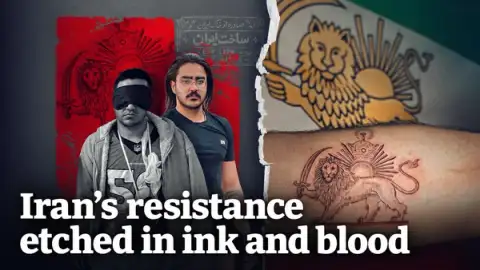
The lion-and-sun emblem was used in Iran before the 1979 revolution and is still embraced by many Iranians as a national symbol outside the framework of the Islamic Republic.

The lion-and-sun emblem has deep roots in Iranian history and was used in different forms for centuries. After the 1979 revolution, the Islamic Republic replaced it with a new flag bearing religious and revolutionary symbols. For many opponents of the current system, the older flag has become a symbol of national identity separate from the Islamic Republic.

For them, a ban is not simply the enforcement of a stadium regulation. It is a choice between two competing narratives of Iran.

“If the Iranian government has registered its own symbol as the official flag, why should a symbol that was part of Iran’s history for centuries be considered political?” one Iranian opponent of the Islamic Republic in Los Angeles told Iran International. “Who gets to decide that definition?”

The debate is not new.

During the 2022 World Cup in Qatar, there were reports that some Iranian fans faced restrictions when trying to enter stadiums with the lion-and-sun flag or symbols associated with anti-government protests.

The same question was raised then: whether sports bodies’ definition of a political symbol is truly neutral, or whether it can itself become a political decision.

A changed relationship with Team Melli

The issue is no longer only about the flag.

Since the Woman, Life, Freedom movement, the relationship between parts of Iranian society and the national football team has changed significantly.

For decades, even as the Islamic Republic tried to fold public institutions into its official narrative, the national football team remained for many Iranians something larger than the government – a source of national pride, shared memory and collective identity.

After nationwide protests and intensified repression inside Iran, however, part of the public no longer views the team only through a sporting lens. The players’ conduct, silence or public positions, and their relationship with the state have all become politically charged.

Some opponents of the Islamic Republic now say the distance has grown deeper than ever, following the killing of large numbers of Iranians during the January protests and the rise in security pressure after the recent war.

In conversations with Iran International, several Iranian opponents of the Islamic Republic in Los Angeles and Seattle repeated the same argument: for part of the public, this team no longer represents the Iranian people.

“We love football. We love Iran’s national team. We were happy when it won and sad when it lost,” one of them said. “But today, many people feel this is no longer the national team in which they can see themselves.”

For this group, the issue is not hostility toward football or rejection of a national sport. On the contrary, they see themselves as part of a society for which football has long been tied to everyday life and national identity.

Their argument is that when the ruling system tries to use every national symbol – from sport to the flag – for political legitimacy, separating sport from politics becomes difficult.

A symbol of reclaiming identity

In that atmosphere, the lion-and-sun flag is not merely a historical symbol for some opponents of the Islamic Republic. It is an attempt to reclaim a version of Iran they feel has been taken from them.

“If a team that the Islamic Republic considers its representative is going onto the pitch, we also want to show our Iran in the stands,” one protester said.

This is where the dispute becomes more complicated.

If some Iranians no longer see the official team as reflecting their national identity, then barring the symbol they identify with is not viewed as a simple stadium rule, but as another exclusion of their voice from the world stage.

At the same time, some Iranian legal and civil groups are pursuing legal avenues to challenge such restrictions. They argue that banning these symbols conflicts with principles of free expression, particularly in a country such as the United States, where free speech has strong legal protection.

The legal issue is complicated. World Cup stadiums under FIFA management operate under specific tournament rules and are not necessarily governed in the same way as ordinary public spaces.

Still, the anger among opponents of the Islamic Republic is real. Some openly say that even if the flag is banned inside stadiums, they will find other ways to display it.

For them, the question is no longer only whether one flag can enter a stadium. It is who has the authority to decide what Iran is, which symbol represents it and which voices are allowed to be visible on the world stage.

FIFA says politics should not enter sport. But when identity itself has become political for part of a nation, the deeper question is whether people can be asked to leave that identity outside the stadium gates.

Most Viewed

Iran restores internet after 88-day blackout, keeps social media blocked
1

Iran restores internet after 88-day blackout, keeps social media blocked

2
VOICES FROM IRAN

Iranians greet internet return with grief, anger and defiance

3
INSIGHT

Khamenei vows Israel’s annihilation as Hezbollah steps up attacks- why now?

4

Period poverty, stigma deepen hardships for Iranian women

5

Iran’s partial internet return exposes rift inside ruling system

Banner
Banner

Spotlight

  • Iran’s lion-and-sun flag at center of FIFA row before 2026 World Cup

    Iran’s lion-and-sun flag at center of FIFA row before 2026 World Cup

  • Iran’s partial internet return exposes rift inside ruling system

    Iran’s partial internet return exposes rift inside ruling system

  • Iranian students in Canada caught between blackout, debt and fear of return

    Iranian students in Canada caught between blackout, debt and fear of return

  • Khamenei vows Israel’s annihilation as Hezbollah steps up attacks- why now?
    INSIGHT

    Khamenei vows Israel’s annihilation as Hezbollah steps up attacks- why now?

  • Oil pressure and economic strain drive Iran-US talks
    ANALYSIS

    Oil pressure and economic strain drive Iran-US talks

  • Family forced into nighttime burial after student killed in protests
    EXCLUSIVE

    Family forced into nighttime burial after student killed in protests

  • Iran women’s football team kept under tight security in Kuala Lumpur

    Iran women’s football team kept under tight security in Kuala Lumpur

  • Iran football chief with IRGC ties sent back by Canada after arrival

    Iran football chief with IRGC ties sent back by Canada after arrival

  • Australia grants asylum to five players of Iran women’s football team

    Australia grants asylum to five players of Iran women’s football team

  • Iran Vs US: Tantalizing For Team Melli, Tormenting For Nation

    Iran Vs US: Tantalizing For Team Melli, Tormenting For Nation

  • Team Melli Or Team Mullah: Iranian Soccer Fans Disown National Team

    Team Melli Or Team Mullah: Iranian Soccer Fans Disown National Team

  • Iran's Football Team Sings Anthem Amid Jeers From Spectators

    Iran's Football Team Sings Anthem Amid Jeers From Spectators

•
•
•

More Stories

Iranian students in Canada caught between blackout, debt and fear of return

May 27, 2026, 19:16 GMT+1
•
Mahsa Mortazavi

Shayan Kabiri came to Canada with his family seven years ago. Today, he sees many friends who arrived from Iran alone, hoping to build a more stable future, trapped in a crisis that threatens not only their education but also their mental health and immigration status.

As an advocacy officer with the Iranian Students’ Association at Toronto Metropolitan University, he says many of his peers have no family in Canada and have been living under severe financial and emotional pressure for months.

“Over 99 percent of Iranian students are suffering from this issue – not just emotionally, but financially. Many no longer have access to the money their families send,” he said.

Crisis reaches Canada

According to the latest figures from Immigration, Refugees and Citizenship Canada, around 30,000 Iranian students live in Canada – young people who moved thousands of kilometers from their families in search of safety and stability.

But for many, the crisis is no longer confined to Iran. It has reached their classrooms, dormitories and daily lives in Canada.

  • Canada’s Middle East role: From Pearson’s legacy to passive diplomacy

    Canada’s Middle East role: From Pearson’s legacy to passive diplomacy

Internet restrictions and blackouts in Iran, difficulties transferring money and growing economic pressure on families have left many Iranian students in Canada facing severe financial and psychological strain. Students say they have lost not only reliable access to family support, but in many cases regular contact with parents and loved ones for weeks or even months.

Kabiri says the problem now goes beyond emotional distress. Many international students are struggling to pay tuition and cover basic living expenses.

“Ontario’s laws are such that if you cannot pay your tuition, the university is allowed to expel you. Then there is the risk of having to return to Iran,” he said.

Fear of return

For some students, returning to Iran would not simply mean the end of their education. Many have taken part in anti-government rallies and protests in Toronto and fear they could face serious security consequences if forced back.

Shervin Akhlaghi, captain of the jiu-jitsu team at Toronto Metropolitan University, a member of the university’s Board of Governors and a member of the Iranian Students’ Association, says this has become one of the most urgent concerns among students in recent months.

  • ‘Permit for a terrorist’: Canada opposition asks who cleared ex-IRGC official’s entry

    ‘Permit for a terrorist’: Canada opposition asks who cleared ex-IRGC official’s entry

“Many were active in the rallies. Their pictures have been published. If, for any reason, they cannot continue their education and are forced to return to Iran, God knows what will happen to them,” he said.

He says financial pressure has become so severe that some students are turning to university food banks to meet basic needs.

“Many students are now using emergency food services. The cost of living in Canada is very high, and many are not allowed to work more than a limited number of hours per week,” he said.

Mental health toll

Alongside the financial pressure, family separation, disrupted communication and uncertainty about the future are weighing heavily on students.

Sara Rahimi, a psychotherapist and author, says many Iranian students are experiencing severe anxiety, depression and helplessness.

“These kids feel like they are caught in the middle of a storm. They have no control over their future, nor are they sure they can finish their studies,” she said.

  • Iran sleeper cell fears rise after Austin shooting, Canada gym attack

    Iran sleeper cell fears rise after Austin shooting, Canada gym attack

For many, Rahimi says, losing contact with family is not just a communication problem but a deep emotional rupture.

“It’s like the severing of an emotional umbilical cord for many of these students. They still need their family’s emotional support, and now that connection has suddenly been cut,” she said.

Rahimi also warns that prolonged stress, grief and anger could expose some students to risky behavior or social conflict, potentially jeopardizing their academic or professional future.

Limited support

Some Canadian universities have introduced limited measures, including tuition deferrals, flexible exam schedules, free counseling and emergency relief funds. But students say the support is inconsistent, limited in scope and unavailable at some institutions.

The Ontario government has also recently gained broader authority to intervene in university affairs under Bill 33, the Supporting Children and Students Act, 2025. That authority could potentially be used to mandate special financial or academic accommodations for students from crisis-affected countries.

So far, however, no specific plan or official policy has been announced for Iranian students.

Akhlaghi says student associations from several Ontario universities, including the University of Toronto, York University, Queen’s University and Toronto Metropolitan University, have tried to raise the issue with the provincial government, but the response has been disappointing.

Generic response

According to Akhlaghi, the response from Ontario’s Ministry of Colleges and Universities felt generic and impersonal.

“Our feeling was as if this answer was written by artificial intelligence, because they sent the exact same repetitive response to student associations and even the media,” he said.

In response to questions from Iran International, the ministry did not directly mention Iranian students, saying only that universities and colleges have introduced “measures and supports” for students affected by global crises and advising students to contact their institutions directly.

Student activists say the situation requires more than generic guidance. They say Iranian students are facing overlapping financial distress, mental health challenges, immigration anxiety and fear of return, and need urgent, targeted policies.

Those measures, they say, should include flexibility on tuition payments, emergency financial aid, specialized mental health support and immigration assurances for students who may face danger if returned to Iran.

Beyond the blackout

Although internet access has improved in some parts of Iran in recent days, many students say their difficulties will not disappear quickly.

The sharp decline in families’ financial capacity, continued disruption in money transfers and months of instability have left many students under sustained financial and psychological strain.

For many, this was never only about internet blackouts. It has become a crisis that calls into question their academic future, mental well-being and ability to remain in Canada.

Family forced into nighttime burial after student killed in protests

May 25, 2026, 10:19 GMT+1
•
Farnoosh Faraji

Rauf Derakhshani-Mehr, a 19-year-old university student killed during January protests in the southern city of Dezful, was buried at night under pressure from security forces after his family located his body in a morgue, according to information obtained by Iran International.

Derakhshani-Mehr, a law student at Islamic Azad University, was shot dead during protests on January 9, a source familiar with the case said.

He was struck by a live bullet in the side and had also suffered metal pellet wounds to the left side of his body before the fatal shooting, the source said.

After he was transferred to Ganjavian hospital, his body was left alongside those of several other young protesters in the hospital grounds, according to witnesses and hospital staff cited by the source.

Witnesses said wounded protesters were denied treatment and that several people died because they did not receive medical care. Blood covered parts of the hospital grounds because of the severity of the injuries, they added.

Family searched hospitals and morgues

Derakhshani-Mehr’s family spent hours searching for him and went to the hospital, where officials initially denied he was there despite the family checking different wards.

Emergency personnel later told the family his body was being held in the hospital morgue, but security forces sealed the facility and prevented relatives from seeing him, the source added.

Family members were also given conflicting information by different authorities and were at one point told that he was still alive.

His body was eventually identified at the forensic medicine office in Ahvaz after being transferred there as an unidentified person, according to the account received by Iran International.

Before handing over the body, authorities forced the family to agree that the burial would take place at night and attended only by a small number of people. Derakhshani-Mehr was buried in Shahidabad cemetery in Dezful.

Night burials reported in earlier crackdowns

Security forces in Iran have previously buried slain protesters at night or without notifying their families.

In one case previously reported by Iran International, a 16-year-old boy named Reza who was killed during protests in Karaj was secretly buried by members of the Islamic Revolutionary Guards Corps without his family’s knowledge.

  • How one Tehran hospital became a window into Iran’s January massacre

    How one Tehran hospital became a window into Iran’s January massacre

Witnesses said Reza was shot by a sniper around 9 p.m. on January 8 in the Shahin Vila neighborhood of Karaj. He later died after being moved to a residential parking area and then taken to a clinic.

People familiar with the case said the teenager’s family was informed the following day that members of the Revolutionary Guards had buried him overnight and disclosed the location of the grave afterward.

Iran executes another detainee arrested during January protests

May 25, 2026, 10:01 GMT+1

The Islamic Republic executed Abbas Akbari Feyzabadi, a detainee arrested during January protests in Isfahan province, after the Supreme Court upheld his death sentence, the judiciary said on Monday.

Akbari Feyzabadi had been convicted on charges including moharebeh, or waging war against God, “deliberate destruction of public property, disrupting public order and collusion against national security,” Judiciary news outlet Mizan said.

The court cited what it described as the defendant’s confessions about carrying a handgun, appearing in the streets and opening fire during the unrest in Naein county, the report said.

The Supreme Court, judiciary said, upheld the ruling after reviewing the case file and found no flaws in the verdict, which it said was based on evidence, documentation and the defendant’s statements.

Cases involving espionage and national security accusations in the Islamic Republic have long drawn scrutiny from rights groups and lawyers over allegations of forced confessions, torture, restricted access to independent lawyers and denial of fair trial guarantees.

With Akbari Feyzabadi’s execution, at least 38 prisoners convicted on political or security-related charges have been executed in Iran since March 18, according to a tally based on publicly reported cases.

  • Iran executes another political prisoner, bringing tally to 37 since March

    Iran executes another political prisoner, bringing tally to 37 since March

Rights group HRANA had previously said at least 52 prisoners facing political or security-related charges were executed during the past Iranian year.

Lawmakers back executions

On May 4, 63 members of parliament issued a statement thanking the judiciary for carrying out death sentences against January protest detainees and urged Judiciary Chief Gholamhossein Mohseni Ejei to take what they called decisive and public action against the “main elements” behind the protests.

The judiciary’s media outlet reported Sunday that another political prisoner, Mojtaba Kian, was executed after being convicted in Alborz province of sending information about defense industry sites to networks linked to the United States and Israel during attacks on Iran.

Iranian security forces have arrested thousands of people across the country on political and security-related accusations since the start of US and Israeli attacks on Feb. 28.

Death sentences handed down in Iran’s Ekbatan protest case

May 24, 2026, 22:44 GMT+1

Iran’s judiciary said several defendants in the high-profile Ekbatan case have been sentenced to death over charges linked to the killing of a Basij member during the country’s 2022 protests, despite courts acknowledging they could not determine who caused the fatal injury.

In a detailed statement published Sunday, the judiciary said some defendants were convicted of “corruption on earth,” a capital offense often used in politically sensitive security cases, while others received prison terms and additional punishments.

The statement did not specify how many people received death sentences or identify them, but IRGC-linked Tasnim News cited Tehran's Revolutionary Court as saying four of the nine defendants had been sentenced to death.

The case stems from the death of Arman Aliverdi, a 21-year-old Basij member and seminary student who was fatally injured during clashes in Tehran’s Ekbatan neighborhood in October 2022, at the height of the nationwide protests triggered by the death of Mahsa Amini in morality police custody.

The Ekbatan proceedings became one of the most closely watched legal cases arising from the 2022 protests, which evolved into the Islamic Republic’s biggest challenge in years and spread across dozens of cities under the slogan “Woman, Life, Freedom.”

The judiciary said forensic examinations, medical reviews, video evidence and investigative findings established that Aliverdi died from severe head trauma caused by a hard object, but investigators were unable to determine which individual inflicted the fatal injury because of what officials described as chaotic conditions and the large number of people present at the scene.

A criminal court consequently refrained from issuing qisas, or retributive execution sentences, ruling that while some defendants had participated in assaulting Aliverdi, responsibility for the fatal strike could not be conclusively assigned.

Three defendants were sentenced to prison and ordered to pay financial compensation, while three others were acquitted of direct involvement in the killing.

Separate proceedings in a Revolutionary Court addressed broader security-related accusations including acting against national security, propaganda against the state and “corruption on earth.”

It was in that branch of the case that death sentences were issued, according to the judiciary.

Rights groups and lawyers have repeatedly raised concerns about due process in protest-related prosecutions, including allegations of coerced confessions and heavy reliance on national security charges.

Iran has sharply increased executions over the past year, according to rights organizations, with activists warning that authorities are increasingly using capital punishment not only in criminal cases but also as a tool of deterrence.

The judiciary said all verdicts in the Ekbatan case remain subject to review by Iran’s Supreme Court.

Citizens voice anger, distrust over possible US-Iran deal

May 24, 2026, 11:15 GMT+1

Reports of a possible agreement between Washington and the Islamic Republic have triggered anger and frustration among Iranians, with messages sent to Iran International reflecting deep distrust toward both foreign powers and Iran’s ruling establishment.

As speculation over renewed diplomacy between Tehran and Washington intensifies, several citizens described the prospect of a deal not as a path toward stability but as another political arrangement reached at the expense of ordinary Iranians.

“We no longer have hope in Trump… we will finish the job ourselves,” one citizen wrote. Another added: “Trump’s decisions should not matter to us. We ourselves must bring down the Islamic Republic from inside the country.”

The messages come amid continued economic pressure inside Iran, where inflation, unemployment and political repression remain key public grievances.

US President Donald Trump said an agreement involving the United States, Iran and several other countries had been “largely negotiated” and was awaiting finalization.

Opposition to ceasefire, negotiations

Some viewers voiced direct opposition to any temporary ceasefire or agreement involving the Islamic Republic.

“We the people of Iran do not want a 60-day ceasefire or agreement,” one citizen wrote. Another described life in Iran as “impossible” and said they were waiting for “another call from the prince,” referring to exiled opposition figure Reza Pahlavi.

Several messages also urged US President Donald Trump not to strike a deal with Tehran, arguing that the Islamic Republic has systematically deprived citizens of the ability to organize or protest freely over the past decades.

An Iranian man walks next to a mural on a street in Tehran, Iran, May 11, 2026.
100%
An Iranian man walks next to a mural on a street in Tehran, Iran, May 11, 2026.

The comments reflected broader skepticism that outside governments would prioritize the demands of Iranian citizens over regional security concerns or diplomatic interests.

Economic pressure and public exhaustion

Economic hardship emerged as another dominant theme in the messages.

“We are being crushed under inflation,” one citizen wrote, warning that any agreement with the Islamic Republic would amount to “the biggest betrayal” of Iranians.

Others described mounting psychological exhaustion after years of overlapping crises, including economic decline, executions, political crackdowns and regional conflict.

“Every day we struggle with the stress of execution news, depression, poverty and countless other hardships,” one viewer wrote. Another added: “The news about a deal shows that we the people have become victims of politics.”