• العربية
  • فارسی
Brand
  • Iran Insight
  • Politics
  • Economy
  • Analysis
  • Special Report
  • Opinion
  • Podcast
  • Iran Insight
  • Politics
  • Economy
  • Analysis
  • Special Report
  • Opinion
  • Podcast
  • Theme
  • Language
    • العربية
    • فارسی
  • Iran Insight
  • Politics
  • Economy
  • Analysis
  • Special Report
  • Opinion
  • Podcast
All rights reserved for Volant Media UK Limited
volant media logo
INSIGHT

Khamenei vows Israel’s annihilation as Hezbollah steps up attacks- why now?

Negar Mojtahedi
Negar Mojtahedi

Iran International

May 26, 2026, 20:30 GMT+1
An Islamic Republic supporter holds an anti-Israel and pro-Palestine placard during a 2026 Quds Day rally in Karaj.

As Washington says a deal with Tehran is drawing closer, Iran’s supreme leader on Tuesday echoed his slain father’s call for Israel’s destruction while Hezbollah intensified drone attacks on northern Israel, raising questions over the timing.
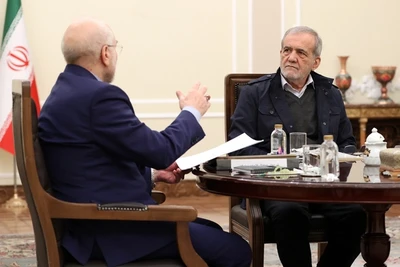
In a fiery Hajj message, Mojtaba Khamenei described Israel as a “cancerous tumor” nearing the “final stages” of its existence, praised the October 7 attacks and repeated his father’s prediction that Israel would not survive beyond 2040.

The statement came as Hezbollah sharply increased attacks on Israel’s northern border, including explosive drone strikes near civilian communities, and as the Trump administration signaled progress toward a possible deal with Tehran.

The parallel escalation has raised questions over whether Tehran may be trying to strengthen its hand in talks with Washington, using Hezbollah as leverage while publicly hardening its posture toward Israel.

On X, Iran analyst Arash Azizi described Mojtaba Khamenei’s statement as “remarkable for how extremely eliminationist it is toward Israel, even by the regime’s standards.”

Israeli Foreign Minister Gideon Sa’ar responded to Mojtaba Khamenei's remarks by invoking the fate of his slain father and pointing to the new supreme leader’s absence from public view since the February 28 attack, which killed several members of his family and left him injured.

“Sounds familiar. I remember someone with a similar surname who used to say it. BTW, where are you?” Sa’ar wrote.

Hezbollah as leverage against US

Reuters reported Tuesday that Israeli troops had expanded ground operations beyond a demarcation line established after the April ceasefire, while Hezbollah claimed attacks on Israeli forces using explosive drones, rockets and artillery.

For Sarit Zehavi, founder of the Alma Research and Education Center, the timing of Hezbollah’s escalation is no coincidence.

“There is no doubt they are doing that under the order of Tehran,” Zehavi told Iran International.

“They intensify the attacks while there is a lot of pressure on Iran to get a deal and the gaps between the Americans and the Iranians are really big,” she said.

Zehavi argued that Iran is using Hezbollah as leverage against Washington, either to pressure the United States into concessions or to prolong negotiations while the Islamic Republic rebuilds.

“They are using Hezbollah as a leverage of pressure on the Americans."

The escalation is already having deadly consequences inside Israel. Zehavi’s cousin’s son, Staff Sgt. Noam Hamburger, 23, was killed last week by a Hezbollah drone strike near the northern border, weeks before he was due to complete his military service.

 The IDF announced on Saturday evening that Staff Sgt. Noam Hamburger was killed by an explosive drone strike near the Lebanese border.
100%
The IDF announced on Saturday evening that Staff Sgt. Noam Hamburger was killed by an explosive drone strike near the Lebanese border.

“In the process people are being killed,” Zehavi said.

Zehavi said Hezbollah’s escalation may also be intended to provoke a wider Israeli response in Lebanon, allowing Tehran to blame Israel if the diplomatic track collapses.

“They are dragging Israel to attack in Beirut at this specific time,” she said, “and that way blame Israel for any dead-end in the negotiations.”

Most Viewed

Iran internet partly restored after 88-day blackout despite court challenge
1

Iran internet partly restored after 88-day blackout despite court challenge

2
ANALYSIS

Iran is turning the internet into a privilege

3
OPINION

Trump vs Tehran: how not signing became the deal

4
INSIGHT

Qatar emerges as key broker in US-Iran frozen funds dispute

5

Prospect of US-Iran deal fuels attacks on Ghalibaf

Banner
Banner

Spotlight

  • Khamenei vows Israel’s annihilation as Hezbollah steps up attacks- why now?
    INSIGHT

    Khamenei vows Israel’s annihilation as Hezbollah steps up attacks- why now?

  • Could Iran be building a Chinese-style internet system?
    ANALYSIS

    Could Iran be building a Chinese-style internet system?

  • Oil pressure and economic strain drive Iran-US talks
    ANALYSIS

    Oil pressure and economic strain drive Iran-US talks

  • Qatar emerges as key broker in US-Iran frozen funds dispute
    INSIGHT

    Qatar emerges as key broker in US-Iran frozen funds dispute

  • Family forced into nighttime burial after student killed in protests
    EXCLUSIVE

    Family forced into nighttime burial after student killed in protests

  • Trump vs Tehran: how not signing became the deal
    OPINION

    Trump vs Tehran: how not signing became the deal

•
•
•

More Stories

Period poverty, stigma deepen hardships for Iranian women

May 26, 2026, 12:29 GMT+1

Rising prices for menstrual hygiene products and persistent social stigma are worsening conditions for women in Iran, with many forced to miss school, reuse disposable products or forgo basic care altogether, the Shargh newspaper reported ahead of World Menstrual Hygiene Day.

The report described how menstruation remains shrouded in shame and silence for many Iranian girls, particularly in smaller towns and poorer communities, where limited education and cultural taboos leave adolescents unprepared for puberty.

One student in a village near Miandoab told Shargh she avoided leaving her classroom during breaks out of fear classmates would notice blood stains on her clothes. Another girl believed she had cancer when she experienced her first period.

  • Pads in plain sight: marketing campaign sparks awkward debate in Iran

    Pads in plain sight: marketing campaign sparks awkward debate in Iran

“Absence from school is one of the first reactions many girls have when they experience menstruation,” a teacher identified as Nazanin told the newspaper. “The less awareness there is in the family, the more common this behavior becomes.”

Rising costs force unsafe alternatives

Inflation, the report said, has sharply increased the cost of sanitary pads and other hygiene products, particularly affecting women in low-income and marginalized areas.

100%

Somayeh, a 38-year-old worker in a food packaging workshop near Tehran, said long shifts and limited bathroom access often force her to delay changing sanitary products for hours.

“When you have to choose between buying food for your children or sanitary pads for yourself, you choose food,” she said.

Social worker Mahya Vahedi said some women have turned to cloth and other non-hygienic substitutes because they cannot afford sanitary pads, leading to infections and untreated wounds.

“Buying hygiene products has become a luxury for many families,” Vahedi said.

Unlike several countries that provide free menstrual products in schools and public spaces, Iran offers almost no free access to sanitary products in schools, universities or public facilities, the report said.

Debate grows over menstrual leave

The report also highlighted growing debate around menstrual leave policies in workplaces.

File photo of schoolgirls in a classroom in Iran, where rising poverty and the high cost of sanitary products have increased concerns over menstrual health and period poverty among students.
100%
File photo of schoolgirls in a classroom in Iran, where rising poverty and the high cost of sanitary products have increased concerns over menstrual health and period poverty among students.

Shima, an office worker interviewed by Shargh, said menstruation remains difficult to discuss openly at work despite the physical pain many women endure.

“How can part of the workforce spend several days each month working through pain and bleeding with no recognition of those conditions?” she said.

Political economy analyst Anisha Asadollahi said menstrual leave has become a point of tension between gender equality demands and Iran’s labor market realities.

Some critics, she said, fear additional labor protections for women could discourage employers from hiring them, citing past labor policies that unintentionally reduced women’s employment opportunities.

  • Female genital mutilation driven by local customs in southern Iran - study

    Female genital mutilation driven by local customs in southern Iran - study

But Asadollahi argued recognizing menstrual leave remains important because workplace norms are still built around “the male body as the standard worker.”

“Giving up rights because of fear of discrimination only strengthens unequal structures,” she said.

Rising care costs hit Iranians with spinal injuries

May 26, 2026, 10:09 GMT+1

Surging inflation and worsening economic hardship in Iran have sharply increased the cost of hygiene and medical supplies for around 45,000 people living with spinal cord injuries, the Iranian news website Khabar Online reported on Tuesday.

Citing field reports from several provinces, the outlet said essential daily items including sterile gauze, specialized wound dressings, catheters, catheter bags, syringes, lubricating gel, tissues and medication for pressure sores have seen steep price increases.

The cost of these supplies, according to the report, has at least doubled or tripled over the past two months for people requiring long-term care.

The continued economic crisis has reduced access to critical medical equipment, worsening pressure sores and undermining the quality of daily care for patients, Khabar Online said.

The outlet warned that the monthly welfare payment of 25 million rials ($15) allocated for hygiene supplies no longer covers rising care costs and could lead to worsening health conditions and higher treatment expenses for people with disabilities.

In recent weeks, Iranians have told Iran International of soaring inflation, medicine shortages, sharp price increases, deepening recession, widespread job losses and disruptions caused by internet outages.

“One family cannot even find medicine for their child anymore,” one citizen said in a message to Iran International, adding that internet restrictions had cut people with mobility impairments off from their only link to society.

‘Disabled people pushed back to the Stone Age’

Some people with spinal injuries have begun reusing disposable hygiene items because of rising costs, leading to infections and secondary wounds, Behrouz Morovati, head of the Campaign for Disabled People, told Khabar Online.

  • Disabled Iranians face ‘critical’ economic hardship amid soaring inflation

    Disabled Iranians face ‘critical’ economic hardship amid soaring inflation

Morovati said soaring diaper prices have forced some families to use makeshift alternatives such as cloth and rags.

“Because of limited access to hygiene supplies, the normal lives of disabled people have been pushed back to the Stone Age,” he said. “Even wounds that could be controlled through regular care have deepened in many cases, increasing the risk of infection, hospitalization and irreversible complications.”

Morovati had previously warned in December 2025 that 95% of people with disabilities in Iran were living below the absolute poverty line.

Patients describe mounting pressure

Khabar Online also spoke to several people with spinal cord injuries about the impact of the economic crisis on their daily lives.

Mahmoud, a resident of Qazvin with a degree in business management, said people with spinal injuries require at least four catheters and four syringes a day.

“Each catheter now costs between 120,000 and 150,000 rials and each syringe around 50,000 rials,” he said. “Those two items alone cost nearly 30 million rials ($17) a month.”

Pressure sores, he added, require daily washing, sterilization and dressing changes, which have become increasingly expensive.

100%

“Some days I have to leave longer gaps between dressing changes or use non-standard supplies to control costs, but that only worsens my condition,” Mahmoud said. “Pain and fear of infection have become part of my daily life.”

Zahra Moradi, a psychology graduate living in Karaj, said women with spinal injuries face additional challenges under worsening economic conditions.

“Access to hygiene products during menstruation, bladder and bowel complications and limited access to healthcare all affect women’s overall health,” she said.

High medical costs and limited services, Moradi added, have also led to emotional and social distress, feelings of shame and declining self-confidence among women with spinal injuries.

Could Iran be building a Chinese-style internet system?

May 26, 2026, 04:04 GMT+1
•
Negar Mojtahedi

Iran may be moving beyond temporary internet blackouts toward something more durable: a Chinese-style system of digital control.

Concerns intensified after a former head of Iran’s state broadcaster said Tehran had imported Chinese equipment for a “permanent internet shutdown,” while millions of Iranians endure what monitoring group NetBlocks says is now the world’s longest ongoing nationwide blackout.

Experts warn the Islamic Republic may not be trying to shut the internet off forever but instead attempting to build a controlled and heavily surveilled online ecosystem designed to filter information, monitor communications and isolate Iranians from the outside world while still keeping parts of the economy online.

Mohammad Sarafraz, the former head of Islamic Republic of Iran Broadcasting and a current member of the Supreme Council of Cyberspace, said in an interview with the online newspaper Faraz that factions in Tehran are seeking to restrict global internet access for the general public while preserving it for a limited and controlled group.

He said the Islamic Republic had imported Chinese equipment for “permanently cutting off the internet.”

Spectre of digital control

Laura Edelson, assistant professor of computer science at Northeastern University, said the closest comparison may be China’s internet crackdown in Xinjiang after unrest there in 2009, when authorities isolated the Uyghur-majority region from the outside internet for 10 months.

“Functionally, for the vast majority of the population, they were effectively cut off entirely from the outside world,” Edelson said.

She said China’s model is far more sophisticated than simply blocking websites, relying on centralized state control to filter content, surveil users and selectively determine what information people can access.

“This centralized model is one that a lot of other countries, including and almost especially Iran, has been moving toward,” she told Iran International.

She added that turning off the internet forever “is not useful,” meaning authoritarian governments increasingly favor adaptable systems that can tighten restrictions during politically sensitive moments and loosen them when economic activity is needed.

“Iran’s government doesn’t trust its own people,” Edelson said. “The vast majority of people don't support the government.”

“If you can have an internet that you can adaptively not just turn on and off, but control what people can reach and what they can’t reach — that’s a set of internet censorship and surveillance systems that I would be more afraid of personally,” she said.

Can Tehran pull it off?

Max Meizlish, Senior Research Analyst at the Foundation for Defense of Democracies and a former US Treasury official focused on sanctions enforcement, said China has long exported censorship technologies and surveillance capabilities to authoritarian partners.

“We know that China has been a significant partner to several malign actors, including Iran, but also Russia and North Korea, with respect to cyber technology censorship capabilities,” Meizlish told Iran International.

He said China’s own internet system gives Tehran both a blueprint and a commercial partner.

According to Meizlish, Iran’s centralized control over internet infrastructure already gives authorities the ability to regulate what information enters or leaves the country.

“What we could actually see is Iran building out its own internet,” he said, “so that the people of Iran are only able to view what the government wants them to view.”

He said technology transfers between Beijing and Tehran should increasingly be viewed through the lens of human rights abuses and digital repression.

“There’s an argument to be made that this form of censorship constitutes a wide-scale human rights abuse,” Meizlish said.

But Amin Sabeti, founder of cybersecurity research group CERTFA, cautioned that Iran still lacks many of the domestic technological capabilities that made China’s censorship system possible.

“The Iranian regime imports the technology; it doesn't own the technology,” Sabeti said.

Unlike China, he said, Iran lacks strong domestic alternatives to many global services and remains heavily dependent on foreign infrastructure and technology.

“In China, there isn't a need for Gmail because they have good services in terms of email,” Sabeti said. “In Iran, there isn't any proper email service.”

Sabeti said Iran has repeatedly shown it can temporarily shut down the internet during protests and unrest, but questioned whether the regime could sustain a truly permanent nationwide blackout over the long term.

“I don't think it will happen,” he said.

Iran’s rulers may not want to permanently disconnect Iranians from the global internet, but they appear to be moving toward a more sustainable architecture of digital control that allows the state to keep commerce functioning while isolating citizens from independent information, encrypted communications and even family members abroad.

For many Iranians, the question is no longer whether the internet will fully return, but what kind of internet the state intends to allow back.

Oil pressure and economic strain drive Iran-US talks

May 26, 2026, 01:02 GMT+1
•
Dalga Khatinoglu

More than six weeks after Iran disrupted shipping through the Strait of Hormuz and the United States moved to enforce a naval blockade, the confrontation increasingly appears to be entering a new phase: negotiations driven by exhaustion.

What began as a military and geopolitical standoff has evolved into a contest over economic endurance, one that neither Iran nor the global economy appears capable of sustaining indefinitely.

After weeks of escalation, diplomacy has regained momentum. Talks involving Tehran, Washington and regional mediators have intensified, while US President Donald Trump has repeatedly suggested a deal may be close.

At the center of the latest negotiations lies the issue of frozen Iranian assets.

Iranian officials are demanding guaranteed access to billions of dollars held abroad before accepting any preliminary understanding, while reports from Tehran suggest Qatar may be exploring financial mechanisms that would allow limited transfers without direct US payments to Iran.

The diplomacy reflects mounting pressure on both sides.

The head of the International Energy Agency warned in May that unless progress is made toward ending the crisis with Iran, the global oil market could enter a “red zone” by summer.

Beginning in mid-March — roughly two weeks after Iran moved to disrupt shipping through the Strait of Hormuz — IEA member states began gradually releasing strategic petroleum reserves to offset sharp declines in Gulf energy exports.

Hundreds of millions of barrels have already been released from emergency stockpiles, according to market estimates, as governments attempt to stabilize prices and prevent a broader supply shock.

But strategic reserves are not unlimited.

Even when commercial inventories are included, only part of global oil storage can realistically be released to the market. Much of the world’s inventories are tied to operational infrastructure, while many governments face legal and political constraints on how deeply emergency reserves can be depleted outside wartime conditions.

The strain is increasingly visible across the global economy.

High energy prices have weakened demand growth and raised recession fears in major economies, while shipping disruptions in the Persian Gulf continue to inject volatility into global markets.

Iran, meanwhile, faces mounting economic pressure of its own.

Exports of crude oil and petroleum products, which account for a large share of the country’s export revenues, have sharply declined under blockade conditions. Iranian steel and petrochemical facilities have also faced repeated disruptions and attacks during the conflict.

According to estimates by Kpler, Iran’s floating oil storage near East Asian waters has fallen sharply in recent weeks as Tehran struggles to maintain exports to China despite mounting logistical constraints.

The United States and its allies retain significant escalation options economically and militarily, while Iran’s ability to sustain prolonged confrontation increasingly appears tied to its capacity to continue threatening shipping routes and regional stability.

But Washington also faces limits. A prolonged energy crisis, rising oil prices and fears of a wider regional war are creating growing pressure on the United States and Gulf allies to secure at least a temporary understanding with Tehran.

That pressure helps explain the renewed urgency surrounding the Doha talks.

What now seems increasingly clear is that neither Iran’s economy nor the global economy can sustain the current trajectory for much longer.

The question is no longer whether economic pressure is being felt. It is whether the pressure forces compromise before miscalculation produces another round of escalation.

Qatar emerges as key broker in US-Iran frozen funds dispute

May 25, 2026, 21:35 GMT+1
•
Maryam Sinaiee

The release of frozen Iranian assets has emerged as the main sticking point in talks between Iran and the United States, with officials in Tehran insisting that guaranteed access to funds must come before any preliminary agreement can move forward.

Several commentators and state-linked outlets have suggested Qatar may be exploring financial mechanisms that would give Tehran access to some of its frozen assets without requiring direct US cash transfers to Iran.

Parliament Speaker Mohammad Bagher Ghalibaf, Foreign Minister Abbas Araghchi and Central Bank Governor Abdolnaser Hemmati paid a highly publicized visit to Doha on Monday, fueling speculation that talks focused heavily on the frozen assets issue.

Iranian media widely linked Hemmati’s presence to negotiations over financial guarantees, though no official details of the discussions have been released.

CNN reported on Monday that Intense talks were ongoing in Doha in coordination with the United States, focusing on the Strait of Hormuz, Iran’s highly enriched uranium and frozen funds.

A day earlier, an informed source with direct knowledge of the negotiations told Iran International that Tehran has demanded guaranteed access to $12 billion in frozen assets during the first phase of any arrangement.

Iranian officials continue to insist that the country’s nuclear program and stockpile of highly enriched uranium should only be addressed in later stages of a broader agreement.

The current focus appears to center on roughly $6 billion in Iranian assets transferred from South Korea to Qatar in 2023 under a US-Iran prisoner exchange deal.

The funds were later re-frozen following the October 7 Hamas attack on Israel and the subsequent deterioration in relations between Tehran and Washington.

Mohammad Marandi, a commentator close to the Iranian government, suggested in a televised interview Sunday that Qatar could initially transfer the money to Iran before later being reimbursed by the United States.

Political analyst Shahir Shahidsaless wrote on X that such an arrangement would allow Washington to avoid directly paying Tehran while still meeting one of Iran’s principal demands.

Reuters previously reported, citing senior Iranian sources, that Washington had agreed in principle to release some frozen Iranian assets as part of efforts to secure safe passage through the Strait of Hormuz, though US officials later denied that any final agreement had been reached.

The IRGC-linked Tasnim news agency, citing what it described as an informed source, reported Sunday that Tehran had made clear it would reject any preliminary arrangement lacking a concrete first step by Washington on the assets issue.

“Iran has emphasized that without the release of a specific portion of the blocked assets in the very first step, and without a clear and guaranteed mechanism for the release of all frozen assets, no agreement will be possible,” the source told Tasnim.

Tasnim also claimed US officials were backtracking on earlier signals delivered through intermediaries regarding the funds.

“Based on past experiences of repeated American violations and obstruction,” the source said, “Iran will not allow the issue of asset release to be reduced to vague and unreal promises.”

Despite the tensions, Mashallah Shamsolvaezin, a member of President Masoud Pezeshkian’s Media Council, expressed cautious optimism, describing the frozen-assets dispute as “a small problem” in remarks to Fars News Agency.

He said the disagreement could be resolved within 48 hours and suggested future negotiations might move from Doha to Geneva or another location more accessible to the American delegation.

At the same time, hardline figures continue to insist on preserving what they describe as “Iran’s management” of the Strait of Hormuz.

Foreign Ministry spokesperson Esmaeil Baghaei denied Monday that Tehran was seeking to impose tolls on ships passing through the waterway, but said providing navigation and environmental protection services would require fees.

Hossein Shariatmadari, editor-in-chief of the hardline Kayhan newspaper, criticized reports suggesting Iran could agree to reopen the Strait of Hormuz under a broader understanding with Washington.

“If this news is true,” he wrote, “the real meaning of opening the Strait of Hormuz is the disarmament of Iran against military, economic and political attacks by enemies.”

The comments highlighted the enduring influence of hardliners advocating maximalist demands, a dynamic critics say has repeatedly helped sink fragile diplomatic openings between Tehran and Washington.