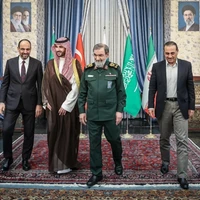
Iranian football chief Mehdi Taj (centre) presents a national team jersey to now-slain IRGC chief Hossein Salami, undated file photo
Iran's football chief Mehdi Taj, once a commander in the Islamic Revolutionary Guard Corps, was sent back from Canada just hours after landing, according to a government source who spoke to Iran International.
Taj and two accompanying individuals left the country at 10:05 p.m. Tuesday, suggesting he was allowed to land but was subsequently questioned by Canadian authorities before being sent back, a source familiar with the matter told Iran International.
The immigration ministry commented only after Taj’s departure, declining to name him, citing privacy laws, and stating that individuals linked to the IRGC are not welcome in Canada—despite having granted him special permission to enter.
His brief presence came after Iran International’s exclusive report revealed that Taj had been granted a Temporary Resident Permit (TRP), a special authorization that can override inadmissibility under Canadian law.
That report quickly drew political reaction in Ottawa.
Leo Housakos, Leader of the Opposition in the Senate of Canada, pressed the government on Tuesday over Taj’s entry, citing Iran International’s reporting.
“Your government can't seem to show the IRGC the door, but it can find a way to roll out the welcome mat and receive him. Leader, why is your government still unable or unwilling to enforce Canada's terrorism-related inadmissibility rules? What's the point of listing the IRGC if you're not serious about throwing him out of our country,” Housakos said.
Canada designated the IRGC as a terrorist entity in 2024, a move that allows authorities to freeze assets and can affect the admissibility of individuals with ties to the group.
Taj had been expected to travel to Vancouver to attend the FIFA Congress on April 30, hosted at the Vancouver Convention Centre.
A diaspora group had also planned a protest outside the venue, reflecting growing anger among Iranian-Canadians over the report of an Islamic Republic official with ties to the IRGC.
Taj began his career as an intelligence commander in the IRGC in Isfahan following the 1979 revolution, where IRGC intelligence units were tasked with monitoring internal dissent, including among Kurdish populations.
His sudden departure now raises fresh questions—about how he was granted entry in the first place.
Many Canadians are questioning how someone deemed inadmissible under the country’s own terrorism-related laws could have been offered an exemption or special permission to enter at all.