Eyewitness details shootings of civilians during Iran protests
An eyewitness who recently fled Iran and whose identity is being withheld for his safety recounts indiscriminate gunfire that turned city streets into a battlefield. He says he saw thousands of bodies stored at a cemetery as families searched for missing loved ones during a nationwide digital blackout.
He is risking his life to speak out and send a message to the world that the killings are still ongoing and Iranians urgently need help. He describes witnessing indiscriminate gunfire directed at unarmed civilians, narrowly escaping being shot himself.
Tom Tugendhat, a British MP and former UK security minister, File photo
The Islamic Republic has entered a decisive rupture, with intensifying protests and internet blackouts pointing to a government increasingly reliant on force — dynamics that senior Western officials and analysts suggested may mark the beginning of an endgame.
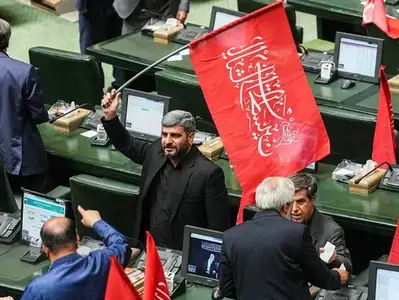
Demonstrations have spread across major cities and provinces despite a nationwide internet and phone blackout, with rights groups reporting at least 42 people killed and more than 2,000 arrested since unrest began.
Supreme Leader Ali Khamenei on Friday accused foreign powers of fueling the protests and warned demonstrators of severe punishment, as security forces fired live ammunition in several regions.
Tom Tugendhat, a British MP and former UK security minister, told Eye for Iran the moment reflects a system confronting its own limits.
“I think this is the end game for the regime,” Tugendhat said.
“What we’re watching is not whether or not the regime survives, but how many people does it try to kill?” he added.
His remarks came as Iranian prosecutors threatened protesters with charges carrying the death penalty, and the Revolutionary Guards’ intelligence arm warned that the continuation of protests was “unacceptable.”
Western officials reassess as fear appears to erode
Early this week, US intelligence assessed that the protests lacked the momentum to threaten regime stability, US officials told Axios, but that assessment is now being reconsidered in light of recent developments.
“This is truly an extraordinary moment,” said Norman Roule, a former senior CIA official, who served as the national intelligence manager for Iran at the Office of the Director of National Intelligence from 2008 to 2017.
“We are watching a regime that is clearly in its dying days,” Roule said.
Roule said the leadership’s response shows narrowing options.
“It’s a government that can sustain itself, but it’s incapable of decisions that can stop this,” he said.
US President Donald Trump has warned Iran’s authorities against killing demonstrators, praising Iranians as “brave people” and signaling consequences if repression escalates. European officials and the UN human rights chief have also condemned the crackdown and the communications blackout.
Policy analysts say the current unrest is not an isolated episode but part of a longer erosion of regime authority.
“The Iranian people have the singular ability to expose the regime for its illegitimacy,” said Jason Brodsky, policy director at United Against Nuclear Iran.
“Since 2017 onwards, the Iranian people have come to the conclusion that the Islamic Republic can’t be reformed and therefore has to be overthrown,” Brodsky said.
Journalist and author of Nuclear Iran David Patrikarakos said the protests differ fundamentally from earlier waves that focused on specific demands.
“These aren’t issue-based protests anymore. These are existential,” Patrikarakos said.
He said the leadership now faces a dangerous calculation. “If the Ayatollahs are tempted to think he’s bluffing, they should take a look at the ruins of their nuclear facilities,” he said, referring to recent US and Israeli strikes.
Protesters defy repression as blackout deepens
Verified videos circulating on social media show protesters confronting security forces in Tehran, Mashhad, Zahedan and other cities, even as authorities cut communications and deploy live fire.
One widely shared video shows a wounded protester declaring: “I’m not scared. For 47 years, I’ve been dead.”
The demonstrations have drawn participation across Iran’s political, ethnic and religious spectrum. Exiled Prince Reza Pahlavi praised the nationwide turnout and urged coordinated nightly protests, while Sunni cleric Molavi Abdolhamid warned of deepening poverty and backed the demonstrations.
International pressure has continued to build. The UN human rights chief said he was “deeply disturbed” by reports of killings and internet shutdowns, while EU officials accused Tehran of using blackouts to conceal violence.
Despite uncertainty over how events will unfold, guests on Eye for Iran converged on a central conclusion: the Islamic Republic is confronting a crisis in which repression remains its primary instrument, even as its effectiveness appears increasingly uncertain.
You can watch Episode 85 of Eye for Iran on YouTube or Listen on any podcast platform of your choosing.
In Hamadan, two protesters sit facing each other and flash the victory sign.
No one can say with certainty whether the current protests will spiral into a revolution. But analysts tell Eye for Iran it is becoming harder to ignore signs that Iran’s theocracy may be entering a period of repeated crises that challenge its ability to function as a state.
Some analysts now warn that Iran may be entering the early stages of regime collapse — not through a single dramatic event, but through a slow erosion of state capacity.
What makes this round different is not only the fury in the streets. It is the growing uncertainty within the clerical establishment, which is leaning more heavily on coercion while projecting less confidence than before.
The protests began with the plunging rial. They have since widened into a broader test of whether the government can still manage a country living in constant crisis. Demonstrations that started in Tehran’s electronics markets have spread across provinces, bazaars and campuses, with chants increasingly aimed at the ruling system itself.
Live fire and deaths have fueled anger, while rare scenes in a religious city like Qom and other cities show crowds refusing to retreat.
A system running out of answers
Shayan Samii, a former US government appointee said the anger goes beyond economic hardship — it reflects a belief that the future has narrowed.
“They are upset because the value of their currency has gone down the drain,” he said. “There is nothing to look forward to.”
That sense of closure, he argued, is what pushes ordinary Iranians to take risks despite repression — a difficult dynamic for a state that relies heavily on deterrence and coercion.
Journalist and author Arash Azizi described protests appearing not only in major cities but in towns once seen as politically quiet.
“There is discontent everywhere,” he said — but protesters “lack leadership” and “lack organization.”
Without that, he warned, unrest can erupt and fade without producing structural change, even as each round leaves the system more brittle.
From an intelligence perspective, Danny Citrinowicz, former head of the Iran branch in Israeli military intelligence, said the deeper issue is not simply mismanagement but the absence of any workable path forward.
“The main problem the regime has is that it has no silver-bullet solution to the economic problems in Iran,” he said. Even if authorities find temporary fixes, “the problem will stay.”
Economic calm, in other words, may only pause — not resolve the crisis.
Cracks inside the ruling class
It is not only public anger that is shifting, said Alex Vatanka of the Middle East Institute but the mood among elites themselves.
“I have certainly not ever seen this level of hopelessness inside the Iranian regime,” he said.
That kind of discouragement, he added, can be more consequential than unrest alone, opening space for miscalculations and internal rivalries that become harder to contain.
Former US State Department official Alan Eyre cautioned against assuming outside forces can engineer rapid political change.
“Regime change is wildly improbable in Iran right now,” he said — warning that intense external pressure could strengthen hard-liners or push Iran toward greater militarization.
His remarks followed comments by Donald Trump that the United States was “locked and loaded” if Iranian authorities kill protesters — language that energized some activists while raising fears of escalation among others.
Why this wave feels different
Bozorgmehr Sharafeddin, head of Iran International Digital, argued that this round cuts deeper because it points to a crisis of state survival rather than policy error.
“This protest is not about inflation,” he said. “This is about the collapse of the Iranian economy.”
He also noted that international reaction came immediately — a contrast with earlier cycles when global attention arrived more cautiously and later.
Across the conversation, one theme recurred: the state still has the means to suppress dissent — but it is doing so with increasing uncertainty about what comes next.
Protesters are directing anger at the foundations of clerical power, not merely the officials administering policy. Reform promises carry less credibility. And senior figures themselves acknowledge problems they cannot easily fix.
That does not guarantee revolution and it does not mean collapse will come overnight. But analysts say a government that relies primarily on coercion while showing visible doubt from within no longer projects stability.
What emerges, they warn, is a system still capable of force yet less certain of itself with every passing crisis.
You can watch Episode 84 of Eye for Iran on YouTube or listen on any podcast platform of your choosing.
A man stands next to a street store selling Argentine flags, in downtown Buenos Aires, Argentina April 14, 2025.
A landmark criminal lawsuit filed in Argentina by victims of the 2022 Woman, Life, Freedom movement signals a new push to hold Islamic Republic officials accountable beyond Iran’s borders.
Shahin Milani, the executive director of the Iran Human Rights Documentation Center (IHRDC), told Iran International's English podcast Eye for Iran, the case marks a turning point – warning that even mid-level officials can no longer assume impunity.
“Iranian officials – even mid-level ones – should understand they are not safe anymore. If they leave Iran, justice may follow them.”
Why Argentina and why this matters now
The complaint was filed by a group of survivors together with the Iran Human Rights Documentation Center and supported by the Strategic Litigation Project at the Atlantic Council.
It asks Argentine judges to investigate crimes against humanity committed during the Islamic Republic's violent response to the 2022 protests, including murder, torture, gender-based persecution and targeted blinding.
Argentina was chosen because its courts recognize universal jurisdiction, allowing them to investigate atrocity crimes even when they were not committed on Argentine soil.
Crucially, Iranian officials – the alleged perpetrators – do not need to set foot in Argentina for a criminal investigation to begin.
Milani says that distinction changes the calculus inside Iran’s power structure.
“If Argentina issues arrest warrants, that alone is a success. Travel becomes risky. Borders become unpredictable.”
Argentina has already heard cases linked to abuses in Venezuela, Myanmar, and Spain’s Franco era, and has dealt with Iran-related cases before, including proceedings tied to the 1994 AMIA bombing – an attack on a Jewish community center in Buenos Aires that killed 85 people.
The list of 40 accused officials remains confidential for now. Much of the case, however, draws on years of documentation, including findings by the UN Fact-Finding Mission, which concluded that Iran’s crackdown amounted to crimes against humanity.
Three of the complainants have chosen to be publicly identified.
Kosar Eftekhari was 23 when she was shot in the eye during the protests. Mersedeh Shahinkar was also blinded at close range, but later returned to the streets wearing an eye patch as an act of defiance. Mahsa Piraei joined the case after her mother, Minou Majidi, was killed by security forces while demonstrating against the clerical establishment.
Majidi’s case drew international attention after an image of her daughter, Roya Piraei, standing without the mandatory hijab beside her mother’s photograph at her gravesite went viral. Majidi’s other daughter, Mahsa, is now seeking justice through the landmark lawsuit.
Roya Piraei at her mother's grave.
“In our own country, Iran, we were unable to find justice for my mother’s killing because there is no fair or independent judiciary,” Piraei told the Atlantic Council. “Our insistence on preserving human dignity is a global cause that knows no borders.”
Their stories form both the moral heart and legal backbone of the complaint.
Not compensation, only accountability
Unlike civil lawsuits in courts, this case does not seek financial damages.
“This is a criminal complaint,” Milani said. “It’s about responsibility, something painfully rare when it comes to the Islamic Republic.”
Even without immediate arrests, he said, the case lays the legal groundwork for accountability when conditions change.
Milani avoids predicting political collapse or transition. But he is clear about the role of human rights lawyers: they build cases now so they are ready when circumstances change.
“We don’t know what’s going to happen in the future. It’s possible that some of these officials’ circumstances change and they have to leave Iran – and they should know they’re not going to be immune from prosecution.”
In other words, even if justice does not arrive immediately, the legal architecture is being laid brick by brick – quietly, deliberately, and beyond Iran’s borders.
No one expects Argentina’s courts to deliver overnight justice. Similar cases against authoritarian officials elsewhere have taken years, and many defendants remain free.
For the families and survivors behind the complaint, however, this marks the clearest indication yet that the struggle that began in the streets in 2022 is now moving into courtrooms – and that justice, however delayed, may no longer be out of reach.
Pictures of slain IRGC commanders and Islamic Republic’s founder Rouhollah Khomeini at a state-organized anti-US rally in Tehran
Iran’s theocracy exits 2025 battered yet still standing, with analysts telling Eye for Iran that Tehran is interpreting survival after a punishing war with Israel, regional losses and domestic strain as grounds for taking greater risks in 2026.
At the start of 2024, Iran appeared to be riding high — expanding regional reach, edging closer to nuclear threshold status and projecting confidence at home and abroad. That trajectory began to reverse in late 2024 and accelerated into 2025.
The past year brought direct confrontation with Israel and later the United States, the weakening of Tehran’s regional proxy network and mounting domestic pressures. What it did not bring was collapse.
That survival, analysts warn, may now be shaping how the Islamic Republic approaches 2026 — not as a moment for restraint, but as proof that it can endure unprecedented pressure and press forward.
The defining moment of the year was the June war with Israel, a confrontation that punctured long-held assumptions about Iran’s deterrence while stopping short of triggering a regime change.
On Eye for Iran, Middle East analyst and former Israeli intelligence official Avi Melamed who directs the Inside the Middle East fellowship program for policy and security professionals; journalist and investigative reporter Jay Solomon, author of The Iran Wars; and historian Shahram Kholdi assessed what the Islamic Republic’s survival says about the year that is about to end and why its interpretation of that survival could make the coming year more volatile.
Fear is breaking — but survival is being reframed
Avi Melamed pointed to a psychological shift inside Iran as one of the most consequential developments of 2025.
“The most significant one is that I think that we are witnessing now a very significant shift in Iran in the sense that many Iranian people are no longer afraid of this regime,” he said.
That erosion of fear has coincided with widespread social defiance, particularly among younger Iranians and women, even as repression continues.
Shahram Kholdi said that Tehran is not reading this moment as a loss. Instead, he argued, the leadership is internalizing 2025 through a survivalist lens — one that encourages defiance rather than restraint.
“If something that can kill you doesn’t destroy you, it makes you stronger,” Kholdi said, describing what he sees as the clerical establishment’s core mentality after the June war with Israel.
That belief, he argued, helps explain why executions have continued and why the Islamic Republic is signaling resolve despite suffering unprecedented blows.
A strategic reversal — interpreted as a test passed
Externally, 2025 marked a sharp break from the trajectory that once favored Tehran. Jay Solomon described the year as a reversal after decades in which Iran expanded influence through proxies and deterrence.
“The word I’d use for the year is weakness,” he said.
Solomon pointed to Israeli strikes, the degradation of Hezbollah and Hamas, and Iran’s struggle to manage overlapping crises — from inflation and water shortages to public dissent.
Yet despite expectations of mass bloodshed following the June conflict, the Islamic Republic ultimately pulled back, reinforcing its own perception that it had weathered the storm.
Why 2026 may be more volatile
For the analysts the biggest concern for 2026 was the risk ahead.
Iran’s deterrence model has been punctured but not abandoned. Instead, Tehran appears determined to rebuild — restoring proxy leverage, advancing missile capabilities and reasserting influence amid uncertainty.
The outlet cited an Israeli security source saying that Israel's military intelligence had conveyed the assessment to the United States in an indication that Israel is urging Washington to again act to address the alleged threat.
Melamed warned that this environment heightens the risk of miscalculation. Kholdi argued that the belief that Iran “didn’t lose” the June war makes confrontation more likely, not less. Solomon added that shifting political currents in the United States are being closely watched in Tehran and Tel Aviv alike, narrowing the window for restraint.
The danger, the panel suggested, is that survival itself is being treated as victory.
As 2026 begins, the Islamic Republic may be weaker — but convinced it has passed a test. That conviction could shape the year ahead more than any battlefield outcome.
A US flag hangs in a street of Los Angeles' "Little Persia" where about 500,000 Iranian-Americans live, in Los Angeles, California, U.S., June 21, 2025
Being born in Iran—not just entering from there—is now affecting even Iranians already living in the United States in how immigration cases are being handled, attorney Ali Rahnama told Iran International.
“For the first time, one of the first times in American history, what we’re seeing here is they’re not talking about only Iranian citizenship,” Rahnama said appearing on Eye for Iran podcast.
“What they’re including in there is being born in Iran.”
Rahnama said the change is being felt by non-citizens already inside the United States who are pursuing legal immigration pathways, including green cards, citizenship, asylum, and work authorization.
He stressed that the shift does not stem from the passage of a new immigration law, but from how existing immigration processes are now being applied.
“What has happened the last month from the last one policy is that the people who are inside the country who have applications pending… those applications are going to be halted now,” he said.
Iran remains among the countries subject to a full suspension of entry for both immigrant and non-immigrant visas. The proclamation is formally written to apply to foreign nationals outside the United States who do not already hold valid visas and does not revoke visas issued before its effective date.
The Trump administration has defended the expanded restrictions as a national security measure, citing concerns about weak vetting, unreliable records, and corruption in some countries.
The measures are being described by authorities as a pause rather than a denial, but Rahnama warned that for many people, the distinction offers little comfort.
“What’s happening is a pause,” he said. “Basically, your application is not being processed and just sitting in there.”
He said the consequences are particularly acute for Iranians living in the United States on temporary visas, where delays can directly jeopardize legal status.
“If you are on a visa, you probably wouldn’t be able to renew that visa,” Rahnama said. “That simply means that you have to leave the country.”
'Running out of time'
Rahnama also said the pause is not limited to early-stage cases. Some applications that were already approved, or close to completion, have been reopened or frozen.
“Some of these cases that have already been either approved or in the process of an approval are being revisited,” he said, describing instances in which applicants were removed from naturalization oath ceremonies despite having passed interviews and background checks.
Concerns over immigration processing inside the United States have also drawn scrutiny on Capitol Hill. More than 100 Democratic lawmakers have sent a letter to the Department of Homeland Security and US Citizenship and Immigration Services condemning the cancellation of naturalization ceremonies and the halting of immigration applications for nationals of countries covered by the travel ban.
The lawmakers cited cases in which individuals were pulled out of oath ceremonies moments before becoming US citizens and demanded transparency about the scope and duration of the pause.
Rahnama said prolonged delays can function as de facto denials for people already living in the United States, even without a formal rejection.
“For some people, that just basically means they’re going to run out of time to be legally present in the US,” he said. “That looks like denial… it would effectively feel like it.”
He added that the broader impact now extends beyond asylum seekers or people attempting to enter the country, increasingly affecting families and individuals who have built their lives in the United States under existing immigration rules.
“Not only the asylum seekers this time are going to be affected,” Rahnama said. “The people inside are going to be heavily affected.”