• العربية
  • فارسی
Brand
  • Iran Insight
  • Politics
  • Economy
  • Analysis
  • Special Report
  • Opinion
  • Podcast
  • Iran Insight
  • Politics
  • Economy
  • Analysis
  • Special Report
  • Opinion
  • Podcast
  • Theme
  • Language
    • العربية
    • فارسی
  • Iran Insight
  • Politics
  • Economy
  • Analysis
  • Special Report
  • Opinion
  • Podcast
All rights reserved for Volant Media UK Limited
volant media logo

IAEA says no damage at Iran nuclear sites, envoy says Natanz was hit

Mar 2, 2026, 09:45 GMT+0
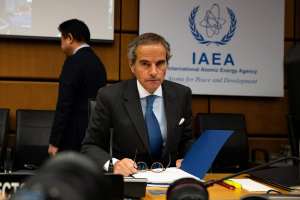
Delegates attend a meeting of the IAEA Board of Governors at the agency’s headquarters in Vienna.

The UN atomic watchdog said on Monday it has no indication that Iran’s nuclear facilities were damaged in recent military attacks, even as Tehran’s ambassador to the agency said the Natanz enrichment site was targeted a day earlier.

“Regarding the status of the nuclear installations in Iran, up to now, we have no indication that any of the nuclear installations, including the Bushehr Nuclear Power Plant, the Tehran Research Reactor or other nuclear fuel cycle facilities have been damaged or hit,” Rafael Grossi, Director General of the International Atomic Energy Agency, told an emergency meeting of the Board of Governors.

“Efforts to contact the Iranian nuclear regulatory authorities through the IEC continue, with no response so far. We hope this indispensable channel of communication can be reestablished as soon as possible,” he added.

The agency’s Incident and Emergency Centre, Grossi said, was fully operational and coordinating with regional safety networks. “So far, no elevation of radiation levels above the usual background levels has been detected in countries bordering Iran,” he said.

Warning against strikes on nuclear facilities

Armed attacks on nuclear sites, Grossi said, carry risks that extend beyond national borders.

“Let me again recall past General Conference resolutions that state that armed attacks on nuclear facilities should never take place and could result in radioactive releases with grave consequences within and beyond the boundaries of the State which has been attacked,” he said.

He urged restraint by all sides. “Consistent with the objectives of the IAEA, as enshrined in its Statute, I reiterate my call on all parties to exercise maximum restraint to avoid further escalation,” Grossi added.

The IAEA chief also said negotiations over Iran’s nuclear program must start again. “To achieve the long-term assurance that Iran will not acquire nuclear weapons and for maintaining the continued effectiveness of the global non-proliferation regime, we must return to diplomacy and negotiations,” he said.

Iran envoy cites Natanz

Separately, Reuters reported that Iran’s ambassador to the IAEA said the United States and Israel attacked Iranian nuclear facilities on Sunday. Asked which facility was struck, the ambassador replied “Natanz,” according to Reuters.

The Natanz nuclear facility is Iran’s main uranium enrichment site and has long been central to international concerns about Tehran’s nuclear activities.

Grossi added that while no radiological release has been detected, the situation remains serious. “Let me underline that the situation today is very concerning. We cannot rule out a possible radiological release with serious consequences,” he said.

Iran calls for IAEA condemnation

During the session, Iran’s ambassador to the IAEA, Reza Najafi, called on the agency to condemn the attacks on Iran’s nuclear facilities.

He rejected that Iran is seeking nuclear weapons, calling them “completely false.”

Najafi said Iran’s response would continue, adding that such measures would remain in place as long as what he described as “aggression” continues.

Most Viewed

Iran negotiators ordered to return after internal rift over Islamabad talks
1
EXCLUSIVE

Iran negotiators ordered to return after internal rift over Islamabad talks

2
ANALYSIS

US blockade enters murky phase as tankers spoof signals and buyers hesitate

3

US tightens financial squeeze on Iran, warns banks over oil money flows

4
INSIGHT

Ideology may be fading in Iran, but not in Kashmir's ‘Mini Iran'

5
INSIGHT

Hardliners push Hormuz ‘red line’ as US blockade tests Iran’s leverage

Banner
Banner

Spotlight

  • Hardliners push Hormuz ‘red line’ as US blockade tests Iran’s leverage
    INSIGHT

    Hardliners push Hormuz ‘red line’ as US blockade tests Iran’s leverage

  • Ideology may be fading in Iran, but not in Kashmir's ‘Mini Iran'
    INSIGHT

    Ideology may be fading in Iran, but not in Kashmir's ‘Mini Iran'

  • War damage amounts to $3,000 per Iranian, with blockade set to add to losses
    INSIGHT

    War damage amounts to $3,000 per Iranian, with blockade set to add to losses

  • Why the $100 billion Hormuz toll revenue is a myth
    ANALYSIS

    Why the $100 billion Hormuz toll revenue is a myth

  • US blockade targets Iran oil boom amid regional disruption
    ANALYSIS

    US blockade targets Iran oil boom amid regional disruption

  • Iran's digital economy battered by prolonged blackout
    INSIGHT

    Iran's digital economy battered by prolonged blackout

  • IAEA says cannot assure Iran’s nuclear program is exclusively peaceful

    IAEA says cannot assure Iran’s nuclear program is exclusively peaceful

•
•
•

More Stories

Israel has no fixed end date for Iran operation, FM says

Mar 2, 2026, 09:08 GMT+0

Israel and the United States have set no timeline for their joint military campaign against Iran, Israel’s foreign minister said on Sunday, describing the strikes that began on Saturday as an effort to weaken the country’s leadership.

Speaking to Euronews, Gideon Sa'ar said the operation would continue without a fixed end date.

“So there is no time like the operation there. There is no timeline that you're looking at. There is no timeline of this operation. Now, we hadn't gave to ourselves timeline,” Sa’ar said.

“Naturally, we want it to be as short as possible. This is clear. But we didn't put to ourselves any timeline,” he added.

Sa’ar described the campaign as coordinated fully with Washington.

“It’s not that they [the United States] support us. They are working with us hand in hand, working together to achieve the same goals we are. It's, it's a, it's a mutual operation,” he said.

Minister urges Iranians to shape future

Sa’ar framed the offensive as aimed at countering what he described as long-term threats to Israel while opening space for change inside Iran.

“I also tell the Iranian people they have an opportunity now. They have an opportunity to regain their freedom, which was denied by this murderous regime that repressed them so cruelly. And I hope they will be able to do it,” he said.

Sa’ar said Israel would not attempt to choose Iran’s next leadership.

  • Iranians react with joy and disbelief to Khamenei's death

    Iranians react with joy and disbelief to Khamenei's death

“We are not, we are not intervening with who will be the next leader of Iran. That will be decided by the Iranian people themselves, hopefully in like free elections, that's the best thing that can happen,” he said.

“Our only requirement is that anyone who will be in power will not work to eliminate the state of Israel. This is enough for us,” he added.

Sa’ar confirmed that the strikes resulted in the killing of Iran’s Supreme Leader Ali Khamenei, whom he said directed repression at home and backed armed groups hostile to Israel.

Residents watch as a large plume of smoke rises over Tehran following Israeli-US strikes (undated).
100%
Residents watch as a large plume of smoke rises over Tehran following Israeli-US strikes.

“He was the supreme leader of Iran but it was a mega terrorist personally gave order for terror actions around the world,” Sa’ar said.

Sa’ar rejected criticism that the operation violates international law.

“This is totally justified by international law because international law justifies self-defense and someone who is… swearing and acting in order to eliminate another state. This state shouldn't wait until it will happen,” he said.

Duration uncertain

Sa’ar declined to predict how long the campaign would last.

“I don't want to be a prophet and to say how many days we are decisive to reach,” he said.

  • Khamenei is dead: The dictator a nation longed to see gone

    Khamenei is dead: The dictator a nation longed to see gone

The Israeli military said on Sunday it would mobilize 100,000 reservists as strikes continue.

Sa’ar argued that any political shift in Iran would depend on domestic will rather than outside orchestration.

“Something is the most important thing here is connected to the will of the Iranian people. It's not something you can orchestrate from outside when you don't have a real will of the Iranian people,” he said.

Iran sleeper cell fears rise after Austin shooting, Canada gym attack

Mar 2, 2026, 01:45 GMT+0

Concerns over the activation of Iran’s sleeper cells in America have increased after a deadly shooting in Austin involving a suspect with alleged ties to Iran and a separate gun attack on an Iranian dissident’s gym in Canada.

A flag of the Islamic Republic and photographs of Iranian regime leaders were discovered inside the apartment of the suspect in the deadly Austin bar shooting, CBS News reported citing sources.

Authorities identified the suspect as 53-year-old Ndiaga Diagne, a naturalized US citizen originally from Senegal, the Associated Press reported, citing law enforcement officials.

He opened fire early Sunday at a bar in Austin’s West Sixth Street district, killing two people and injuring about 14 others before being shot and killed by police.

The suspect was wearing clothing bearing Islamic references, including a sweatshirt reading “Property of Allah” and a shirt featuring the flag emblem of the Islamic Republic of Iran, and a Quran was found in his vehicle, the report said.

The FBI and the Joint Terrorism Task Force are assisting in the investigation, and officials said there were indicators that could suggest a possible terrorism nexus, according to the Associated Press.

The suspect’s alleged X account shows a reply last year to a post by Iran’s Foreign Minister Abbas Araghchi, who wrote that any strike on Iran would be “immediately reciprocated.” In response, the account identified as Ndiaga Diagne wrote that the “Islamic Revolution is eternal and here to stay until the end of time.”

Canada gym attack

Separately, hours after the announced death of Iran’s Supreme Leader Ali Khamenei following US-Israeli strikes on Tehran, a boxing gym in Richmond Hill, Ontario, run by Iranian-Canadian dissident activist and cruiserweight champion Salar Gholami, was struck by gunfire overnight.

Video shared by Gholami showed multiple bullet holes across the front windows of Saliwan Boxing Club on Yonge Street, some displaying pro-Iranian liberation flags and images. At least two panes were shattered, and an evidence marker was visible above one of the bullet holes.

"Seventeen live rounds were fired randomly at the gym, and it was sprayed with bullets," Gholami told Iran International, describing the shooting as intimidation directed at critics of the Islamic Republic.

"This is the result of shaking hands with the mullahs and delaying action. When the Canadian government leaves the door open for them to enter, this will no longer be a safe place even for Canadians themselves. Seventeen bullets means it could have left behind 17 Canadian bodies."

Salar Gholami's gym in Toronto hit by multiple bullets
100%
Salar Gholami's gym in Toronto hit by multiple bullets

Concerns over sleeper cells

Following the US-Israeli strikes on Iran and the killing of Ali Khamenei, retaliatory measures including by Iranian sleeper cells cannot be ruled out, a senior German lawmaker said on Sunday.

“The Iranian regime has repeatedly demonstrated in the past that it carries out its terror beyond its own borders,” Marc Henrichmann told the Sueddeutsche Zeitung newspaper.

Last June, US law enforcement stepped up its monitoring of potential Iran-backed operatives within the United States amid the 12-day Israeli war on Iran which was later joined by the US.

In the days after Israel launched its attacks on Iran, the FBI under its director Kash Patel boosted surveillance over what sources cited by CBS described as Hezbollah-linked sleeper cells.

CIA helped pinpoint Khamenei gathering before Israeli strike – NYT

Mar 1, 2026, 09:09 GMT+0

The CIA helped identify a Saturday morning gathering of Iran’s top leaders in Tehran, including Supreme Leader Ali Khamenei, before Israel carried out a strike that killed him and other senior officials, The New York Times reported.

Citing people familiar with the operation and officials briefed on the intelligence, the newspaper said the agency had tracked Khamenei for months and passed “high fidelity” intelligence on his location to Israel ahead of the attack.

According to the report, US and Israeli officials adjusted the timing of their planned strike to take advantage of intelligence that senior political and military figures would gather Saturday morning at a leadership compound housing the offices of the supreme leader, the presidency and the Supreme National Security Council.

Israel had assessed that those present would include Mohammad Pakpour, commander in chief of the Islamic Revolutionary Guard Corps; Defense Minister Aziz Nasirzadeh; Admiral Ali Shamkhani, head of the Military Council; Majid Mousavi, commander of the IRGC Aerospace Force; and Deputy Intelligence Minister Mohammad Shirazi, among others.

The operation began around 8 a.m. Tehran time, when fighter jets took off armed with long-range precision munitions. About two hours later, in Tehran, missiles struck the compound.

Senior national security officials were in one building, while Khamenei was in another nearby structure, the report said.

An Israeli defense official said in a message reviewed by the newspaper that the strike was “carried out simultaneously at several locations in Tehran,” adding that Israel achieved “tactical surprise” despite Iranian preparations for war.

Iran’s state news agency IRNA confirmed on Sunday the deaths of some of the senior military figures Israel said it had killed, including Shamkhani, Pakpour, and Nasirzadeh.

Last June, as plans were underway to strike Iran’s nuclear facilities, President Trump said the United States knew where Khamenei was hiding and could have killed him.

Explosions reported across Persian Gulf as Iran retaliates US, Israeli attacks

Feb 28, 2026, 10:05 GMT+0

Explosions were reported across parts of the Persian Gulf on Saturday after Iran’s Revolutionary Guards launched multiple waves of regional attacks, prompting several countries to activate air defense systems.

Air raid sirens sounded in Kuwait, the United Arab Emirates, Qatar and Bahrain in the early hours, news agencies reported.

Iran’s Guards said they had begun an operation dubbed “True Promise 4.”

In Qatar, a government official told Agence France-Presse that air defenses intercepted an Iranian missile, adding that US-made Patriot systems destroyed the projectile.

Qatar hosts the Al Udeid Air Base, the largest US military installation in the region. Qatar’s Interior Ministry later said the attack caused no damage.

Bahrain said a facility linked to the US Navy’s Fifth Fleet had been targeted in a missile attack, according to a statement carried by the country’s national communications center, without giving further details.

Kuwait’s military said it had dealt with missiles in its airspace, state news agency KUNA reported.

Jordan’s military said it had shot down two ballistic missiles targeting the country.

Residents in Abu Dhabi told AFP they heard loud explosions, and the UAE state news agency said one person was killed after Emirati forces intercepted Iranian missiles.

The UAE condemned the attack as a “flagrant violation” of its sovereignty and international law and said it reserved the right to respond.

Explosions were also reported in Riyadh, Saudi Arabia’s capital, according to AFP. Saudi authorities did not immediately comment.

Israel, United States strike Islamic Republic, targeting heart of regime

Feb 28, 2026, 08:33 GMT+0
•
Negar Mojtahedi

Israel, acting in coordination with the United States, launched strikes in Iran on Saturday, hitting multiple targets as explosions were reported in Tehran and other cities.

Among the most significant reported targets was the office complex of Supreme Leader Ali Khamenei in central Tehran. Reuters, citing Iranian officials, said Khamenei was not at the location at the time of the strike, though this could not be independently confirmed.

Videos circulating online appeared to show black plumes of smoke rising from an area associated with the Supreme Leader’s headquarters — long considered the symbolic and operational center of the regime’s authority.

Footage shared on social media also showed some Iranians reacting with disbelief and celebration, with witnesses heard laughing and referring to the site as the “leader’s house,” while others were seen thanking Israel as strikes unfolded.

Explosions were reported across Tehran and multiple Iranian cities early Saturday, including Tabriz, Qom, Karaj, Khorramabad, Kermanshah and Ilam, as Israeli officials confirmed a preemptive operation aimed at dismantling what they described as imminent threats posed by Iran’s missile and military infrastructure.

Iranian state media said the southern port city of Bushehr was also attacked, though it remains unclear whether nuclear-related facilities were damaged.

Israeli authorities said the operation, named “Lion’s Roar,” had been planned for months and carried out in coordination with Washington.

A US official confirmed American participation through air and sea strikes, with the US Air Force involved, though details regarding targets and damage assessments remain limited.

Iran’s Civil Aviation Organization closed the country’s airspace for six hours following the strikes.

Semi-official news agency ISNA reported that thousands of members of the Islamic Revolutionary Guard Corps were killed or wounded in attacks on military installations.

US President Donald Trump said Washington had begun what he described as “major combat operations,” framing the action as a defensive effort aimed at preventing Iran from advancing its nuclear and long-range missile programs.

“Our objective is to defend the American people by eliminating imminent threats from the Iranian regime,” Trump said in a video message, adding that the United States would ensure Iran does not obtain a nuclear weapon.

Shortly after the strikes, the Israeli military said missiles were launched from Iran toward Israeli territory, triggering air raid sirens across northern Israel as air defense systems attempted interceptions — an early indication of Tehran’s retaliation.

An Iranian official told Reuters the country’s response would be “crushing,” raising fears the confrontation could rapidly expand into a broader regional conflict.

Inside Iran, authorities began restricting communications as the attacks unfolded.

Internet monitoring group NetBlocks reported national connectivity dropping to roughly 54 percent of normal levels, while Iranian media said mobile networks and messaging services were being disrupted. Several Iranian news websites were also reportedly hacked amid wider cyber activity.

The escalation comes only weeks after security forces carried out a nationwide crackdown in which tens of thousands of Iranians were killed — widely described as one of the worst massacres in the modern history of the world.

The strikes now unfold against a backdrop of deep internal anger and unprecedented pressure on the ruling establishment.

Exiled crown prince Reza Pahlavi called on Iranians to prepare to return to the streets, describing the Islamic Republic as nearing collapse while urging citizens to remain calm and await further instructions.