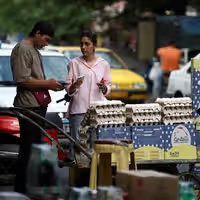
A man stands next to a street store selling Argentine flags, in downtown Buenos Aires, Argentina April 14, 2025.
A landmark criminal lawsuit filed in Argentina by victims of the 2022 Woman, Life, Freedom movement signals a new push to hold Islamic Republic officials accountable beyond Iran’s borders.
Shahin Milani, the executive director of the Iran Human Rights Documentation Center (IHRDC), told Iran International's English podcast Eye for Iran, the case marks a turning point – warning that even mid-level officials can no longer assume impunity.
“Iranian officials – even mid-level ones – should understand they are not safe anymore. If they leave Iran, justice may follow them.”
Why Argentina and why this matters now
The complaint was filed by a group of survivors together with the Iran Human Rights Documentation Center and supported by the Strategic Litigation Project at the Atlantic Council.
It asks Argentine judges to investigate crimes against humanity committed during the Islamic Republic's violent response to the 2022 protests, including murder, torture, gender-based persecution and targeted blinding.
Argentina was chosen because its courts recognize universal jurisdiction, allowing them to investigate atrocity crimes even when they were not committed on Argentine soil.
Crucially, Iranian officials – the alleged perpetrators – do not need to set foot in Argentina for a criminal investigation to begin.
Milani says that distinction changes the calculus inside Iran’s power structure.
“If Argentina issues arrest warrants, that alone is a success. Travel becomes risky. Borders become unpredictable.”
Argentina has already heard cases linked to abuses in Venezuela, Myanmar, and Spain’s Franco era, and has dealt with Iran-related cases before, including proceedings tied to the 1994 AMIA bombing – an attack on a Jewish community center in Buenos Aires that killed 85 people.
The list of 40 accused officials remains confidential for now. Much of the case, however, draws on years of documentation, including findings by the UN Fact-Finding Mission, which concluded that Iran’s crackdown amounted to crimes against humanity.
Three of the complainants have chosen to be publicly identified.
Kosar Eftekhari was 23 when she was shot in the eye during the protests. Mersedeh Shahinkar was also blinded at close range, but later returned to the streets wearing an eye patch as an act of defiance. Mahsa Piraei joined the case after her mother, Minou Majidi, was killed by security forces while demonstrating against the clerical establishment.
Majidi’s case drew international attention after an image of her daughter, Roya Piraei, standing without the mandatory hijab beside her mother’s photograph at her gravesite went viral. Majidi’s other daughter, Mahsa, is now seeking justice through the landmark lawsuit.
Roya Piraei at her mother's grave.
“In our own country, Iran, we were unable to find justice for my mother’s killing because there is no fair or independent judiciary,” Piraei told the Atlantic Council. “Our insistence on preserving human dignity is a global cause that knows no borders.”
Their stories form both the moral heart and legal backbone of the complaint.
Not compensation, only accountability
Unlike civil lawsuits in courts, this case does not seek financial damages.
“This is a criminal complaint,” Milani said. “It’s about responsibility, something painfully rare when it comes to the Islamic Republic.”
Even without immediate arrests, he said, the case lays the legal groundwork for accountability when conditions change.
Milani avoids predicting political collapse or transition. But he is clear about the role of human rights lawyers: they build cases now so they are ready when circumstances change.
“We don’t know what’s going to happen in the future. It’s possible that some of these officials’ circumstances change and they have to leave Iran – and they should know they’re not going to be immune from prosecution.”
In other words, even if justice does not arrive immediately, the legal architecture is being laid brick by brick – quietly, deliberately, and beyond Iran’s borders.
No one expects Argentina’s courts to deliver overnight justice. Similar cases against authoritarian officials elsewhere have taken years, and many defendants remain free.
For the families and survivors behind the complaint, however, this marks the clearest indication yet that the struggle that began in the streets in 2022 is now moving into courtrooms – and that justice, however delayed, may no longer be out of reach.
Demonstrations across Iran, initially sparked by economic hardship and the sharp fall of the national currency, continued for a third day on Tuesday, drawing in university students as authorities deployed force and made multiple arrests.
Protests spread across Iran on Tuesday, with universities and commercial districts emerging as key hubs amid a widening strike by shopkeepers in Tehran and other cities.
Human rights and student groups said at least 11 protesters were arrested near Tehran’s Shoush Square.
Five students were also detained at universities in the capital, four of whom were later released.
Student outlets reported that one student at Tehran’s Amirkabir University was severely injured during a campus crackdown after members of the Basij militia of the Islamic Revolutionary Guard Corps attacked their gathering.
Videos circulating on social media showed students chanting anti-government slogans, dismantling signs linked to the office of the Supreme Leader’s representatives and confronting security forces at campus gates.
In some clips, officers appeared to retreat as crowds advanced; in others, security forces were seen firing tear gas and, in several locations, shooting toward demonstrators.
The protests coincided with the government’s announcement that public offices would close in nearly 25 provinces, including the capital on Wednesday - a move officials said was necessary to conserve energy amid a severe cold snap. However, online weather data showed no significant drop in temperatures.
The unrest began Sunday after shopkeepers in several Tehran malls and later the Grand Bazaar launched a strike in response to the rial hitting a record low against the US dollar.
Since then, videos verified by Iran International have documented protests in Tehran, Karaj, Qeshm Island, Isfahan, Kermanshah, Shiraz, Yazd, Kerman and several other cities.
Government spokeswoman Fatemeh Mohajerani acknowledged widespread frustration, saying the protests reflected “intense economic pressure” and that peaceful assembly is recognized under Iran’s constitution.
President Masoud Pezeshkian said he instructed the interior minister to engage in dialogue with representatives of the demonstrators to hear their “legitimate” demands. He later attended a meeting with a handpicked group of trade officials on Tuesday.
Heavy security deployments were reported in Tehran, Mashhad, and Kermanshah, with residents describing checkpoints, constant patrols, and the presence of both uniformed and plainclothes officers.
In Hamadan, footage appeared to show security forces opening fire toward protesters, while riot police in Tehran and the nearby city of Malard used tear gas to disperse crowds.
Demonstrations were held on Tuesday night in several parts of Iran, and are expected to continue into a fourth day, with more Iranian businesses announcing on social media that they will close in solidarity with the movement.
A spokesman for Iran’s Revolutionary Guards and top state officials on Tuesday warned Israel and the United States against launching any new attack on Iran, vowing a harsher and unpredictable response.
“Israel should remember the blows it received in the recent war and take a lesson from the previous attack before thinking of entering a new one,” IRGC spokesman Brigadier General Mohammad Ali Naeini said.
“Iran’s power is increasing by the day, and Israelis only talk about a weak Iran in the media while they themselves know very well how strong our missile capabilities are,” Naeini said.
Trump said on Monday he would support possible Israeli strikes on Iran if the Islamic Republic develops its ballistic missile or nuclear programs, warning Tehran against rebuilding military capabilities destroyed in Israeli and American airstrikes in June.
Parliament Speaker Mohammad Bagher Qalibaf on Tuesday issued a separate warning, saying that Tehran’s defensive actions do not require external approval.
“Iran does not ask anyone’s permission to defend itself. The Iranian people’s response to any adventurism and wickedness will be broad, uncompromising and even unexpected,” he said.
“Iran’s decisions and actions to secure national interests and exercise its legitimate self-defense will not necessarily be predictable or similar to the past,” he added.
President Masoud Pezeshkian posted a message on X earlier on Tuesday saying the Islamic Republic’s response to any “tyrannical aggression would be harsh and remorse-inducing,” adding that any new attack “will make the enemy regret what it has done."
The United States held five rounds of negotiations with Iran over its nuclear program earlier this year, for which Trump set a 60-day deadline.
When no agreement was reached by the 61st day on June 13, Israel launched a surprise military offensive followed by US strikes on June 22 targeting key nuclear facilities in Isfahan, Natanz and Fordow.
The attacks killed nuclear scientists along with hundreds of military personnel and civilians. Iranian counterattacks killed 32 Israeli civilians and an off-duty soldier.
Iran denies seeking nuclear weapons and says its nuclear program is for peaceful purposes. Supreme Leader Ali Khamenei has said dealing with Trump is beneath the dignity of the Islamic Republic, while Iranian officials have rejected US demands to end uranium enrichment and curb missile capabilities.
The United States has long insisted that Iran must completely halt its uranium enrichment program, stop supporting its armed allies in the Middle East and accept restrictions on its ballistic missile program.
Tehran rejects the conditions as a non-starter for any talks.
Iran’s foreign minister appealed directly to Donald Trump in a Guardian op-ed on Tuesday, urging him to reopen negotiations with Tehran, reconsider Washington’s alignment with Israel and acknowledge what he described as Iran’s invincibility.
“For those willing to go where no one has gone before, there is a brief window of opportunity,” Abbas Araghchi wrote.
Standing beside Netanyahu, Trump warned that renewed Iranian missile expansion or nuclear advances would trigger a US response.
"We’ll knock the hell out of them," said Trump. “Now I hear that Iran is trying to build up again, and if they are, we’re going to have to knock them down."
In June, Israel and the US carried out coordinated strikes on Iran that severely damaged several key nuclear facilities. Iran retaliated with missile attacks on a US base in Qatar and on Israeli targets. After 12 days of escalation, a ceasefire was reached under US pressure.
Israeli officials say Iran is quietly rebuilding systems damaged during the conflict.
Trump on Monday expressed his support for possible Israeli attacks on Iran if Tehran continues to develop its ballistic missile program.
Israel shaped US policy through 'myths'
Araghchi argued that what he called a “manufactured crisis” over Iran’s nuclear program has long been driven by Israeli narratives, misleading Washington into abandoning the 2015 nuclear deal and adopting a “maximum pressure” strategy that produced only resistance, according to the foreign minister.
“Those myths encouraged Washington to abandon a functional diplomatic framework in favor of ‘maximum pressure’ that only produced ‘maximum resistance’,” he wrote.
He also pointed to what he described as shifting opinion among Trump supporters, saying Israel is increasingly seen as a liability rather than an ally.
“A growing number of Americans – particularly those who want a focus on rebuilding the US – are publicly acknowledging what has been taboo: that uncritical acceptance of Israel’s narratives has drained American resources, undermined American credibility, and entangled the US in conflicts that do not serve American interests,” Araghchi wrote.
Araghchi also said recent conflicts across Gaza, Lebanon, Syria, Iran, Yemen and Qatar have led regional governments to view Israel’s actions as “a threat to us all,” opening space for new diplomatic alignments.
Iran open to negotiations
Araghchi said “mutual friends of Iran and the US” are prepared to help facilitate talks and guarantee implementation of any future agreement, without naming those mediators.
Iran, Araghchi insisted, remains open to negotiations but not to surrender.
“Despite Israel’s attack on diplomacy amid Iran-US nuclear negotiations, Iran remains open to an agreement that is built on mutual respect and mutual interest,” he wrote, warning that Iran’s restraint should not be mistaken for weakness.
Araghchi reiterated that Iran will not give up what it regards as its rights under the Nuclear Non-Proliferation Treaty, including domestic enrichment for civilian use, and said any future deal must include “tangible and verifiable sanctions lifting.”
The unrest, driven by the plunging rial and surging prices, is widening in scope against the leadership and some analysts warn it could threaten the Islamic Republic itself.
Iran’s President Masoud Pezeshkian on Monday issued his first official response to the latest protests over worsening economic conditions, saying he has instructed his interior minister to hold talks with demonstrators.
In a post on X, Pezeshkian said he had ordered Interior Minister Ahmad Vahidi to “listen to the legitimate demands of protesters” and help the government “respond responsibly.”
Pezeshkian said improving people’s livelihoods remains his “daily concern,” and that reforms to the banking and monetary system are on the agenda.
But it remains unclear how the dialogue he has proposed will work or whether it can contain protests that are increasingly political in tone.
The unrest began with anger over the surging price of the US dollar and the collapse of the rial but quickly broadened.
Strikes and demonstrations spread nationwide on Monday, turning violent in several cities as nighttime crowds chanted against the ruling system and bazaar merchants vowed to continue their shutdowns.
In Tehran, large parts of the Grand Bazaar were shuttered, while clashes were reported in central streets.
While the slogans were mainly focused on economic issues on the first day, the second day's chants underscored a transition from economic frustration to more explicit political dissent.
Chants in several cities targeted Iran's political authority, with crowds shouting slogans such as "death to the dictator" and "Seyyed Ali (Khamenei) will be toppled this year".
The turmoil has been fueled by a currency crisis that pushed the dollar to roughly 144,000 tomans over the weekend. The head of Iran’s central bank resigned amid the turmoil, and Pezeshkian appointed former chief Abdolnaser Hemmati in a move seen as aimed at calming markets.
A senior aide to Iran’s supreme leader warned on Monday that any new aggression would draw a harsher response, following comments by US President Donald Trump about possible further attacks on Iran.
“Iran’s missile and defensive capabilities are neither containable nor in need of permission. Any act of aggression will be met with a harsh, immediate response beyond the imagination of its planners,” Ali Shamkhani, a top adviser to Supreme Leader Ali Khamenei, posted on X.
His comments came after Trump said on Monday he would support possible Israeli strikes on Iran if the Islamic Republic develops its ballistic missile or nuclear programs, warning Tehran against rebuilding military capabilities destroyed in a brief June war.
“I’m hearing that Iran is trying to recover — if that happens, we’ll have to hit them hard,” Trump said. Asked whether he would support Israeli strikes on Iran if it further develops its ballistic missile and nuclear programs, he replied: “If they continue with missiles, yes, quickly. If they continue with nuclear, immediately.”
Shamkhani, a member of Iran's Supreme Defense Council, warned that “in Iran’s defense doctrine, some responses are determined before a threat even reaches the execution stage."
The United States held five rounds of negotiations with Iran over its nuclear program earlier this year, for which Trump set a 60-day deadline. When no agreement was reached by the 61st day on June 13, Israel launched a surprise military offensive, followed by US strikes on June 22 targeting key nuclear facilities in Isfahan, Natanz and Fordow.
The attacks killed several Iranian officials and nuclear scientists as well as hundreds of military personnel and civilians, while Iranian counterattacks killed 32 Israeli civilians and an off-duty soldier.
Iran denies seeking nuclear weapons and says its nuclear program is for peaceful purposes, and Khamenei has said dealing with Trump is beneath the dignity of the Islamic Republic, while Iranian officials have rejected US demands to end uranium enrichment and curb missile capabilities.