• العربية
  • فارسی
Brand
  • Iran Insight
  • Politics
  • Economy
  • Analysis
  • Special Report
  • Opinion
  • Podcast
  • Iran Insight
  • Politics
  • Economy
  • Analysis
  • Special Report
  • Opinion
  • Podcast
  • Theme
  • Language
    • العربية
    • فارسی
  • Iran Insight
  • Politics
  • Economy
  • Analysis
  • Special Report
  • Opinion
  • Podcast
All rights reserved for Volant Media UK Limited
volant media logo
PODCAST

'This is the endgame,' former UK Security Minister says of Iran

Negar Mojtahedi
Negar Mojtahedi

Iran International

Jan 10, 2026, 02:51 GMT+0
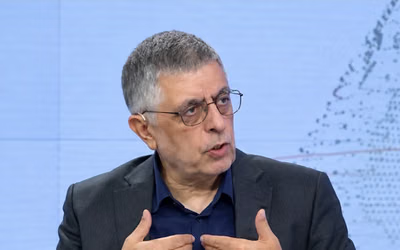
Tom Tugendhat, a British MP and former UK security minister, File photo

The Islamic Republic has entered a decisive rupture, with intensifying protests and internet blackouts pointing to a government increasingly reliant on force — dynamics that senior Western officials and analysts suggested may mark the beginning of an endgame.

Demonstrations have spread across major cities and provinces despite a nationwide internet and phone blackout, with rights groups reporting at least 42 people killed and more than 2,000 arrested since unrest began.

Supreme Leader Ali Khamenei on Friday accused foreign powers of fueling the protests and warned demonstrators of severe punishment, as security forces fired live ammunition in several regions.

Tom Tugendhat, a British MP and former UK security minister, told Eye for Iran the moment reflects a system confronting its own limits.

“I think this is the end game for the regime,” Tugendhat said.

“What we’re watching is not whether or not the regime survives, but how many people does it try to kill?” he added.

His remarks came as Iranian prosecutors threatened protesters with charges carrying the death penalty, and the Revolutionary Guards’ intelligence arm warned that the continuation of protests was “unacceptable.”

Western officials reassess as fear appears to erode

Early this week, US intelligence assessed that the protests lacked the momentum to threaten regime stability, US officials told Axios, but that assessment is now being reconsidered in light of recent developments.

“This is truly an extraordinary moment,” said Norman Roule, a former senior CIA official, who served as the national intelligence manager for Iran at the Office of the Director of National Intelligence from 2008 to 2017.

“We are watching a regime that is clearly in its dying days,” Roule said.

Roule said the leadership’s response shows narrowing options.

“It’s a government that can sustain itself, but it’s incapable of decisions that can stop this,” he said.

US President Donald Trump has warned Iran’s authorities against killing demonstrators, praising Iranians as “brave people” and signaling consequences if repression escalates. European officials and the UN human rights chief have also condemned the crackdown and the communications blackout.

Policy analysts say the current unrest is not an isolated episode but part of a longer erosion of regime authority.

“The Iranian people have the singular ability to expose the regime for its illegitimacy,” said Jason Brodsky, policy director at United Against Nuclear Iran.

“Since 2017 onwards, the Iranian people have come to the conclusion that the Islamic Republic can’t be reformed and therefore has to be overthrown,” Brodsky said.

Journalist and author of Nuclear Iran David Patrikarakos said the protests differ fundamentally from earlier waves that focused on specific demands.

“These aren’t issue-based protests anymore. These are existential,” Patrikarakos said.

He said the leadership now faces a dangerous calculation. “If the Ayatollahs are tempted to think he’s bluffing, they should take a look at the ruins of their nuclear facilities,” he said, referring to recent US and Israeli strikes.

Protesters defy repression as blackout deepens

Verified videos circulating on social media show protesters confronting security forces in Tehran, Mashhad, Zahedan and other cities, even as authorities cut communications and deploy live fire.

One widely shared video shows a wounded protester declaring: “I’m not scared. For 47 years, I’ve been dead.”

The demonstrations have drawn participation across Iran’s political, ethnic and religious spectrum. Exiled Prince Reza Pahlavi praised the nationwide turnout and urged coordinated nightly protests, while Sunni cleric Molavi Abdolhamid warned of deepening poverty and backed the demonstrations.

International pressure has continued to build. The UN human rights chief said he was “deeply disturbed” by reports of killings and internet shutdowns, while EU officials accused Tehran of using blackouts to conceal violence.

Despite uncertainty over how events will unfold, guests on Eye for Iran converged on a central conclusion: the Islamic Republic is confronting a crisis in which repression remains its primary instrument, even as its effectiveness appears increasingly uncertain.

You can watch Episode 85 of Eye for Iran on YouTube or Listen on any podcast platform of your choosing.

Most Viewed

Iran negotiators ordered to return after internal rift over Islamabad talks
1
EXCLUSIVE

Iran negotiators ordered to return after internal rift over Islamabad talks

2
ANALYSIS

US blockade enters murky phase as tankers spoof signals and buyers hesitate

3
ANALYSIS

Why the $100 billion Hormuz toll revenue is a myth

4

US tightens financial squeeze on Iran, warns banks over oil money flows

5
INSIGHT

Ideology may be fading in Iran, but not in Kashmir's ‘Mini Iran'

Banner
Banner

Spotlight

  • Hardliners push Hormuz ‘red line’ as US blockade tests Iran’s leverage
    INSIGHT

    Hardliners push Hormuz ‘red line’ as US blockade tests Iran’s leverage

  • Ideology may be fading in Iran, but not in Kashmir's ‘Mini Iran'
    INSIGHT

    Ideology may be fading in Iran, but not in Kashmir's ‘Mini Iran'

  • War damage amounts to $3,000 per Iranian, with blockade set to add to losses
    INSIGHT

    War damage amounts to $3,000 per Iranian, with blockade set to add to losses

  • Why the $100 billion Hormuz toll revenue is a myth
    ANALYSIS

    Why the $100 billion Hormuz toll revenue is a myth

  • US blockade targets Iran oil boom amid regional disruption
    ANALYSIS

    US blockade targets Iran oil boom amid regional disruption

  • Iran's digital economy battered by prolonged blackout
    INSIGHT

    Iran's digital economy battered by prolonged blackout

•
•
•

More Stories

'People die in the dark': experts decry Iran's 'worst internet shutdown'

Jan 9, 2026, 22:02 GMT+0
•
Negar Mojtahedi

Internet experts are warning that Iran’s sweeping nationwide internet blackout is being used to shield lethal crackdowns on protesters, cutting off evidence of state violence as unrest continues across the country.

“This is the worst internet shutdown in Iran’s history,” said Ali Tehrani, director of Washington operations for Psiphon, an open-source anti-censorship tool widely used in Iran. “Even Starlink uploads have been affected.”

Tehrani said supporting internet freedom in Iran must become a serious and active priority for the U.S. government, particularly as Iranian authorities increasingly rely on digital blackouts during periods of unrest.

Cybersecurity expert Amin Sabeti told Iran International that the blackout, which began Thursday evening local time, has severed access to the global internet across much of the country and disrupted domestic online services that remained partially available during previous crackdowns.

“This is the most extreme internet shutdown we’ve ever had,” Sabeti said, adding that its scope signals a significant escalation in Tehran’s use of digital repression amid nationwide unrest.

‘Iranians will die’

Iranian authorities have imposed the communications blackout to prevent protesters from coordinating and to stop evidence of state violence from reaching the outside world.

Tehrani said the current shutdown is even more severe than the near-total blackout during the November 2019 uprising, widely known as Bloody Aban, named after the month in the Persian calendar when the protests occurred.

“It’s not just for The Washington Post that democracy dies in the darkness—it’s Iranians that die in the dark,” said Behnam Ben Taleblu, a senior fellow at the Foundation for Defense of Democracies.

Taleblu said communications shutdowns are a core component of Iran’s repression strategy, designed to sever the link between protesters and the international community while security forces operate with reduced scrutiny.

Dozens killed

Despite the blackout, Iran International said it has received and reviewed a disturbing video showing several people lying motionless on the ground following large protests held Thursday night in Fardis, about 25 miles west of Tehran.

The outlet said the shutdown has obstructed efforts to determine the full scale of casualties shown in the footage.

The Center for Human Rights in Iran said on Friday that it has grave and urgent concerns that Iranian security forces may be carrying out lethal repression under the cover of the internet shutdown.

The group said it has received credible first-hand reports of hospitals overwhelmed with injured protesters in several cities and has documented the use of live ammunition by security forces.

It warned that reports of mass killings from the night of January 8 could not be independently verified due to the communications blackout.

Crisis at home shrinks Tehran’s margin for error abroad

Jan 9, 2026, 20:02 GMT+0
•
Danny Citrinowicz

In a speech on Friday, Supreme Leader Ali Khamenei left little doubt that Tehran intends to confront the current wave of protests with force rather than concession.

The remarks pointed to an intensifying crackdown, unfolding amid a near-total internet shutdown across Iran.

Those signals have placed renewed focus on Washington, where US President Donald Trump has issued repeated public warnings to Tehran in recent days, including statements suggesting the United States could act if Iranian authorities continue killing protesters.

Whether those threats translate into policy remains unclear, but they have sharpened attention on how the White House responds as events unfold inside Iran.

Khamenei’s remarks, which included renewed accusations that protesters are being directed by foreign powers, were accompanied by direct criticism of Trump, who late Thursday night warned Iran against further violence.

Taken together, the exchanges have added to tensions already heightened by months of mutual suspicion and rhetorical escalation.

The result has been growing unease across the Iran–US–Israel triangle. Iranian officials routinely frame internal unrest as foreign intrigue, while Israeli leaders have long described the Islamic Republic as a persistent, existential threat.

Risk of escalation

Iran’s rulers now appear increasingly concerned that the United States or Israel could seek to exploit domestic instability—fears that, in turn, risk shaping Tehran’s military calculations.

Earlier this week, Iran’s National Defense Council and other security bodies issued statements warning that the country could carry out a preemptive strike if it detected preparations for an attack.

Those warnings coincided with missile tests, moves officials described as defensive but which analysts say added another layer of volatility.

The rhetoric and military signaling have raised fears of escalation even in the absence of clear intent on any side to seek a confrontation.

In Israel, security officials have expressed concern that Iran could attempt to divert attention from internal unrest by provoking an external crisis, though many analysts consider such a move unlikely.

Still, Israel’s heightened sensitivity to risk since the October 7 attacks has reinforced a preference for preparing for worst-case scenarios.

Critical decisions

As Iran’s leadership faces mounting pressure at home, the margin for error abroad appears to be narrowing.

Clear signals of US support for protesters, even if not backed by immediate action, risk aggravating Tehran’s fears of external intervention, while Iranian military signaling increases the danger of miscalculation.

Some in Washington worry that even limited American involvement—military or otherwise—could destabilize an already fragile regional balance and draw Israel into a broader confrontation.

At the same time, a White House decision to refrain from action, despite repeated warnings, could also carry consequences. Protesters inside Iran have often looked to international pressure for protection or leverage, and the absence of follow-through could further dampen momentum on the streets.

What is clear is that Iran’s internal crisis is no longer insulated from its external rivalries.

Developments inside the country now carry implications far beyond its borders, raising the risk that repression at home could intersect with miscalculation abroad—between Iran, the United States and Israel.

The dead of Iran’s protests, and the stories yet untold

Jan 9, 2026, 16:50 GMT+0
•
Maryam Sinaiee

Dozens of people have been killed in protests across Iran in recent days, according to human rights groups and witness accounts, with the full scale of casualties from Thursday night still unknown after authorities imposed a nationwide internet blackout.

Before communications were cut, Iran Human Rights, a Norway-based monitoring group, said at least 45 protesters had been killed between December 28 and January 8, and that more than 2,000 people had been arrested.

Those figures are likely to rise following Thursday’s nationwide protests and reports of further unrest on Friday night, but verification has become increasingly difficult as images and firsthand accounts from inside Iran have largely disappeared.

One video that circulated online on Thursday appears to show at least seven bodies lying on the ground in what looks like an underground parking area.

The footage, which has not been independently verified, is said by the narrator to have been recorded in Fardis, near the city of Karaj, west of Tehran. The narrator claims the victims were killed by live fire.

Warnings from the top

Supreme Leader Ali Khamenei, who has appeared rarely in public since last month’s 12-day war, addressed the nation on Friday, a day after the mass protests. He referred to demonstrators as “saboteurs” and said he would not retreat in the face of unrest.

Soon afterward, the Secretariat of Iran’s Supreme National Security Council issued a statement warning that security forces and the judiciary would show “no leniency toward saboteurs.”

Similar statements later issued by the national police force and the Revolutionary Guards’ intelligence arm described the protests as a “joint design” by Israel and the United States to undermine Iran’s security and vowed retaliation.

The remarks heightened concerns among activists and rights groups that the authorities were preparing for further violent crackdowns.

Recasting the dead

Alongside the use of force, Iranian authorities have in several cases sought to portray slain protesters as government supporters or as victims of protesters’ violence—a pattern seen in previous waves of unrest.

One such case involved Amir-Hessam Khodayari, 22, who was wounded by security forces on December 31 in the western city of Kouhdasht, in Lorestan province, and later died after being transferred to a hospital in the provincial capital, Khorramabad.

Little is publicly known about his education or occupation, but his family is described as working-class Kurds who follow the Yarsan faith, a religious minority.

The Revolutionary Guards issued a statement describing Khodayari as a member of the Basij, a pro-government militia, and as one of the “forces defending security.” State media echoed the claim, and local officials visited his family.

That account was contradicted after his family rejected efforts to identify him as a Basij member.

In a widely shared video, his father is seen telling mourners that his son had been a protester. Other videos showed crowds forcing security forces to retreat from his funeral, despite attempts by authorities to control the ceremony.

Family members and activists said they faced pressure, including threats to withhold his body and offers of financial compensation, to accept the official version of events.

A similar pattern was documented during the 2022 Woman, Life, Freedom protests, including in the case of Hamid-Reza Rouhi, another protester initially portrayed by authorities as a Basij member after his death.

Many more to come?

Another recent case involved Shayan Asadollahi, 28, who was killed in the city of Azna, also in Lorestan province. Authorities withheld his body for five days, pressuring his family to say he had been a Basij member or that he had died in a traffic accident.

He was eventually buried quietly in the remote village of Deh Haji.

Asadollahi worked as a hairdresser and was the sole breadwinner for his mother and sister after his father died in an accident last year. Friends described him as an avid supporter of the Persepolis football club.

Like many young Iranians, he was active on Instagram, where he shared photos of his work, daily life and football fandom—an online presence that fell silent after his death.

The stories that have emerged so far may represent only a fraction of what occurred, with many more accounts expected to surface if and when full internet access is restored.

Khamenei says Trump will fall, targets protesters in speech

Jan 9, 2026, 09:43 GMT+0

Iran’s Supreme Leader Ali Khamenei on Friday warned US President Donald Trump that he would be brought down, as he spoke about protests and accused foreign-backed forces of trying to destabilize Iran.

“Trump should know that world tyrants such as Pharaoh, Nimrod, Reza Shah and Mohammad Reza were brought down at the peak of their arrogance. He too will be brought down,” Khamenei said in remarks aired on state television.

He said the Islamic Republic would not retreat in the face of unrest. “Everyone should know that the Islamic Republic came to power with the blood of hundreds of thousands of honorable people, and it will not back down in the face of saboteurs,” he said.

Referring to protests in the country, Khamenei accused demonstrators of acting to please the US president. “They want to make him happy. If he knew how to run a country, he would run his own,” he said, adding that there were many problems inside the United States.

Referring to the June attacks, Khamenei said: “In the 12-day war, more than a thousand of our compatriots were martyred.” He added that the US president had said, “I gave the order and I commanded the attack,” and said this amounted to an admission that “his hands are stained with the blood of Iranians.”

Khamenei urged supporters to remain united. “Dear young people, keep your readiness and your unity. A united nation will overcome any enemy,” he said.

Iran crossed a political threshold

Jan 9, 2026, 07:29 GMT+0
•
Mehdi Parpanchi

What happened in Iran on Thursday night was not simply another protest. Coordinated mass demonstrations unfolded nationwide in response to a direct call from Prince Reza Pahlavi that specified not only the action but also the timing.

Calls for action from outside Iran have been issued many times over the years and largely ignored. This one was answered, simultaneously and at scale. The precision of the call and the response to it surprised supporters and skeptics alike. Thursday night did not produce regime change, but it marked something no less significant: a visible crossing of a political threshold.

Revolutions do not begin on a single night. They surface after long periods of accumulated rupture. Iran has been politically and psychologically boiling for roughly two decades. What we are witnessing today is the outward expression of a process that began with the collapse of legitimacy in 2009.

That year’s presidential election shattered the Islamic Republic’s claim to popular consent. Until then, despite deep frustration, many Iranians still believed meaningful change was possible through participation, through the ballot, reformist candidates, and gradual adjustment within the system. The blatant manipulation of the vote and the violent suppression of mass protests ended that belief. What followed was not merely repression, but an emotional and moral divorce between society and state. The system survived, but consent did not.

The 2015 nuclear agreement briefly altered the trajectory. It reopened the possibility that Iran might normalize and that ordinary people could reclaim what they often describe as a “normal life.” That hope proved fleeting. Billions of dollars entered the country after nuclear-related sanctions were lifted, yet resources were overwhelmingly diverted toward missile and drone programs and the expansion of proxy networks in Syria, Iraq, Lebanon, and Yemen. Meanwhile, the national currency collapsed, inflation surged, and household purchasing power steadily eroded.

These economic realities are widely known. What has been far less understood, particularly across Western media and policymaking circles, is what was happening beneath the surface. Iranian society had largely exited the Islamic Republic at the level of belief. This was no longer dissent or protest. It was post-loyalty. People were no longer asking how to reform the system. They were asking what could replace it.

Symbols matter when legitimacy erodes, especially when long-standing taboos break. A critical moment came in 2018, when a mummified body, widely believed to be that of Reza Shah, was discovered at a construction site in Shahr-e Rey, near Tehran, where his mausoleum once stood before being demolished after the revolution. Whether the remains were authentic was ultimately irrelevant. What mattered was the reaction. Public chants of “Reza Shah, may God bless your soul” emerged, chants that would have been unthinkable in public space just years earlier.

At first, these slogans were interpreted as expressions of anger toward the Islamic Republic rather than positive reassessment of the Pahlavi era. That reading did not hold. The chants returned, spread geographically, and grew more explicit. A psychological barrier had been crossed.

By the mid-2020s, this symbolic shift became increasingly evident on social media, where attention clustered around Reza Pahlavi. Some observers dismissed his prominence there as a product of manipulation or as evidence that social media itself is an unreliable gauge of political reality. Yet the pattern was unmistakable. Content linked to him consistently generated unusually high engagement across Persian-language platforms, circulating organically, resurfacing repeatedly, and sustaining visibility well beyond individual protest cycles.

The current wave of protests made this underlying reality impossible to dismiss. From the outset, calls for Pahlavi’s return were explicit and widespread. Some skeptics again attempted to discredit the scenes by claiming that videos were manipulated or that slogans had been dubbed in. That explanation did not withstand repetition or scale. The same chants were heard across multiple cities and nights in unrelated recordings, revealing in public what had been forming beneath the surface for years.

The significance of Thursday night lies not in raw numbers alone, but in coordination and credibility. Many external calls in the past produced little or nothing. This one did not. For the first time, a call issued for a specific hour was answered across the country. Demonstrations began simultaneously at the designated time, offering clear evidence of collective response rather than scattered unrest. That precision, and the response to it, marked a qualitative shift in Iran’s political dynamics.

The Islamic Republic still controls the machinery of the state. What it lost on Thursday night is exclusivity over its remaining political legitimacy, both domestically and internationally. From this point on, foreign governments are no longer dealing with an uncontested representative of the Iranian nation, but with a regime whose claim to speak for Iran is openly challenged. Power maintained by force can endure for a time. Power stripped of legitimacy does not recover it.
At the same time, Reza Pahlavi crossed a line that many before him failed to reach. This was not symbolism, nostalgia, or digital noise. It was a successful act of political command. Others issued calls from abroad and were ignored. He issued one, and it was answered nationwide and on schedule. That is not popularity. That is operational leadership.

With this, Iran’s opposition space has been fundamentally reordered. The question is no longer whether Iranians are searching for an alternative or whether a leader could emerge. Both questions have been settled. A focal point now exists, and the regime is forced to reckon with it.

From this moment on, Iranian politics operates under new constraints. The state must now respond not to spontaneous unrest, but to an identifiable center of mobilization. History shows that regimes can survive protests. They struggle far more to survive leaders.

After Thursday night, the Islamic Republic faces a reality it has long sought to prevent. It no longer confronts a crowd. It confronts a contender.