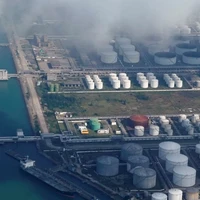
Iran has shown it can disrupt regional energy flows. What remains far less clear is whether it can use that leverage to shape the outcome of the conflict in its favor.
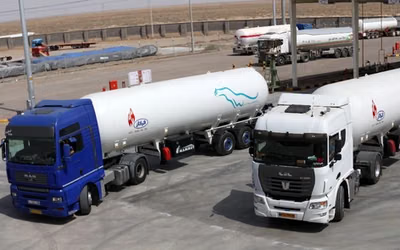
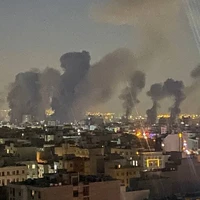
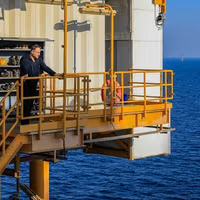
Over the past several days, Iranian missiles have targeted three oil tankers and several oil and gas facilities in neighboring countries while also obstructing maritime traffic through the Strait of Hormuz.
The immediate market reaction was sharp but limited. On Monday, Brent crude surged more than 8 percent to $79 per barrel. Yet this level remains well below earlier projections tied to a potential full closure of the Strait of Hormuz.
So far, Tehran has failed to generate sufficient pressure on Washington by attacking tankers and regional energy infrastructure. On March 2, following two drone strikes on its gas facilities, Qatar announced a temporary suspension of liquefied natural gas (LNG) production.
The Strait of Hormuz accounts for roughly 20 percent of global LNG trade and a similar share of global oil and petroleum product consumption.
Last year, over 80 percent of the crude oil and LNG passing through the strait was destined for Asian markets. Still, Qatar’s LNG suspension triggered a 45 percent surge in European gas prices—underscoring the fragility of global energy interdependence.
Why haven’t oil prices spiked further?
The muted market response, despite near-disruptions to Hormuz transit, has several structural explanations.
First, according to the International Energy Agency, global oil markets were already oversupplied last year. If tanker disruptions in the Strait of Hormuz persist over the medium term, however, market conditions could tighten considerably.
Second, Saudi Arabia and the United Arab Emirates possess alternative pipeline routes capable of bypassing the strait. Combined, these pipelines can transport an additional 2.6 million barrels per day to global markets. This represents about 40 percent of their normal crude exports but remains a significant mitigating factor.
Iran has previously demonstrated its willingness to target critical infrastructure. In 2019, it struck Saudi facilities in Ras Tanura and the Abqaiq oil processing hub—located roughly 55 miles away—which is connected via a 1,200-kilometer pipeline to the Red Sea. On March 2, Iran again targeted the Ras Tanura refinery.
Thus far, however, Tehran has not attacked the Saudi and Emirati pipelines designed to bypass Hormuz. Should it do so, oil prices would likely rise again—but probably not to levels that would trigger severe market dislocation given current supply buffers.
Inventory data reinforce this point. OECD members—including the United States, the European Union, the United Kingdom, Japan and Canada—hold commercial oil stocks of about 2.8 billion barrels. These reserves provide weeks of supply flexibility in the event of temporary disruption.
Iran itself reportedly holds around 200 million barrels of oil in floating storage in Asian waters and could continue deliveries to Chinese buyers for several months.
Taken together, these factors suggest that in the short term Iran’s oil weapon is unlikely to prove an effective instrument for destabilizing global markets or compelling Washington to halt its military operations.
Tehran’s apparent objective may instead be to pressure US-aligned Arab states into urging Washington to cease its attacks.
This strategy, however, carries significant risks. On March 1, Saudi Arabia signaled it would respond to Iranian attacks and placed its armed forces on heightened alert. Continued escalation could push the kingdom and other Arab states to join the US-Israeli military campaign.
The risk of a protracted conflict
US and Israeli officials have indicated that operations against Iran could continue for several weeks. The key question is whether Tehran can sustain a prolonged war of attrition.
Around 70 percent of Iran’s non-oil trade passes through ports that depend on access via the Strait of Hormuz. While Tehran may be able to disrupt the strait in the short term, sustained interference would disproportionately harm its own economy.
Thus far, the United States and Israel have not targeted Iran’s oil facilities or broader industrial and economic infrastructure, and they may prefer to avoid doing so. But that could change if Iran continues attacking regional energy assets and obstructing Hormuz transit.
Any such escalation could severely damage the country’s already fragile economy.
Another possible countermeasure would be the formation of an international coalition to secure maritime traffic through the Strait of Hormuz—effectively neutralizing Tehran’s leverage over global energy trade.
Finally, it is important to note that the Islamic Republic faces a severe domestic legitimacy deficit. Further weakening of the state could increase the likelihood of widespread unrest similar to the protests of January 2026, potentially raising the prospect of regime collapse from within.
All in all, Iran’s oil weapon appears structurally constrained. While capable of generating volatility, it is unlikely to deliver decisive strategic leverage.