As Iran goes dark, the state tightens its grip

It is the Islamic Republic as envisioned by Supreme Leader Ali Khamenei: no internet, no social media, hundreds of national and local newspapers shuttered, and mobile phones rendered largely useless.
Iran International

It is the Islamic Republic as envisioned by Supreme Leader Ali Khamenei: no internet, no social media, hundreds of national and local newspapers shuttered, and mobile phones rendered largely useless.
The darkness is deliberate. It is enforced to prevent protesters from communicating and organizing—and to conceal the crimes committed to crush them when they do.
Iran International on Tuesday put the death toll from the crackdown at around 12,000, vowing in a statement that the mass killing “will not be buried in silence.”
With nearly all communication channels severed, Khamenei remains one of the few figures whose website continues to function. State television—a network of more than 30 channels—is still broadcasting the image he wants the world to see.
The same is true of a handful of state-aligned news agencies, including Fars, Tasnim, and Mehr, all controlled by the Revolutionary Guards or the Organization for Islamic Propagation.
Although Iran’s national intranet has partially resumed after several days of shutdown, even state television has struggled to maintain its broadcasts following the severing of international internet links.
Despite those limitations, state TV aired footage promoting a tightly stage-managed pro-government rally in one of Tehran’s smallest squares, a space that can barely hold 3,000 people.
Internet experts say a small number of X users inside Iran have been selectively allowed to post content supporting government narratives. Limited Starlink access also exists, but analysts warn that the sporadic signal means foreign media remain largely blind to developments across most of the country.
As of Tuesday evening in Tehran, the government had not responded to calls from the United Nations secretary-general and European Union officials urging it to restore communication lines.
Meanwhile, social media posts describe security forces raiding homes and confiscating Starlink terminals, satellite dishes, computers, and mobile phones — part of a broader effort to prevent Iranians from accessing independent reporting or sending information abroad.
With the blackout, censorship, and signal jamming, foreign-based Persian-language media—now the primary source of information for many Iranians—may be forced to revive shortwave radio broadcasting. It would represent a step backward in media technology, but perhaps the only way to move forward in reaching a silenced population.
Shukriya Bradost, an Iran analyst based in Washington, wrote on X on Tuesday that while protesters stand “empty-handed against a regime that answers them with bullets,” no significant defections appear to have occurred within the military.
“Starlink and outside reporting no longer have the impact they once did,” she wrote, because the world already knows what is happening in Iran. If any action is to be taken, she concluded, “the time is now, not later.”

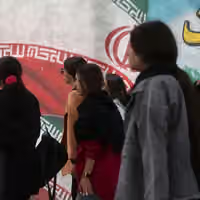
Iran's historic Lion and Sun flag has had a resurgence with latest round of widespread protests after nearly half a century of absence from the country's official identity.
Carried by some demonstrators from the earliest days of the unrest, it served as a visual rejection of the Islamic Republic’s theocratic rule.
But after exiled Prince Reza Pahlavi called on Iranians abroad to replace the Islamic Republic’s flag at embassies and consulates, the Lion and Sun moved to the center of Iran’s political narrative.
Even before that call, an Iranian protester climbed the wall of Iran's embassy in London to replace the official flag with the Lion and Sun. The footage spread rapidly online and was even shared by US President Donald Trump.
The act was repeated the following day, turning the embassy into a symbolic battleground over national identity.
Similar actions followed in Canberra, Stockholm, Oslo, Rome, Munich, Hamburg, and Ljubljana, where Iranians replaced official symbols, installed flags at entrances, or painted the Lion and Sun emblem and protest slogans on diplomatic buildings.
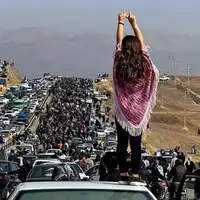
Videos from several cities inside Iran showed protesters carrying or displaying the Lion and Sun during demonstrations–an instant visual marker that a local protest was part of a broader national movement.
For many, the flag is less about monarchism and more about distancing themselves from the Islamic Republic. Its power lies in clarity. In a single image, it communicates rejection of the regime and identification with an alternative vision of Iran.
That efficiency has made it one of the most repeated visual motifs of the current unrest.
And that is perhaps why X also decided to change its Iran flag icon to the Lion and Sun.
The endurance of the tricolor
Iran’s green, white, and red tricolor was formalized during the Constitutional Revolution of the early 20th century, when the idea of a modern Iranian nation-state first took shape. Over time, the colors acquired widely accepted meanings: green for vitality and land, white for peace and clarity, red for courage and sacrifice.
What makes the tricolor distinctive is its continuity. It has survived monarchies, coups, revolutions, and war with minimal dispute. Across political divisions, it remained one of the few symbols broadly viewed as “Iranian” rather than “governmental.”
The Lion and Sun emblem is among Iran’s oldest political symbols. Its formal use dates back to the Safavid era and was standardized under the Qajars and later the Pahlavis as a lion holding a sword beneath a radiant sun.
In Iranian symbolism, the lion represents power, guardianship, and independence; the sun conveys enlightenment, sovereignty, and renewal. Together, they evoke a civilizational memory that predates the Islamic Republic.
This layered meaning explains why many Iranians view the emblem as representing Iran itself rather than a specific political system.
After 1979: a symbolic rupture
After the 1979 revolution, the Islamic Republic removed the Lion and Sun and replaced it with a new emblem built from stylized Islamic inscriptions.
The post-revolutionary clerical government viewed the Lion and Sun symbol as representing the "oppressive Westernising monarchy."
Over four decades of its placement on ministry façades, military uniforms, public buildings, textbooks, and state media, the emblem increasingly became seen as the “flag of the Islamic Republic” – not the “flag of Iran.”
This symbolic rupture explains why the Lion and Sun resurfaces during moments of crisis – from 2009 to 2019 to 2022, and now again. Its return in 2026 is simply its most visible resurgence.
Many leftists, republicans, and nationalists avoided it, wary of monarchist associations. This year’s protests have altered that calculus. The scale of unrest and the need for a non-regime symbol have softened ideological boundaries.
Many Iranians with no attachment to monarchy now carry the Lion and Sun as a marker of resistance, not restoration, as a symbol of “Iran without the Islamic Republic.”
In a moment of complete digital blackout, censorship and repression, symbols have again become the language of the street – durable, replicable, and difficult to silence.
Whether the lion and sun becomes a temporary emblem of a protest movement or a lasting symbol of a future political order remains one of the most consequential questions emerging from this year’s unrest.

I am writing this from Tehran after three days of trying to find a way to send it: things may get a lot worse before they get any better.
There is no internet. Only a few people still have access to Starlink, and even that works only in patches. Messages fail. Calls fail. Most of the time, there is nothing.
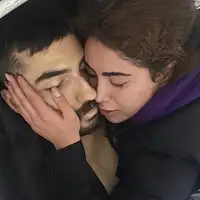
The killing has been unprecedented. I know that word is used too easily, so let me explain what I mean. Almost everyone you see or speak to knows a victim. I personally know five. One is dead. Two are injured. Two have been missing for three days.
The only time that comes close, in terms of scale and fear, was during Covid.
During the day, Tehran is mostly quiet. By around three in the afternoon, people start heading home. Some do it to prepare to go out again later. Others do it to stay out of everything entirely.
Mobile phones work during the day, but even then, they are limited. Text messages do not exist. The only messages that arrive are state “alerts,” which are really threats—warnings not to go out.
We are taken hostage. Literally. And without internet, our loved ones outside the country are taken hostage in a different way.
None of this was a surprise. They have done it before. Everyone knew there was a kill switch.
Which makes me ask something I cannot stop thinking about: how did the opposition outside, the activists, never think seriously about this? How do you call on people to risk their lives without even a rough plan for what happens once the security apparatus starts moving?
I am angry. At everything. At those who rule Iran. I have nothing but expletives for them. I wish them unimaginable suffering.
But I am also angry at the keyboard warriors abroad. “We will not rest until the regime is gone, no matter the cost,” one prominent figure said last week from a European capital. “F**k you, I say. With whose blood?"
Everyone I see is angry and helpless. Often both at once. People are conflicted. You want the butchers to be beaten. You want pressure from outside. But you do not want your country attacked. You do not want war.
Most people I speak to believe Trump will do something. No one knows what. There is hope, but there is more fear.
What if the blow only bruises the beast and makes it more savage, many ask. What if parts of the system refuse to give in and keep fighting and killing? We have seen this before. After the revolution 1979, there were years of power struggles and bloodshed.
And another thing, which some people outside may not want to hear.
Those who think that a change in leadership would mean none of this could happen again are either deeply mistaken or lying. No leader has universal support. Even Khomeini faced armed opposition after the revolution, both ideological and ethnic.
But then you say all of this, and immediately another question comes: what if nothing happens? What if there is no intervention, no turning point? How much longer can we go on like this?
All I can say—and I hope people read this—is that I don’t know. Like most people here, I don’t know.
And I don’t trust those who say they do. Those who declare from their chaise longues in London or Washington that the days or even the years ahead will be easy, clean and bright.
They won’t be.

A video circulated by Iran’s state media to promote pro-government rallies has gained wide traction online, with social media users questioning its authenticity and pointing to apparent inconsistencies, reflecting broader public mistrust of official messaging.
As nationwide protests continue, authorities have taken steps including staging government-organized countermarches, shutting down the internet, and tightening controls on the media to shape the narrative.
One clip aired by state media and presented as aerial helicopter footage of pro-government rallies in Tehran drew fresh questions after viewers pointed to anomalies, including wind visibly blowing the reporter’s hair while leaving his clothing and microphone seemingly unaffected.
IRIB News shared the video on X on Monday, writing: “Breaking | The first aerial video of the people of Tehran, the capital of Iran, marching in support of the Islamic Republic of Iran has been released.”
Readers added context on X saying the video appears to have been altered using chroma key (green screen), citing what they described as “unnatural subject edges, mismatched lighting and shadows, wind affecting only the reporter’s hair and not his clothing, a lack of realistic depth of field, and the absence of a seatbelt and headset," calling it a crude propaganda edit.
Multiple users also suggested the post showing large crowds appeared to recycle older material rather than depict new footage from the ongoing protests.
In a follow-up video, the reporter featured in the clip defended the broadcast footage as authentic. Some users, however, said they also saw inconsistencies in the new recording, and continued to question the original video’s provenance and how it was produced.
Separately, another image that circulated widely from the Monday rally showed demonstrators carrying a large Islamic Republic flag. In the photo, one person appears to be visibly inside the cloth, and some users pointed to irregularities in the flag’s details, including inconsistencies in the Arabic takbir rendered in white Kufic script along the edges of the green and red bands.
In another state-rally video, social media users focused on the color of trees in the background, arguing that the foliage appeared unusually vivid for mid-winter and did not match how Tehran’s street trees typically look at this time of year.
The government has a track record of recycling old footage and using AI-generated visuals, tactics that can help dominate the news cycle quickly.
In mid-2025, during a period of heightened regional conflict, state-run IRIB TV1 was shown in fact-check reports to have reused 2022 footage of Russian missile launches and presented it as Iranian strikes. State-run PressTV also published recycled images, including photos linked to a downed drone from the India-Pakistan border, which it labeled as an Israeli drone shot down over Iran.
State-affiliated social media accounts and some news broadcasts went further during the 12-day war with Israel, using high-fidelity graphics from the military simulator Arma 3 to claim “confirmed kills” of advanced fighter jets such as the F-35.
Such measures are framed by Iranian officials within the concept of soft war, an information and influence campaign in which the aim is not necessarily to persuade everyone indefinitely, but to create a temporary sense of superiority or confusion.
Iran has been under an almost complete internet blackout since January 8, when authorities largely cut off access amid nationwide protests, reducing connectivity to around 1 % of normal levels, according to internet monitoring group NetBlocks.

Several foreign influencers supportive of the Islamic Republic have published content portraying life in Tehran as calm despite an escalating deadly crackdown on protests across the country amid an internet blackout.
Video they share presents scenes of shopping, leisure and normal activity, offering images that contrast sharply with stark scenes of unrest and bloodshed emerging daily.
Foreign nationals in Iran typically operate under close monitoring, and public activity by visitors—particularly during periods of unrest—requires official permission. The influencers’ movements and access leaves little doubt that their ventures are state-sponsored or at least approved.
Among the most prominent figures is Maram Susli, a Syrian-Australian influencer known online as “Syrian Girl” or “Partisan Girl,” who has more than half a million followers on X.
Over the past several days, she has posted repeatedly in support of the Islamic Republic, framing Iran as the target of Western and Israeli misinformation.
In a post dated January 11 and captioned “Come shopping with me in Iran, Tehran,” Susli shared images showing herself without a hijab inside a Tehran shopping mall and the city’s Grand Bazaar.
“They are lying to you about Iran, and Iranian women, to sell you regime change for Israel!!!” she posted.
Counter-narrative
In another image, which she later acknowledged had been edited using artificial intelligence, Susli appears wearing a short-sleeved T-shirt and jeans in front of Tehran’s Azadi Tower while burning an Israeli flag.
Many users on social media noted that the images appeared to have been taken during summer months, while Tehran is currently experiencing winter conditions. Others pointed out that Susli appears to be posting from Australia, where she resides.
Another pro-Islamic Republic figure, Suleiman Ahmed, shared a video showing a woman burning an image of Reza Shah, the founder of the Pahlavi dynasty and grandfather of the exiled opposition figure Reza Pahlavi.
The post appeared to respond directly to a viral image circulating inside Iran of a young woman setting fire to a portrait of Supreme Leader Ali Khamenei and lighting a cigarette with it.
On Monday, other pro-Tehran influencers from various countries shared footage of state-organized rallies broadcast on Iranian state television, presenting the gatherings as evidence of mass public support—as the nation entered its fourth day of blackout.
Deadly crackdown
Fragmentary messages transmitted via Starlink connections and accounts from recent travelers indicate that security forces have carried out a widespread lethal crackdown.
Eyewitnesses and medics told Iran International the preliminary death tolls since protests began on Dec. 28 had ramped up in recent days to up to 2,000 people.
In an article published Sunday on Substack, the Berlin-based political analyst Hamidreza Azizi wrote that after January 8, Iranian authorities increasingly sought to frame the domestic unrest as a continuation of Iran’s recent confrontation with Israel, shifting the narrative from internal dissent to external conflict.
Officials have largely stopped referring to demonstrators as “protesters” or even “rioters,” instead describing them as “CIA- and Mossad-backed terrorists” and characterizing the unrest as “urban warfare.”
Senior officials, including the head of the judiciary, have said detainees will be prosecuted swiftly on charges of moharabeh or "waging war against God", an offense that carries the death penalty.
The contrast between the images circulating online and the conditions reported from inside Iran underscores the degree to which information itself has become a central battleground, as the state seeks to shape perceptions at home and abroad while restricting independent verification on the ground.

At least 12,000 people have been killed in Iran in the largest killing in the country's contemporary history, much of it carried out on January 8 and 9 during an ongoing internet shutdown, according to senior government and security sources speaking to Iran International.
After cross-checking information obtained from reliable sources, including the Supreme National Security Council and the presidential office, the initial estimate by the Islamic Republic’s security institutions is that at least 12,000 people were killed in this nationwide killing.
Iran International reached the conclusion after reviewing information it received from a source close to the Supreme National Security Council; two sources in the presidential office; accounts from several sources within the Islamic Revolutionary Guard Corps in the cities of Mashhad, Kermanshah, and Isfahan; testimonies from eyewitnesses and families of those killed; field reports; data linked to medical centers; and information provided by doctors and nurses in various cities.
The killing was carried out on the direct order of Supreme Leader Ali Khamenei, with the explicit knowledge and approval of the heads of all three branches of government, and with an order for live fire issued by the Supreme National Security Council, Iran International has learned.
Iran International’s Editorial Board has set out its findings on the latest crackdown in a statement titled “The killing of 12,000 Iranians will not be buried in silence,” calling for documents and testimony by the victims' families.
The full text of the statement follows:
Iran is under a coordinated blackout aimed not only at security control but at concealing the truth. Internet cuts, crippled communications, media shutdowns, and intimidation of journalists and witnesses point to one goal: preventing a vast and historic crime from being seen.
In recent days, after receiving scattered but shocking and deeply troubling reports, Iran International has focused on verifying information to build a clearer picture of the scale of repression and the killings during the latest protests.
In a country where authorities deliberately restrict access to information, such an assessment is difficult and time-consuming – particularly because rushing to publish incomplete casualty figures risks errors in documenting events and could distort the true scale of this tragedy.
From Sunday, the volume of evidence and the convergence of accounts reached a point where a relatively accurate assessment became possible.
Over the past two days, Iran International’s editorial board has reviewed – through a rigorous, multi-stage process and in accordance with established professional standards – information received from a source close to the Supreme National Security Council; two sources in the presidential office; accounts from several sources within the Islamic Revolutionary Guard Corps in the cities of Mashhad, Kermanshah, and Isfahan; testimonies from eyewitnesses and families of those killed; field reports; data linked to medical centers; and information provided by doctors and nurses in various cities.
Based on these reviews, we have concluded that:
In the largest killing in Iran’s contemporary history – carried out largely over two consecutive nights, Thursday and Friday, January 8 and 9 – at least 12,000 people were killed.
In terms of geographic scope, intensity of violence, and the number of deaths in a short time span, this killing is unprecedented in Iran’s history.
Based on information received, those killed were mainly shot by forces of the Islamic Revolutionary Guard Corps and the Basij.
This killing was fully organized, not the result of “sporadic” and “unplanned” clashes.
Information received from the Supreme National Security Council and the presidential office indicates that the killing was carried out on the direct order of Ali Khamenei, with the explicit knowledge and approval of the heads of all three branches of government, and with an order for live fire issued by the Supreme National Security Council.
Many of those killed were young people under the age of 30.
Casualty estimate
Based on available data and cross-checking information obtained from reliable sources, including the Supreme National Security Council and the presidential office, the initial estimate by the Islamic Republic’s security institutions is that at least 12,000 people were killed in this nationwide killing.
It is clear that, under a communications blockade and without direct access to information, confirming a final figure will require further, detailed documentation.
Experience in recent years shows that security institutions have consistently withheld information and avoided recording and announcing accurate figures for those killed.
Iran International commits to refining this figure with the help of its audience – by collecting documentation, cross-checking accounts, and verifying information on an ongoing basis – so that no name is lost and no victim’s family is left unheard.
Communications and media blackout
Media outlets inside the country have been shut down. Hundreds of national and local newspapers, an unprecedented development in the history of Iran’s press, have fallen silent since Thursday.
Today, aside from the Islamic Republic of Iran Broadcasting (IRIB), only a handful of news websites remain active inside the country, and they too operate under censorship and the direct control of security institutions.
This is not “crisis control.” It is an admission of fear that the truth will be exposed.
Call for evidence
Iran International calls on all compatriots inside and outside the country to send any documents, videos, photographs, audio testimony, and information related to those killed, medical centers, locations of clashes, the time and place of incidents, and any other verifiable details from the events of recent days.
The security of sources and confidentiality of information are our absolute priority.
Verified findings and international follow-up
After careful verification and assessment, Iran International will publish its findings and provide them to all relevant international bodies and institutions.
The Islamic Republic cannot conceal this crime by cutting the people of Iran off from the world. The truth will be recorded; the names of those killed will be preserved; and this massacre will not be buried in silence.
These honored dead belong not only to their grieving families and loved ones, but to the national revolution of Iranians.
Iran International Editorial Board