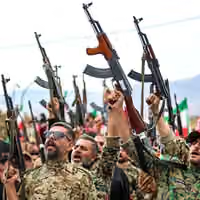
Supporters of the Islamic Republic hold Iranian flags and images of supreme leader Ali Khamenei, in a state-sponsored rally in Tehran, Iran, January 12, 2026
Tehran on Monday conducted large pro-government rallies in several cities intended to counter the nationwide protests challenging its rule, in a strategy it has deployed against previous bouts of mass unrest ultimately crushed by deadly force.
The aim is not necessarily to convince skeptics, but to project an image of control and popular backing at a moment of visible strain.
After days of sustained demonstrations calling for the overthrow of the system, authorities organized counter-rallies in several cities on Monday, presenting them as popular condemnations of the protests themselves.
State television depicted the gatherings as mass denunciations of unrest, echoing official claims that the uprising was driven by “armed terrorists” and foreign adversaries.
A familiar mobilization
The mechanics of the rallies followed a script many Iranians recognize. State bodies drew participants to central locations in Tehran and other major cities, relying on administrative pressure and access to public resources.
Coverage was then amplified by state television and media outlets affiliated with the Islamic Revolutionary Guards Corps.
In recent broadcasts, state outlets released a mix of ground-level footage and aerial images intended to convey scale. Some of the images show visible crowds, underscoring that the authorities retain a base of support.
It is difficult to determine precise numbers, the duration of the gatherings, or whether all images reflect live events from the same day. Similar visual techniques — including the reuse of footage or the circulation of undated aerial shots — have been employed during previous protest cycles.
Even taken at face value, the rallies appeared limited in duration and geographic spread.
By contrast, demonstrations opposing the government have persisted for weeks, erupting across hundreds of locations according to tallies compiled by activists and researchers, despite the risks involved.
The contrast is sharpened by the conditions under which each takes place: pro-government gatherings proceed under heavy security, while protesters have faced gunfire, mass arrests and lethal force.
Information control as context
This round of rallies unfolded amid unusually severe restrictions on communication. For several consecutive days, internet connectivity across much of Iran has been sharply curtailed, according to digital rights groups and user reports, leaving millions unable to communicate freely or share information.
State and Guards-linked outlets, by contrast, have continued to publish without interruption. Agencies such as Tasnim, Fars and Mehr have maintained full access, flooding television and online platforms with official narratives.
The result is a highly asymmetric information environment. While ordinary citizens struggle to document events or verify developments, state-aligned media dominate the public space with curated imagery.
Under such conditions, rallies are presented largely on the authorities’ terms, with limited independent means to corroborate scale, timing or participation.
A recurring sequence
Similar state-organized rallies followed major protest movements in 2009, 2019 and 2022, each time presented as demonstrations of enduring legitimacy. In each case, they coincided with intensified security measures and tighter controls on dissent.
Evidence of the human toll has continued to surface despite efforts to restrict documentation.
Videos circulating online in recent days, which could not be independently verified, appeared to show bodies in a morgue in Kahrizak, with grieving relatives gathered nearby—imagery that contrasted sharply with official broadcasts of unity and resolve.
In a message released Sunday night, Reza Pahlavi described the moment as a new phase in what he called a national uprising, urging supporters to challenge the state’s control over information and public space.
What the competing images ultimately underscore is a question that spectacle alone cannot answer: how Iranian cities would look if opposing sides were able to assemble under comparable conditions.
The return to this familiar choreography comes as protests continue despite severe limits on communication, widespread arrests and the high personal cost of participation.
The repeated staging of loyalty rallies suggests not confidence, but the absence of other tools for demonstrating consent. Carefully framed images may circulate for a time, but they cannot indefinitely substitute for credibility rooted in broad public trust.
In the end, theater may delay recognition of a crisis, but it does not resolve one.
Protests continued in Tehran and in northern Iran on Sunday despite a near-total internet blackout, as security forces used lethal force nationwide and reports from activists and medical sources pointed to hundreds, possibly thousands, killed.
Videos received by Iran International showed protests in Tehran, including the Punak neighborhood, and in Shahsavar in Mazandaran province on Sunday.
Videos from Tehran’s Kahrizak forensic center showed rows of bodies, while doctors in Rasht and Karaj said hospitals received dozens of dead in recent days. Independent verification has been hampered by the communications blackout.
Two eyewitnesses who visited Kahrizak in search of their loved ones told Iran International that they saw more than 400 bodies there. The most conservative estimates indicate that at least 2,000 people have been killed across Iran on January 8 and 9.
Internet monitoring groups NetBlocks and Cloudflare said nationwide connectivity remained near zero for a fourth day, isolating the country as protests resumed in Tehran and provincial cities, according to videos and eyewitness accounts sent to Iran International.
International reactions intensified. The UN secretary-general said he was “shocked” by reports of excessive force and urged restraint. European officials voiced concern, while Israel said it had gone on high alert amid the possibility of US intervention.
US President Donald Trump is set to be briefed on Tuesday on options to respond to the situation, the Wall Street Journal and New York Times reported, citing US officials. Axios said measures under discussion range from cyber and information operations to military deterrence, though officials cautioned that major strikes could backfire by undermining the protest movement.
Another report by Jerusalem Post said Trump is expected to assist Iranians protesting nationwide against Iran’s ruling establishment, The Jerusalem Post reported, citing several sources familiar with the details of the discussions held in recent days
“Trump has essentially decided to help the protesters in Iran. What he has not yet decided is the ‘how’ and the ‘when,’” the sources said, according to the report published on Sunday.
Iran’s leadership accused foreign enemies of fomenting unrest and warned that any US or Israeli attack would draw retaliation.
Overseas rallies by Iranians were reported across Europe, the UK, Turkey and Australia, as exiled Prince Reza Pahlavi called for sustained protests and strikes.
A widely shared image of a young Iranian woman using a burning portrait of Supreme Leader Ali Khamenei to light a cigarette has gone viral as a symbol of defiance in Iran’s latest protests.
The now-iconic gesture – which some users likened to the final scene of Malèna, starring Monica Bellucci – has been echoed in photos and videos shared on social media in recent days. Over the weekend, some Iranians abroad also staged symbolic recreations during demonstrations in several countries.
Burning images of Iran’s supreme leader – who routinely brands protesters “rioters” – has been a recurring feature of anti-government demonstrations since 2008 and remains a powerful symbol of resistance.
The woman posts on X under the handle Morticia Addams and, according to her posts, is 25 and lives in Canada. She has said she was arrested during the November 2019 protests in Iran. In one post, she wrote: “Every time I was on the street. This time I couldn’t be. Forgive me, Mother Iran.”
Iran has faced an internet blackout in recent days, but Iranian users abroad also reacted strongly. One user, posting as “Iran-Dokht,” wrote sarcastically: “I don’t smoke, but I really felt like lighting a cigarette, right now.”
International attention
The image drew wider international attention after J.K. Rowling, the author of the Harry Potter series, shared a poster showing the woman lighting a cigarette from a half-burned portrait of Supreme Leader Ali Khamenei.
Rowling wrote: “If you claim to support human rights yet can’t bring yourself to show solidarity with those fighting for their liberty in Iran, you’ve revealed yourself. You don’t give a damn about people being oppressed and brutalized so long as it’s being done by the enemies of your enemies.”
The Europe-based outlet Nexta TV commented: “This isn’t shock value. It’s a blunt political gesture – open contempt for a regime that has spent decades controlling women’s bodies, clothing, behavior, and lives.”
Other powerful images
The imagery has also evoked moments from the 2022 “Woman, Life, Freedom” protests, which erupted after the death of 22-year-old Mahsa Amini following her detention by Iran’s morality police. During that period, videos of women burning headscarves spread rapidly online, including scenes some viewers said recalled Nika Shakarami, a young protester killed in Tehran.
Another widely shared image from that time showed a young woman in Karaj tying back her short hair before joining protesters. Many women also cut locks of hair and posted the footage online. The gesture became so widely recognized that female lawmakers in several countries repeated it on parliamentary floors in solidarity with Iranian women.
More recently, another clip circulating widely shows an elderly woman with white hair and a bloodied mouth chanting slogans. In footage posted on social media before the internet shutdown, she says, referring to the Islamic Republic’s 47-year rule: “I am not afraid. I have been dead for 47 years.”
Rowling wrote: “If you claim to support human rights yet can’t bring yourself to show solidarity with those fighting for their liberty in Iran, you’ve revealed yourself. You don’t give a damn about people being oppressed and brutalised so long as it’s being done by the enemies of your enemies.”
The European media outlet Nexta TV commented: “This isn’t shock value. It’s a blunt political gesture — open contempt for a regime that has spent decades controlling women’s bodies, clothing, behavior, and lives.“
Other powerful images
The imagery recalls earlier moments from the 2022 “Woman, Life, Freedom” protests that erupted after the death of 22-year-old Mahsa Amini, who died after being detained by Iran’s morality police. During that period, videos of women burning their headscarves went viral, including scenes reminiscent of Nika Shakarami, a young protester killed in Tehran.
Another widely shared image from that time showed a young woman in Karaj tying back her short hair before joining protesters. Many women also cut locks of their hair and shared the footage online. The gesture became so iconic that female lawmakers in several countries repeated it in their parliaments in solidarity with Iranian women.
Among the more recent viral images is a video of an elderly woman with white hair and a bloodied mouth chanting slogans. In the footage that emerged on social media before the internet shutdown, she is heard saying, in reference to the 47-year rule of the Islamic Republic: “I am not afraid. I have been dead for 47 years.”
As protests continue across Iran under a near-total internet shutdown, a viral clip showing a cleric calling for the Islamic Republic’s overthrow has fueled debate over the role of the clergy and broader shifts in public attitudes.
The widely circulated video appears to show an elderly cleric who identifies himself as Ali Kashani. Responding to a question from a woman filming him on a busy street that appears to be in Tehran, he says he opposes what he calls a “criminal and murderer” government as shoppers and passersby move through the scene.
In the footage, he denounces Ruhollah Khomeini, founder of the Islamic Republic, and what he describes as “his sedition,” saying it has harmed the people, the country and religion, and calls on people to rise up against it. A woman off camera is heard chanting “Death to Khamenei” and insulting Khomeini, while the cleric signals approval.
A notable feature of the current wave of protests has been the visible turnout in Mashhad, Iran’s second-largest city, and Qom, a center of Shi’ite seminaries. Both cities have long been seen as bastions of hardline clerics who wield influence over local governance, including the appointment and removal of officials.
During recent demonstrations, protesters in several cities chanted slogans such as “Clerics must go and get lost” and “Until clerics are in shrouds, the homeland will not be free.”
In several cities, protesters have used anti-clerical slogans, and some have targeted religious sites, with reports that a seminary in Mashhad and a mosque at Kaj Square in Tehran were set on fire.
During the earlier “Woman, Life, Freedom” protests, videos of people knocking off clerics’ turbans also spread widely, becoming a symbol of opposition to the religious establishment.
Secularization of Iranian society
The Iranian government has long sought to present public religious rituals – such as Ashura commemorations, which many Iranians continue to observe annually – as evidence of popular support for the Islamic Republic. However, many analysts argue that Iranian society has moved closer to secularism in recent years than at any time since the 1979 revolution.
Even among those who maintain religious beliefs, hostility toward religious governance has grown. For most Iranians, religion is increasingly seen as a personal matter rather than a political system.
In February 2024, the results of a confidential research report commissioned by state institutions were leaked. The study was based on face-to-face interviews with more than 15,000 randomly selected individuals aged over 15 across Iran. According to the findings, over 70% of respondents supported the separation of religion and politics, while only slightly more than 20% opposed it.
The same survey found that 85% of respondents believed religious observance among the population had declined compared with five years earlier, and more than 80% expected society to become even less religious over the following five years.
Online reactions
Within a short time of being posted, the video was viewed hundreds of thousands of times and drew strong reactions before internet access was fully shut down.
Many users accused the cleric of opportunism, arguing he had shifted his position because he believed the Islamic Republic’s collapse was imminent.
One user wrote: “Why the rush now? He could have waited another 46 years to testify to these Islamic crimes and plunder.” Another wrote: “A good cleric is a dead cleric… die and make a nation happy.”
Another commenter wrote: “Don’t be fooled by clerics. Anyone who still gets excited by these words after 47 years of humiliation under clerical rule is nothing but a traitorous fool.
A good cleric is a dead cleric.” Another wrote: “If there were any honorable clerics, they would have abandoned this robe and turban – symbols of oppression – long ago.”
A few users sought to distinguish between ideology and appearance. One wrote: “When I say ‘death to clerics,’ I mean death to that outdated political and ideological system – not the person’s clothing.” Some users, however, expressed cautious agreement with the cleric’s remarks. One wrote: “I don’t care about his clothes or his profession, but he’s telling the truth. No one has harmed religion the way they have.”
A pro-government user reacted angrily, writing: “This cleric is an infidel who thinks religion is nothing but myths and stories. Imam Khomeini and Imam Khamenei are no less than prophets and divinely appointed imams, like Imam Ali and Imam Hussein.”
Iran's security forces are using lethal force against protesters nationwide, informed sources told Iran International, with preliminary estimates pointing to mass casualties as a sweeping crackdown unfolds amid a near-total internet shutdown.
Footage sent to Iran International from Kahrizak, south of Tehran, shows several dead bodies in body bags.
According to eyewitness accounts accompanying the videos, dozens of bodies are visible at the site, with additional bodies reportedly located in another nearby industrial shed.
A series of videos obtained by @Vahid from Tehran’s Kahrizak forensic center show rows of bodies reportedly transported by pickup trucks after the January 8 crackdown on Iran protests.
In one clip, an on-screen label refers to “photo number … out of 250,” suggesting the scale of fatalities.
Two eyewitnesses who visited Kahrizak in search of their loved ones told Iran International that they saw more than 400 bodies there.
The most conservative estimates indicate that at least 2,000 people have been killed across Iran over the past 48 hours.
A doctor in the northern city of Rasht told Iran International that one hospital alone received at least 70 bodies.
On Friday alone, 44 bodies were transferred to Madani Hospital in Karaj and 36 to Ghaem Hospital in Karaj.
Medical sources in other cities also reported a high number of fatalities to Iran International.
Videos earlier sent to Iran International from Fardis, Karaj, and Alghadir Hospital in eastern Tehran showed similar scenes of dead bodies falling on the ground, pointing to an unfolding mass killing that is not confined to a limited number of cities.
The internet shutdown that started on January 8 have made it impossible to obtain a full picture of events on the ground. However, the volume and consistency of incoming accounts suggest that lethal force is being widely used to disperse protesters.
Sources describe particularly intense violence in areas including Fardis in Karaj, and parts of Tehran, while stressing that similar reports are emerging from many other locations across the country including the western provinces of Ilam and Kermanshah.
Despite the near-total internet blackout, videos and messages continue to reach Iran International through limited channels, including Starlink users. These users are largely based in major cities and more affluent areas, leaving large parts of the country with little visibility. Even so, journalists say they are receiving credible information indicating that mass protests are continuing nationwide.
Independent verification remains extremely difficult under current conditions.
Tehran is signaling no retreat in the face of escalating protests, issuing fresh threats and hardening its rhetoric even as unrest continues across multiple cities.
Rather than acknowledge public anger or suggest compromise, Iran’s leadership has moved to project defiance—tightening control, mobilizing loyalists and insisting that the state remains firmly in charge.
That posture was most clearly on display on state television on Friday, with thinly veiled threats against protesters, including warnings to parents to keep their children off the streets “if they care about their safety.”
Channel 3, one of the country’s most-watched stations, framed the unrest as a coordinated assault on the state, while commentators denounced protesters for demanding basic civil rights even as images showed security forces firing tear gas and live ammunition into crowds.
Tehran’s mayor, Alireza Zakani, said protesters in the capital had set fire to dozens of buses and public buildings, branding them “terrorists” while omitting that many of those buses are routinely used to transport detainees.
Parallel universes
Leading this hard line—as always—was Supreme Leader Ali Khamenei, who delivered a defiant, threat-laden speech after a night of furious protests. He accused demonstrators of acting on behalf of foreign enemies and vowed to confront what he called “sabotage” with force.
Throughout the day, television screens depicted two Irans unfolding in parallel.
On one channel, young men with patchy beards sang aging anthems glorifying violence and sacrifice in the name of religious devotion. On another, images showed frustrated protesters attacking a supermarket—only to leave without taking anything. The two sides appeared to inhabit different moral and political universes.
The attacks on regime icons, including toppled effigies of former IRGC Qods Force commander Qasem Soleimani, point to something deeper than rage: the breaking of a spell.
For decades, Khamenei cultivated the image of an untouchable ruler—a giant towering over a society long conditioned to fear the machinery of repression. But power often begins to erode symbolically before it does materially.
An unmistakable shift
The Islamic Republic’s response to loud cries of rejection has been to insist, ever more loudly, that nothing essential has changed. Yet the need for such insistence is itself revealing. Giants do not announce their strength; they assume it.
When power must be constantly performed, restated and enforced on screen, it is often because the myth that sustained it is beginning to crack.
Iran’s leadership may yet suppress the unrest. It still commands formidable coercive tools. But the scenes now unfolding—even through the narrow lens of state television—suggest that something has shifted.
The state is shouting certainty into a country that no longer appears convinced. And once that moment arrives, the fall of a giant is no longer unthinkable—even if it is not yet complete.