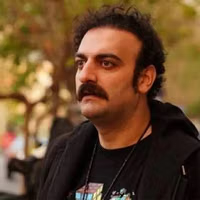
A memorial placard featuring X users Alireza Mousavi Noor, Vahid Mohammadlou, and Hamed Hamidian.
A series of Iranian social media accounts fell silent after their owners were shot during January protests, leaving behind final posts that now read like unfinished testimonies and have turned into digital memorials where protesters mourn, vent anger and hail the fallen.
Across platforms, the pattern repeats: a final slogan, a warning, a declaration — and then silence.
Profiles remain searchable, timelines intact, bios unchanged. Friends return to the comment sections to grieve. Strangers leave messages of defiance.
What began as personal accounts have, in death, become public memorials.
Sam Rezaee: a final slogan
Sam Rezaee was 21 years old when he posted, “Long Live the Shah (King).”
Born in Shiraz, he joined X in 2024 and quickly became active in pro-monarchy circles, mixing political commentary with humor and memes. Friends say he followed online trends closely and cared deeply about how he presented himself, both digitally and in person.
A screengrab of Sam Rezaee’s X page
On January 8, near Saadi Cinema in Shiraz, Sam was struck by pellets in the neck and chest. A source close to the family confirmed that a viral video circulating online shows the moment he was shot.
“He was still alive here,” the source said. “They took him to the hospital, where he later died.”
Iranian slain protester Sam Rezaee
“It is very important for us to let the world know this is how Sam was killed and what they did to him,” the source added.
Sam had graduated from Iran’s elite gifted-students school system and worked in his family’s jewelry shop. He planned to study medicine in Italy.
A childhood photo of killed protester Sam Rezaee, shared by one of his friends with Iran International.
Authorities delayed handing over his body for a week, the source said. Officials tried to pressure the family to declare that he was affiliated with the Basij militia. The family refused and were required to sign a pledge to remain silent.
He was buried under security supervision. Even the 40th-day memorial was sparsely attended.
His timeline remains visible, halted at that final message.
An image of Sam Rezaee’s grave sent to Iran International by one of his friends.
Raha Bohloulipour: a final declaration
Raha Bohloulipour was 23 when she posted her last message.
A first-year Italian literature student at the University of Tehran, she ran a Telegram channel with nearly 24,000 subscribers and had more than 4,500 followers on X.
A screengrab of Raha Bahloulipour’s X page
Her final Telegram post read: “I’ve connected for a moment and I just want to write: Woman, Life, Freedom – forever.” After that, she never returned.
Bohloulipour was killed by live ammunition during protests on January 9 and buried in her hometown of Firouzabad in Fars province, according to colleagues and local sources.
Iranian slain protester Raha Bahloulipour
In the days before her death, she wrote openly about exhaustion and fear.
“I’m disgusted – disgusted, disgusted – and so exhausted with the Islamic Republic. From the moment I stepped into the faculty today until I left, I was in tears... I’m unbearably tired and disgusted with the Islamic Republic.”
An image of Raha Bahloulipour’s grave
In another post she wrote: “…when I leave the dorm, deep down I’m not sure whether I’ll come back at night or not. Living under the shadow of the Islamic Republic.”
Students at the University of Tehran commemorated her during a protest gathering and chanted: “For every one person killed, a thousand stand behind them.”
Her channel remains frozen on that final declaration.
Vahid Mohammadlou: a bio left unchanged
Vahid Mohammadlou, 39, described himself on X as: “Former military man → soldier of Reza Shah II Pahlavi → soldier of the land of Iran || ‘Long live Iran, long live the King.’”
A screengrab of Vahid Mohammadlou’s X page
Posting under @IraniansWarrior, he had more than 3,700 followers.
On January 8 in Sadeghiyeh (Aryashahr), Tehran, he was shot in the eye and died from his injuries, according to family accounts and obituary posts. He left behind two children, aged 9 and 4.
Protester Vahid Mohammadlou, who was shot dead in the eye on January 8 in Tehran, seen here with his children.
In a widely circulated video, his four-year-old daughter hugs his photograph and asks those around her to leave. “Leave the room, I would like only my dad to be next to me,” she says in the heart-wrenching video.
An image of Vahid Mohammadlou's wife at his grave
His bio remains as he wrote it.
Mosayeb Nezami: a call to the streets
Mosayeb Nezami, 32, was a farmer from Borujerd in Lorestan province. He joined X in 2019 and had more than 1,500 followers.
His final post read: “Anger has to move into the streets – only tweeting lets us vent.”
A screengrab of Mosayeb Nezami’s X page
On January 8 in Kourosh Square, Borujerd, he was shot from behind with live ammunition. The bullets struck his shoulder and heart. He died from his injuries.
Nezami had lost his father at age 10 and became the sole breadwinner for his family, supporting two sisters and a younger brother, according to colleagues.
Mosayeb Nezami, a farmer from Borujerd in Lorestan province, who was killed during the January 8 protests.
His account still carries that final line.
Alireza Mousavi Noor: a warning in advance
Alireza Mousavi Noor, 29, known on X as Derakoolaye Ghamgin – Sad Dracula – had more than 10,000 followers.
A screengrab of Alireza Mousavi Noor’s X page
On January 7, he wrote: “If I don’t come online again, don’t forget me. Know that I didn’t die for nothing. Say my name at the celebration of freedom.”
Slain protester Alireza Mousavi Noor
He was shot and killed the next day during protests in Baharestan, Isfahan.
The message now reads as premonition.
An image of slain protester Alireza Mousavi Noor’s grave
Masoud Zatparvar: from influencer to protester
Masoud (Mehdi) Zatparvar was an international bodybuilding coach and two-time World Classic Bodybuilding Overall Champion. His Instagram account had 242,000 followers, and he ran a website providing training and nutrition programs.
A screengrab from Masoud Zatparvar’s Instagram page. He was killed in Rasht, northern Iran, on January 8.A screengrab of Masoud Zatparvar's website
In his final post in January 2026, he wrote: “We only want our rights. A voice that has been stifled in me for forty years must be shouted. You caused what we are going through today. You took our youth, hope, dreams, and even the bare minimum from us. Today I am here – so that tomorrow I don’t look in the mirror and say I had no backbone, no honor. I stood, whatever the cost, I will pay it. I, Masoud Zatparvar, am in the street today. I have neither fear nor worry! I want my rights.”
Slain protester and bodybuilding champion Masoud Zatparvar
He was killed on January 8, in Rasht after being struck by live ammunition, according to local accounts and social media posts.
His Instagram page has not been updated since.
Hamed Hamidian: A plea to Trump
Hamed Hamidian, 38, an X user with more than 7,300 followers who joined the platform in 2009, addressed US President Donald Trump in his final post before the January killings.
A screengrab of Hamed Hamidian’s X page
“Mr. president @realDonaldTrump, since you said you’re watching the situation in Iran, at least 20 people got killed! We can’t beat the devil empty handed, I’m begging you to cut to the chase and finish the Mullahs' regime.”
Hamed Hamidian, 38, was killed during January 8 protests in Tehran
He was later reported killed during the protests on January 8 in Tehran.
An image of Hamed Hamidian's grave
Social media becomes a battleground
Researchers say this transformation — from personal timeline to digital shrine — has become a defining feature of protest movements in Iran.
“In the waves of anti-regime protests sweeping Iran, social media has played a paradoxical yet indispensable role as both a lifeline and a battleground for information and identity,” said Sahar Tahvili, an artificial intelligence and information technology researcher.
“In this environment, control over social media is no longer peripheral to politics — it is the political struggle itself,” she told Iran International.
Even during internet disruptions, users have documented protests through satellite connections, VPNs and diaspora networks, while authorities deployed competing narratives and digital manipulation, she added.
Each account now stands as a frozen timestamp — unfinished testimonies suspended in time. The posts remain, the timestamps fixed, but the authors do not.
Davoud Sohrabi, a 30-year-old bodybuilding champion who was shot in the eye with live ammunition on January 8 during protests in Shahr-e Rey, south of Tehran, died on Monday after more than 50 days in a coma, according to information received by Iran International.
Sohrabi underwent surgery to remove his eye after being transferred to hospital and subsequently fell into a coma. His family later donated his organs.
Videos circulating on social media show Sohrabi participating in a southeast Tehran provincial bodybuilding competition earlier that same afternoon, hours before he joined the protests.
Sohrabi had worked from the age of 14 and later became a bodybuilding coach. Following his death, images of him circulated widely online, with some users comparing his appearance to Turkish actor Can Yaman and others calling him “Iran’s Brad Pitt.”
Slain protester Davoud Sohrabi
His brother announced on Instagram that their mother had been hospitalized due to the physical and psychological toll of her son’s death. Minutes after the post was published, the story was deleted and all images related to Davoud and his funeral were removed from the account. The page later became inaccessible.
IranWire reported that the family has been under heavy pressure from security authorities and was asked to describe Davoud as a Basij member.
A 53-year-old Iranian man was shot dead with what live ammunition while taking out his household trash, as videos and witness accounts point to a pattern of security forces firing on bystanders during unrest last month.
Behzad Nikyar, also known as Behzad Kimasi Selkhori, was killed on the evening of January 9 in the city of Qazvin, according to relatives who spoke to Iran International.
They said he was not taking part in protests and had walked a few meters from his home to leave a garbage bag at the end of his alley when he was struck.
The bullet entered one side of his body and exited the other as he was returning home, relatives said.
Behzad Nikyar
A video said to have been filmed the following morning shows blood stains along an alley in the Khaghani area of Qazvin, which family members say trace the path Nikyar tried to crawl back to his front door. He later died of his injuries. He was the father of one daughter, according to those accounts.
Nikyar’s death comes amid a wave of social media videos and testimonies alleging that security forces opened fire on pedestrians on January 8, 9 and 10, including people described by witnesses as not participating in demonstrations.
One video from Tehran’s Sattarkhan district, recorded by a building’s surveillance camera and circulated online, appears to show three people walking along a sidewalk when two armed men on a motorcycle stop ahead of them and fire in their direction without visible warning.
In Mashhad, a man was shot in the neck on the evening of January 9 while buying groceries about 50 meters from security forces, according to a witness account sent to Iran International.
In the northern city of Rasht, a resident said his elderly mother was hit by multiple pellet rounds in the head and legs after leaving a pharmacy at dusk that day. Another report described a pregnant woman shot outside a pharmacy in Isfahan.
Separately, a 16-year-old boy, Kasra Vafapour, was killed by a gunshot wound to the heart on January 9, according to citizen reports, which said he had gone out to buy medicine for his younger sister.
Residents from several cities, including Neyshabur, Borujerd and Sari, have said that security forces fired pellet rounds “indiscriminately” at passersby in recent weeks.
At least 36,500 people have been killed during the national uprising. Tens of thousands more have been reported injured or detained.
A stuffed rat hung by protesting students at Tehran’s Sharif University and removed by a Basij-affiliated student signaled that supporters of Supreme Leader Ali Khamenei have effectively acknowledged and amplified a mocking nickname that chips away at his authority.
Students at several Iranian universities held a third consecutive day of protests on Monday, chanting against Ali Khamenei. At Amir Kabir, Tehran and Alzahra universities, students set fire to the flag of the Islamic Republic. At some of these universities, including Tehran University, Basij forces attacked students.
The image – a Basij-aligned student climbing up to pull down a stuffed animal – spread quickly online. More than a campus scuffle, it suggested a phrase that began on social media is now being contested in the physical arena of protest and counter-mobilization.
From meme to material symbol
The nickname Rat-Ali gained traction during the June war with Israel, when Khamenei largely disappeared from public view and state media aired only prerecorded video messages. Reports that he had taken shelter in fortified underground facilities during military escalation and later unrest fueled the metaphor.
In Persian, “moush” connotes hiding and evasion. By pairing it with the Supreme Leader’s name, critics flip the state’s image of firm leadership.
On Monday, that inversion took tangible form. The rat was not only an online meme but an object displayed and physically removed.
Political satire often loses force when ignored. Authority can neutralize insult through indifference. The decision by a Basiji student to climb the tree and take down the toy had the opposite effect: it signaled that the symbol was perceived as threatening enough to confront.
Precedent in protest language
Iran’s protest culture has repeatedly transformed ridicule into durable shorthand. After the 2020 US drone strike that killed IRGC Quds Force commander Qasem Soleimani, some Iranians referred to him as “cutlet,” a darkly comic reference to the condition of his remains. The term proved difficult to suppress despite official efforts to preserve Soleimani’s image as a national icon.
However, Moush-Ali carries sharper political implications because it targets the apex of the system. Khamenei’s authority rests not only on constitutional powers but also on cultivated distance – a blend of religious stature and institutional control.
Mockery compresses that distance. A rat hanging from a tree reduces a figure positioned as untouchable into a repeatable visual punchline.
Authoritarian systems rely in part on aura – an impression of inevitability and psychological dominance. When that aura becomes vulnerable to parody, the cost of reaction rises. Suppression can amplify visibility; indifference can appear weak.
The scene at Sharif involved a toy, a tree and a handful of students. Yet the rapid spread of the image suggested a broader recalibration of political language.
The new academic term in Iran has begun under heavy tension, with students at several major universities staging anti-government protests and forcing authorities to confront a familiar dilemma: suppress dissent or risk wider unrest.
In early January, shortly after protests that began over economic grievances spread nationwide, authorities moved classes online in what officials described as a seasonal measure but which students widely viewed as an effort to preempt campus mobilization.
Now, with in-person classes resumed, memorial gatherings for those killed in January’s violent crackdown have evolved into open defiance on campuses in Tehran, Mashhad and Isfahan. Some have escalated into stand-offs between protesting students and pro-establishment groups.
In a notable shift, recent rallies have included chants naming Reza Pahlavi, the exiled son of Iran’s last monarch, as “the leader of Iran’s revolution,” and calling for the restoration of monarchy nearly five decades after the 1979 revolution.
On Monday, students at the University of Tehran organized a ceremony for Mohammad Reza Mohammadi Ali, a master’s student in theology. A group known as United Students reported that the Basij student organization sought to appropriate the event, claiming the deceased had supported the government.
Opposing students responded with chants including “This flower has fallen, a gift to the homeland,” “Woman, Life, Freedom,” and “By the blood of our comrades, we stand to the end.”
At Sharif University of Technology, a silent candlelight vigil turned confrontational after university cultural officials broadcast Quran recitations and music over loudspeakers. Students holding photos of the dead protested what they described as an attempt to drown out the gathering.
Videos circulating online show rival groups facing off. Pro-government students chanted support for Supreme Leader Ali Khamenei and slogans such as “Allahu Akbar” and “Death to America,” while calling for the expulsion of those they labeled “rioters.”
Opposition chants targeted the Islamic Republic, Khamenei, and institutions such as the Basij and the Islamic Revolutionary Guard Corps.
Symbols have become vivid markers of division. Pro-government students carried the flag of the Islamic Republic and burned U.S. and Israeli flags during demonstrations. Opposition students, by contrast, covertly brought in the pre-revolutionary lion-and-sun flag — replaced after 1979 — and raised it during gatherings this week. On Monday, students at three Tehran universities also set fire to the Islamic Republic flag.
Students at two Tehran universities and one in Isfahan have also called for the restoration of their pre-1979 names, which referenced members of the Pahlavi royal family before being changed after the revolution.
University security offices — and, according to student accounts, plainclothes forces believed to be operating from outside campuses — have been present during several confrontations, at times appearing to side with pro-establishment students.
Students report identification cards being photographed and participants filmed, actions widely interpreted as intimidation. Some universities have allegedly sent text messages barring certain students from campus and warning of possible disciplinary proceedings.
The renewed campus unrest places Iran’s leadership in a delicate position. A forceful intervention risks inflaming tensions and pushing protests beyond university gates. Yet allowing sustained mobilization at institutions long regarded as incubators of political activism could embolden broader opposition.
That dilemma is complicated by a longstanding legal safeguard.
A 2000 law prohibits military, police and security forces from entering university campuses to conduct operations, make arrests or use weapons without formal authorization. The measure was enacted after the July 1999 unrest, when vigilantes and plainclothes security forces stormed dormitories at the University of Tehran, triggering nearly a week of nationwide turmoil.
Despite the law, human rights groups and media outlets have documented repeated instances over the years in which security forces entered campuses without authorization, including during recent protests.
The Central Intelligence Agency on Tuesday published a direct message in Farsi on its official X account, urging Iranians to contact the agency securely amid ongoing domestic unrest and heightened Iran-US tensions.
“Hello. The Central Intelligence Agency (CIA) can hear your voice and wants to help you. Below is the necessary guidance on how to securely contact us virtually,” the post said, accompanied by a short video outlining encrypted communication methods.
The message marks the CIA’s most explicit Persian-language public outreach effort, similar to prior calls by Israel’s Mossad but rare for the US agency.
The move appears aimed at gathering intelligence on Iran’s nuclear and military programs, as well as domestic dissent, while providing support to potential informants.
In recent years, several intelligence services - especially the CIA, and to a lesser extent MI6 and Mossad - have normalized open, platform-based messaging that resembles advertising but is intended for secure outreach to potential sources.
In 2025, the head of MI6 used X to unveil “Silent Courier,” a Tor-only dark-web portal for people in hostile or high-risk states - particularly Russia - to contact the agency securely.
In October 2024, the CIA published text and infographic instructions in Mandarin, Korean, and Farsi on how to securely contact the agency through its public and dark‑web (onion) sites.