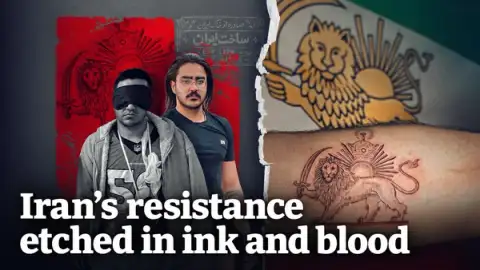
Iran's historic Lion and Sun flag has had a resurgence with latest round of widespread protests after nearly half a century of absence from the country's official identity.
Carried by some demonstrators from the earliest days of the unrest, it served as a visual rejection of the Islamic Republic’s theocratic rule.
But after exiled Prince Reza Pahlavi called on Iranians abroad to replace the Islamic Republic’s flag at embassies and consulates, the Lion and Sun moved to the center of Iran’s political narrative.
Even before that call, an Iranian protester climbed the wall of Iran's embassy in London to replace the official flag with the Lion and Sun. The footage spread rapidly online and was even shared by US President Donald Trump.
The act was repeated the following day, turning the embassy into a symbolic battleground over national identity.
Similar actions followed in Canberra, Stockholm, Oslo, Rome, Munich, Hamburg, and Ljubljana, where Iranians replaced official symbols, installed flags at entrances, or painted the Lion and Sun emblem and protest slogans on diplomatic buildings.
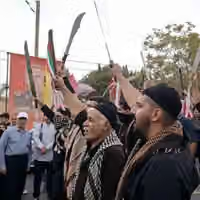
Videos from several cities inside Iran showed protesters carrying or displaying the Lion and Sun during demonstrations–an instant visual marker that a local protest was part of a broader national movement.
For many, the flag is less about monarchism and more about distancing themselves from the Islamic Republic. Its power lies in clarity. In a single image, it communicates rejection of the regime and identification with an alternative vision of Iran.
That efficiency has made it one of the most repeated visual motifs of the current unrest.
And that is perhaps why X also decided to change its Iran flag icon to the Lion and Sun.
The endurance of the tricolor
Iran’s green, white, and red tricolor was formalized during the Constitutional Revolution of the early 20th century, when the idea of a modern Iranian nation-state first took shape. Over time, the colors acquired widely accepted meanings: green for vitality and land, white for peace and clarity, red for courage and sacrifice.
What makes the tricolor distinctive is its continuity. It has survived monarchies, coups, revolutions, and war with minimal dispute. Across political divisions, it remained one of the few symbols broadly viewed as “Iranian” rather than “governmental.”
The Lion and Sun emblem is among Iran’s oldest political symbols. Its formal use dates back to the Safavid era and was standardized under the Qajars and later the Pahlavis as a lion holding a sword beneath a radiant sun.
In Iranian symbolism, the lion represents power, guardianship, and independence; the sun conveys enlightenment, sovereignty, and renewal. Together, they evoke a civilizational memory that predates the Islamic Republic.
This layered meaning explains why many Iranians view the emblem as representing Iran itself rather than a specific political system.
After 1979: a symbolic rupture
After the 1979 revolution, the Islamic Republic removed the Lion and Sun and replaced it with a new emblem built from stylized Islamic inscriptions.
The post-revolutionary clerical government viewed the Lion and Sun symbol as representing the "oppressive Westernising monarchy."
Over four decades of its placement on ministry façades, military uniforms, public buildings, textbooks, and state media, the emblem increasingly became seen as the “flag of the Islamic Republic” – not the “flag of Iran.”
This symbolic rupture explains why the Lion and Sun resurfaces during moments of crisis – from 2009 to 2019 to 2022, and now again. Its return in 2026 is simply its most visible resurgence.
Many leftists, republicans, and nationalists avoided it, wary of monarchist associations. This year’s protests have altered that calculus. The scale of unrest and the need for a non-regime symbol have softened ideological boundaries.
Many Iranians with no attachment to monarchy now carry the Lion and Sun as a marker of resistance, not restoration, as a symbol of “Iran without the Islamic Republic.”
In a moment of complete digital blackout, censorship and repression, symbols have again become the language of the street – durable, replicable, and difficult to silence.
Whether the lion and sun becomes a temporary emblem of a protest movement or a lasting symbol of a future political order remains one of the most consequential questions emerging from this year’s unrest.