Canada orders Iranian man deported over role in sanctions evasion
Passengers carry their luggage at Toronto Pearson International Airport, following the end of the Air Canada labour strike, in Mississauga, Ontario, Canada, August 19, 2025.
Canada's Immigration and Refugee Board has ordered the deportation of an Iranian man living in Toronto over his role in a criminal network that helped Iran evade international sanctions, Global News reported Wednesday, citing a 36-page ruling.
Amin Yousefijam, a former Tehran police lieutenant who has lived in Canada since 2016, helped coordinate shipments of restricted equipment from the United States to Iran through the United Arab Emirates, the board found, according to the report.
The shipments included electronics, motors and other dual-use goods with both civilian and military applications. Global News reported that some of the materials could potentially be used in the manufacture of weapons of mass destruction.
The deportation order was issued in July but only released to Global News this week. The board found that Yousefijam played an essential role in an operation that violated Canadian and US sanctions, although his involvement was more limited than that of his brother, Arash Yousefijam, who led the scheme.
Yousefijam was arrested in Toronto in 2021 and extradited to the United States, where he pleaded guilty to sanctions violations, the report said. After returning to Canada, he legally changed his name to Ameen Cohen.
The immigration board found that he intentionally failed to disclose his US conviction when applying for the name change, rejecting his explanation that he had been advised not to report convictions outside Canada.
The Canada Border Services Agency argued that Yousefijam posed a threat to national security. The board found insufficient evidence that he remained a security threat, however, and instead ordered his deportation on the grounds of membership in a criminal organization.
Global News quoted Yousefijam as saying he remained in Canada and was considering his legal options. He declined to say whether he had appealed the deportation order.
The case comes amid a broader Canadian effort to remove people with ties to the Islamic Republic, although Yousefijam's deportation is separate from proceedings targeting senior Iranian government officials.
According to Canada Border Services Agency figures, authorities had identified 40 senior Iranian officials living in Canada as of October 1. Two had been deported, eight had left voluntarily and two more were awaiting removal.
The Revolutionary Guards' threat to target undersea internet cables in the Strait of Hormuz raises questions about its feasibility, as the waterway carries a fraction of global bandwidth and damaging its cables would not shut down the world's internet.
Yadollah Javani, the Revolutionary Guards' political deputy, warned on Wednesday, October 21, that vital internet cables in the Strait of Hormuz could be targeted if Iranian infrastructure came under attack.
The strait's importance to global oil and gas shipments may suggest that it holds similar significance for international internet traffic. Telecommunications data, however, paints a different picture.
According to the International Cable Protection Committee (ICPC), five active submarine cable segments pass through the Strait of Hormuz, accounting for less than one percent of the world's international bandwidth.
Telecommunications research firm TeleGeography identifies three major cable systems serving the route: Asia Africa Europe-1 (AAE-1), FALCON and Gulf Bridge International (GBI).
The principal data routes linking Europe and East Asia pass through the Red Sea, meaning the strategic importance of Hormuz to global energy markets does not translate into equivalent influence over the internet.
Cables serving Iran's neighbors
Submarine cables crossing the Strait of Hormuz, according to TeleGeography, have been routed through Omani waters because of longstanding political considerations and difficulties in relations with Iran.
These cables primarily serve countries in the Persian Gulf, meaning an attack would pose a more immediate threat to regional connectivity than to the wider global internet.
Damage to submarine cables in the Strait of Hormuz could disrupt international connectivity in Bahrain, Qatar, Kuwait and the United Arab Emirates, although all four countries have alternative terrestrial connections. Saudi Arabia is less dependent on Persian Gulf cable routes, with most of its international bandwidth carried through systems landing on its Red Sea coast.
Why cutting cables does not mean cutting internet access
The global internet does not depend on a single network or point of failure. Telecommunications operators use multiple submarine and terrestrial routes to carry data and can redirect some traffic when a connection becomes unavailable.
Such rerouting may reduce speeds, increase latency or disrupt certain services, but it does not necessarily disconnect users entirely.
Damaging a cable is also fundamentally different from depriving a country of internet access. The outcome depends on the number of affected routes, operators' dependence on them and the capacity remaining elsewhere in the network.
Mehdi Saremifar, a Canada-based technology expert, described earlier Revolutionary Guards threats against submarine cables as largely rhetorical in an interview with Iran International.
Referring to similar threats made by Iranian authorities during the summer, Saremifar said their calculations had used the total volume of global submarine cable traffic rather than the much smaller amount passing through the Strait of Hormuz.
"These cables carry much of the traffic for countries along the southern shores of the Persian Gulf, Kuwait, parts of Iraq, Jordan and Syria. That means traffic in these areas would be affected, but not all of it," Saremifar said.
Alternative terrestrial connections, including routes through Saudi Arabia and Egypt, could carry some of the displaced traffic, Saremifar said, adding that Iran's earlier threats had already encouraged consideration of backup routes.
"So it is neither a particularly far-reaching threat nor a particularly serious one," Saremifar said.
He also questioned the operational significance of the earlier warning, noting the institutional background of the Revolutionary Guards official who issued it. Evidence of actual naval movements toward the cables would warrant a different assessment, he said.
Damage could disrupt communications and economic activity in Persian Gulf commercial centres, but would not necessarily produce a prolonged internet outage, Saremifar added.
What the Red Sea disruptions reveal
Previous submarine cable failures have disrupted communications without shutting down internet access across entire regions.
In February 2024, three cables were damaged in the Red Sea, most likely by the dragging anchor of the Rubymar, a cargo ship struck by Houthi missiles. Repairs took six months, according to TeleGeography.
Four submarine cables were damaged in the Red Sea in September 2025, disrupting connectivity across parts of the Middle East and Asia, according to the Center for Strategic and International Studies.
In March 2024, damage to four cables off West Africa disrupted internet services in 13 countries. Operators rerouted some traffic through unaffected submarine and terrestrial networks, according to the Internet Society.
These cases illustrate an important distinction: the time required to repair a cable is not necessarily the length of the resulting internet disruption. Operators may restore some services through alternative networks before physical repairs are completed.
Security risks in the Persian Gulf could delay cable repairs by restricting access for specialized vessels. However, the availability of alternative submarine and terrestrial routes means delayed repairs would not necessarily cause a prolonged internet shutdown across the region.
Legal constraints on targeting submarine cables
Submarine communications cables are also subject to international legal protections.
The United Nations Convention on the Law of the Sea protects the laying and maintenance of submarine cables under Article 79, while Article 113 requires states to criminalize certain intentional or negligently caused damage to cables beneath the high seas.
Legal responsibility would depend on factors including the location of an attack, applicable jurisdiction and the international obligations of the countries involved.
During armed conflict, international humanitarian law also applies.
According to the International Committee of the Red Cross, civilian communications infrastructure is generally protected against direct attack unless it meets the specific criteria for becoming a military objective.
Military use of part of a communications network does not automatically make the entire network a lawful target. The principles of distinction, proportionality and precaution must still be observed.
Workers install the 2Africa undersea cable on the beach in Amanzimtoti, South Africa, February 7, 2023.
These requirements are particularly relevant to cables carrying civilian communications for several countries simultaneously.
The gap between the threat and the internet's reality
Javani's warning follows earlier threats by Iranian officials against submarine internet infrastructure in the Persian Gulf.
Yet the Strait of Hormuz's limited share of international bandwidth, together with the availability of alternative routes, means that even substantial damage to cables in the area would not amount to a global internet shutdown.
The more immediate consequences could fall on Persian Gulf Arab states and businesses dependent on regional connectivity.
The threat therefore highlights a gap between the Revolutionary Guards' warnings and the technical and geographical limits of carrying them out: cables in the Strait of Hormuz can be damaged, but the global internet does not depend on them to remain operational.
Pakistani border guards and officials gather at the Jalgai border crossing between Pakistan and Iran, with cargo trucks lined up in the background.
Trade between Iran and Pakistan remained suspended at two major border crossings on Tuesday, leaving trucks and cargo stranded, with Pakistani authorities citing security and anti-smuggling measures and Iran pointing to technical difficulties.
Commercial traffic through the Gabd-Rimdan and Taftan crossings was halted as of October 20, although passenger movement reportedly continued at Gabd-Rimdan.
Pakistan described the suspension as a temporary measure to strengthen security and combat smuggling, while Iran attributed the disruption to technical issues and precautionary measures.
The two countries remain in contact to resolve the problem, Iranian Foreign Ministry spokesman Esmail Baghaei said on Tuesday.
The closures come as Iran increasingly relies on land routes to sustain foreign trade following restrictions on maritime shipping during the war.
Before the conflict and the US military blockade of Iran's southern ports, more than 80 percent of the country's foreign trade passed through the southern ports of Rajaei and Khomeini.
The diversion of shipments to road networks has increased transport costs and congestion, although land crossings lack the capacity to replace maritime trade.
Thousands of trucks stranded
Iranian media had already reported queues of approximately 3,000 trucks at Rimdan before the latest suspension, with some drivers waiting between 20 and 30 days to cross.
Limited processing capacity on the Pakistani side and requirements to transfer cargo from Iranian trucks to Pakistani vehicles have contributed to the delays.
An industry circular issued in August also described difficulties unloading Iranian trucks in Pakistan and transferring their cargo.
“I urge all truck drivers not to bring cargo toward the borders. The situation is so bad that since last night and throughout October 20, huge queues of trucks have been turning back. The border is closed and is being cleared. Do not come!” a person affected by the disruption told Iran International.
Another person contacted the broadcaster with a similar warning, urging drivers to avoid sending additional shipments until the crossings reopen.
The latest suspension has increased the risk of prolonged vehicle inactivity and financial losses for transport operators and cargo owners.
Talks continue on reopening
Negotiations with Pakistani authorities to remove obstacles at Rimdan were continuing, border market director Abdolsalim Hoot said on October 18, adding that perishable goods were receiving priority.
An official in Pakistan's Balochistan province also described progress in negotiations and the possibility of reopening the crossings soon.
No timetable for resuming commercial traffic had been announced by Tuesday.
Iran and Pakistan had previously set a target of increasing annual bilateral trade to $10 billion, but border disruptions, banking difficulties and limited freight capacity have complicated efforts to reach that goal.
The suspension also coincides with Washington's efforts to increase economic pressure on the Islamic Republic, including warnings of sanctions against countries and companies maintaining financial and commercial dealings with Iran.
Between 30 and 40 of Iran’s operational aircraft were destroyed during the war, while another 70 to 80 were hit, Iran Air chief executive Taher Abdolhai said on Monday.
Abdolhai said Iran had a little over 300 aircraft in total, but only around 130 to 140 were operational before the latest losses, according to Nournews, a media outlet close to Iran’s Supreme National Security Council.
He said the scale of damage varied. Some aircraft were hit by missiles and suffered holes in their fuselages, while one Iran Air aircraft was “completely pulverized.”
Wartime losses cut into an already limited fleet
The figures suggest the war significantly reduced an aviation fleet that was already constrained by sanctions, aging aircraft and difficulties obtaining spare parts.
Abdolhai’s estimate is higher than some earlier figures given by Iranian officials. The secretary of Iran’s Association of Airlines had previously estimated that about 20 aircraft suffered serious damage.
Mohammadreza Rezaei Kouchi, head of parliament’s Civil Commission, had separately said around 50 aircraft were damaged and 10 destroyed.
It remains unclear how many of the damaged aircraft can be repaired and returned to service.
Sanctions have long constrained Iran’s aviation sector
Iran’s commercial aviation industry has for years faced restrictions on buying aircraft, sourcing parts, carrying out maintenance and receiving services at some foreign airports.
Abdolhai said those restrictions had made it harder for Iran Air to maintain its fleet and had also cut the airline off from some profitable markets.
The wartime losses have added another layer of pressure by shrinking the pool of aircraft available for commercial flights and reducing the industry’s ability to preserve routes and revenue.
Final scale of damage remains unclear
Abdolhai did not give a final estimate for the financial cost of the losses or say how many damaged aircraft were beyond repair.
The differing figures offered by Iranian officials also make the full scale of the damage difficult to establish independently.
An Iranian ballistic missile launches from a desert test site, sending clouds of dust and smoke into the air.
Iranian military officials warned of a stronger response to any renewed US attack on Monday, as Russia's foreign minister visited Tehran for talks and regional security concerns grew following Houthi attacks on Saudi Arabia.
Russian Foreign Minister Sergei Lavrov met his Iranian counterpart Abbas Araghchi during an official visit, with talks also planned with President Masoud Pezeshkian.
The visit came as Iranian officials discussed the prospect of renewed fighting with the United States and the country's military capabilities.
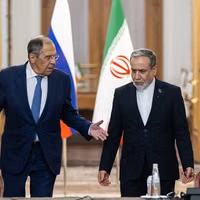
Russian Foreign Minister Sergei Lavrov (left) and Iranian Foreign Minister Abbas Araghchi hold talks in Tehran on October 19, 2026.
Iran threatens US against new attack
The Revolutionary Guards said that Iran would respond more forcefully to any renewed US military action.
“The US entered the war with all its might, and it is certainly not in a position now to start a new conflict that would bring it any new gains,” Revolutionary Guards spokesman Hossein Mohebi said on Monday.
Mohebi said most US bases in the region were inactive and American forces had moved hundreds of kilometers away from Iran.
Revolutionary Guards deputy commander Mostafa Izadi said US naval forces had moved approximately 700 kilometers away to avoid Iranian missiles, according to the Guards-affiliated Fars news agency.
Senior Guards adviser Mohammadreza Naghdi separately said Iran's missile facilities had survived heavy bombardment and its strategic stockpiles remained intact.
Germany summons Iranian ambassador
Germany summoned Iran's ambassador on Monday over attempted attacks targeting Josef Schuster, head of the Central Council of Jews in Germany, and Volker Beck, chairman of the German-Israeli Society.
“Attacks on Jewish life and on those who defend it are something we will not tolerate - anywhere, and especially not in Germany,” the German Foreign Ministry wrote on X.
The ministry condemned Iran's activities and said the attempted attacks would have legal consequences.
Israeli Foreign Minister Gideon Sa'ar also criticized Araghchi after the Iranian foreign minister accused French President Emmanuel Macron of supporting US military action against Iran.
Sa'ar accused Iran of suppressing protesters at home while criticizing France over its response to unrest.
Regional security concerns grow
Saudi Arabia's Civil Defense said the danger had passed in the southern Najran region after an earlier alert over a potential threat.
The announcement followed a Houthi attack on a Yemeni government military camp in Shabwa province that killed at least 18 people, Reuters reported, citing government and medical sources.
The US State Department urged Americans across the Middle East to exercise heightened vigilance, warning that Houthi attacks could disrupt flights and airspace.
The US Embassy in Riyadh separately warned that Iran and groups supporting it could target American interests overseas.
Economic uncertainty weighs on Iran
The prospect of renewed conflict has also affected economic activity, according to an Iranian lawmaker.
“When conditions are unstable, no one can make decisions about their life and future; they cannot make a deal, invest or take action,” Mohammadmehdi Shahriari, a member of parliament's national security committee, said on Monday.
Shahriari said proposals for negotiations with Washington had been raised and officials should be allowed to formulate a response.
Another lawmaker, Mohammad Rashidi, rejected suggestions that Iran's economy was approaching collapse under US pressure.
Meanwhile, Iran Air chief executive Taher Abdolhay said the national airline had only six operational aircraft despite employing more than 9,000 people, down from a fleet of 40.
Abdolhay cited operational restrictions and air traffic difficulties, adding that the airline had faced obstacles to flights intended to bring medicine into Iran.
The developments featured the competing pressures facing Iran, with officials emphasizing military preparedness and diplomatic engagement as concerns over renewed fighting continue to affect regional security and economic activity.
Iranian officials raised the possibility of a shift in nuclear policy and threatened retaliation against further US-Israeli attacks, while Tehran outlined its conditions for reopening the Strait of Hormuz on Sunday.
The developments came after Iran's parliament approved a new defense minister with longstanding ties to the Revolutionary Guards' missile program, and Israeli Prime Minister Benjamin Netanyahu called for eliminating what he described as the Iranian threat.
Nuclear doctrine comes under scrutiny
Iran's new supreme leader, Mojtaba Khamenei, may take a different position on nuclear weapons from his late father, Ali Khamenei, whose religious ruling opposed their development, Iranian lawmaker Ahmad Naderi said.
“From Mojtaba Khamenei's conduct, my understanding is that his fatwa will be different,” Naderi told.
Naderi separately expressed his own support for acquiring an atomic bomb, saying he had advocated the move for more than a decade and believed Iran should pursue what he called ultimate military deterrence.
Calls for nuclear deterrence have become more prominent among Friday prayer leaders and representatives of the supreme leader, Naderi added.
The remarks came after US Vice President JD Vance said Washington had achieved a decisive military advantage over Iran but could not consider the conflict finished without a firm commitment that Tehran would not rebuild its nuclear program.
Vance also linked US involvement to energy security, warning that Iranian control over shipping through the Strait of Hormuz could increase gasoline prices.
Hormuz proposal remains unresolved
Iran's seven-day proposal for reopening the Strait of Hormuz remains under consideration, with Tehran reviewing Washington's comments, Foreign Minister Abbas Araghchi said.
“Our conditions are completely clear and were presented to the United States in the form of a seven-day plan,” Araghchi said.
Under the proposal, the strait would reopen on the sixth day if Washington met Iran's conditions, with negotiations resuming on the seventh, Araghchi added.
The conditions were fair and had previously been accepted by the United States, he said.
New defense minister threatens retaliation
Iran's parliament approved Mehrdad Akhlaghi Ketabchi for the post of defense minister with 237 votes in favor and 15 against.
Akhlaghi, a sanctioned veteran of Iran's missile industry, replaces Aziz Nasirzadeh, who was killed during the opening day of US-Israeli strikes in February.
The new minister warned that any further American attack would bring casualties among US personnel stationed in the region.
“If he drops one bomb, he should see how many of his people he will have to carry out horizontally (dead),” Akhlaghi said, referring to President Donald Trump.
Iran's armed forces have also prepared a new operational plan for any renewed attack, Supreme National Security Council Secretary Mohsen Rezaei said.
The plan would be more destructive than those used during the previous wars and would not follow familiar patterns, Rezaei added.
Army commander-in-chief Amir Hatami separately urged the new defense minister to accelerate military modernization, citing the impact of recent wars and international sanctions.
Israel presses for further action
The complete elimination of what Israel considers the Iranian threat remains a central objective for the remainder of Trump's presidency, Netanyahu said in an interview with Life, Liberty & Levin.
Netanyahu argued that military and economic pressure should continue and called for the eventual removal of Iran's current political leadership.
The Israeli prime minister also said Tehran is pursuing intercontinental ballistic missiles capable of reaching the United States and seeking nuclear warheads for them.
Separately, Iran's hardline Kayhan newspaper urged strikes against Israeli nuclear facilities if Washington attacked the underground Pickaxe Mountain complex near Natanz.
The warning followed Trump's suggestion that US forces could target the fortified site.
The statements underscored the competing priorities shaping the confrontation: Washington's demand for guarantees against renewed Iranian nuclear activity, Tehran's conditions for restoring maritime access, and continuing threats of military escalation from both sides.