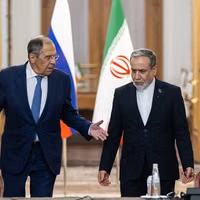
Russian Foreign Minister Sergei Lavrov and his Iranian counterpart Abbas Araghchi during talks in Tehran, October 20, 2026.
Russian President Vladimir Putin discussed Iran with US envoy Steve Witkoff on Wednesday and offered Moscow’s help, shortly after Foreign Minister Sergei Lavrov visited Tehran as Russia seeks a role in efforts to end the Iran-US conflict.
The meeting adds to signs that Moscow is positioning itself as both an ally of Tehran and a potential intermediary with Washington as diplomatic efforts remain deadlocked over Iran’s nuclear program and the sequencing of commitments.
Earlier this month, Putin said Russia was prepared to do everything it could to help resolve the crisis and subsequently conveyed Tehran’s position to US President Donald Trump. Neither the contents of the message nor Washington’s response was made public.
In Tehran on Tuesday, Iranian Foreign Minister Abbas Araghchi said the two countries had “never” worked as closely as they do now, while Lavrov described Iran’s cause as “just” and said Russian specialists who left the Bushehr nuclear power plant during the war were gradually returning.
Yet Iranian media and commentators questioned how much Moscow could achieve as an intermediary given the fundamental differences between Tehran and Washington.
Tabnak, a news website considered close to Supreme National Security Council Secretary Mohsen Rezaei, said Moscow could help by conveying messages, consulting with both capitals and supporting a political solution, but cautioned that no mediator could overcome the underlying disagreements on its own.
“As long as fundamental disagreements over the terms of an agreement persist, no mediator can guarantee success,” it wrote, citing differences over the sequencing of negotiations and the scope of commitments.
The reformist outlet Rouydad24 said there was little evidence Moscow had brought a comprehensive plan capable of breaking the deadlock.
“What has so far been presented by official Iranian and Russian sources points less to a ‘grand peace plan’ than to the continuation of Russia’s traditional role as a facilitator of dialogue,” it wrote.
Uranium emerges as key obstacle
A central obstacle in the diplomatic impasse is Iran’s stockpile of uranium enriched to 60%.
Russian officials, including Deputy Foreign Minister Sergei Ryabkov, have indicated that Moscow is prepared to receive the stockpile, a move that could address one of the central concerns surrounding Iran’s nuclear program.
Tehran, however, has rejected the idea of transferring its enriched uranium abroad and denied that nuclear negotiations with Washington are under way.
The position was reiterated during Pakistani army chief Asim Munir’s visit to Tehran on Tuesday. Rezaei told Munir that none of Iran’s enriched material would leave the country, describing it as a national asset intended for domestic use.
Before Lavrov’s arrival, conservative political activist Ali Gholhaki claimed Russia had been partly persuaded by an Iranian proposal, advanced when Ali Larijani was secretary of the Supreme National Security Council, to establish a framework for transferring uranium enriched to 60%.
But following the visit, Gholhaki said Lavrov had produced no tangible result and had left “without any particular achievement.”
The conservative newspaper Khorasan argued that negotiating over Iran’s enriched uranium could increase rather than reduce the danger of another attack.
It argued that while Iran did not possess a nuclear deterrent, its stockpile of highly enriched uranium itself acted as a form of deterrence by raising the risks of further US escalation.
Mohammad-Sadegh Alizadeh, a journalist interviewed by the conservative Farhikhtegan newspaper, said Tehran’s immediate priority should instead be ending the war on terms acceptable to Iran.
“Whether the Russians have agreed to accept Iran’s 440 kilograms of uranium enriched to 60% is a secondary issue to be addressed later,” he said. “First, the question of ending the war must be settled.”
Doubts over Moscow’s interests
Doubts about Russia’s intentions extend beyond whether it can bridge the divide between Tehran and Washington.
Reformist journalist Ahmad Zeidabadi argued that Iranian decision-makers should nevertheless welcome any Russian initiative capable of stopping another war.
“Russian interference is an evil, of course, but compared with the prospect of another war, it is the lesser evil,” he wrote on Telegram.
Commentator Mehran Tabatabaei argued that Moscow’s approach to Iran remained subordinate to its negotiations with Washington over Ukraine.
“Russia will not take any positive steps until it resolves the Ukraine issue and obtains the concessions it wants from the United States over Ukraine,” he wrote.
Journalist Mohammad Aghazadeh offered a starker assessment, saying failure by Lavrov to make progress would suggest diplomacy itself was approaching a dead end.
“Either the current state of uncertainty will continue, or an intense war will begin,” he wrote, “one that will probably not be as easy to end as it is to start.”
The Revolutionary Guards' threat to target undersea internet cables in the Strait of Hormuz raises questions about its feasibility, as the waterway carries a fraction of global bandwidth and damaging its cables would not shut down the world's internet.
Yadollah Javani, the Revolutionary Guards' political deputy, warned on Wednesday, October 21, that vital internet cables in the Strait of Hormuz could be targeted if Iranian infrastructure came under attack.
The strait's importance to global oil and gas shipments may suggest that it holds similar significance for international internet traffic. Telecommunications data, however, paints a different picture.
According to the International Cable Protection Committee (ICPC), five active submarine cable segments pass through the Strait of Hormuz, accounting for less than one percent of the world's international bandwidth.
Telecommunications research firm TeleGeography identifies three major cable systems serving the route: Asia Africa Europe-1 (AAE-1), FALCON and Gulf Bridge International (GBI).
The principal data routes linking Europe and East Asia pass through the Red Sea, meaning the strategic importance of Hormuz to global energy markets does not translate into equivalent influence over the internet.
Cables serving Iran's neighbors
Submarine cables crossing the Strait of Hormuz, according to TeleGeography, have been routed through Omani waters because of longstanding political considerations and difficulties in relations with Iran.
These cables primarily serve countries in the Persian Gulf, meaning an attack would pose a more immediate threat to regional connectivity than to the wider global internet.
Damage to submarine cables in the Strait of Hormuz could disrupt international connectivity in Bahrain, Qatar, Kuwait and the United Arab Emirates, although all four countries have alternative terrestrial connections. Saudi Arabia is less dependent on Persian Gulf cable routes, with most of its international bandwidth carried through systems landing on its Red Sea coast.
Why cutting cables does not mean cutting internet access
The global internet does not depend on a single network or point of failure. Telecommunications operators use multiple submarine and terrestrial routes to carry data and can redirect some traffic when a connection becomes unavailable.
Such rerouting may reduce speeds, increase latency or disrupt certain services, but it does not necessarily disconnect users entirely.
Damaging a cable is also fundamentally different from depriving a country of internet access. The outcome depends on the number of affected routes, operators' dependence on them and the capacity remaining elsewhere in the network.
Mehdi Saremifar, a Canada-based technology expert, described earlier Revolutionary Guards threats against submarine cables as largely rhetorical in an interview with Iran International.
Referring to similar threats made by Iranian authorities during the summer, Saremifar said their calculations had used the total volume of global submarine cable traffic rather than the much smaller amount passing through the Strait of Hormuz.
"These cables carry much of the traffic for countries along the southern shores of the Persian Gulf, Kuwait, parts of Iraq, Jordan and Syria. That means traffic in these areas would be affected, but not all of it," Saremifar said.
Alternative terrestrial connections, including routes through Saudi Arabia and Egypt, could carry some of the displaced traffic, Saremifar said, adding that Iran's earlier threats had already encouraged consideration of backup routes.
"So it is neither a particularly far-reaching threat nor a particularly serious one," Saremifar said.
He also questioned the operational significance of the earlier warning, noting the institutional background of the Revolutionary Guards official who issued it. Evidence of actual naval movements toward the cables would warrant a different assessment, he said.
Damage could disrupt communications and economic activity in Persian Gulf commercial centres, but would not necessarily produce a prolonged internet outage, Saremifar added.
What the Red Sea disruptions reveal
Previous submarine cable failures have disrupted communications without shutting down internet access across entire regions.
In February 2024, three cables were damaged in the Red Sea, most likely by the dragging anchor of the Rubymar, a cargo ship struck by Houthi missiles. Repairs took six months, according to TeleGeography.
Four submarine cables were damaged in the Red Sea in September 2025, disrupting connectivity across parts of the Middle East and Asia, according to the Center for Strategic and International Studies.
In March 2024, damage to four cables off West Africa disrupted internet services in 13 countries. Operators rerouted some traffic through unaffected submarine and terrestrial networks, according to the Internet Society.
These cases illustrate an important distinction: the time required to repair a cable is not necessarily the length of the resulting internet disruption. Operators may restore some services through alternative networks before physical repairs are completed.
Security risks in the Persian Gulf could delay cable repairs by restricting access for specialized vessels. However, the availability of alternative submarine and terrestrial routes means delayed repairs would not necessarily cause a prolonged internet shutdown across the region.
Legal constraints on targeting submarine cables
Submarine communications cables are also subject to international legal protections.
The United Nations Convention on the Law of the Sea protects the laying and maintenance of submarine cables under Article 79, while Article 113 requires states to criminalize certain intentional or negligently caused damage to cables beneath the high seas.
Legal responsibility would depend on factors including the location of an attack, applicable jurisdiction and the international obligations of the countries involved.
During armed conflict, international humanitarian law also applies.
According to the International Committee of the Red Cross, civilian communications infrastructure is generally protected against direct attack unless it meets the specific criteria for becoming a military objective.
Military use of part of a communications network does not automatically make the entire network a lawful target. The principles of distinction, proportionality and precaution must still be observed.
Workers install the 2Africa undersea cable on the beach in Amanzimtoti, South Africa, February 7, 2023.
These requirements are particularly relevant to cables carrying civilian communications for several countries simultaneously.
The gap between the threat and the internet's reality
Javani's warning follows earlier threats by Iranian officials against submarine internet infrastructure in the Persian Gulf.
Yet the Strait of Hormuz's limited share of international bandwidth, together with the availability of alternative routes, means that even substantial damage to cables in the area would not amount to a global internet shutdown.
The more immediate consequences could fall on Persian Gulf Arab states and businesses dependent on regional connectivity.
The threat therefore highlights a gap between the Revolutionary Guards' warnings and the technical and geographical limits of carrying them out: cables in the Strait of Hormuz can be damaged, but the global internet does not depend on them to remain operational.
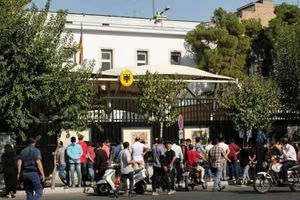
Iranian applicants for German work and vocational-training visas protest outside the German Embassy in Tehran over delays in securing appointments.
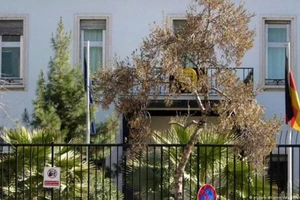
Iranians seeking German work and vocational-training visas protested outside the German Embassy in Tehran on Tuesday over lengthy delays in securing appointments, with some saying they had already lost job offers or training places while waiting.
Some applicants told Iran International they had been waiting since July for appointments despite already receiving preliminary approval from German authorities. They included healthcare and nursing professionals seeking work visas, as well as applicants using Germany’s fast-track procedure for skilled workers.
Some said the delays had caused language certificates or preliminary approvals to expire, forcing them to repeat parts of the process and pay additional costs.
Applicants say delays are costing them jobs
The protesters also include applicants for Germany’s Ausbildung system, which combines workplace training with classroom instruction and typically lasts between two and three-and-a-half years.
Applicants told Iran International that appointments had been released only in small numbers despite repeated protests and correspondence with German authorities. Some said they had lost job offers or places on vocational programs because they could not complete the visa process in time.
Thousands of people are reported to be waiting for appointments to submit German visa applications in Tehran.
Family reunification applicants have also protested
The latest gathering follows repeated protests by Iranians seeking other types of German visas.
Family reunification applicants have demonstrated outside the embassy in recent weeks, with some saying they have waited as long as two years for appointments or decisions.
Videos sent to Iran International showed applicants calling for faster processing and an end to prolonged uncertainty.
Students have faced similar delays, with some saying they risk losing university places because they cannot complete the visa process before their courses begin.
Embassy remains on emergency operations
Germany’s Foreign Office told Iran International in August that its embassy in Tehran remained open but that its consular and visa section was operating in emergency mode because of the security situation.
“The visa section is closed to regular visitors until further notice; no regular visa appointments are being issued,” the ministry said at the time.
Applications already submitted through the embassy or an external service provider were continuing to be processed where capacity allowed, and visas already approved could still be issued.
Berlin said the latest crisis had worsened problems that had already affected the visa section since June last year, when conflict between Iran and Israel forced several foreign embassies to reduce or suspend consular operations.
Germany also said staffing had been affected by restrictions imposed by Iranian authorities on diplomatic accreditations.
Germany offers limited alternatives for some visa applicants
Germany’s Foreign Office told Iran International in August that it had introduced alternative arrangements for some Iranians affected by the reduced visa services in Tehran.
Family reunification applicants who had already joined the embassy’s waiting list were being contacted to submit applications in Istanbul through the International Organization for Migration’s Family Assistance Programme. Priority was being given to people whose appointments in Tehran had been canceled because of the war.
The ministry also said visa provider TLScontact was issuing appointments to some applicants with preliminary approval under Germany’s fast-track skilled-worker procedure.
Since July, new waiting lists have also been opened for several national visa categories, including students and doctors, although German authorities had not said when those applicants would receive appointments.
Asking for a divorce, refusing a marriage, speaking to a man she did not know: in Iran, each has preceded the killing of a woman or girl by her own family, according to a Shargh daily investigation that counted at least 38 dead in two months.
The Shargh daily documented at least 38 women and children killed in 28 cases over a two-month period from late August to late October in an investigation published Wednesday. Thirteen of the victims were under 18.
In most cases, the perpetrators were men close to the victims, including husbands, fathers, brothers and other relatives. Some women were killed after seeking separation, while girls were murdered after resisting decisions imposed on them by their families.
Femicide is not confined to disadvantaged areas, less educated households or traditional communities, Pegah Banihashemi, a senior legal researcher at the University of Chicago, told Iran International.
Banihashemi pointed to cases involving educated couples and professional households, saying educational achievement alone does not necessarily eliminate attitudes that treat women as subject to male authority.
Figures compiled by rights organizations indicate the wider scale of the violence. The Norway-based rights group Hengaw documented at least 207 femicides in Iran in 2025 and another 45 during the first six months of 2026.
When personal choices become grounds for killing
One of the cases examined by Shargh involved a 16-year-old girl in the western Iranian city of Kermanshah whose father shot her dead while she slept.
The girl had resisted a forced marriage and had previously been prevented by her family from continuing her education beyond the fourth grade.
In another case, a man strangled his 70-year-old wife after she spoke to an unfamiliar man. A 26-year-old woman was killed by her 50-year-old husband over what was described as her failure to carry out household duties.
In a Tehran neighborhood, a woman who had requested a divorce died in a deliberately set house fire.
Two women were beheaded by their husbands in separate cases in Mashhad and Isfahan. In the Mashhad case, two young children were also killed before the perpetrator died by suicide.
Shargh found that four killings followed requests for divorce or separation, while five cases involved previous disputes or domestic violence.
Although the motives were not established in every case, several involved women resisting demands or attempting to make independent decisions about their lives.
Education alone does not prevent violence
Whether higher levels of education and economic independence can protect women from violence remains an important question.
A 2025 review published in BMC Women's Health examined 81 Iranian studies involving more than 42,000 participants and identified a range of economic, social, psychological and cultural factors associated with domestic violence.
The review considered education and employment alongside family relationships and patriarchal attitudes, indicating that violence cannot be explained by poverty or limited schooling alone.
Another study of women who had experienced domestic violence in Ardebil, northwestern Iran, included participants whose education extended to postgraduate qualifications, while their husbands' education reached the doctoral level.
The findings do not mean that violence occurs equally across all social groups, but they show that university education does not necessarily prevent abusive relationships.
Beliefs surrounding male honor, authority and the right to control women's decisions can persist even in highly educated households, Banihashemi said.
Changing those attitudes requires public education alongside social support and effective mechanisms to prevent violence, she added.
Children among the victims
Children accounted for a substantial share of those killed in Shargh's investigation, sometimes alongside their mothers and sometimes directly at the hands of fathers or brothers.
In Dehloran, a city in western Iran's Ilam province, a 57-year-old man killed his second wife and three children, including nine-year-old twins and a 13-year-old boy, before taking his own life.
In Tabriz, a man killed his wife and their two children. Other cases included a two-year-old girl beaten to death by her father and a 13-year-old girl shot by her brother.
An October 2026 study published in Children and Youth Services Review examined the experiences of 10 Iranian girls aged 12 to 18 who had suffered domestic violence and were living in shelters.
The researchers identified patterns of parental humiliation, coercion and control, with the girls responding through silence, seeking assistance or running away from home.
Although the study did not directly examine femicide, it highlighted how unequal power relationships and limited access to support can expose girls to continuing abuse.
Violence that begins before the killing
Repeated death threats, restrictions on communication, confinement at home and isolation from relatives can signal an escalating risk of violence, women's rights lawyer Fatemeh Babakhani told Shargh.
Babakhani emphasized the importance of establishing networks of trusted people and arranging discreet emergency signals to seek help.
Social worker Leila Arshad called for expanded access to shelters, social workers in schools and earlier intervention to prevent violence.
Femicide should not be attributed solely to psychiatric illness, Amirhossein Jalali, spokesperson for the Iranian Psychiatric Association, told Shargh.
Jalali identified previous threats, coercive control, stalking and escalating violence during separation as factors that deserve attention when examining such killings.
The problem extends beyond Iran. Around 50,000 women and girls worldwide were killed by intimate partners or other family members in 2024, according to a joint report by UN Women and the United Nations Office on Drugs and Crime.
That represented approximately 60 percent of all women and girls intentionally killed worldwide that year.
Legal deterrence and demands for protection
Insufficient legal deterrence and difficulties accessing effective protection leave women in Iran particularly vulnerable when threatened by men close to them, Banihashemi said.
"If there is no deterrence, and people are certain that the cost to them will not be high, they will commit these crimes again," Banihashemi told Iran International.
Legislation intended to strengthen protections for women against violence has remained unresolved despite more than a decade of debate.
Public demands for action have continued. Sixty-three campaigns addressing femicide, domestic violence and related issues have collected more than 360,000 signatures, Hamed Bidi, chief executive of the petition platform Karzar, told Shargh.
Reports of femicide, research into domestic violence and warnings from specialists show that violence against women is neither confined to a particular social class or educational background nor simply the result of personal disputes. In many cases, it is linked to patriarchal attitudes, attempts to control women's lives and inadequate protection, factors that continue to threaten the safety and autonomy of women and girls in Iran.
Iranian Parliament Speaker Mohammad Bagher Ghalibaf visits the grave of former Iraqi paramilitary commander Abu Mahdi al-Muhandis in Najaf, Iraq, on August 21, 2026 (Reuters)
A current within Iran’s conservative establishment associated with Parliament Speaker Mohammad Bagher Ghalibaf favors maintaining military and economic leverage while keeping open the possibility of a negotiated end to the war with the United States.
Ghalibaf has played a leading role in negotiations. The position reflected in the conservative newspapers Khorasan and Sobh-e No rejects both indefinite confrontation and a settlement on US terms, favoring preparations for renewed fighting, retaining Iran’s strategic leverage and keeping open the possibility of a negotiated settlement.
The divisions are also reflected in Iran’s media landscape, with outlets including Kayhan, Javan and Tasnim taking more confrontational positions, while Shargh and Sazandegi have generally favored diplomacy.
Commentaries and an interview published by Khorasan on October 18 illustrate the argument emerging from conservatives associated with Ghalibaf.
Hormuz as negotiating leverage
In “Ambiguity: The New Battlefield”, Khorasan argues that diplomatic contacts do not mean the military threat has disappeared. Uncertainty itself, the commentary suggests, can wear down Iran’s psychological and operational readiness, making continued vigilance necessary even while negotiations remain possible.
A second article, “The Puzzle of Iranian and American Resilience”, develops the economic case for resistance. It acknowledges Iran’s severe inflation and financial pressures but questions whether the United States can necessarily outlast Iran simply because its economy is larger. American debt, exposure in financial markets, borrowing costs and the economic consequences of disruption around the Strait of Hormuz are presented as potential weaknesses.
Taken together, the Khorasan articles present the Strait of Hormuz as a source of bargaining power that Iran should retain during negotiations. They do not address how long Iran could sustain disruption or whether the economic costs to its adversaries would outweigh those to Iran.
A negotiated exit
The articles leave room for diplomacy. “Ambiguity” refers to a seven-day proposal transmitted through Qatar under which maritime traffic could resume if specified conditions were met.
In a separate interview, political analyst Ehsan Salehi, an adviser to former President Ebrahim Raisi, argues that the diplomatic outcome associated with the Islamabad understanding should have been presented to the public as a potential achievement. Otherwise, negotiations risk becoming synonymous with betrayal.
Salehi also warns against labeling officials as traitors without evidence, arguing that disagreements over diplomacy should not divide the country.
The arguments point toward a conditional settlement addressing Iran’s security concerns and providing economic or political benefits that could be presented domestically as the result of resistance. The articles do not establish whether this faction would accept particular compromises on the nuclear program, sanctions or control of Hormuz. Those questions remain unresolved.
How the faction differs from its rivals
The clearest contrast is with the more confrontational conservative current associated with the Paydari (Steadfastness) Front. Paydari figures have generally resisted concessions to Washington and challenged negotiators when agreements fall short of maximalist demands.
The position associated with Ghalibaf is more transactional, treating military pressure as potential leverage for an agreement and diplomacy as a means of securing gains that military action alone may not deliver. The disagreement is less about whether Iran should resist American pressure than about how that resistance should end and what would constitute an acceptable outcome.
Reformist and pragmatic voices have placed greater emphasis on ending the conflict, reducing sanctions and easing economic pressure, contrasting with conservatives who argue that Iran should retain leverage while negotiating. Ghalibaf’s camp, by contrast, insists that distrust of Washington and the possibility of renewed attacks must shape any agreement.
Salehi’s interview adds a domestic dimension. His calls for broader political representation, stronger parties and a more inclusive state broadcaster suggest that national resilience requires political reform as well as military strength.
Parliamentary influence and its limits
Ghalibaf has considerable institutional weight. He was re-elected speaker in May 2026 with 235 votes, following his 198-vote victory in 2024. The results show that his parliamentary support extends beyond a narrow personal faction, although they do not establish that those lawmakers share his foreign-policy positions.
His former senior role in the Revolutionary Guards also gives him military credentials and connections that many civilian politicians lack. But these should not be confused with command over the armed forces. Parliament can influence political debate, scrutinize ministers and shape legislation, but it does not independently determine questions of war and peace.
The Supreme National Security Council brings together the presidency, parliament, the armed forces and other centers of power. Its decisions require the Supreme Leader’s approval. Ghalibaf can influence deliberations but cannot guarantee that the military establishment or the supreme leadership will accept his preferred compromise.
The political test
The faction’s broader influence across Iranian society is harder to establish. Salehi argues that wartime solidarity will not last if citizens who defended the country feel excluded from political life. This is a strategic argument, not evidence that Ghalibaf’s faction commands majority public support.
The immediate political question is whether conservatives advocating this approach can present a negotiated settlement to their rivals as the result of resistance rather than its abandonment.
The unresolved question is whether Iran can retain the Strait of Hormuz as negotiating leverage while pursuing an agreement that ends the conflict without deepening its own economic pressures.
Iranian President Masoud Pezeshkian meets with chief of Defence Forces of Pakistan, Field Marshal Asim Munir, in Tehran, Iran, August 24, 2026.
Renewed efforts to avert another war with the United States drew conflicting responses in Tehran, with hardliners questioning mediators’ motives while officials defended keeping diplomatic channels open.
The contrasting positions were reflected in Sedaye Iran (Voice of Iran), the internet daily of Iran’s supreme leader. Discussing Pakistani army chief Asim Munir's latest visit to Tehran, it praised Pakistan's relations with Iran and Oman's longstanding role in mediating with Washington.
Yet the publication said that although the mediators' efforts were appreciated, there were “serious and profound doubts” about their effectiveness because “the United States is not seeking an agreement.”
The daily accused Washington of combining negotiations with military threats and argued that intermediaries must persuade President Donald Trump to abandon what it called unrealistic demands.
The front page of Sedaye Iran (Voice of Iran), an online publication of the office of Supreme Leader Mojtaba Khamenei, features an article titled “What's Holding Up Mediation?” about efforts to revive US-Iran negotiations, October 2026.
Hardliners question mediators' motives
Others were far less welcoming. Conservative commentator Ali Gholhaki portrayed visits to Tehran this week by Russian Foreign Minister Sergei Lavrov and Pakistan's General Munir as diplomatic failures. In posts on X Tuesday, he pointed to Tehran's public refusal to send any enriched uranium abroad, which he presented as evidence that Russia's proposed nuclear arrangement had failed. Gholhaki said Tehran’s reiteration of the same position during Munir’s visit meant both men had “returned empty-handed.”
Ebrahim Rezaei, a member of parliament's National Security and Foreign Policy Committee, went even further, accusing an unnamed mediator of blaming Iran for the recent war, keeping Iranian assets frozen and participating in Washington's economic pressure campaign against Tehran.
Such a mediator was “part of the enemy's hybrid warfare machine,” he wrote on X as Munir visited Tehran. Rezaei did not explicitly identify the country or person he meant.
Suspicion also extended to the timing of the visits. The Revolutionary Guards-affiliated Fars news agency cited an unnamed source linking Munir's hastily arranged trip to a rise in oil prices to around $110 a barrel. It said past mediation announcements had helped lower prices without producing significant negotiating progress for Tehran.
In a separate report, the Iranian news agency IMNA questioned whether mediators were appearing whenever higher oil prices increased pressure on Washington, potentially weakening Tehran's economic leverage by raising hopes of negotiations.
Officials defend continued diplomacy
Iranian officials, however, defended continued diplomacy. Foreign Ministry spokesman Esmail Baghaei called Pakistan an important partner and said diplomatic efforts should continue wherever they could prevent escalation. Abandoning diplomacy, he said, would leave the ministry open to criticism for failing to pursue available options.
Munir met senior Iranian officials Tuesday, including Parliament Speaker Mohammad Bagher Ghalibaf and Supreme National Security Council Secretary Mohsen Rezaei. They repeated Tehran's conditions for new talks, including refusing to transfer enriched nuclear material abroad.
Sedaye Iran ended its editorial by again calling for mediation despite its doubts about the prospects for an agreement. The publication urged intermediaries to convince Washington to change course. Iran had already shown perhaps more flexibility than necessary, it said, before concluding about the negotiations: “It is not easy, but there is no other way.”