Saudi Arabia should join forces with the United States, Israel and the United Arab Emirates to help bring about political change in Iran, rather than continue policies that have failed to contain Tehran's regional influence, an analyst told Iran International.
The Islamic Republic's support for Yemen's Houthis has exposed the limits of Saudi military power and diplomacy, making a broader coalition against Iran necessary, said Hussain Abdul-Hussain, a research fellow at the Foundation for Defense of Democracies.
“I'm not saying the Marines should land anywhere in Tehran,” Abdul-Hussain said. “I'm just saying push the regime enough so that the other Iranians can take over.”
The proposed strategy, he said, would draw on the US-led coalition that expelled Iraqi forces from Kuwait in 1991, with Saudi Arabia providing regional political support for a campaign aimed at weakening the Islamic Republic and enabling Iranians to determine their country's political future.
Such a coalition could fundamentally alter the regional balance of power and influence the calculations of China and Russia, Abdul-Hussain added.
Iran's Houthi leverage
The Houthis have emerged as one of the Islamic Republic's most effective regional allies, maintaining their military capabilities despite years of Saudi-led operations and pressure on other Iran-backed armed groups.
Their geographical distance from Israel has also made them more difficult to weaken than Hezbollah in Lebanon or Iran-aligned militias in Iraq, according to Abdul-Hussain.
The challenge, he said, has become more pronounced since the withdrawal of Emirati forces from Yemen following divisions within the Saudi-led coalition.
Pro-UAE militias had provided some of the coalition's most effective ground forces, leaving Saudi Arabia increasingly dependent on air power and Yemeni government forces weakened by corruption, inflated troop numbers and divisions, Abdul-Hussain said.
Airstrikes alone cannot defeat an armed group operating from mountainous terrain and fortified positions, he argued, drawing comparisons with Israel's experience fighting Hezbollah in 2006 and 2023.
The absence of reliable ground partners has therefore allowed the Houthis to remain a persistent military challenge despite Saudi Arabia's superior conventional capabilities.
The group's operations also serve Iran's wider regional strategy by placing Saudi energy infrastructure and shipping routes within reach of an Iranian ally.
Recent Houthi advances and strikes on Saudi territory reflect a broader Iranian message that disruptions to its own oil exports could be accompanied by pressure on other regional producers, particularly as Saudi Arabia shifts exports toward the Bab el-Mandeb shipping route, Abdul-Hussain added.
Saudi diplomatic failures
Saudi Arabia's continued diplomatic engagement with the Islamic Republic has failed to reduce the security challenge posed by Iran's regional allies, Abdul-Hussain said.
Maintaining an ambassador in Tehran and inviting Revolutionary Guards officials to Saudi National Day celebrations, even as Saudi energy infrastructure faces missile strikes, sends a message of weakness rather than diplomatic pragmatism, he argued.
Armed Houthi fighters carry rocket-propelled grenade launchers in Yemen.
The UAE, despite its smaller size and closer geographical proximity to Iran, had previously demonstrated greater willingness to sever diplomatic relations with the Islamic Republic, according to Abdul-Hussain.
Saudi Arabia's diplomatic outreach to Turkey and Pakistan has also produced limited practical support against the Houthis and the Revolutionary Guards, he said.
Abdul-Hussain attributed part of the problem to a Saudi leadership structure in which advisers are reluctant to challenge prevailing assumptions, leaving decision-makers without a credible alternative to their existing strategy.
“They have to swallow their pride with the Emiratis and the Israelis,” Abdul-Hussain said. “This is the key.”
Restoring cooperation with Abu Dhabi and establishing open relations with Israel would provide the foundation for a more effective regional alignment against Iran, he added.
Such cooperation would need to be public rather than confined to private security arrangements, particularly because Israeli participation could expose Israeli shipping to additional Houthi operations.
Saudi Arabia's decision to condition normalization with Israel on Palestinian statehood has further complicated the formation of an anti-Iran coalition, Abdul-Hussain said.
The shift, he noted, has moved Riyadh away from Crown Prince Mohammed bin Salman's earlier emphasis on prioritizing Saudi national interests, without producing corresponding security benefits for the kingdom.
Coalition against Iran
A coalition modeled on the international military campaign that expelled Saddam Hussein's forces from Kuwait in 1991 could provide a framework for confronting the Islamic Republic without a US ground invasion of Iran, Abdul-Hussain said.
Saudi Arabia played a central role in assembling regional support for that campaign, lending political legitimacy to a military operation led by the United States.
A similar alignment involving Washington, Riyadh, Abu Dhabi and Israel could apply sustained pressure on Iran's ruling establishment while leaving the ultimate outcome to Iranians themselves, according to the analyst.
“Throw all the chips behind President Trump and the war on Iran, and push for regime change,” Abdul-Hussain said.
The proposed approach would mark a departure from Saudi Arabia's efforts to balance diplomatic relations with Iran against military operations targeting its regional allies.
Rather than continuing to absorb the costs of confronting the Houthis without weakening their principal backer, Saudi Arabia should help organize a broader campaign directed at the Islamic Republic itself, Abdul-Hussain argued.
The central objective, in his view, would not be a foreign occupation of Iran but sufficient external pressure to create an opportunity for Iranians to replace the country's ruling establishment.
An Iranian ballistic missile launches from a desert test site, sending clouds of dust and smoke into the air.
Iranian military officials warned of a stronger response to any renewed US attack on Monday, as Russia's foreign minister visited Tehran for talks and regional security concerns grew following Houthi attacks on Saudi Arabia.
Russian Foreign Minister Sergei Lavrov met his Iranian counterpart Abbas Araghchi during an official visit, with talks also planned with President Masoud Pezeshkian.
The visit came as Iranian officials discussed the prospect of renewed fighting with the United States and the country's military capabilities.
Russian Foreign Minister Sergei Lavrov (left) and Iranian Foreign Minister Abbas Araghchi hold talks in Tehran on October 19, 2026.
Iran threatens US against new attack
The Revolutionary Guards said that Iran would respond more forcefully to any renewed US military action.
“The US entered the war with all its might, and it is certainly not in a position now to start a new conflict that would bring it any new gains,” Revolutionary Guards spokesman Hossein Mohebi said on Monday.
Mohebi said most US bases in the region were inactive and American forces had moved hundreds of kilometers away from Iran.
Revolutionary Guards deputy commander Mostafa Izadi said US naval forces had moved approximately 700 kilometers away to avoid Iranian missiles, according to the Guards-affiliated Fars news agency.
Senior Guards adviser Mohammadreza Naghdi separately said Iran's missile facilities had survived heavy bombardment and its strategic stockpiles remained intact.
Germany summons Iranian ambassador
Germany summoned Iran's ambassador on Monday over attempted attacks targeting Josef Schuster, head of the Central Council of Jews in Germany, and Volker Beck, chairman of the German-Israeli Society.
“Attacks on Jewish life and on those who defend it are something we will not tolerate - anywhere, and especially not in Germany,” the German Foreign Ministry wrote on X.
The ministry condemned Iran's activities and said the attempted attacks would have legal consequences.
Israeli Foreign Minister Gideon Sa'ar also criticized Araghchi after the Iranian foreign minister accused French President Emmanuel Macron of supporting US military action against Iran.
Sa'ar accused Iran of suppressing protesters at home while criticizing France over its response to unrest.
Regional security concerns grow
Saudi Arabia's Civil Defense said the danger had passed in the southern Najran region after an earlier alert over a potential threat.
The announcement followed a Houthi attack on a Yemeni government military camp in Shabwa province that killed at least 18 people, Reuters reported, citing government and medical sources.
The US State Department urged Americans across the Middle East to exercise heightened vigilance, warning that Houthi attacks could disrupt flights and airspace.
The US Embassy in Riyadh separately warned that Iran and groups supporting it could target American interests overseas.
Economic uncertainty weighs on Iran
The prospect of renewed conflict has also affected economic activity, according to an Iranian lawmaker.
“When conditions are unstable, no one can make decisions about their life and future; they cannot make a deal, invest or take action,” Mohammadmehdi Shahriari, a member of parliament's national security committee, said on Monday.
Shahriari said proposals for negotiations with Washington had been raised and officials should be allowed to formulate a response.
Another lawmaker, Mohammad Rashidi, rejected suggestions that Iran's economy was approaching collapse under US pressure.
Meanwhile, Iran Air chief executive Taher Abdolhay said the national airline had only six operational aircraft despite employing more than 9,000 people, down from a fleet of 40.
Abdolhay cited operational restrictions and air traffic difficulties, adding that the airline had faced obstacles to flights intended to bring medicine into Iran.
The developments featured the competing pressures facing Iran, with officials emphasizing military preparedness and diplomatic engagement as concerns over renewed fighting continue to affect regional security and economic activity.
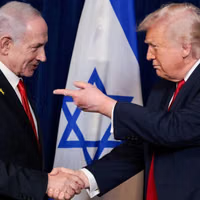
US President Donald Trump speaks next to Israeli Prime Minister Benjamin Netanyahu upon arrival for meetings at Trump's Mar-a-Lago club in Palm Beach, Florida, US, December 29, 2025.
US President Donald Trump on Sunday warned Washington could “soon finish the job” against Iran unless Tehran changed course, as Israeli Prime Minister Benjamin Netanyahu said Israel was prepared to strike Iran without US support and vowed to bring down Tehran’s government.
“Unless they change their ways, rapidly, we will soon finish the job,” Trump wrote in a post on Truth Social, after saying Iran had been “systematically destroyed, both Militarily and Financially.”
Addressing the people of Israel directly, Trump pointed to Tehran’s long-standing slogans of “Death to Israel, Death to America,” saying it had only been a matter of time before Iran sought to act on such threats.
He endorsed Netanyahu for re-election in Israel’s October 27 parliamentary vote, calling him a “Great Warrior Prime Minister” and an “even greater Partner for Peace in combatting the Islamic Republic of Iran.”
He said that if Israel were led by “anyone other than Bibi,” the United States would have to take on the work against Iran itself, adding that he was “not inclined to do so.”
Trump gave Netanyahu his “Complete and Total Endorsement” for re-election and praised him as “Strong, Brave, and Brilliant.”
Netanyahu thanked Trump on X, saying: “Together we will complete the mission!”
Israelis will vote on October 27 in the country’s first national election since the Hamas-led October 7, 2023 attack. The prime minister is not directly elected but emerges through coalition-building in the 120-seat Knesset.
Trump did not say what further action against Iran he had in mind. Earlier this month, he said the United States would not attack Iran before the November 3 US midterm elections and said Washington and Tehran were having “productive discussions.”
His latest comments come after he and Netanyahu discussed the possibility of a new military operation against Iran, according to Axios, which reported last week that the Israeli leader raised concerns about intelligence suggesting Tehran was trying to rebuild its nuclear program.
Netanyahu says Israel can strike Iran without US support
Separately on Sunday, Netanyahu said Israel was prepared to launch a preemptive strike against Iran without US support and that his objectives regarding Tehran did not depend on Washington’s approval.
“The objectives I set do not depend on American approval,” Netanyahu said as he presented an updated national security doctrine, according to Israel Hayom. “To the extent necessary, we will also act independently. We have done so before, and if necessary, we will do so again.”
Netanyahu described confronting Iran as his “life’s mission” and identified a nuclear-armed Iran as Israel’s greatest security threat. “We are prepared to take the initiative,” he said. “We must prevent the enemy from delivering the first blow.”
He said “90% of the job is done,” pointing to Iran’s economic crisis, recent protests and what he described as the government’s weakened position.
“We must bring this regime down once and for all,” Netanyahu said. “That is the directive I have given to all the security agencies.”
Iranian officials raised the possibility of a shift in nuclear policy and threatened retaliation against further US-Israeli attacks, while Tehran outlined its conditions for reopening the Strait of Hormuz on Sunday.
The developments came after Iran's parliament approved a new defense minister with longstanding ties to the Revolutionary Guards' missile program, and Israeli Prime Minister Benjamin Netanyahu called for eliminating what he described as the Iranian threat.
Nuclear doctrine comes under scrutiny
Iran's new supreme leader, Mojtaba Khamenei, may take a different position on nuclear weapons from his late father, Ali Khamenei, whose religious ruling opposed their development, Iranian lawmaker Ahmad Naderi said.
“From Mojtaba Khamenei's conduct, my understanding is that his fatwa will be different,” Naderi told.
Naderi separately expressed his own support for acquiring an atomic bomb, saying he had advocated the move for more than a decade and believed Iran should pursue what he called ultimate military deterrence.
Calls for nuclear deterrence have become more prominent among Friday prayer leaders and representatives of the supreme leader, Naderi added.
The remarks came after US Vice President JD Vance said Washington had achieved a decisive military advantage over Iran but could not consider the conflict finished without a firm commitment that Tehran would not rebuild its nuclear program.
Vance also linked US involvement to energy security, warning that Iranian control over shipping through the Strait of Hormuz could increase gasoline prices.
Hormuz proposal remains unresolved
Iran's seven-day proposal for reopening the Strait of Hormuz remains under consideration, with Tehran reviewing Washington's comments, Foreign Minister Abbas Araghchi said.
“Our conditions are completely clear and were presented to the United States in the form of a seven-day plan,” Araghchi said.
Under the proposal, the strait would reopen on the sixth day if Washington met Iran's conditions, with negotiations resuming on the seventh, Araghchi added.
The conditions were fair and had previously been accepted by the United States, he said.
New defense minister threatens retaliation
Iran's parliament approved Mehrdad Akhlaghi Ketabchi for the post of defense minister with 237 votes in favor and 15 against.
Akhlaghi, a sanctioned veteran of Iran's missile industry, replaces Aziz Nasirzadeh, who was killed during the opening day of US-Israeli strikes in February.
The new minister warned that any further American attack would bring casualties among US personnel stationed in the region.
“If he drops one bomb, he should see how many of his people he will have to carry out horizontally (dead),” Akhlaghi said, referring to President Donald Trump.
Iran's armed forces have also prepared a new operational plan for any renewed attack, Supreme National Security Council Secretary Mohsen Rezaei said.
The plan would be more destructive than those used during the previous wars and would not follow familiar patterns, Rezaei added.
Army commander-in-chief Amir Hatami separately urged the new defense minister to accelerate military modernization, citing the impact of recent wars and international sanctions.
Israel presses for further action
The complete elimination of what Israel considers the Iranian threat remains a central objective for the remainder of Trump's presidency, Netanyahu said in an interview with Life, Liberty & Levin.
Netanyahu argued that military and economic pressure should continue and called for the eventual removal of Iran's current political leadership.
The Israeli prime minister also said Tehran is pursuing intercontinental ballistic missiles capable of reaching the United States and seeking nuclear warheads for them.
Separately, Iran's hardline Kayhan newspaper urged strikes against Israeli nuclear facilities if Washington attacked the underground Pickaxe Mountain complex near Natanz.
The warning followed Trump's suggestion that US forces could target the fortified site.
The statements underscored the competing priorities shaping the confrontation: Washington's demand for guarantees against renewed Iranian nuclear activity, Tehran's conditions for restoring maritime access, and continuing threats of military escalation from both sides.
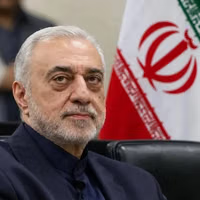
Iran's new Defense Minister Mehrdad Akhlaghi Ketabchi attends an official meeting, with the Islamic Republic's flag behind him.
Mehrdad Akhlaghi Ketabchi, a sanctioned veteran of Iran's missile industry with ties to the Revolutionary Guards, became defense minister on Sunday, following his predecessor's killing in the war with the United States and Israel.
Akhlaghi secured 237 votes in favor and 15 against in a virtual parliamentary session attended by 277 lawmakers.
He replaces Aziz Nasirzadeh, who was killed on February 28 during the opening day of joint US-Israeli strikes on Iran. The ministry had since been overseen by acting minister Majid Ebn al-Reza.
Unlike several previous defense ministers who rose through military command positions, Akhlaghi built his career inside Iran's weapons manufacturing establishment, overseeing industrial organizations involved in missile production, aerospace technologies and military procurement.
His name has appeared on international sanctions lists since 2007, reflecting his longstanding involvement in institutions central to Iran's ballistic missile program.
From engineering to missile production
Born on September 10, 1958, in Rasht, northern Iran, Akhlaghi studied chemical engineering at Amirkabir University of Technology before earning a master's degree in strategic management from Malek Ashtar University of Technology, an institution affiliated with the Defense Ministry.
He entered Iran's defense industries in the early 1980s and spent more than four decades in technical, industrial and managerial positions, according to Iranian state-linked media.
Much of his career has involved solid-fuel missile propulsion systems and the management of industrial facilities associated with ballistic missile development.
Solid-fuel propulsion allows missiles to remain stored for extended periods and reduces preparation time before launch, making it a significant component of Iran's missile capabilities.
Akhlaghi previously headed the Shahid Bagheri Industrial Group, a subsidiary of the Aerospace Industries Organization involved in Iran's ballistic missile program.
In November 2014, then-Defense Minister Hossein Dehghan appointed him managing director of the Aerospace Industries Organization, replacing Mehdi Farahi.
Iran's new Defense Minister Mehrdad Akhlaghi Ketabchi (right) is welcomed by acting Defense Minister Majid Ebn al-Reza during a meeting with senior military officials.
He later became head of the Defense Industries Organization, which produces conventional weapons and supplies military equipment to Iran's armed forces.
Akhlaghi's role in the Fateh-110 missile project
Akhlaghi's close relationship with Hassan Tehrani Moghaddam, a founder of the Revolutionary Guards' missile program, was central to his involvement in developing Iran's missile industry.
Akhlaghi worked closely with Hassan Tehrani Moghaddam, widely known as the father of Iran's ballistic missile program. Tehrani Moghaddam oversaw the development of the Revolutionary Guards' missile arsenal before he was killed in a November 2011 explosion at a military facility near Tehran.
Iran's IRGC-linked Tasnim news agency, citing The Eternal Man, a biography by Masoumeh Sepehri, reported that Akhlaghi approved $10 million in equipment purchases and production facilities for the Fateh-110 missile despite uncertainty over whether the project would succeed.
The account, based on an interview with a senior missile designer, describes Akhlaghi's direct involvement in financing infrastructure used to produce missiles for the Revolutionary Guards.
Pezeshkian also referred to Akhlaghi's association with Tehrani Moghaddam during Sunday's parliamentary session, crediting figures such as the two men with developing Iran's military capabilities.
Nearly two decades under international sanctions
Akhlaghi's involvement in Iran's missile industry brought him under international sanctions long before his appointment to the cabinet.
The United Nations Security Council included him in Resolution 1747, adopted on March 24, 2007, identifying him as head of the Shahid Bagheri Industrial Group.
The group had previously been sanctioned over its involvement in Iran's ballistic missile program.
The US Treasury Department also placed Akhlaghi under sanctions in 2008.
US State Department information about his activities identified him as a senior figure in missile-related industrial operations and described his participation in negotiations to purchase equipment for the missile industry.
In 2020, the first Trump administration sanctioned him in connection with his position as director of the Defense Industries Organization.
Iran's new Defense Minister Mehrdad Akhlaghi Ketabchi addresses lawmakers during a virtual parliamentary session.
The European Union has also included Akhlaghi on its sanctions lists, identifying his senior roles within both the Defense Industries Organization and the Aerospace Industries Organization.
Britain imposed sanctions on him in 2023, citing his involvement in activities connected to the development of systems capable of delivering nuclear weapons.
His name was also included in UN sanctions lists following the reimposition of international sanctions in September 2025.
The measures have made Akhlaghi one of the more extensively sanctioned figures to enter Pezeshkian's cabinet, with restrictions linked to his work in institutions involved in missile development and weapons production.
Missile production and air defenses top priorities
Akhlaghi outlined plans to expand weapons production, strengthen air defenses and rebuild military industrial facilities during his parliamentary confirmation session.
His proposed program includes developing new military technologies, improving production efficiency and increasing cooperation with universities and technology companies.
Akhlaghi also proposed shortening the development cycle for certain new defense technologies to a maximum of six months.
The program envisages increasing the share of production outsourced to companies outside the Defense Ministry to 75 percent in the Iranian year beginning in March 2026 and more than 85 percent the following year.
Highly classified weapons production would remain within facilities controlled by the ministry.
Akhlaghi has also identified continued support for armed groups aligned with the Islamic Republic across the region as a ministry priority.
His agenda builds on programs developed under Nasirzadeh, with adjustments intended to address the damage and military requirements arising from the recent wars.
Akhlaghi portrayed Iran's military capabilities as having frustrated US and Israeli objectives during the latest conflict.
"These capabilities have brought the American-Zionist enemy to the point of desperation in the recent war and placed it in a strategic deadlock," Akhlaghi told lawmakers.
His remarks came as the Defense Ministry faces the task of replacing damaged infrastructure and restoring weapons production capacity following months of military confrontation.
Warning to Washington over possible strikes
Akhlaghi also delivered a warning to the United States on the sidelines of Sunday's parliamentary session.
Asked about the possibility of Washington using the GBU-43 bomb, commonly known as the Mother of All Bombs, against Iran, he said the Defense Ministry had prepared measures to respond.
"The US president should be thinking about how to get his forces out of our region alive. If he drops one bomb, he will have to see how many of his troops he will have to take out of the region horizontally (dead)," Akhlaghi told reporters.
The remarks followed warnings by US officials about the possibility of further military action against Iranian facilities.
Iran's new Defense Minister Mehrdad Akhlaghi Ketabchi secured 237 votes in favor and 15 against in parliament's confidence vote.
President Donald Trump has raised the possibility of striking the underground Pickaxe Mountain complex near Natanz, while US Defense Secretary Pete Hegseth has warned of severe military consequences if negotiations with Iran fail.
A sanctioned missile official takes charge after the war
Akhlaghi's appointment follows the war with the United States and Israel, which killed senior Iranian military officials and exposed vulnerabilities in the Islamic Republic's military infrastructure and air defenses.
Pezeshkian told lawmakers that the new minister had the backing of the army, the Revolutionary Guards and other military and security institutions.
The president also referred to Akhlaghi's presence on US sanctions lists and expressed hope that he would remain alive to continue his work.
The decision to appoint an official sanctioned for nearly two decades over his involvement in Iran's ballistic missile program points to the leadership's continued reliance on the same military-industrial establishment that oversaw the development of its missile arsenal.
Akhlaghi now faces the task of rebuilding military production capacity and expanding weapons manufacturing at a time when Iran's missile program remains a major source of confrontation with Washington and European governments.
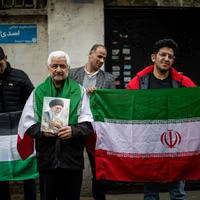
A poster bearing an image of late Iranian Supreme Leader Ayatollah Ali Khamenei is seen at a rally with Houthi supporters in Sanaa, Yemen, March 6, 2026.
Iranian support has helped Yemen’s Houthis carry out their most potent and sophisticated attacks yet on Saudi Arabia and its Yemeni allies, the Wall Street Journal reported, citing people briefed on intelligence from Saudi Arabia and Yemen’s anti-Houthi alliance.
The assistance includes help targeting drone and missile attacks, as well as training, intelligence and tactical guidance, according to the report. It has also contributed to rapid Houthi territorial gains in Yemen. The group now controls coastline along its side of the Bab al-Mandeb Strait and has attacked Saudi oil tankers, energy facilities and airports.
People briefed on regional intelligence cited by the WSJ said IRGC officers inside Yemen had helped the Houthis deploy missiles and radars threatening the Red Sea and Bab al-Mandeb.
The report said the Houthis used large numbers of fighters backed by missiles and drones during an offensive launched in early September, seizing the Red Sea port city of Mokha and territory around Bab al-Mandeb after catching Saudi-backed Yemeni forces off guard.
A person with forces opposing the Houthis cited by the WSJ said the group showed greater sophistication than in previous fighting, combining infantry assaults with missile and drone attacks, including first-person-view drones guided by fiber-optic wire.
Another anti-Houthi official cited by the newspaper said IRGC officers were on the front lines helping direct drone and missile attacks.
Danny Citrinowicz, a former head of the Iran branch for Israeli defense intelligence, said the operational relationship between Tehran and the Houthis was “very, very strong.”
“Iran has a major interest in the Houthis’ success,” he said, describing the relationship as strategic cooperation rather than a simple patron-client arrangement.
Senior Houthi official Mohammed al-Bukhaiti rejected allegations of Iranian military involvement, saying such claims exaggerated Tehran’s role and ignored the group’s own development of its capabilities.
“Iran does not interfere in Yemeni affairs,” Iranian Foreign Ministry spokesman Esmail Baghaei said last month, describing the Houthis as “entirely independent actors who make their decisions based on their own interests.”
A UN panel of experts found in 2024 that the Houthis had established joint operations rooms in Lebanon and Iraq to coordinate activities.