• العربية
  • فارسی
BrandBrand
  • Iran Insight
  • Politics
  • Economy
  • Analysis
  • Special Report
  • Opinion
  • Podcast
  • Live TV
  • Iran Insight
  • Politics
  • Economy
  • Analysis
  • Special Report
  • Opinion
  • Podcast
  • Live TV
  • Theme
  • Language
    • العربية
    • فارسی
  • Iran Insight
  • Politics
  • Economy
  • Analysis
  • Special Report
  • Opinion
  • Podcast
  • Live TV
All rights reserved for Volant Media UK Limited
volant media logo
ANALYSIS

US military support against Houthis risks widening Iran war, expert says

Oct 13, 2026, 02:14 GMT+1

The US could support the Saudi campaign against the Houthis at little direct cost by lifting political objections to its operations, but deeper military involvement risks appearing to widen the Iran war, MENA analyst Ryan Bohl told Iran International.

Recent Houthi attacks on Saudi Arabia, including Riyadh’s international airport, have sharpened questions about how far Washington and other governments are prepared to go in supporting the kingdom.

Continue reading

Most Viewed

US pressure threatens Iran’s political survival but may not bring concessions
1
INSIGHT

US pressure threatens Iran’s political survival but may not bring concessions

2

World leaders condemn Houthi attack on Riyadh airport

3
ANALYSIS

Machete-wielding men at IRGC-backed rally revive scrutiny of crackdowns

4

Iran-US diplomacy stalls as Houthi attacks on Saudi Arabia intensify

5
INSIGHT

Tehran seizes on Rubio’s Xerxes remarks to champion a past it once disparaged

Banner
Banner
Banner
Banner

Spotlight

  • US military support against Houthis risks widening Iran war, expert says
    ANALYSIS

    US military support against Houthis risks widening Iran war, expert says

  • Iran hardliners back threats to strike Persian Gulf digital infrastructure

    Iran hardliners back threats to strike Persian Gulf digital infrastructure

  • Can US sanctions derail Iran’s China trade route?
    ANALYSIS

    Can US sanctions derail Iran’s China trade route?

  • Machete-wielding men at IRGC-backed rally revive scrutiny of crackdowns
    ANALYSIS

    Machete-wielding men at IRGC-backed rally revive scrutiny of crackdowns

  • Russia fears a pro-Western Iran more than an Iranian atomic bomb
    ONE-ON-ONE

    Russia fears a pro-Western Iran more than an Iranian atomic bomb

  • War puts Iran’s nuclear ambiguity under scrutiny
    INSIGHT

    War puts Iran’s nuclear ambiguity under scrutiny

  • Iran’s oil lifeline could run dry by mid-December, Kpler says
    PODCAST

    Iran’s oil lifeline could run dry by mid-December, Kpler says

  • 'Three golden weeks': Trump’s no-strike pledge fuels calls in Iran to act first

    'Three golden weeks': Trump’s no-strike pledge fuels calls in Iran to act first

•
•
•

More Stories

US military support against Houthis risks widening Iran war, expert says

Oct 13, 2026, 02:01 GMT+1
•
Kambiz Tavana
100%
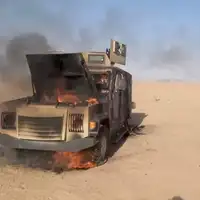
Iran-aligned Houthi fighters move next to a destroyed vehicle following what the source described as an attack on Saudi-backed forces in the location given by the source as al Jawf governorate, Yemen, in this screengrab taken from a video released by Houthi Military Media on September 15, 2026

Washington could support the Saudi campaign against the Houthis at little direct cost by lifting political objections to its operations, but deeper military involvement risks appearing to widen the Iran war, senior Middle East analyst Ryan Bohl told Iran International.

Recent Houthi attacks on Saudi Arabia, including Riyadh’s international airport, have sharpened questions about how far Washington and other governments are prepared to go in supporting the kingdom.

Bohl, a senior analyst at the risk intelligence firm RANE, said the least costly US option would be to drop objections similar to those Washington raised over Saudi-led military operations before the 2022 truce. Those concerns included civilian casualties from airstrikes and the humanitarian consequences of an offensive on the Red Sea port city of Hudaydah.

Washington helped push for a halt to the offensive on Hudaydah in 2018. The UN-brokered Stockholm Agreement established a ceasefire there later that year.

“That will cost the United States virtually nothing,” Bohl said of lifting political objections, referring to munitions, troops and additional spending.

Greater intelligence support, assistance in targeting Houthi forces or direct American airstrikes would carry military, economic and especially political costs, he said.

“It will look like President Trump is now expanding the war that he seems to be trapped in with the Iranians.”

Air power has limits

Air power alone is unlikely to defeat the Houthis, Bohl said, but could help capable ground forces advance and hold territory.

He pointed to Yemeni units backed by the Saudi-led coalition, including the Giants Brigades, whose ability to capture and retain territory could depend heavily on tactical air support.

The question is whether those forces have recovered sufficiently from recent Houthi advances to mount a sustained counteroffensive.

Bohl said forces aligned with Yemen’s internationally recognized government had appeared disorganized after a Houthi advance toward the southern end of the Red Sea coast. Some units were now regrouping and resuming offensive operations, he said, but their ability to coordinate remained uncertain.

“The big question is, will they gain enough coherence in order to push back the Houthi advances around Taiz, and more importantly, push up the Red Sea coast towards Hudaydah.”

More support for defense than offense

Foreign governments are more willing to help defend Saudi Arabia than to support a campaign to recapture Houthi-held territory, Bohl said.

He cited Pakistani military support and Turkish preparations to provide defensive assistance as examples of efforts to protect the kingdom. Such support, he said, was primarily aimed at defending Saudi airspace and preventing further attacks.

An offensive inside Yemen would be a harder commitment to secure.

Israeli Prime Minister Benjamin Netanyahu is seeking Saudi consent through US mediation for Israel to join the campaign against the Houthis, Haaretz reported on Monday.

Saudi Crown Prince Mohammed bin Salman opposes Israeli participation over concerns about a public backlash, the newspaper said. Netanyahu reportedly hopes cooperation would strengthen ties with Riyadh and help advance normalization.

Many governments see the country as “a geopolitical black hole that their forces will disappear into and that they’ll never achieve victory,” Bohl said.

They also look to Washington to provide military capabilities they cannot deploy at comparable scale. Turkey could influence events in its neighborhood, he said, but would face greater constraints in sustaining an extensive campaign as far away as Yemen.

Whether an effective offensive coalition emerges will depend heavily on Washington’s objectives, Bohl said. Those could range from reversing recent Houthi gains to supporting a broader effort to recapture territory, potentially including Sanaa.

The United States’ 2025 air campaign ended with an Oman-brokered ceasefire with the Houthis in May that year. A campaign supporting territorial advances would raise a different question: how far Washington was prepared to help allied ground forces go.

“America’s role in it will be instrumental in us understanding whether or not a coherent offensive coalition can actually be put together and have an impact on conditions on the ground.”

Can US sanctions derail Iran’s China trade route?

Oct 12, 2026, 03:57 GMT+1
•
Umud Shokri
100%
File photo: The inaugural double-stack container train linking Iran and China, July 2024

Washington’s new sanctions are unlikely to stop a China–Iran freight train at the border, but may make the route Tehran has turned to under pressure from the US naval blockade costlier and less reliable.

The blockade has sharply restricted maritime trade, while years of sanctions have squeezed Iran’s access to international finance. But not every trade channel had already closed.

Trains carrying goods from China were still reaching Iran before the latest US measures. The question now is whether sanctions on Iran’s railway companies will narrow that remaining route and complicate the flow of goods, including auto parts, carried on it.

Last week, the US Treasury designated three Iranian rail companies: the state-owned Islamic Republic of Iran Railway Company, known as RAI; Raja Passenger Trains Company; and private freight operator Railway Transportation Company.

The department said Iran had turned to rail to sustain trade and transport oil as the maritime blockade took hold.

The sanctions block the US-based property of the designated companies and prohibit US persons from dealing with them, while separate sectoral determinations give Washington wider scope to impose future designations. They do not automatically block every foreign railway, freight company or shipment connected to Iran.

The more immediate effect may be caution among companies involved in the trade. Banks may reject payments. Insurers and equipment suppliers may refuse to handle business involving designated companies. Others may charge higher fees or take longer to process shipments.

None of this would close the railway, but together it could make the route less dependable.

A useful route, with clear limits

The China–Iran rail connection is no longer just a proposal. In September, a block train bound for Iran was reported traveling through Kazakhstan, Uzbekistan and Turkmenistan before entering at Sarakhs.

A train from Xi’an to Iran’s Aprin dry port in 2025 was reported to have taken about 15 days, compared with an estimated 30 to 40 days by sea. Iranian railway officials also reported that 43 freight trains arrived from China in the first nine months of 2025.

Those figures show a route in use, although they do not indicate how much of Iran’s overall trade moves by rail.

Rail can move selected goods, industrial inputs, equipment and containerized cargo faster than shipping by sea. But it cannot replace the volume carried by tankers or bulk freighters.

Treasury says Iran is using rail to help transport oil, but its announcement provides no figures for oil moved this way. There is therefore little evidence that rail is a meaningful substitute for seaborne oil exports.

The new designations could nevertheless complicate the China route. Freight must be coordinated among operators, border agencies and terminals in several countries, making the response of Chinese and Central Asian companies important to how disruptive the sanctions ultimately prove.

Auto parts show where the sanctions overlap

The automotive sanctions create a second pressure point because auto parts from China have traveled to Iran by rail.

In 2025, Iran Khodro reportedly received an all-rail shipment through Sarakhs. The head of the local special economic zone said the route reduced transit and stockpiling time from about 50 days to 15.

Sanctions on automakers and rail operators could therefore put pressure on the same supply chain from two directions.

Procurement and payment may become harder, while freight companies and intermediaries may avoid shipments linked to designated firms.

The impact on car production, however, will depend on what parts are affected, how much stock manufacturers have and whether other suppliers or routes are available.

The trains may run, but at a price

The blockade has squeezed Iran’s maritime options; the rail sanctions raise the risks attached to an overland alternative.

They may not stop the China–Iran connection, but could make it costlier and less predictable by deterring the banks, insurers and logistics firms that keep shipments moving.

How much traffic falls will depend largely on the response of Chinese and Central Asian operators.

For now, the railway remains open. But as Iran leans more heavily on the trade routes still available to it, Washington is trying to make those routes harder to use.

Machete-wielding men at IRGC-backed rally revive scrutiny of crackdowns

Oct 11, 2026, 16:39 GMT+1
•
Pooya Jahandar
100%
Men wield machetes during the IRGC-backed "Jan-Fadayan" rally, held along the route from Azadi Square to Golestan-e Shohada cemetery in Isfahan, Iran, October 1, 2026.

Footage and images showing men wielding machetes and swords at an IRGC-backed rally in the central Iranian city of Isfahan have renewed scrutiny of the Islamic Republic's history of using unofficial armed groups to suppress anti-government protests.

The October 1 event, dubbed "Jan-Fadayan," or "Those Willing to Sacrifice Their Lives," brought together members of the Basij paramilitary force, religious organizations and other participants, according to Iranian state media.

Organizers described the gathering as a demonstration of public readiness and mobilization capabilities.

Iranian lawyer Ali Mojtahedzadeh described the public display of bladed weapons as a "show of force with weapons" and called on local security authorities to explain why it had been permitted.

A review of statements by senior Islamic Revolutionary Guard Corps (IRGC) commanders and former security officials shows that the use of unofficial groups, including individuals described as criminals and street thugs, to confront protesters dates back decades.

From the 1999 student protests to the 2009 crackdown

One of the earliest documented accounts dates to July 1999, when security forces and allied groups attacked Tehran University student dormitories, triggering widespread demonstrations.

100%
Iranian security and plainclothes forces confronting protestors during the 2009 Iranian election protests following the disputed presidential election.

Ali Hashemi, a former deputy security minister at Iran's Intelligence Ministry, said in an audio recording published by Iran International that approximately 250 individuals described as "thugs and hooligans" were organized during the student protests.

Hashemi said the experience later served as a model for deploying similar groups during the mass demonstrations that followed Iran's disputed 2009 presidential election.

He also described the use of individuals with criminal records to beat detainees, including at the notorious Kahrizak detention center, referring to authorization from judicial authorities.

Hashemi said similar individuals were subsequently deployed during protests in 2017, 2018 and November 2019.

One of the most explicit accounts came from Hossein Hamedani, a senior IRGC commander responsible for security operations in Tehran during the 2009 unrest.

100%
Iran's then Supreme Leader Ali Khamenei (L) receives a gesture of respect from Islamic Revolutionary Guard Corps (IRGC) Brigadier General Hossein Hamedani (R) during a meeting in Tehran, Iran, in this handout photo released by the official website of the Leader on October 10, 2015.

Hamedani said the Revolutionary Guards identified approximately 5,000 people who had participated in disturbances but were not affiliated with political parties or movements. He described them as "criminals and thugs."

According to Hamedani, these individuals were initially prevented from leaving their homes on days when protests were planned, but some were later recruited and organized into three battalions.

"I then made them members of the battalions," he said.

Explaining the strategy, Hamedani said that training fighters required recruiting individuals accustomed to handling "blades and machetes."

Hamedani also described preparations to confront protesters during Ashura, a major Shiite religious observance, in December 2009.

He said cinemas, schools and religious halls were made available to pro-government forces, while approximately 30 religious groups were mobilized in Tehran.

"On Ashura, these same three battalions put an end to the unrest," Hamedani said, adding that approximately 45,000 Basij members had also been deployed.

Following Hamedani's death in Syria in 2015, Mohammad Ali Jafari, then commander-in-chief of the IRGC, credited him with helping suppress the 2009 protests, saying his leadership had been crucial to ending what Iranian authorities described as "sedition."

Hamedani had also played a central role in organizing local militias supporting Syrian President Bashar al-Assad during the country's civil war.

Jafari later said Hamedani had organized approximately 100,000 local fighters in Syria.

Allegations of machete-wielding clerics in 2022 protests

Similar allegations emerged following the nationwide protests triggered by the death of Mahsa Jina Amini in morality police custody in September 2022.

In 2024, former lawmaker Mohammad Ashrafi Esfahani accused a group of clerics associated with influential religious figure Alireza Panahian of attacking protesters with knives and machetes while dressed as civilians.

He alleged that the men returned from the streets wearing bloodstained clothes before changing into clerical robes.

Ashrafi Esfahani also said members of the group operated in plainclothes and changed into clerical attire, including turbans, when police officers appeared to avoid being confronted.

The allegations emerged amid a legal and financial dispute between Ashrafi Esfahani and Panahian over a religious complex in Tehran and have not been independently verified.

Renewed scrutiny of unofficial armed groups

Nearly three decades after the 1999 student protests, the images from Isfahan have again raised questions about the role of unofficial groups operating alongside Iran's formal security forces.

Although the names, structures and political circumstances of the groups involved in past crackdowns have varied, accounts by former security officials and IRGC commanders describe the repeated recruitment and deployment of individuals capable of using violence against demonstrators.

The available evidence does not establish that the groups involved in different periods belonged to a single organization or were directly connected.

Nor has any organizational link been established between those previously deployed against protesters and the men seen carrying machetes and swords at the Isfahan rally.

The identities and affiliations of the armed men have not been independently verified.

Their appearance at an IRGC-backed event has nevertheless renewed attention to the Islamic Republic's documented history of mobilizing forces outside conventional security structures during periods of political unrest.

Three years after October 7, Iran pays the price of miscalculation

Oct 8, 2026, 15:59 GMT+1
•
Ata Mohamed Tabriz
100%
Three masked Iran-backed Hamas militants carrying assault rifles stand beneath a Palestinian flag.

Three years after Hamas's October 7 attack on Israel, the Islamic Republic faces a weakened network of regional allies, direct military confrontation and mounting economic pressure, upending its long-held strategy of deterring enemies while keeping war away from its territory.

"Don't ask when Iran will enter Gaza. Ask when it will leave," Hossein Shariatmadari, editor-in-chief of the hardline Kayhan newspaper, said a few weeks after the October 2023 attack.

The remark captured a contradiction in Tehran's approach. Iranian officials denied directing the Hamas operation while celebrating its consequences and presenting the so-called axis of resistance as evidence of the Islamic Republic's growing regional influence.

“Axis of Resistance” is the term Tehran uses for a network of Iran-backed groups in the region, including Palestinian militant groups, Lebanon’s Hezbollah, Iraqi militias and the Houthis in Yemen.

  • Hardline media admits losses after Assad’s fall in Syria

    Hardline media admits losses after Assad’s fall in Syria

The calculation rested on two assumptions: that time favored Iran and that its network of allied armed groups could simultaneously pressure Israel and shield Tehran from direct confrontation.

Three years later, both assumptions have been tested by wars that have weakened Iran's regional allies and brought military confrontation onto Iranian territory.

Celebrating an attack while denying responsibility

On October 10, 2023, then-Supreme Leader Ali Khamenei praised the Palestinian fighters behind the Hamas operation while denying Iranian involvement in planning it.

The distinction was deliberate. Tehran sought to benefit politically from the operation without assuming direct responsibility or risking a wider war with Israel and the United States.

Former Iranian vice president Mohammad Bagher Nobakht warned officials against remarks suggesting Iran had directly orchestrated the attack. Meanwhile, figures within the establishment argued that Hamas's weapons, tactics and organization would inevitably be associated with Iranian support.

The competing messages reflected a broader strategic dilemma: Tehran wanted its regional allies to appear powerful enough to deter its adversaries, but sufficiently independent to insulate Iran from retaliation.

Hossein Salami, then commander of the Revolutionary Guards, described the Hamas operation as Israel's greatest defeat since its establishment.

Iranian officials and military figures portrayed the attack as evidence of a shifting regional balance of power and declining US and Israeli influence.

  • Inside Iran’s Rhetoric On Hamas War On Israel

    Inside Iran’s Rhetoric On Hamas War On Israel

The underlying expectation was that Israel would struggle to sustain a prolonged conflict across multiple fronts, eventually strengthening Iran's position without requiring direct Iranian military intervention.

The regional shield breaks down

For decades, the Islamic Republic invested in a network of armed allies, including Hezbollah in Lebanon, Hamas in Gaza, Iraqi militias and the Houthis in Yemen.

These groups provided Tehran with influence beyond its borders and the ability to impose military costs on adversaries without committing Iranian forces directly.

But the wars following October 7 exposed the limitations of that arrangement.

The collapse of Bashar al-Assad's government in Syria deprived Iran of a central regional ally and a critical link in its network of influence.

Hezbollah suffered major military losses, including the killing of its leader Hassan Nasrallah, while Hamas and other Iran-aligned groups faced mounting military and political pressure.

The weakening of these allies preceded direct confrontation between Iran and Israel.

During the 12-day war, Israeli strikes damaged Iran's air defenses and killed senior military commanders, including figures who had spent years developing the Islamic Republic's regional network.

  • Iran replaces air defense commander in charge during June war

    Iran replaces air defense commander in charge during June war

The subsequent 40-day war exposed further weaknesses. The United States and Israel killed Iran's Supreme Leader Ali Khamenei at the outset of the conflict, while Hezbollah entered the fighting against Israel.

The Houthis later launched ballistic missiles toward Israel, and Iraqi militias targeted American positions in Iraq.

Although these operations imposed costs, they failed to prevent continued military action against Iran and its allies.

Fighting in southern Lebanon continued even after Tehran presented the cessation of hostilities as covering multiple fronts, underscoring its limited ability to protect regional partners.

  • Fall of Hezbollah heights ignites blame game in Tehran

    Fall of Hezbollah heights ignites blame game in Tehran

The network once intended to keep war away from Iranian territory had become increasingly unable to perform that function.

From regional proxies to strategic waterways

With its regional military network weakened, Tehran increasingly turned to geography as an instrument of pressure.

The Strait of Hormuz, a vital passage for global energy shipments, became central to Iran's efforts to raise the economic cost of military confrontation.

By restricting maritime traffic, the Islamic Republic sought to exert pressure not only on its immediate adversaries but also on Persian Gulf countries and the wider international economy.

  • Yemen takes Syria’s place in Iran’s security doctrine, says former commander

    Yemen takes Syria’s place in Iran’s security doctrine, says former commander

Tehran also looked toward the Houthis and their ability to threaten shipping through the Bab al-Mandab Strait, another critical maritime chokepoint connecting the Red Sea to international trade routes.

The strategy marked a shift from relying primarily on allied armed groups to using disruption of international commerce as leverage.

Yet it carried significant limitations.

Economic pressure on global markets did not necessarily translate into military deterrence against adversaries already prepared for confrontation.

At the same time, restrictions on shipping and the resulting increases in transportation costs placed additional pressure on Iran's own economy.

The Islamic Republic was therefore attempting to use economic disruption as a strategic weapon while facing increasingly severe economic constraints itself.

The cost of a strategy built on time

One assumption has remained remarkably consistent since October 2023: that prolonged confrontation will ultimately work in Iran's favor.

Tehran's strategy continues to depend on the belief that economic pressure on Persian Gulf states, disruption to global markets and the cost of sustained American military involvement will eventually strengthen its negotiating position.

But the conditions under which that calculation operates have changed substantially.

Iran now faces US pressure extending across maritime, air and land routes, alongside the consequences of war and the erosion of its regional military partnerships.

The pressure has exposed a contradiction in Tehran's strategy. Measures intended to raise the cost of confronting Iran have also increased the economic burden on the country itself.

  • Iran bears biggest economic cost of Hormuz closure

    Iran bears biggest economic cost of Hormuz closure

In 2023, the Islamic Republic sought to use the strength of its allies to force concessions from its adversaries while avoiding direct war.

Three years later, it is attempting to preserve its regional influence with fewer military buffers, a weakened economy and greater reliance on the strategic importance of Hormuz and Bab al-Mandab.

  • From Hormuz to Bab el-Mandeb, conflict converges on vital shipping lanes

    From Hormuz to Bab el-Mandeb, conflict converges on vital shipping lanes

The central question is no longer whether Iran's allies can exhaust Israel through prolonged confrontation, but whether Tehran can construct a credible form of deterrence after the weakening of the regional network on which its strategy depended.

The Islamic Republic entered the post-October 7 period expecting time and geography to strengthen its hand. Three years later, it must determine whether those same instruments can compensate for the military and economic costs of its original calculation.

From talks to war: Tehran sees the gap narrowing

Oct 8, 2026, 02:57 GMT+1
•
Maryam Sinaiee
100%
People carry Iranian and religious flags during a state-organized rally in Mashhad, October 6, 2026

Fears of renewed war with the United States, Israel or both are growing in Iran, as military officials talk openly about pre-emptive action and analysts warn that the distance between diplomacy and another round of fighting is becoming dangerously short.

The warnings come as Tehran and Washington continue indirect discussions, mediated by Qatar and others, over a framework for reopening the Strait of Hormuz and ending the conflict, while military preparations and explicit threats complicate the diplomatic track.

Morteza Maki, a senior international relations analyst, wrote in Etemad newspaper that another war was not inevitable, but pressure had reached a point where “the boundary between the threat of war and the start of war has become more fragile than before.”

Ruydad24 similarly warned Wednesday that the most important message from recent developments may not be that Washington has decided to go to war, but that “the distance between the path of negotiations and the path of military escalation has once again become very short.”

Fararu described “strategic ambiguity” as one of the defining features of the current crisis, warning that contradictory claims and uncertainty over the rules of engagement could lead to miscalculation.

The Strait of Hormuz, it said, “has now reached a point where every action there is not merely a tactical move, but a strategic statement.”

Iran signals readiness to strike first

The concerns have taken on greater significance as Iranian military officials increasingly describe pre-emption as part of Tehran’s strategy.

Brig. Gen. Mohammad Akrami-Nia, an army spokesman, told Fars that Iran had carried out pre-emptive operations in the past and would do so again under the framework of self-defense if necessary.

If Iran concludes that an enemy attack is imminent, he said, it will “definitely” launch a pre-emptive operation.

Akrami-Nia described an Iranian attack on a US base in Jordan as pre-emptive and said last week that Iran had shifted its strategy toward pre-emptive warfare following the 12-day war.

The statements have added to concerns that confrontation could escalate not only through a deliberate decision to start a war, but through either side acting on the assumption that an enemy attack is imminent.

Israeli preparations draw scrutiny

Iranian media have also focused on Israeli preparations for a possible new operation against Tehran.

Ruydad24 cited warnings by Israeli Prime Minister Benjamin Netanyahu about a possible Iranian attack alongside reports of Israeli military preparations as reasons the prospect of renewed conflict was being taken more seriously.

The outlet argued, however, that Iran’s ability to launch a pre-emptive attack should not be confused with an intention to do so, saying such an operation would carry significant costs for Tehran.

Fears of a trigger

The possibility of an incident providing the trigger for a wider conflict has become a recurring theme in Iranian commentary.

Journalist Ahmad Zeidabadi warned that Israel could stage a false-flag operation and attribute it to Iran, or conduct such an operation through infiltrators inside the country. He urged Iranian decision-makers not to fall into what he described as Netanyahu’s trap.

Foreign Ministry spokesman Esmail Baghaei raised similar concerns Wednesday in a video about alleged false-flag operations by the United States and Israel.

“False flags are an old craft: manufacture the incident, assign the blame, and harvest the consequences,” Baghaei wrote on X.

Ruydad24 warned that the greatest danger may be an ambiguous incident that sets off a wider escalation.

“The biggest danger for Tehran is not merely a direct attack; it is becoming trapped in a scenario in which a limited action, an ambiguous incident or an operation attributed to Iran becomes the pretext for another round of war,” it wrote.

War or pressure for a deal?

Despite the increasingly alarmed tone, some Iranian analysts believe a direct confrontation before the US elections remains unlikely.

Jafar Ghanadbashi, an international affairs analyst, told ILNA that “one should not expect a war before the US elections.”

He argued that the approaching elections and recent Israeli moves could instead produce efforts to create the impression that war was imminent in order to extract concessions from Iran.

That assessment offers a different reading of the military signaling: the threat of war may itself be a tool of pressure, without either side necessarily having decided to initiate another conflict.

The central concern running through Iranian commentary is not that either side has necessarily decided to start another war, but that pre-emptive military doctrines, strategic ambiguity and fears of a triggering incident have left little distance between confrontation and full-scale conflict.