• العربية
  • فارسی
BrandBrand
  • Iran Insight
  • Politics
  • Economy
  • Analysis
  • Special Report
  • Opinion
  • Podcast
  • Live TV
  • Iran Insight
  • Politics
  • Economy
  • Analysis
  • Special Report
  • Opinion
  • Podcast
  • Live TV
  • Theme
  • Language
    • العربية
    • فارسی
  • Iran Insight
  • Politics
  • Economy
  • Analysis
  • Special Report
  • Opinion
  • Podcast
  • Live TV
All rights reserved for Volant Media UK Limited
volant media logo
ANALYSIS

From talks to war: Tehran sees the gap narrowing

Maryam Sinaiee
Maryam Sinaiee

Iran International

Oct 8, 2026, 02:57 GMT+1
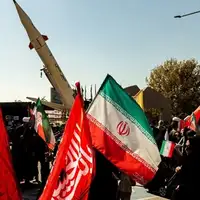
People carry Iranian and religious flags during a state-organized rally in Mashhad, October 6, 2026

Fears of renewed war with the United States, Israel or both are growing in Iran, as military officials talk openly about pre-emptive action and analysts warn that the distance between diplomacy and another round of fighting is becoming dangerously short.

The warnings come as Tehran and Washington continue indirect discussions, mediated by Qatar and others, over a framework for reopening the Strait of Hormuz and ending the conflict, while military preparations and explicit threats complicate the diplomatic track.

Morteza Maki, a senior international relations analyst, wrote in Etemad newspaper that another war was not inevitable, but pressure had reached a point where “the boundary between the threat of war and the start of war has become more fragile than before.”

Ruydad24 similarly warned Wednesday that the most important message from recent developments may not be that Washington has decided to go to war, but that “the distance between the path of negotiations and the path of military escalation has once again become very short.”

Fararu described “strategic ambiguity” as one of the defining features of the current crisis, warning that contradictory claims and uncertainty over the rules of engagement could lead to miscalculation.

The Strait of Hormuz, it said, “has now reached a point where every action there is not merely a tactical move, but a strategic statement.”

Iran signals readiness to strike first

The concerns have taken on greater significance as Iranian military officials increasingly describe pre-emption as part of Tehran’s strategy.

Brig. Gen. Mohammad Akrami-Nia, an army spokesman, told Fars that Iran had carried out pre-emptive operations in the past and would do so again under the framework of self-defense if necessary.

If Iran concludes that an enemy attack is imminent, he said, it will “definitely” launch a pre-emptive operation.

Akrami-Nia described an Iranian attack on a US base in Jordan as pre-emptive and said last week that Iran had shifted its strategy toward pre-emptive warfare following the 12-day war.

The statements have added to concerns that confrontation could escalate not only through a deliberate decision to start a war, but through either side acting on the assumption that an enemy attack is imminent.

Israeli preparations draw scrutiny

Iranian media have also focused on Israeli preparations for a possible new operation against Tehran.

Ruydad24 cited warnings by Israeli Prime Minister Benjamin Netanyahu about a possible Iranian attack alongside reports of Israeli military preparations as reasons the prospect of renewed conflict was being taken more seriously.

The outlet argued, however, that Iran’s ability to launch a pre-emptive attack should not be confused with an intention to do so, saying such an operation would carry significant costs for Tehran.

Fears of a trigger

The possibility of an incident providing the trigger for a wider conflict has become a recurring theme in Iranian commentary.

Journalist Ahmad Zeidabadi warned that Israel could stage a false-flag operation and attribute it to Iran, or conduct such an operation through infiltrators inside the country. He urged Iranian decision-makers not to fall into what he described as Netanyahu’s trap.

Foreign Ministry spokesman Esmail Baghaei raised similar concerns Wednesday in a video about alleged false-flag operations by the United States and Israel.

“False flags are an old craft: manufacture the incident, assign the blame, and harvest the consequences,” Baghaei wrote on X.

Ruydad24 warned that the greatest danger may be an ambiguous incident that sets off a wider escalation.

“The biggest danger for Tehran is not merely a direct attack; it is becoming trapped in a scenario in which a limited action, an ambiguous incident or an operation attributed to Iran becomes the pretext for another round of war,” it wrote.

War or pressure for a deal?

Despite the increasingly alarmed tone, some Iranian analysts believe a direct confrontation before the US elections remains unlikely.

Jafar Ghanadbashi, an international affairs analyst, told ILNA that “one should not expect a war before the US elections.”

He argued that the approaching elections and recent Israeli moves could instead produce efforts to create the impression that war was imminent in order to extract concessions from Iran.

That assessment offers a different reading of the military signaling: the threat of war may itself be a tool of pressure, without either side necessarily having decided to initiate another conflict.

The central concern running through Iranian commentary is not that either side has necessarily decided to start another war, but that pre-emptive military doctrines, strategic ambiguity and fears of a triggering incident have left little distance between confrontation and full-scale conflict.

Most Viewed

Houthi gains reversed at Bab al-Mandab, but Iran’s leverage runs deeper
1
ANALYSIS

Houthi gains reversed at Bab al-Mandab, but Iran’s leverage runs deeper

2
INSIGHT

Iran, US back to ‘square one’ as diplomacy stalls

3

Iran’s own surveys reveal demand for 'fundamental change'

4
EXCLUSIVE

IRGC commander, son helped build new oil-sales network

5

Iran says economy holding up as pressure mounts on oil, rial

Banner
Banner

Spotlight

  • From talks to war: Tehran sees the gap narrowing
    ANALYSIS

    From talks to war: Tehran sees the gap narrowing

  • Iran looks for escape routes as US sanctions close in
    INSIGHT

    Iran looks for escape routes as US sanctions close in

  • China's turn to Iraqi crude shows growing impact of Iran oil blockade
    ANALYSIS

    China's turn to Iraqi crude shows growing impact of Iran oil blockade

  • Tehran divided over $2 billion plan to prop up rial

    Tehran divided over $2 billion plan to prop up rial

  • Parsian Exchange transferred millions of dollars for Iran despite sanctions
    EXCLUSIVE

    Parsian Exchange transferred millions of dollars for Iran despite sanctions

  • Iran protester recounts torture, mock execution after January arrest

    Iran protester recounts torture, mock execution after January arrest

  • Iran’s own surveys reveal demand for 'fundamental change'

    Iran’s own surveys reveal demand for 'fundamental change'

  • Iran executes nearly two people a week since January protests

    Iran executes nearly two people a week since January protests

  • Iran, US back to ‘square one’ as diplomacy stalls
    INSIGHT

    Iran, US back to ‘square one’ as diplomacy stalls

Banner
Banner
•
•
•

More Stories

Iran looks for escape routes as US sanctions close in

Oct 8, 2026, 00:00 GMT+1
•
Behrouz Turani
100%
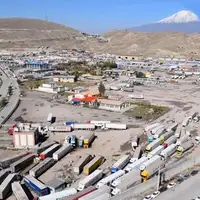
File photo: Trucks at the Bazargan border crossing between Iran and Turkey, with Mount Ararat in the background.

The widening reach of US sanctions across Iran’s transport and industrial networks has raised alarms in Tehran that Washington is seeking to close off the alternative trade routes the country has relied on to circumvent years of economic pressure.

Recent US measures have targeted Iran’s national railway system and major automakers including Iran Khodro and SAIPA, alongside foreign facilitators involved in their supply chains, while pressure has also expanded across aviation, maritime transport and financial networks.

The pattern has prompted some Iranian commentators to warn of what they describe as “network encirclement”: rather than trying to stop Iranian trade at a single chokepoint, sanctions raise the cost of moving money and goods across multiple routes simultaneously.

But Iranian economists and industry analysts are divided over how much additional pressure that can produce after years in which businesses have adapted to sanctions, and whether domestic dysfunction now poses a greater threat to industry than new US designations.

Closing alternative routes

Moderate outlet Khabar Online described the emerging strategy as “network encirclement,” arguing that modern economic blockades do not require borders to be physically sealed.

Instead, pressure can be applied simultaneously through financial sanctions, transport restrictions, higher insurance and compliance costs, and measures targeting companies and intermediaries that facilitate trade.

The importance of alternative routes was illustrated in a recent report by Mehr News Agency examining how Iran has sought to compensate for restrictions on maritime trade and rising insurance costs in the Persian Gulf.

The report highlighted truck traffic through northwestern crossings including Bazargan, Astara and Jolfa, connecting Iran with Turkey, the Caucasus and Russia. It argued that expanding land and rail corridors could reduce dependence on maritime shipping.

But Washington is increasingly targeting some of those alternatives as well.

Recent US sanctions have included Iran’s national railway system and major automakers, while also targeting facilitators in the UAE, Turkey, Hong Kong and India involved in supply chains.

Donya-e-Eghtesad described the measures as an expansion of pressure from maritime routes to overland trade, including networks used to obtain automotive parts.

An economy that has learned to adapt

Whether that approach can substantially increase pressure on Iran is less clear.

Industry analysts cited by Donya-e-Eghtesad said major Iranian automakers have developed extensive domestic sourcing after years of sanctions and reduced dependence on direct relationships with foreign manufacturers.

Eqtesad News went further, arguing that the latest measures against automakers and rail companies may carry greater political and psychological significance than immediate economic consequences.

Iran’s automotive industry has operated without direct partnerships with major international manufacturers for more than eight years and already relies heavily on intermediaries to obtain foreign components, it said.

The outlet argued that sanctions may therefore be producing diminishing returns, while domestic problems including price controls, supply-chain mismanagement and regulatory bottlenecks increasingly constrain production.

Economist Rasoul Safarahang made a similar argument in Khabar Online, saying an economy that has spent years adapting to sanctions is likely to respond to additional pressure by developing informal workarounds rather than immediately altering government policy.

Pressure extends to aviation

Aviation represents another potential pressure point because of its dependence on international maintenance, insurance, fuel and other services.

Iranian media have reported that US restrictions now cover 27 Iranian airlines, potentially affecting not only passenger travel but also time-sensitive cargo and the movement of industrial equipment and other goods.

Khabar Online estimated that restrictions on commercial aviation could cause between $3.5 billion and $5.2 billion in losses through reduced trade, tourism and supply-chain disruption, although the report did not provide sufficient detail to independently assess that estimate.

The outlet argued that longer transport times and more expensive alternative routes could ultimately feed through into higher domestic prices.

The debate in Iranian media therefore reflects two competing assessments of Washington’s strategy.

One sees sanctions as closing the routes Iran has used to adapt to earlier restrictions. The other sees an economy already so accustomed to sanctions that additional designations produces less leverage, while Iran’s own structural economic problems pose the greater threat.

Kayhan attacks Ghalibaf’s role in talks. Didn’t Khamenei approve it?

Oct 7, 2026, 19:01 GMT+1
100%
Iranian Parliament Speaker Mohammad-Bagher Ghalibaf speaks with a lawmaker during a parliamentary session in Tehran, September 29, 2026

An editorial questioning Mohammad-Bagher Ghalibaf’s role as Iran’s lead negotiator has raised an awkward question in Tehran: who exactly is Kayhan criticizing, given that senior officials have said the parliament speaker was given the job with the Supreme Leader’s approval?

In a sharply worded column Wednesday, Kayhan editor Hossein Shariatmadari argued that Ghalibaf’s appointment had effectively sidelined parliament for seven months and said those responsible should explain why they had allowed one of Iran’s central institutions to become largely inactive during wartime.

“If those who made this decision knew that its consequence would be the closure of parliament, they must answer this question: What was their purpose in shutting down parliament?” he wrote. “And if they were unaware of the consequence, that is regrettable.”

Iran’s parliament largely suspended its normal work following the outbreak of war in February, with security conditions and Ghalibaf’s negotiating responsibilities limiting its activities.

‘Coordinated with the Leader’

The criticism is striking because Mahmoud Nabavian, a senior hardline lawmaker, said on April 10 that Khamenei had specifically stipulated that Ghalibaf should lead negotiations with Washington.

Nabavian said the selection had been made “with the opinion and coordination of the leadership.”

Ghalibaf has played a central role in talks with Washington since negotiations began in Islamabad in April. He subsequently said he had not volunteered for the role and took it on following a decision by the country’s governing institutions, while describing the negotiations as having proceeded with Khamenei’s authorization.

Shariatmadari did not name Khamenei or directly question his role in the appointment. But his criticism leaves unclear whom he holds responsible for a decision publicly attributed to Iran’s highest authority.

Who watches the negotiator?

The Kayhan editor went further, arguing that Ghalibaf’s roles as parliament speaker and chief negotiator were fundamentally incompatible.

Parliament is responsible for overseeing the negotiating team, Shariatmadari wrote, meaning Ghalibaf is effectively expected both to supervise the negotiations and to be subject to that supervision.

The argument amounts to a challenge to Ghalibaf’s continued combination of the two roles while negotiations with Washington remain unresolved.

Shariatmadari, a longtime hardline figure appointed to Kayhan by the late Supreme Leader Ali Khamenei, publicly clashed with Ghalibaf in August over his support for negotiations.

Ghalibaf responded by defending diplomacy as a tool of statecraft, writing that negotiations were neither inherently valuable nor taboo and that Iran should “talk when necessary, and fight when necessary.”

Ghalibaf has also acknowledged divisions within the establishment, criticizing both those who reject diplomacy altogether and those he accuses of advocating concessions to Washington.

Shariatmadari’s latest intervention goes further. Rather than challenging Ghalibaf over what he is negotiating, it questions whether the parliament speaker should have been given the job in the first place.

China's turn to Iraqi crude shows growing impact of Iran oil blockade

Oct 7, 2026, 17:59 GMT+1
•
Negar Mojtahedi
100%
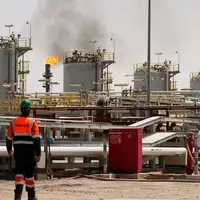
The Zubair Oil Field in Basra, Iraq, April 6, 2026.

China’s independent refiners are turning to Iraqi crude to replace dwindling Iranian supplies as a US blockade chokes Tehran’s exports, forcing some of Iran’s biggest oil customers to seek barrels elsewhere.

The shift is a sign of the blockade’s widening impact. Iran loaded no new crude or condensate onto tankers in September, although previously exported Iranian oil continued arriving in China, according to Homayoun Falakshahi, Head of Crude Oil Analysis at Kpler.

Of nearly 90 million barrels that initially made it out, only around 10 million remain to be discharged in China, Falakshahi said.

Once those barrels and the payments for them are exhausted, Iran risks losing not only a crucial export market but one of its main sources of dollars.

Chinese refiners that once absorbed more than one million barrels per day of Iranian crude are now buying Iraq’s Basrah Heavy and Basrah Medium as they search for replacement supplies.

Iran loses a crucial outlet

China’s independent refiners have long provided Tehran with a critical market for oil sold under US sanctions, drawn in part by steep discounts on Iranian barrels.

Iran loaded an average of around 250,000 barrels per day of crude and condensate in August, Falakshahi said. In September, that fell to zero.

“I think that’s the first since the revolution, actually, 1979 revolution,” he said, describing the impact of the blockade as “very much brutal.”

The turn toward Iraq shows what is happening as Iranian supply disappears: buyers that relied heavily on Tehran’s crude are finding replacement barrels elsewhere.

The financial squeeze comes next

The full financial impact of the blockade has yet to reach Tehran.

Chinese buyers typically have one to two months to pay for Iranian crude, Falakshahi said, meaning payments for oil already exported could continue until around mid-December.

“After that, it’s zero revenue from oil sales,” he said, assuming the blockade remains in place.

Oil sales are Iran’s main source of foreign exchange, and despite sanctions, Falakshahi said the country is still paid mainly in dollars for its crude.

In recent years, Iran had typically generated around $2 billion to $3 billion per month from oil sales, he said. The prospect of losing those inflows is already weighing on Iran’s currency.

“The revenues have not yet dropped to zero,” Falakshahi said. “It’s just the expectation that they will drop to zero in December that is causing that.”

Once the remaining payments end, the pressure will “probably ... only accelerate,” he added.

Can Iran find another way out?

Iran has spent years developing methods to circumvent US sanctions, leaving open the possibility that some crude could still reach China through less transparent channels.

Max Meizlish, senior research analyst at the Foundation for Defense of Democracies and a former US Treasury official, said the increase in Chinese purchases of Iraqi crude could be entirely legitimate, but cautioned against assuming that reported origin always establishes where the oil was produced.

Iraq has previously been used to obscure the origin of Iranian crude, he said.

“Iraqi crude has been used as a vehicle for Iran to mask the source of its crude,” Meizlish told Iran International.

“It’s entirely possible that this is a legitimate ordinary increase by China of Iraqi crude,” he added, while saying data on the source of Chinese imports should be viewed “with a little bit of skepticism or with a critical eye.”

Even if Iran does move crude through Iraq, the larger constraint is scale.

Falakshahi said transporting 50,000 to 100,000 barrels per day through Iraq could require around 5,000 trucks. At 100,000 barrels per day, Iran would be replacing only around 5% to 7% of what it previously sold by tanker.

“It would be just a portion of that,” he said.

Iran’s own response also points to the difficulty of replacing those exports.

Falakshahi said Tehran has rapidly reduced oil production toward the level needed to meet domestic demand, while 20 to 25 empty tankers remain inside the blockade zone despite being available to load crude.

During an earlier blockade, Iran continued loading tankers in apparent anticipation that restrictions would eventually ease. This time, the vessels are remaining empty.

Kpler also understands that tankers beginning to move inside the blockade zone have received radio warnings from the US Navy against continuing, Falakshahi said.

“This is something that did not happen during the first blockade,” he said.

Iran may still find ways to move smaller volumes or disguise the origin of some crude. What those workarounds have not demonstrated is an ability to replace the tanker trade being lost.

The buyers are still there. So is their demand for oil. But increasingly, the barrels they are buying are coming from somewhere else.

And as the remaining Iranian oil already at sea dwindles, the impact of the blockade is shifting from Iran’s export terminals to its finances.

Tehran divided over $2 billion plan to prop up rial

Oct 7, 2026, 16:46 GMT+1
•
Maryam Sinaiee
100%

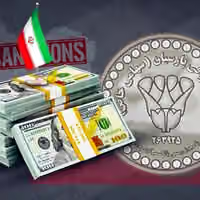
Iran’s central bank is offering as much as $2 billion in cash dollars to the public in an effort to slow the rial’s slide, triggering a fierce debate over whether the intervention can stabilize the currency or merely burn through increasingly scarce foreign reserves.

The dollar traded at nearly 2.7 million rials on Tuesday, after crossing the psychologically important threshold of 2.5 million last week, despite repeated efforts by authorities to contain the currency’s decline.

Central Bank Governor Abdolnaser Hemmati said Monday that the bank would take whatever measures it deemed necessary to manage the foreign exchange market.

The central bank announced on Sept. 30 that it would offer up to $2 billion in banknotes at a rate below the free-market price, beginning with $1 billion sold through selected banks and bank-affiliated exchange offices. Individuals can buy up to $10,000.

The rial’s decline has intensified public anxiety over the cost of living and the value of savings. Iranian news sites now routinely publish daily prices not only for currencies, gold and cars but even staples such as meat.

‘Structural problems’

Economists have questioned whether selling dollars can have more than a temporary effect while the forces driving the currency’s decline remain unchanged.

Kamran Nadari, an economist and university professor, told Rokna that the intervention could temporarily stabilize the exchange rate if its purpose was to meet speculative demand.

“The main problems in the foreign exchange market are declining foreign currency revenues, difficulties in transferring money and sanctions,” Nadari said. “Selling banknotes cannot solve these structural problems.”

He also warned that selling dollars below the free-market rate creates an opportunity for arbitrage, allowing buyers to obtain currency from the central bank and resell it for a profit.

“As a result, part of these $2 billion could go toward speculation and arbitrage rather than meeting genuine demand,” he said.

Hardliners attack the policy

The intervention has also triggered unusually strong criticism from hardliners in parliament.

Mehdi Kuchakzadeh, a prominent member of the hardline Paydari Party, argued that ordinary Iranians struggling with living costs could not afford the roughly 25 billion rials needed to purchase the maximum $10,000 allocation.

He called the central bank’s action a “crime” and urged parliament to intervene immediately.

“If I were not afraid of hell because of the shortcomings I have committed against you, the people, I would set myself on fire in front of the central bank,” Kuchakzadeh said.

Parliament Speaker Mohammad-Bagher Ghalibaf said he agreed with Kuchakzadeh’s concerns and would personally follow up on the issue, which he said could be raised at a parliamentary oversight session.

Rouhollah Abbaspour, a member of parliament’s Industries and Mines Committee, argued that the program would primarily benefit people with money to invest, who could also pay others to use their national ID cards to obtain additional dollars.

A fight over scarce dollars

The conservative newspaper Jomhouri Eslami described the policy as putting $2 billion of Iran’s foreign reserves “up for auction.”

It questioned the decision as Iran contends with reduced oil sales, difficulties repatriating export earnings and increased government costs from war-related destruction.

The criticism strikes at a broader vulnerability for Tehran. Oil exports have been heavily constrained by the US maritime blockade, depriving Iran of its principal source of foreign currency just as the rial has fallen to successive record lows.

Tabnak, a website considered close to former IRGC commander and National Security Council secretary Mohsen Rezaei, described the measure as “Hemmati’s controversial gift to the rich.”

A question of transparency

Supporters of the policy argue that selling dollars directly through banks makes the allocation of scarce foreign currency more transparent and reduces opportunities for connected intermediaries to profit.

Former communications minister Mohammad-Javad Azari-Jahromi sarcastically suggested that critics apparently preferred a system in which dollars passed through “insiders” and currency dealers without transparency over who obtained them or at what price.

Economist Sadegh al-Hosseini made a similar argument.

“Central banks everywhere manage markets by buying or selling foreign currency,” he wrote on Instagram. “The only question is: whom should the dollar be sold to—a particular exchange office, a few acquaintances and trusts, or everyone equally?”

The dispute has exposed a deeper dilemma for Iran as its foreign currency revenues shrink: whether scarce dollars should be used to defend the rial in the market, and whether doing so can have any lasting effect without addressing the sanctions, falling revenues and barriers to bringing export earnings back into the country.

Iran’s own surveys reveal demand for 'fundamental change'

Oct 7, 2026, 07:30 GMT+1
•
Behrouz Turani
100%

Two surveys emerging from within or around Iran's political establishment paint a bleak picture of public confidence: deep skepticism toward state institutions, single-digit trust in political officials and overwhelming demand for change.

What they reveal much less clearly is what kind of change Iranians actually want, partly because answering such questions openly can carry serious consequences.

One, presented by Ebrahim Hajiani, a former director of the state-affiliated Iranian Students Polling Agency (ISPA), says the proportion of Iranians seeking "fundamental political change" has risen from 8 to 67 percent in two decades.

The other, supervised by Ali Rabiei, social adviser to President Masoud Pezeshkian, found that about 53 percent supported fundamental reforms, 19 percent wanted regime change and 13 percent favored minor structural adjustments. Only 9 percent supported preserving the status quo.

Despite their different methodologies and categories, the findings converge on one broad conclusion: dissatisfaction with Iran's political and social institutions is deep, and relatively few respondents appear content with the status quo. Hajiani's "fundamental political change," however, cannot automatically be equated with regime change.

The trust figures are similarly stark.

According to Hajiani, only 7 to 8 percent of respondents trust political officials, while trust in the three branches of government ranges between 25 and 30 percent.

Rabiei's survey found trust in the judiciary at just over 30 percent, against more than 54 percent who expressed distrust. The executive branch was trusted by just over 25 percent, while more than 59 percent expressed distrust. Parliament was trusted by 23 percent, with more than 59 percent saying they distrusted it.

The security institutions fare better. Hajiani found that 53 percent trust the regular Army, while both the Islamic Revolutionary Guard Corps and the police are trusted by 46 percent.

Both researchers describe the findings in terms of an institutional crisis. Hajiani speaks of a "crisis of authority" or "crisis of reference," while Rabiei identifies a "crisis of efficiency, trust and political representation."

Hajiani also identifies 2022, the year the Woman, Life, Freedom uprising erupted, as a social watershed, dividing Iranian society into a "before" and "after" in attitudes towards dress codes, family dynamics, religion and the role of women.

Rabiei, meanwhile, argues that a "broad social middle" still exists: a large segment of society that is dissatisfied but seeks reform, stability and gradual improvement rather than upheaval. He says this constituency is poorly represented in the media, political parties and state institutions.

His figures provide some support for that interpretation, but the conclusion should be treated cautiously. The surveys themselves illustrate why.

Hajiani says around 70 percent of those approached by pollsters do not respond. That raises an obvious question over whether those willing to participate are representative of those who refuse, particularly when questions concern the legitimacy of the political system.

Sharq newspaper has previously noted that refusals and evasive answers are particularly common on questions touching on the legitimacy of the government and political system.

In an environment where opposition activity can bring serious consequences, respondents may have reason to be cautious about openly expressing support for replacing the Islamic Republic.

That does not necessarily mean the polling itself is dishonest. Even a methodologically rigorous survey can produce guarded responses when the questions are politically sensitive.

There are other limitations. Neither of the reports as publicly presented provides sufficient detail about sample size, methodology or response rates to allow a full assessment of representativeness.

Their institutional connections also warrant caution: Rabiei is a presidential adviser, while Hajiani is a former head of a state-affiliated polling organization.

A potentially more consequential problem is harder to measure: who agrees to answer sensitive questions, how those questions are framed, and which findings ultimately become public.

That makes precise conclusions about how many Iranians want reform, fundamental change or the replacement of the Islamic Republic difficult to draw from these surveys alone.

Still, even research emerging from institutions connected to Iran's establishment describes a society in which confidence in political leaders is extremely low, demand for substantial change is widespread and only a small minority appears satisfied with the status quo.