A shopkeeper sits in darkness at a laptop store in Dezful, southern Iran, during a power outage affecting local businesses, July 14, 2026
Iran's closure of the Strait of Hormuz appears to have dealt far greater damage to its own trade with China than to Beijing's commerce with the rest of the Persian Gulf, according to newly released Chinese customs data.
Between March and June 2026, Iran's non-oil trade with China totaled just $830 million, down from $3.3 billion during the same period last year—a decline of roughly 75%.
Kpler shipping data reviewed by Iran International also point to a sharp decline in Iranian oil exports to China.
Average daily unloadings at Chinese ports fell from 1.74 million barrels per day in April to around 550,000 barrels per day in the first half of July.
Together, the figures suggest the Strait of Hormuz closure has dealt a severe blow to Iran's economic ties with its largest trading partner.
China remains the only major buyer of sanctioned Iranian crude and was by far Iran's most important commercial partner in 2025.
The disruption has also sharply increased transportation costs. According to the head of logistics at Iran's Trade Promotion Organization, shipping a container from China to Iran now costs $8,000–$9,000, up from $2,500–$3,500before the conflict.
Transporting goods through Central Asian rail corridors has become even more expensive.
Iran hit harder than regional rivals
Although trade between China and other Persian Gulf states also declined after the Strait closure, the contraction was far less severe than in Iran's case.
Chinese customs data show Bahrain, Iraq, Kuwait, Qatar, Saudi Arabia and the United Arab Emirates recorded a combined $109 billion in bilateral trade with China during the first half of 2026, a 29% decline from a year earlier.
By contrast, total trade between Iran and China during the same six-month period fell 59%.
Trade between China and Oman proved even more resilient, remaining virtually unchanged at around $16 billion during the first half of the year.
The figures indicate that Iran has borne a disproportionately large share of the commercial costs associated with disrupting one of the world's most important shipping lanes.
Broader trade slowdown
The impact extends well beyond China.
Last year, Iran’s Arab neighbours accounted for roughly 51% of Iran's total non-oil trade. Since March, trade between Iran and all of those countries except Iraq has effectively come to a halt.
Iran itself has stopped publishing monthly foreign trade statistics since the regional war began, leaving customs data from trading partners among the few remaining indicators of the country's external commerce.
Data from other major economies point in the same direction.
According to Eurostat, trade between Iran and the European Union fell by more than half during the first three months of the conflict, dropping below €430 million.
India offered one notable exception. A one-month US sanctions waiver allowed Indian refiners to receive two cargoes of Iranian crude in May, lifting India's imports from Iran by more than 340% to about $950 million during the first five months of the year.
Even so, India's exports to Iran fell 17% to $470 million, reflecting weaker non-oil trade.
Official Turkish data painted a steadier picture. Despite a doubling of Iranian natural gas exports, overall trade between Iran and Turkey remained broadly unchanged at around $1.9 billion during the first half of the year.
The Chinese customs figures, shipping data and trade statistics from Europe suggest that while the Strait of Hormuz crisis has disrupted commerce across the region, Iran has so far paid a markedly higher commercial price than many of the countries it sought to pressure.
A vessel at the Strait of Hormuz, as seen from Musandam, Oman, July 17, 2026.
Just one vessel transited the Strait of Hormuz on Thursday, the lowest daily traffic since May 7, as the United States and Iran escalated military and economic threats while commercial shipping continued to avoid one of the world's most important energy chokepoints.
Kpler ship-tracking data showed only one vessel exited the strait on July 23, down from three the previous day, while no ships entered.
The sole crossing was the New Giant, a very large crude carrier carrying 2 million barrels of Iraqi Basrah crude bound for China's Rizhao port.
The sharp decline came as US strikes on Iran entered a 13th consecutive night and oil prices climbed back above $100 a barrel.
US President Donald Trump on Thursday expanded the confrontation beyond the battlefield, warning that Iranian funds under US control would be used to compensate victims of attacks on commercial shipping.
"Any and all damages done to Ships, Cargo, or anything related thereto, will be paid for by Iranian Money that the United States has in its possession, and controls," Trump wrote on Truth Social.
Iranian Foreign Minister Abbas Araghchi condemned the proposal, warning that once governments normalize confiscating another state's assets, "no one's assets are safe."
Calling the idea an "incendiary precedent," he said seizing another country's assets to pay for unrelated future claims would create international instability and that the resulting chaos would not be "pretty or peaceful."
Iranian leaders meanwhile continued to frame disruption to Persian Gulf shipping as part of their broader deterrence strategy.
"The equation of this war is clear: either everyone or no one," Parliament Speaker Mohammad-Bagher Ghalibaf wrote on X this week. "In a region where we cannot sell oil, no one will sell oil."
The disruption is increasingly reshaping regional shipping patterns.
The clean tanker Torm Innovation, carrying around 500,000 barrels of naphtha bound for Asia, altered course toward the Suez Canal instead of taking its usual route through the Bab el-Mandeb Strait, according to Kpler and LSEG ship-tracking data.
Regional trading sources said routing vessels to Asia via the Suez Canal rather than the Bab el-Mandeb could make voyages nearly three times longer, adding substantially to transport costs.
Saudi Aramco has also begun offering additional crude cargoes loading from Egypt's Mediterranean port of Sidi Kerir as an alternative to its Red Sea export terminals, reflecting growing efforts by producers and shippers to adapt to the disruption.
Traffic through the Bab el-Mandeb Strait nevertheless increased on Thursday.
Kpler recorded 32 commodity tanker crossings, up from 26 a day earlier. Fourteen vessels entered the Red Sea and 18 exited into the Gulf of Aden, including nine crude carriers—two of them Chinese supertankers bound for China.
U.S. President Donald Trump arrives at Dobbins Air Reserve Base in Marietta, Georgia, U.S., July 22, 2026.
President Donald Trump moved closer on Thursday to expanding the US campaign against Iran, threatening both a major new military operation and financial punishment as diplomacy faltered.
Trump told Israel’s Channel 12 that he was considering a “massive attack” larger than Operation Epic Fury, though he stressed that no final decision had been made and no new military orders had been issued.
“I am close to making a decision. We are fully prepared for it,” Trump said, adding that the United States could act alone but Israel would join “within two minutes” if asked.
Trump also said Iran would ultimately bear the financial cost of attacks on commercial shipping.
In a post on Truth Social, he said that “any and all damages” to ships, cargo and related property would be paid from Iranian funds under US control.
“These damages may be very substantial but, nevertheless, this is the fair and equitable thing to do,” he wrote.
Iran has nearly $100 billion in assets frozen abroad and beyond Tehran’s control, though only part of that sum is directly held by the United States or clearly within its legal reach.
The threat added an economic dimension to Washington’s military pressure as mediation efforts showed fresh signs of collapse.
Axios, citing two regional sources involved in the talks, reported that Iran had rejected the latest proposal delivered through intermediaries. One source said Tehran was “not cooperating.”
Trump struck a similar tone at the White House, telling reporters that Iran wanted an agreement but was not prepared to accept Washington’s terms.
Iranian Foreign Minister Abbas Araghchi responded by accusing figures in the US administration of ignoring “realities on the ground” and focusing instead on the 2028 presidential election.
The diplomatic impasse unfolded alongside a widening regional confrontation.
Kuwaiti authorities said hostile drones struck the Abdali border crossing with Iraq, causing material damage but no casualties. The military later reported intercepting additional drones.
The IRGC-affiliated Tasnim News Agency attributed two attacks near the crossing to Iran-allied armed groups, saying a border terminal and command building were targeted in retaliation for a reported US strike near Iran’s Shalamcheh crossing.
Iran also sharpened its dispute with neighboring states. Foreign Ministry spokesman Esmail Baghaei said Persian Gulf countries and Jordan must formally deny a US Central Command claim that they had assisted American operations against Iran.
Baghaei argued that Tehran was entitled to strike US bases and assets on their territory in self-defense if they had participated in the campaign.
Israel, meanwhile, prepared for the possibility that a broader US operation could draw it directly back into the conflict.
Defense Minister Israel Katz said the country was ready “for every scenario” and warned that Iran would face a “crushing blow” if it attacked Israel.
In Washington, the Senate voted 49-47 against advancing a resolution that would have required congressional authorization for continued hostilities against Iran, blocking an effort to limit Trump’s war powers as he considers expanding the campaign.
Iranian lawmakers raise fists and wave red “revenge” flags during a parliamentary session in Tehran, beneath a portrait of slain Supreme Leader Ali Khamenei, July 14, 2026
The surge in oil prices appears to be hardening Tehran's resolve against renewed negotiations with Washington, giving ammunition to those who argue that a prolonged conflict puts more pressure on the United States than on Iran.
The shift comes as Brent crude climbed above $100 a barrel for the first time in two months after Iran-aligned Houthi attacks expanded maritime tensions from the Strait of Hormuz to the Bab al-Mandab Strait, raising fears of broader disruption to Middle Eastern energy exports.
US President Donald Trump this week warned that the United States would destroy Iranian bridges or power plants in response to attacks on shipping in the Strait of Hormuz.
He later blamed Tehran for Houthi attacks on commercial vessels in the Red Sea, saying any further assaults would trigger an "extremely severe" US response against both the Houthis and Iran.
Amid the escalating threats, Brent crude surged 6% on Thursday, climbing back above $100 a barrel for the first time in two months.
Tehran sees leverage
Iranian officials increasingly portrayed the price rally as evidence that insecurity around the Strait of Hormuz and the Bab al-Mandab had strengthened Tehran's negotiating position.
"The equation of this war is clear: either everyone or no one," Parliament Speaker and Iran's chief negotiator Mohammad-Bagher Ghalibaf wrote on X. "In a region where we cannot sell oil, no one will sell oil. If our security is not guaranteed, no infrastructure will remain safe."
He later added: "They wanted to punish Iran. Punished themselves with triple-digit oil instead."
Mohammad Mokhber, an adviser to Supreme Leader Mojtaba Khamenei, argued that the latest rally reflected disruptions to transportation rather than production, implying prices could climb much higher if energy infrastructure itself came under attack.
"Oil at $100 is, so far, merely the result of disruptions in transportation, not production. The fire the United States is igniting in the region's oil and gas fields will eventually engulf the entire world."
Ali Akbar Velayati, another senior adviser to Mojtaba Khamenei, likewise warned that "the illusion of striking Iran at low cost" could have consequences extending well beyond the battlefield to global energy markets.
Talks lose momentum
The more confident tone in Tehran coincided with signs that diplomacy was stalling.
According to Axios, citing two regional sources familiar with mediation efforts, Iran's leadership rejected the latest proposal presented through intermediaries.
"We're trying, but the Iranians are not cooperating," one source told the outlet.
Trump also acknowledged that negotiations had made little progress, saying Tehran wanted to negotiate but had not "suffered enough yet."
Conservative Iranian media and hardline commentators argued that soaring oil prices had renewed Washington's interest in diplomacy and urged Tehran to resist returning to the negotiating table while economic pressure on the United States and its partners continued to build.
Following its announcement of attacks on US facilities in Kuwait, the Islamic Revolutionary Guard Corps (IRGC) declared that Washington "must pay the price for breaking its commitments" and vowed not to allow the United States to use "deceptive ceasefires" to replenish military supplies and strategic reserves before resuming hostilities.
The statement accused Washington of seeking negotiations only after being "defeated on the battlefield."
Hardline commentator Hamid Moghaddam similarly argued that renewed American interest in diplomacy reflected the surge in oil prices and urged Iranian negotiators to hold their position.
Another hardline commentator wrote that unless households in the West began to feel the economic consequences of the conflict, the United States and Israel "would have no hesitation in turning Iran into another Libya or Gaza."
Former Israeli intelligence officer Danny Citrinowicz questioned whether Trump's increasingly forceful warnings would alter Tehran's calculations.
"The Houthis are not going to stop attacking, just as Iran is not going to stop supporting them," he said.
"These threats are unlikely to change behavior in either Sana'a or Tehran. If anything, repeated ultimatums that are not enforced risk highlighting the limits of American deterrence."
Workers remove a damaged vehicle from a bridge near Bandar Abbas after a US airstrike, as the conflict between Iran and the United States continues to intensify, July 18, 2026
Recent statements by officials in Tehran and Washington illustrate how public rhetoric has shifted beyond military deterrence toward explicit threats against civilian and energy infrastructure across the Middle East.
The escalation accelerated after President Donald Trump warned that the United States would destroy an Iranian bridge or power plant for every attack on shipping in the Strait of Hormuz.
Iranian officials responded not by narrowing the confrontation but by broadening it, signaling that any future conflict would no longer be confined to military targets or the strategic waterway itself.
Until recently, Iranian messaging had focused largely on asserting its authority over the Strait of Hormuz and threatening commercial shipping.
Since Trump's warning, however, officials and state media have increasingly portrayed bridges, power grids, oil infrastructure and other civilian facilities across the region as legitimate targets in a broader campaign of reciprocal retaliation.
Iranian Foreign Minister Abbas Araghchi responded on Wednesday by declaring that Iran would follow an "eye for an eye" doctrine.
"I believe any attack on Iran's bridges, power plants or civilian infrastructure will be met with a powerful and decisive response," he said, warning that retaliation would target not only US assets but also any regional country facilitating such attacks.
On Thursday, Secretary of State Marco Rubio escalated the rhetoric further, saying Trump's Iran policy amounted to "a head for an eye" and warning Tehran it would pay a heavy price for attacks on Americans or US interests.
Iran's chief negotiator, Parliament Speaker Mohammad Bagher Ghalibaf, dismissed Washington's warnings and declared that the confrontation had entered an "either all or none" phase.
"If Iran is prevented from exporting oil or securing its domestic infrastructure, no infrastructure in the region will be safe, and no one will be able to sell oil," he warned.
His remarks reflected a growing effort to frame attacks on Persian Gulf energy infrastructure not simply as retaliation but as an integral part of Iran's deterrence strategy.
State and IRGC-linked media quickly amplified that message.
The IRGC-linked Tasnim News Agency quoted senior military sources as saying Iran had a "steel determination" to control the Strait of Hormuz and would strike multiple energy targets across the region in response to any attack on Iranian bridges or power plants.
State television likewise warned that Trump's infrastructure threats "will have no result other than the expansion of the war."
The rhetoric broadened further after Trump said he was considering strikes on Iran's nuclear facilities under Pickaxe Mountain.
In response, the Khatam al-Anbiya Central Headquarters warned such an attack would constitute an existential escalation, compelling Iran to target "all interests of America, its allies and supporters" throughout the Middle East.
Not everyone in Tehran supported the increasingly confrontational tone.
Former Iranian ambassador to Germany Hossein Mousavian argued that "continued military confrontation between Iran and the United States will produce no winner and will instead drag the region and the global economy into a costly war of attrition."
Writing in Rouydad24, he said the only viable exit lay in "an immediate return to diplomacy, an agreement on the security of the Strait of Hormuz, and the achievement of a durable nuclear deal."
Yet those voices remain overshadowed by an increasingly reciprocal exchange of threats.
Rubio has warned that Iran "will have to pay a price" if it continues attacking US interests, while Iranian hardliners increasingly argue that accepting a ceasefire itself was a strategic mistake.
Lawmaker Abolfazl Abutorabi told Didban Iran that Washington would have "kissed our boots" had Tehran continued fighting for another two weeks.
The increasingly symmetrical rhetoric suggests both governments are treating attacks on civilian and energy infrastructure not as exceptional acts of escalation but as legitimate retaliation, lowering the threshold for a conflict that could spread well beyond the battlefield and the Strait of Hormuz.
A file photo from ISNA shows people queuing at a gas station in Iran.
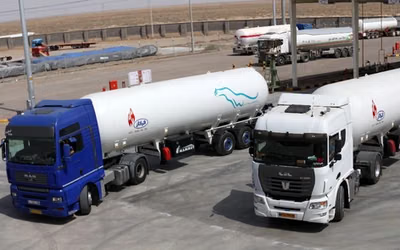
Russia’s turn to imported gasoline after Ukrainian attacks damaged its refineries is adding demand to a tight Asian fuel market, creating a potential new complication for Iran as it struggles to cover a daily shortfall of about 30 million liters.
Iran currently produces about 105 million liters of gasoline a day while consuming approximately 135 million liters, according to Reza Sepahvand, a member of parliament’s energy committee. He said in May that wartime damage had reduced domestic production while fuel imports had also declined.
Before the US-led war that started on February 28, Iran covered part of its fuel deficit through imports and barter arrangements, particularly with traders in the United Arab Emirates.
Those regular seaborne channels have been largely cut off by the ongoing US naval blockade, which bars maritime traffic entering or leaving Iranian ports. Tehran has diverted some trade through Oman’s Khasab port and Iraq’s Umm Qasr, but trade sources say those indirect routes are slower, more expensive and have far less capacity than conventional shipping, making them ill-suited to replacing large fuel deliveries.
The disruption has left Iran more dependent on a narrower pool of non-Western suppliers and alternative trading networks. That pool is now facing additional demand from Russia, which has turned to gasoline imports after Ukrainian drone strikes damaged its refining sector and disrupted domestic supplies.
Reuters reported that Russia was seeking as much as 400,000 metric tons of gasoline a month from countries including India, Belarus and Kazakhstan. At least 60,000 tons had been shipped from India to Russia by early July.
Where Russian and Iranian demand overlaps
Not all those purchases directly compete with Iran. Fuel from Belarus and Kazakhstan largely reaches Russia through established regional and overland networks that Tehran does not normally use.
The more relevant overlap is in India and the wider seaborne fuel market, where Russian purchases could increase competition for available cargoes, tankers, insurance and financial intermediaries.
Miad Maleki, a senior fellow at the Foundation for Defense of Democracies and a former senior sanctions strategist at the US Treasury, told Iran International that Russia and Iran were increasingly looking to overlapping parts of the non-Western energy market.
“Both countries are now drawing from the same pool of non-Western refiners with spare export capacity, but Russia is a far bigger buyer,” Maleki said.
India has sharply increased its exports of gasoline and other refined fuels in response to international shortages. Its exports of light and middle distillates were expected to reach 1.55 million barrels per day in July, almost double the 866,000 barrels per day recorded in May, Reuters reported, citing data from the commodities intelligence firm Kpler.
But the additional Indian supply has not fully relieved pressure on the Asian market. Kpler estimated that Asian imports of light and middle distillates would reach 5.8 million barrels per day in July, about 18% below levels seen before the latest conflict-related disruptions.
The Financial Times reported that a 42,000-ton gasoline cargo originating at India’s Vadinar refinery was scheduled to arrive at a Russian terminal. More than 90% of the crude processed at Vadinar this year had come from Russia, according to Kpler, effectively allowing Russian oil to be refined in India and shipped back as gasoline.
For Iran, the concern is not that Russia has already taken cargoes intended for Tehran. There is no public evidence that Moscow has directly displaced a specific Iranian purchase.
Rather, Russia is adding substantial demand to a market in which Iran already faces limited suppliers, restricted banking access and higher transportation and insurance costs.
Why Tehran has fewer options
Iran’s reliance on imported fuel had been increasing even before the war. A confidential Oil Ministry report obtained by Iran International showed that the country imported nearly 5 billion liters of gasoline and diesel combined in the Iranian year ending in March 2025, twice the volume recorded a year earlier.
The figure covers both gasoline and diesel and does not establish the volume of gasoline imports alone. But it illustrates Iran’s growing dependence on foreign fuel as domestic consumption outpaces refinery production.
The report said Iran had increasingly relied on barter arrangements because sanctions restricted its access to international banking and conventional payment systems. Tehran exchanged fuel oil for gasoline and diesel, particularly through traders operating in the United Arab Emirates.
Russia’s greater purchasing power and established commercial relationships could give it an advantage where the two countries’ needs overlap.
“Russia’s economy and import bill dwarf Iran’s, giving it far more purchasing power and better logistics networks with India, Kazakhstan and Belarus,” Maleki said.
Any resulting pressure inside Iran would probably not appear first through an official increase in gasoline prices. Fuel is heavily subsidized, and the government has historically been reluctant to raise prices because of the risk of public anger.
Instead, a prolonged shortage could lead to tighter quotas, uneven distribution, longer lines at filling stations and greater reliance on unofficial markets.
Drivers in several parts of Iran were already reporting tighter rationing, long queues and gasoline being sold outside the official distribution system at sharply higher prices in May, according to Iran International.
Russia’s gasoline imports do not mean Iran will lose access to foreign fuel. But they introduce another large buyer into parts of the market Tehran relies on at a time when Iran is already struggling with damaged production capacity, rising consumption and restricted access to international trade.