"Don't ask when Iran will enter Gaza. Ask when it will leave," Hossein Shariatmadari, editor-in-chief of the hardline Kayhan newspaper, said a few weeks after the October 2023 attack.
The remark captured a contradiction in Tehran's approach. Iranian officials denied directing the Hamas operation while celebrating its consequences and presenting the so-called axis of resistance as evidence of the Islamic Republic's growing regional influence.
“Axis of Resistance” is the term Tehran uses for a network of Iran-backed groups in the region, including Palestinian militant groups, Lebanon’s Hezbollah, Iraqi militias and the Houthis in Yemen.
The calculation rested on two assumptions: that time favored Iran and that its network of allied armed groups could simultaneously pressure Israel and shield Tehran from direct confrontation.
Three years later, both assumptions have been tested by wars that have weakened Iran's regional allies and brought military confrontation onto Iranian territory.
Celebrating an attack while denying responsibility
On October 10, 2023, then-Supreme Leader Ali Khamenei praised the Palestinian fighters behind the Hamas operation while denying Iranian involvement in planning it.
The distinction was deliberate. Tehran sought to benefit politically from the operation without assuming direct responsibility or risking a wider war with Israel and the United States.
Former Iranian vice president Mohammad Bagher Nobakht warned officials against remarks suggesting Iran had directly orchestrated the attack. Meanwhile, figures within the establishment argued that Hamas's weapons, tactics and organization would inevitably be associated with Iranian support.
The competing messages reflected a broader strategic dilemma: Tehran wanted its regional allies to appear powerful enough to deter its adversaries, but sufficiently independent to insulate Iran from retaliation.
Hossein Salami, then commander of the Revolutionary Guards, described the Hamas operation as Israel's greatest defeat since its establishment.
Iranian officials and military figures portrayed the attack as evidence of a shifting regional balance of power and declining US and Israeli influence.
The underlying expectation was that Israel would struggle to sustain a prolonged conflict across multiple fronts, eventually strengthening Iran's position without requiring direct Iranian military intervention.
The regional shield breaks down
For decades, the Islamic Republic invested in a network of armed allies, including Hezbollah in Lebanon, Hamas in Gaza, Iraqi militias and the Houthis in Yemen.
These groups provided Tehran with influence beyond its borders and the ability to impose military costs on adversaries without committing Iranian forces directly.
But the wars following October 7 exposed the limitations of that arrangement.
The collapse of Bashar al-Assad's government in Syria deprived Iran of a central regional ally and a critical link in its network of influence.
Hezbollah suffered major military losses, including the killing of its leader Hassan Nasrallah, while Hamas and other Iran-aligned groups faced mounting military and political pressure.
The weakening of these allies preceded direct confrontation between Iran and Israel.
During the 12-day war, Israeli strikes damaged Iran's air defenses and killed senior military commanders, including figures who had spent years developing the Islamic Republic's regional network.
The subsequent 40-day war exposed further weaknesses. The United States and Israel killed Iran's Supreme Leader Ali Khamenei at the outset of the conflict, while Hezbollah entered the fighting against Israel.
The Houthis later launched ballistic missiles toward Israel, and Iraqi militias targeted American positions in Iraq.
Although these operations imposed costs, they failed to prevent continued military action against Iran and its allies.
Fighting in southern Lebanon continued even after Tehran presented the cessation of hostilities as covering multiple fronts, underscoring its limited ability to protect regional partners.
The network once intended to keep war away from Iranian territory had become increasingly unable to perform that function.
From regional proxies to strategic waterways
With its regional military network weakened, Tehran increasingly turned to geography as an instrument of pressure.
The Strait of Hormuz, a vital passage for global energy shipments, became central to Iran's efforts to raise the economic cost of military confrontation.
By restricting maritime traffic, the Islamic Republic sought to exert pressure not only on its immediate adversaries but also on Persian Gulf countries and the wider international economy.
Tehran also looked toward the Houthis and their ability to threaten shipping through the Bab al-Mandab Strait, another critical maritime chokepoint connecting the Red Sea to international trade routes.
The strategy marked a shift from relying primarily on allied armed groups to using disruption of international commerce as leverage.
Yet it carried significant limitations.
Economic pressure on global markets did not necessarily translate into military deterrence against adversaries already prepared for confrontation.
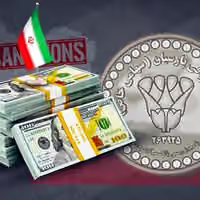
At the same time, restrictions on shipping and the resulting increases in transportation costs placed additional pressure on Iran's own economy.
The Islamic Republic was therefore attempting to use economic disruption as a strategic weapon while facing increasingly severe economic constraints itself.
The cost of a strategy built on time
One assumption has remained remarkably consistent since October 2023: that prolonged confrontation will ultimately work in Iran's favor.
Tehran's strategy continues to depend on the belief that economic pressure on Persian Gulf states, disruption to global markets and the cost of sustained American military involvement will eventually strengthen its negotiating position.
But the conditions under which that calculation operates have changed substantially.
Iran now faces US pressure extending across maritime, air and land routes, alongside the consequences of war and the erosion of its regional military partnerships.
The pressure has exposed a contradiction in Tehran's strategy. Measures intended to raise the cost of confronting Iran have also increased the economic burden on the country itself.
In 2023, the Islamic Republic sought to use the strength of its allies to force concessions from its adversaries while avoiding direct war.
Three years later, it is attempting to preserve its regional influence with fewer military buffers, a weakened economy and greater reliance on the strategic importance of Hormuz and Bab al-Mandab.
The central question is no longer whether Iran's allies can exhaust Israel through prolonged confrontation, but whether Tehran can construct a credible form of deterrence after the weakening of the regional network on which its strategy depended.
The Islamic Republic entered the post-October 7 period expecting time and geography to strengthen its hand. Three years later, it must determine whether those same instruments can compensate for the military and economic costs of its original calculation.