• العربية
  • فارسی
BrandBrand
  • Iran Insight
  • Politics
  • Economy
  • Analysis
  • Special Report
  • Opinion
  • Podcast
  • Live TV
  • Iran Insight
  • Politics
  • Economy
  • Analysis
  • Special Report
  • Opinion
  • Podcast
  • Live TV
  • Theme
  • Language
    • العربية
    • فارسی
  • Iran Insight
  • Politics
  • Economy
  • Analysis
  • Special Report
  • Opinion
  • Podcast
  • Live TV
All rights reserved for Volant Media UK Limited
volant media logo

Rights groups report execution of two January protest detainees in Iran

Oct 5, 2026, 10:40 GMT+1

Some human rights groups said on Monday that Iran had executed Alireza Sepahi and Alireza Raeisi, two men detained during the nationwide January protests.

Iran’s judiciary has not commented on the reports.

Most Viewed

Iranian currency hits another record low under US economic pressure
1

Iranian currency hits another record low under US economic pressure

2

Trump weighs Iran decision with ‘all options’ on the table

3

Khamenei adviser warns UAE as tensions with Tehran escalate

4

Iran reviews US response to seven-day proposal as officials debate next steps

5
ANALYSIS

Security meeting, military buildup: US weighs next move on Iran?

Banner
Banner

Spotlight

  • Islamic Republic's 'slow meltdown' leaves it fewer ways out, analysts say
    PODCAST

    Islamic Republic's 'slow meltdown' leaves it fewer ways out, analysts say

  • Officials trade blame as Iran’s economy sinks deeper

    Officials trade blame as Iran’s economy sinks deeper

  • As the rial sinks, Iranians seek shelter in almost anything else
    INSIGHT

    As the rial sinks, Iranians seek shelter in almost anything else

  • Shot in leg, forced into hiding: Iran protester recounts January crackdown

    Shot in leg, forced into hiding: Iran protester recounts January crackdown

  • Al-Qaeda is Iran's quiet backup if the war turns, expert says

    Al-Qaeda is Iran's quiet backup if the war turns, expert says

  • Can the Caspian give Iran a way around Hormuz?
    ANALYSIS

    Can the Caspian give Iran a way around Hormuz?

  • A Mossad spy in Iran: From banking infiltration to nuclear and missile sabotage
    SPECIAL REPORT

    A Mossad spy in Iran: From banking infiltration to nuclear and missile sabotage

Banner
Banner
Banner
•
•
•

More Stories

Iran workers face delayed wages, lost benefits and job fears

Oct 5, 2026, 09:54 GMT+1
•
Baharan Azadi
100%
File photo of workers at an industrial facility in Iran.

Workers across several sectors in Iran say employers are delaying or splitting wage payments, cutting benefits and warning staff they could lose their jobs for protesting, as inflation and rising living costs deepen pressure on households.

Messages sent to Iran International by employees at companies spanning the automotive, energy, pharmaceutical and aviation industries describe wages arriving weeks or months late, with some workers saying they have taken second jobs to cover everyday expenses.

Several employees said their salaries were being paid in installments rather than on schedule. Others described losing workplace benefits or being told to resign if they objected to payment delays.

Delayed wages and disappearing benefits

Two workers at Megamotor, a subsidiary of automaker Saipa, criticized the company's wage and benefit payments in messages to Iran International.

  • US blockade divides Iranians online over pressure on rulers, cost to public

    US blockade divides Iranians online over pressure on rulers, cost to public

Salary payments became irregular after the 40-day war, one worker said.

“We are suffering greatly and do not know how we can provide for our families.”

Another Megamotor employee said some wages and benefits, including overtime and meal allowances, were no longer being paid to workers, while managers and supervisors continued to receive overtime and other benefits.

Low pay at Saipa Yadak has forced most employees to work for the Snapp ride-hailing service from the afternoon until late at night, an employee of the auto-parts company said.

Some of the company's resources are spent on government ceremonies or large payments to senior managers, the employee added.

Workers at Bahman Motor are also facing financial and psychological pressure, an employee of the automaker said.

The company has declined to make payments to employees even as it continues constructing new industrial buildings, according to the employee.

100%
File photo of workers carrying out construction and maintenance work in Iran.

The accounts come as Iran's economic problems have deepened in recent months alongside the Islamic Republic's regional policies, tighter sanctions and a sharp decline in the value of the national currency.

Rapid inflation and declining purchasing power have increased pressure on household budgets and made basic goods harder to afford for a broad section of the population.

Iran International reported in August that workers at mines and companies had gone months without receiving wages.

Workers say complaints put jobs at risk

Employees at other companies described wages being divided into installments and said challenging the delays could put their jobs at risk.

Salaries at Imen Tak Pishro in Jajrud are paid in installments and employees who object are warned they could be dismissed, one worker told.

Another employee previously told Iran International that their employer paid three months of overdue salaries in two installments.

Mapna has not paid workers at 25 power plants for 40 days, an employee of the company said.

At pharmaceutical company Arya Tinagen, salaries remained unpaid 11 days into the month, an employee said.

“The company has cut all employee benefits, from meals to the monthly benefit card. If we complain, they tell us to resign and leave.”

Messages in recent days have also described overdue wages, unpaid insurance contributions and warnings of dismissal across a range of workplaces.

An employee at Yasuj University of Medical Sciences said at the time that staff had gone three months without salaries and were warned they could lose their jobs if they pursued their demands.

Second jobs and unemployment fears

For some workers, irregular wages and rising living costs have made additional employment a necessity. For others, the concern is whether their main job will survive at all.

An employee at Ata Airlines said inflation, the rising exchange rate and aviation sanctions had led the carrier to cut jobs.

The airline had previously borrowed billions of tomans in an effort to avoid dismissing employees, according to the worker.

Employees at Kish Air said they had been instructed not to report for work until further notice and had not received a year's worth of performance-related payments.

Concerns extend beyond individual companies.

Large numbers of factories at the Shamsabad industrial estate have shut down, one person familiar with employment conditions there told Iran International.

  • As the rial sinks, Iranians seek shelter in almost anything else

    As the rial sinks, Iranians seek shelter in almost anything else

The person said they had filled out around 50 job applications for factories in the industrial estate without receiving an offer.

The accounts follow broader signs of concern about employment. In an Iran International survey published in August, 92% of respondents said they had witnessed unemployment among people around them.

What can Iran’s new oil chief change under the US blockade?

Oct 5, 2026, 01:58 GMT+1
•
Umud Shokri
100%
Vessels in the Strait of Hormuz are visible near the beach of Bandar Abbas, Iran, August 26, 2026. Majid Asgaripour/WANA (West Asia News Agency) via REUTERS

Iran’s oil minister Mohsen Paknejad resigned Sunday, leaving acting minister Hamid Bovard with crude exports choked by a US blockade and scrutiny of intermediaries used to sell sanctioned oil, raising questions over what he can change.

President Masoud Pezeshkian accepted Paknejad’s resignation on October 4 and appointed Bovard, chief executive of the National Iranian Oil Company (NIOC), to lead the ministry temporarily.

The presidential office said Paknejad had sought to resign some time earlier for personal reasons and that Pezeshkian initially wanted him to remain, eventually accepting the resignation at Paknejad’s insistence.

That leaves little verified basis for attributing his departure to the blockade or any particular dispute inside the oil industry. The more answerable question is what Bovard inherits — and which of the pressures facing Iran’s most important source of revenue are actually within the Oil Ministry’s control.

A blockade no minister can lift

The immediate problem is physical: Iran is struggling to get new oil to its customers.

Iran International reported, citing Kpler and TankerTrackers, that no Iranian crude cargo has crossed the US blockade line toward China since mid-July and that no new crude has been loaded at Iranian terminals since mid-August.

Iran initially kept deliveries going from crude already stored aboard tankers. By mid-August, around 67 million barrels had accumulated on vessels in Iran’s southern waters. But access to empty tankers became increasingly limited, bringing new loadings to a halt.

Iran’s crude production has consequently fallen to about 1.8 million barrels per day, roughly the amount required for domestic consumption and around half its pre-war output, according to Kpler.

The decline follows an already sharp fall in exports. Crude and condensate loadings were estimated at around 220,000 to 255,000 barrels per day in August, down from about 740,000 in July and roughly two million in March.

Paknejad, shortly before his resignation was announced, said revenue from oil already sold was continuing to reach Iran.

That is not necessarily at odds with the collapse in new loadings. Payments can continue for cargoes sold and delivered earlier even after the physical flow of fresh crude slows. The larger problem for the government is how long those revenues can be sustained without new oil entering the export system.

Here, Bovard’s room for maneuver is limited. A new minister cannot by himself remove a US naval blockade, provide empty tankers or reopen a route to China. Any meaningful recovery in export volumes would depend largely on a change in the conditions surrounding the blockade.

An oil-sales system Bovard can influence

The ministry has more direct control over another problem: how sanctioned oil is sold and how the proceeds are returned.

Iran has long relied on intermediaries, commonly known as trustees, to sell crude and move the proceeds because sanctions restrict its access to conventional banking channels. The system has become increasingly controversial as cases involving unpaid revenues and heavily indebted intermediaries have emerged.

Iran International reported on September 8, based on two confidential documents from the Oil Ministry and Supreme National Security Council, that large oil cargoes had been handed on credit and at steep discounts to four trustees who already carried substantial debts from earlier transactions.

One confidential letter said the four had been granted an unusually high discount of $8.50 per barrel despite outstanding debts and failures to return proceeds from previous oil sales.

The investigation also identified Mohammad Javad Bavand, appointed by Paknejad as special assistant for supervision of oil trading, as a central figure in managing a new network of intermediaries. Subsequent documents obtained by Iran International showed an 86-million-barrel oil consignment being assigned to four indebted trustees.

The cases form part of a broader dispute over oil revenues that have failed to return to the state. Iran International previously reported that the head of the State Inspection Organization had acknowledged at least $1.6 billion misappropriated by intermediaries, while 59 criminal cases had been opened.

The Oil Ministry has defended the trustee system as a necessity created by sanctions and rejected allegations that it failed to supervise the firms involved. But the controversy poses a problem that is more directly within a minister’s reach than the blockade: who receives oil to sell, on what terms, what guarantees are required and what happens when proceeds are not returned.

Bovard’s appointment is relevant here because he comes directly from NIOC, putting an official familiar with the operational side of the industry at the head of the ministry.

He also inherits a ministry that has faced disputes over appointments and authority. Iranian media have reported friction surrounding Mohammad Shariatmadari’s continued leadership of Persian Gulf Petrochemical Industries Company, including disagreement over attempts to replace him.

There is no established evidence that either the Shariatmadari dispute or the trustee controversy prompted Paknejad’s resignation, particularly given the presidential office’s account that he left for personal reasons. Their significance is instead in what they show about the management system Bovard is taking over.

What can actually change?

The two main challenges confronting Bovard therefore require very different responses.

The blockade is largely beyond the ministry’s control. Even an experienced NIOC executive cannot restore export routes or tanker access through an administrative reshuffle.

The internal oil-sales system is different. Bovard could have greater influence over how intermediaries are chosen, whether indebted trustees continue receiving cargoes, what payment guarantees they must provide, how overdue proceeds are pursued and how closely oil transactions are supervised.

No such changes were announced with his appointment.

That makes the significance of the reshuffle relatively straightforward to assess. If Iranian terminals resume loading crude and exports to China restart, the decisive factor will probably be a change in the blockade or the wider conflict.

If the ministry changes the way trustees are selected, tightens guarantees, recovers overdue revenues or alters the officials managing sanctioned oil sales, those would be changes Bovard can more directly influence.

Paknejad’s resignation therefore does not by itself explain what is happening to Iran’s oil exports or signal a new policy. Bovard inherits an external constraint he has little power to remove and an internal sales system over which he may have considerably more room to act.

Whether the change at the top matters will depend on which of those problems, if either, begins to change.

Iran’s Olympiad paradox: Building scientific talent for a future abroad

Oct 4, 2026, 19:35 GMT+1
•
Umud Shokri
100%
Iran’s national Astronomy and Astrophysics Olympiad team, which won five gold medals at the 19th International Olympiad on Astronomy and Astrophysics (IOAA 2026) in Hanoi, Vietnam, October 4, 2026.

Iran’s scientific Olympiad system has become a pipeline of elite talent into universities feeding sensitive nuclear, missile and technology sectors, even as many of the same high achievers leave the country for better opportunities abroad.

The system produced another striking result this weekend, when Iran’s five-member team won five gold medals at the International Olympiad on Astronomy and Astrophysics in Hanoi, securing the world championship for a third consecutive year.

The achievement is part of a much longer record. Iran has spent decades identifying exceptional schoolchildren, training them intensively and directing them toward mathematics, physics, engineering, computer science and other technical disciplines.

International victories bring prestige, but the students themselves are arguably more valuable. They form part of the human capital on which Iran’s universities, technology sector and some of its most strategically important industries depend.

That is also where the system encounters its central contradiction. Iran has proved remarkably effective at finding and developing scientific talent. It has had considerably more difficulty keeping it.

A pipeline for elite science

Iran’s Olympiad program is not simply a collection of international competitions. It is the upper end of an extensive system for identifying gifted students while they are still in school.

The Young Scholars Club organizes national Olympiads across mathematics, physics, chemistry, biology, informatics, astronomy and other disciplines, with many successful competitors coming through Iran’s selective schools for gifted students, commonly known as Tizhooshan.

Students who advance through successive rounds receive specialized instruction well beyond the standard school curriculum. A small number are eventually selected for international teams and spend months preparing to compete against the strongest students from other countries.

Participation has grown sharply. Some 121,000 students entered Iran’s scientific Olympiads in the Iranian year ending in March 2026, up from 87,000 the previous year, an increase of about 40% and the highest participation in a decade.

There are substantial incentives for those who reach the top. International gold medalists in established scientific Olympiads can receive exemptions from Iran’s fiercely competitive national university entrance examination, or Konkoor, giving them a privileged route into the country’s leading universities and technical programs.

The results extend well beyond astronomy. Iran has repeatedly won medals in mathematics, physics, chemistry, biology and informatics, including some of the highest placements in international competition.

For the state, those performances provide visible evidence that sanctions and international isolation have not prevented Iran from cultivating world-class scientific ability.

There is substance to that claim. Repeated success shows that Iran has developed an effective mechanism for discovering exceptional students and preparing them to compete at the highest level.

But Olympiad results demonstrate concentrated excellence rather than the overall strength of Iran’s education system. A small group of highly selected students can receive intensive training and state support while ordinary schools face shortages, unequal resources and deteriorating economic conditions.

More revealing is what happens to the medalists after they leave school.

From Olympiad medals to strategic universities

Research into the careers of International Mathematical Olympiad medalists illustrates how concentrated Iran’s elite science pipeline has become.

Among 75 Iranian mathematics medalists whose undergraduate education could be established in one study covering medalists from 1986 to 2005, 71 attended Sharif University of Technology and the other four went to the University of Tehran.

The concentration provides a direct link between Iran’s Olympiad system and two of the institutions at the center of its scientific establishment.

Sharif is widely regarded as Iran’s leading engineering and technical university. It has also had longstanding connections with research areas tied to Iran’s nuclear, missile and defense sectors.

Several research bodies located at the university have been sanctioned by the United States under authorities targeting proliferation of weapons of mass destruction.

European sanctions have gone further, citing Sharif’s cooperation with organizations involved in Iran’s ballistic missile program and its connections with entities associated with nuclear research and uranium enrichment.

The University of Tehran has its own history of research touching sensitive fields. Its academics have worked in areas relevant to missiles, drones, aerospace technology and nuclear science, as well as projects connected to Iran’s space program.

The university also played an early role in the development of Iran’s nuclear infrastructure. Its Atomic Center, established in the 1960s around a US-supplied research reactor, was transferred to the Atomic Energy Organization of Iran in 1974 and became the Tehran Nuclear Research Center.

None of this means Olympiad winners are systematically recruited into nuclear or missile programs. There is no evidence of such a direct mechanism, and the overwhelming majority of teaching and research at Iran’s major universities is civilian.

The connection is one of human capital.

The mathematics, physics, computing and problem-solving skills cultivated through Olympiad training are also essential to artificial intelligence, aerospace engineering, advanced computing, cybersecurity, nuclear science and missile development.

The universities that attract Iran’s strongest students supply engineers and researchers to a broad range of institutions, from civilian technology firms and research centers to parts of the defense and nuclear establishment.

For a heavily sanctioned state, such expertise has particular value.

Restrictions on imports, technology transfers, investment and international research collaboration make indigenous scientific capacity more important. Iran may struggle to obtain certain foreign technologies or advanced equipment, but scientific expertise developed domestically is considerably harder to restrict.

The Olympiad system therefore serves a purpose beyond medals. It identifies unusually capable students early, concentrates resources on their development and helps direct them toward disciplines important both to Iran’s economy and to sectors the state considers strategically vital.

But producing that talent does not mean Iran gets to keep it.

The talent drain

Studies of Iranian Olympiad medalists suggest that a substantial proportion eventually build their lives elsewhere.

Among 82 Iranian International Mathematical Olympiad medalists whose current location could be established in one study, 49 — around 60% — were living abroad.

The same research found a strong relationship between studying abroad and permanent migration. More than 70% of Olympiad medalists who pursued either undergraduate or doctoral education overseas eventually remained abroad, while those educated entirely in their home countries were considerably more likely to stay.

Other figures circulated in Iran have been even more dramatic.

In 2022, the secretary-general of the Iranian Talent Association said that 82 or 83 members of a group of 86 Olympiad medalists tracked by the organization had emigrated, arguing that inadequate support for talented young people inside Iran was a major factor.

Iranian officials disputed that figure and cited research suggesting that a majority of a much larger group of international Olympiad winners still lived in Iran or had returned after studying abroad.

The samples and methodologies differ, making the figures difficult to compare directly. But the broader problem of migration among Iran’s most highly educated young people is widely acknowledged.

For students who spend years preparing to compete at international level, the contrast between opportunities inside and outside Iran can be stark.

At home they face inflation, currency depreciation, weakened salaries, limited research funding, shortages of modern laboratory equipment, bureaucratic restrictions and obstacles to international scientific cooperation.

Sanctions deepen many of those pressures by limiting access to equipment, software, financing and research partnerships.

The qualities that make these students valuable to Iran also make them unusually mobile.

An international Olympiad medal is a credential recognized by universities around the world. A student emerging from Sharif with an Olympiad background can compete for places at elite graduate schools, research laboratories and technology companies abroad.

The investment that makes the student valuable inside Iran therefore also increases their ability to leave it.

Maryam Mirzakhani remains the best-known example.

She won mathematics Olympiad gold medals for Iran as a teenager, studied at Sharif and later moved to the United States, where she became a professor at Stanford University and the first woman to win the Fields Medal.

Her career demonstrated both sides of Iran’s Olympiad system: its ability to identify exceptional talent and its difficulty retaining the long-term scientific benefits of that talent.

That does not mean every medalist leaves. Many remain in Iran and contribute to universities, research centers, technology companies and industry. Some who study overseas also maintain scientific ties with Iran or eventually return.

But the loss carries disproportionate weight when those leaving represent some of the most intensively selected and trained scientific talent the country produces.

The Olympiad paradox

Iran’s investment in scientific Olympiads therefore remains rational even when some of its most successful products emigrate.

The system discovers talent that might otherwise go unnoticed, raises scientific standards, gives exceptional students opportunities and produces genuine international achievements.

It also develops scientists and engineers in disciplines Iran considers essential to its economic and technological future.

Under sanctions, that logic becomes even stronger. When technology, equipment and capital are difficult to import, investing in people becomes one of the few capabilities a country can develop largely from within.

Yet that strategy depends on more than discovering talented teenagers.

Iran can identify an exceptional student at 15, provide intensive training, waive the university entrance examination, send them to Sharif and celebrate when they defeat competitors from dozens of countries.

What the Olympiad system cannot provide is the research environment, professional freedom, economic security and long-term career prospects that determine where that student chooses to live at 25 or 35.

That gap can turn Iran’s investment into an unintended subsidy for institutions abroad.

Iranian families, schools and public institutions bear much of the cost of discovering and developing globally competitive students. Foreign universities, laboratories and companies can later recruit scientists and engineers whose foundational training has already been completed.

For Iran, the implications extend beyond academia. The same talent that can strengthen a university laboratory or technology company can also contribute to aerospace, artificial intelligence, nuclear research and other strategically important sectors.

This weekend’s five astronomy gold medals show that the first part of Iran’s system continues to work exceptionally well. For a third consecutive year, Iranian students have demonstrated that they can compete with the best young scientific talent in the world.

The harder measure of success comes years later: whether Iran can offer those students a future compelling enough to keep the talent it worked so hard to discover.


Iran reviews US response to seven-day proposal as officials debate next steps

Oct 4, 2026, 14:22 GMT+1
100%

Iran is reviewing Washington’s response to a seven-day proposal sent through intermediaries, a senior foreign ministry official said on Sunday, as other officials offered differing assessments of whether further negotiations with the United States were needed.

Iran reviews US response

Iran’s seven-day proposal, outlined by Foreign Minister Abbas Araghchi in New York, was sent to Washington through intermediaries and the United States subsequently provided its views on the plan, Deputy Foreign Minister Kazem Gharibabadi said Sunday.

“The proposal that Mr. Araghchi outlined in New York, Iran’s seven-day plan, was sent to the United States through intermediaries, and they provided their views on the plan,” Gharibabadi said.

  • Iranian press sees diplomacy alive but narrowing after US response

    Iranian press sees diplomacy alive but narrowing after US response

The US response is being reviewed inside Iran and Tehran will communicate its final position through the appropriate channel once that process is complete, Gharibabadi said. Iran was also maintaining readiness for “other scenarios,” he added.

Parliament deputy speaker Hamid-Reza Haji Babaei separately said negotiations with Washington were taking place, while expressing little confidence that they would ultimately produce an understanding.

“Negotiations with the United States are in fact underway now,” Haji Babaei said.

Alaeddin Boroujerdi, a member of parliament’s National Security and Foreign Policy Committee, said US proposals had recently been conveyed through Qatar, although he did not know their details.

Foreign Ministry spokesman Esmaeil Baghaei said US proposals remained focused on the nuclear issue and Iran had already responded. He also rejected President Donald Trump’s remark that Washington did not know who represented Iran in negotiations, saying a six-member committee under the Supreme National Security Council was overseeing the process.

Lawmakers differ on further talks

Despite the exchanges, parliament’s National Security and Foreign Policy Committee spokesman Hassan Ghashghavi said there were no unresolved substantive issues requiring new negotiations.

“We are, in my view, at a post-negotiations stage both on the Strait of Hormuz and on the conditions,” Ghashghavi said.

Another committee member, Ebrahim Rezaei, said Iran would not retreat from its conditions and presented diplomacy and military pressure as the alternatives facing Washington.

“The Americans must either surrender to our diplomats or surrender to Iran’s missiles. We have no other proposal for them,” Rezaei said.

Nuclear debate continues as rial falls

The nuclear program remained part of the diplomatic debate. Baghaei said Iran remained bound by its obligations under the Treaty on the Non-Proliferation of Nuclear Weapons for as long as it remained a member.

Parliament will consider a possible withdrawal from the NPT while maintaining uranium enrichment, parliament board member Alireza Salimi said.

  • US ‘feedback’ leaves Iran debating the price of diplomacy

    US ‘feedback’ leaves Iran debating the price of diplomacy

Iran is also considering a Russian offer to take custody of its uranium enriched to 60%, with a final decision to be based on its national interests, Baghaei said.

The diplomatic maneuvering coincided with further pressure on Iran’s currency, with the US dollar rising above 2.7 million rials on the free market on Sunday.

The statements put the focus on Tehran’s review of Washington’s response, with Iranian officials differing over whether the next step requires further negotiations or a decision on proposals already exchanged.

Iranian currency hits another record low under US economic pressure

Oct 4, 2026, 10:52 GMT+1
100%

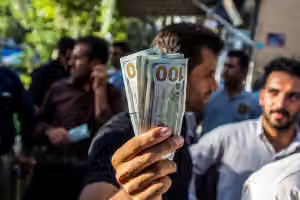
Iran’s currency fell to another record low against the dollar on Sunday, extending its decline during a US campaign aimed at restricting the Islamic Republic’s oil exports and financial flows.

The dollar traded at 2.723 million rials on the open market earlier on October 4, up 1.3% from the previous day.

The euro climbed above 3.06 million rials and the British pound surpassed 3.59 million rials.

US pressure targets oil revenue

Washington has sought in recent weeks to restrict the Iranian government's financial lifelines through a naval blockade, efforts to prevent Iranian oil exports and measures targeting channels used to move oil revenue.

  • Iran’s rial hits another record low under economic and military pressure

    Iran’s rial hits another record low under economic and military pressure

US Treasury Secretary Scott Bessent said on October 3 that Iran would have no oil cargoes on the water this week and would earn no revenue from such shipments, describing it as a first.

Bessent described the US military campaign, naval blockade and economic isolation of the Islamic Republic as interconnected elements of Washington’s strategy.

Iranian parliament deputy speaker Ali Nikzad had earlier said the United States would “never” be able to reduce Iran’s oil exports to zero.

Government moves to curb currency slide

Iranian authorities are seeking ways to contain the currency’s decline and inflation as economic pressure increases.

Tasnim news agency, which is affiliated with the Revolutionary Guards, reported on Sunday that five Iranian banks were selling up to $10,000 to each person over 18 at a rate of 2.57 million rials per dollar on the second day of an official foreign currency program.

The banks participating in the program are Mellat, Tejarat, Melli, Saderat and Saman, according to Tasnim.

Lawmaker Mehdi Kouchakzadeh criticized the central bank program during an online parliamentary session on Sunday, questioning why it had been introduced at what he described as a time of severe foreign currency shortages.

“Other than their friends, dealers and thieves, who can afford to buy this $10,000?” Kouchakzadeh said. “This is money for butterfly skin patients and struggling people that is going into the pockets of capitalists and thieves.”

Kouchakzadeh called the policy a “crime” and urged parliament speaker Mohammad Bagher Ghalibaf to prevent its implementation.

The physical management of foreign currency was of “fundamental importance,” Ghalibaf said in response, promising to pursue the issue.

  • As the rial sinks, Iranians seek shelter in almost anything else

    As the rial sinks, Iranians seek shelter in almost anything else

Supreme National Security Council Secretary Mohsen Rezaei attended a meeting of the government’s economic coordination headquarters on October 3 and said the country was going through one of its most difficult periods.

Despite the deepening economic crisis and growing pressure on citizens, the Islamic Republic continues to pursue policies that have fueled confrontation, particularly its standoff with the United States and its nuclear program.