More cargo moving across the Caspian could help Iran keep supplies coming in. But rising freight totals do not show whether Tehran has found a practical alternative for exporting oil.
To establish that, we need to know what is being shipped, where it is going and what trade it replaces.
Grain and industrial goods can ease shortages; crude needs its own export infrastructure and buyers. Iran’s oil swaps at Neka show both what the northern route can offer and what it cannot.
What the freight numbers measure
Russia’s Ministry of Transport reported 1.8 million tonnes of freight on the trans-Caspian route in 2025 and 1.3 million tonnes in the first half of 2026. It separately reported maritime freight of 2.8 million tonnes in 2025 and about 4.5 million tonnes in the first seven months of 2026.
The figures point to increased activity, but the ministry does not break the cargo down by Iranian origin, Iranian destination or commodity.
The North–South Transport Corridor spans several countries, routes and modes. Cargo can transit Iran without being Iranian trade or move between other participating countries.
A corridor-wide increase could reflect transit shipments, trade between third countries or Iranian goods rerouted from elsewhere. The aggregate numbers do not distinguish among them.
Nor should the route and maritime figures be added together as if they measure the same flow. The ministry presents them separately and does not provide enough detail to establish how their coverage overlaps.
Evidence of genuine substitution requires knowing what cargo moved, where and which route it replaced. Grain rerouted from a southern port to northern Iran would demonstrate substitution for that cargo.
A shipment merely transiting Iran would demonstrate corridor use, not replacement of lost Iranian trade.
Imports and exports are different problems
Northern routes can still be valuable for Iran. Food, feed and industrial inputs can support domestic supply during a disruption. But that resilience should not be confused with replacing oil revenue.
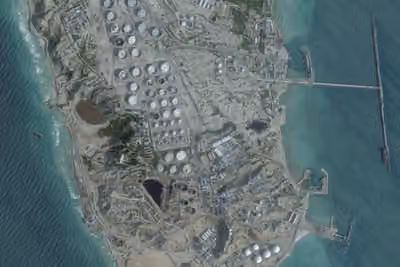
Around 90% of Iran’s crude exports normally pass through Kharg Island in the Persian Gulf, according to Reuters. Bringing goods into northern Iran does not automatically provide the terminals, pipelines and shipping arrangements needed to move Iranian crude to international buyers.
Iran’s ports have nominal annual capacity of about 300 million tonnes, but only around 30 million tonnes is in the north, according to figures cited by Al Jazeera. One large vessel in the south can potentially carry as much cargo as 20 Caspian ships.
The question is not simply whether trade can move north, but whether those routes can serve the same economic purpose at comparable scale.
Neka was not an oil-export system
Iran’s Neka terminal was connected by pipeline to refineries in Tehran and Tabriz. Under previous oil-swap arrangements, crude from Caspian producers was delivered to Neka and processed in northern Iran. Iran then made an equivalent volume of its own crude available for export through Kharg.
The arrangement helped supply northern refineries while freeing Iranian crude elsewhere for export. It did not eliminate reliance on southern export infrastructure.
Swap volumes peaked at about 110,000 barrels per day in June 2006, fell to almost zero by 2011 and did not subsequently resume at scale, according to Lee and Kalyuzhnova. Changes in relative pricing were among the factors that made the route less attractive.
Infrastructure alone therefore does not create a durable oil route. The economics of each barrel, the terms of any swap and the availability of buyers matter too.
Any claim that Neka now provides a meaningful export alternative requires current evidence: how much crude is arriving, whether it is being refined, swapped or exported, and where any exported Iranian barrels actually leave the country.
Who controls the alternative?
Moscow’s transport ministry links freight growth to Russian-Iranian cooperation and identifies the unfinished Rasht–Astara railway as a key project.
The more important question is whether Iranian access depends on a limited number of suppliers, carriers, financiers or cross-border arrangements. Iran could gain another route while still having little control over the terms on which it operates.
That is not inevitable. A corridor involving several suppliers and transport partners could give Tehran more options.
The test is whether cargo can move regularly at competitive cost, with workable payment and customs arrangements, without a single partner becoming a bottleneck.
What would an alternative look like?
The available figures establish that activity on parts of the northern corridor has increased. They do not establish how much Iranian trade has been rerouted, whether those routes are commercially sustainable or whether they can substitute for oil-export capacity.
The Caspian may give Iran useful alternatives for specific shipments. Whether that amounts to strategic diversification depends on what Iran can move, at what scale, where it can send it and who sets the terms.
For now, rising freight totals are a starting point for that analysis, not proof that Iran has built a northern substitute for its oil-export system.