• العربية
  • فارسی
Brand
  • Iran Insight
  • Politics
  • Economy
  • Analysis
  • Special Report
  • Opinion
  • Podcast
  • Live TV
  • Iran Insight
  • Politics
  • Economy
  • Analysis
  • Special Report
  • Opinion
  • Podcast
  • Live TV
  • Theme
  • Language
    • العربية
    • فارسی
  • Iran Insight
  • Politics
  • Economy
  • Analysis
  • Special Report
  • Opinion
  • Podcast
  • Live TV
All rights reserved for Volant Media UK Limited
volant media logo
INSIGHT

US ‘feedback’ leaves Iran debating the price of diplomacy

Behrouz Turani
Behrouz Turani

Iran International

Sep 30, 2026, 17:18 GMT+1
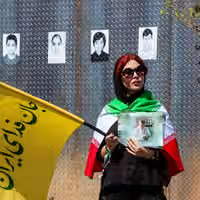
A woman holds a Janfada flag and a photograph during a mobilisation rally in Tehran, Iran, September 18, 2026

Iran’s receipt of Washington’s response to its seven-point proposal for ending the Strait of Hormuz crisis has sharpened divisions in Tehran over whether to pursue further compromise or intensify pressure on the United States.

The response was reportedly delivered through Qatar and has been described as US “feedback” rather than acceptance or rejection of the Iranian plan.

Hardline voices have portrayed Washington’s position as evidence that further diplomacy is futile, while more pragmatic commentators argue that the fact the US responded at all shows negotiations remain alive.

President Donald Trump had publicly dismissed Iran’s proposal as insufficient. Iranian diplomats said reopening the Strait and lifting the naval blockade were discussed in indirect talks mediated by Qatar.

The dispute in Tehran is increasingly about what it should do next.

Jame Jam, affiliated with state television, published an op-ed Wednesday by hardliner Abbas Salimi-Namin titled “America’s Fear of Admitting Defeat Against Iran.”

Salimi-Namin argued that Washington’s resistance to the seven-point plan, rooted in the earlier Islamabad talks, reflected the White House’s unwillingness to acknowledge that framework as a strategic setback.

US policymakers, he wrote, still cling to the prospect of delivering a “crippling blow” to Iran and fear the domestic political cost of acknowledging failure more than continued escalation.

Kayhan went considerably further.

Editor-in-chief Hossein Shariatmadari portrayed US demands for verifiable nuclear concessions as evidence that Washington never intended to negotiate in good faith.

He argued that linking freer navigation through the Strait to nuclear concessions was an attempt to strip Iran of its principal leverage while maintaining US economic and military pressure.

Kayhan criticized what it described as the Foreign Ministry’s excessive “patience” and called for non-attributable maritime interdictions, deployment of coastal anti-ship batteries and expanded targeting of Western-escorted vessels.

Global energy markets, it argued, must face an “unbearable cost” before Washington lifts its blockade.

The moderate daily Sharq offered an almost opposite prescription.

In a commentary, Ahmad Zeidabadi argued that despite the rigidity of the US response, Washington’s decision to send detailed feedback through Qatar showed that a diplomatic off-ramp remained open.

He urged the government to preserve the Qatari channel and proposed a two-stage approach under which Iran could offer targeted technical assurances, including temporary IAEA monitoring protocols, in return for an immediate, phased easing of restrictions on commercial transit under the Islamabad memorandum.

Zeidabadi rejected calls for military escalation, warning that abandoning shuttle diplomacy as restrictions on Iranian aviation and banking intensify would push the country towards deeper economic and civilian isolation.

The contrasting reactions show how Washington’s response has shifted the argument in Tehran from whether diplomacy should continue to what price Iran should be prepared to pay for it.

Jame Jam occupies a space somewhere between the positions represented by Kayhan and Sharq: deeply skeptical of Washington’s intentions, but portraying the impasse as a product of US reluctance to acknowledge Iran’s leverage rather than as grounds for immediately abandoning negotiations.

With an actual US response now before Tehran, those competing interpretations are no longer arguments about a hypothetical deal. They are becoming arguments over how Iran should answer.

Most Viewed

Iran’s shrinking air links raise costs, strain regional ties
1

Iran’s shrinking air links raise costs, strain regional ties

2
EXCLUSIVE

Key IRGC intelligence figure in Iran’s oil sales identified: Who is Mostafa Ahadi?

3
INSIGHT

Iranian hardliners turn on Ghalibaf and judiciary after lawmaker’s sentencing

4

US-Iran contacts continue as terms of possible deal remain disputed

5

Iran's Guards urge Americans to vote out their leaders in 26-page letter

Banner
Banner

Spotlight

  • US ‘feedback’ leaves Iran debating the price of diplomacy
    INSIGHT

    US ‘feedback’ leaves Iran debating the price of diplomacy

  • ‘I never asked about regime change’: Student speaks out after El-Sayed exchange

    ‘I never asked about regime change’: Student speaks out after El-Sayed exchange

  • Iranian hardliners turn on Ghalibaf and judiciary after lawmaker’s sentencing
    INSIGHT

    Iranian hardliners turn on Ghalibaf and judiciary after lawmaker’s sentencing

  • The body as a battleground: Iran's resistance etched in ink and blood
    SPECIAL REPORT

    The body as a battleground: Iran's resistance etched in ink and blood

  • Khamenei’s vision of Iranian power faces a test of reality
    ANALYSIS

    Khamenei’s vision of Iranian power faces a test of reality

  • Why Trump said no to Iran’s Hormuz proposal
    ANALYSIS

    Why Trump said no to Iran’s Hormuz proposal

Banner
Banner
•
•
•

More Stories

Iranian hardliners turn on Ghalibaf and judiciary after lawmaker’s sentencing

Sep 30, 2026, 01:48 GMT+1
•
Maryam Sinaiee
100%
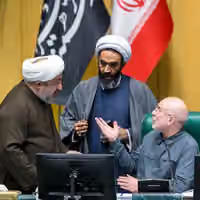
Hardline lawmaker Hamid Rasaei (left) speaking with Speaker Mohammad-Bagher Ghalibaf (right) in this file photo from July 2026.

Attacks by hardliners on Parliament Speaker Mohammad-Bagher Ghalibaf and Chief Justice Gholam-Hossein Mohseni-Ejei following hardline lawmaker Hamid Rasaei’s imprisonment have intensified the rift among Iran’s conservatives.

Rasaei said during an online parliamentary session on Sunday that Ghalibaf, former president Hassan Rouhani, President Masoud Pezeshkian and the Secretariat of the Supreme National Security Council had filed complaints against several lawmakers.

He said one of those complaints had resulted in a 10-month prison sentence against him. Rasaei described the ruling as “non-legal” and “political,” but said he would report to prison to serve the sentence.

Rasaei was elected third in Tehran in the parliamentary election three years ago, when around 80 percent of eligible voters in the capital boycotted the election.

He is the first sitting lawmaker to be sent to prison during his term in office.

The complaint dates to before Rasaei was elected to parliament and concerns a case brought by Ghalibaf against the weekly 9 Dey, where Rasaei was managing director. The complaint followed an article published in January 2024 under the headline “Ghalibaf’s Manipulation of Parliamentary Documents.”

The judiciary announced on Monday that Rasaei had appeared at Tehran’s Special Clerical Court and was sent to the clerics’ section of Evin Prison the same day to begin serving his sentence. According to the judiciary’s statement, Rasaei had more than 18 months to resolve the case by apologizing to Ghalibaf.

Rasaei’s positions are closely aligned with those of the Paydari Party and former nuclear negotiator Saeed Jalili.

Hardliners react to the sentence

Rasaei’s supporters have accused Ghalibaf of “silencing the voices of critics” and criticized him for pursuing the complaint against Rasaei rather than focusing on the country’s economic and security problems.

Figures associated with these groups and their media outlets also attacked Mohseni-Ejei. The criticism has spilled over into some recent nightly pro-government gatherings.

Mohammad-Manan Raeisi, a Qom lawmaker who headed Saeed Jalili’s presidential campaign in the city two years ago, sharply criticized Ghalibaf and other officials and warned of a possible popular backlash against them.

“I doubt that, under these circumstances, people will allow you to appear in any mosque, gathering, public square or religious ceremony, and you may face a popular backlash,” he wrote.

Meysam Nili, managing director of the Raja News website and a figure associated with the Paydari Party, accused the judiciary of injustice and political bias, claiming that a “coup” was being organized against media and political figures belonging to the faction.

Hardline social media user Mohsen Maghsoudi, referring to arguments in favour of negotiations with the United States, wrote: “When it is possible to negotiate with the killer of the martyred Imam (Ali Khamenei) in the national interests and still talk about negotiations despite receiving insult, humiliation and aggression, why can’t we, in order to preserve unity, drop a three-year-old complaint over the headline of a weekly newspaper so that a revolutionary representative does not go to prison and hundreds of thousands of people’s votes do not become ineffective for 10 months?”

Other conservatives push back

Other conservative figures have sharply criticized the controversy generated by Rasaei’s supporters and the hardline groups.

The IRGC-affiliated Tasnim news agency published an article headlined “On Mr Rasaei’s Strange Fallacies!” and described his objections to the ruling as “slander against a judicial ruling.”

Tasnim said Rasaei had effectively challenged the validity of the ruling by describing it as “strange” and “contrary to procedure,” while accusing the judiciary of political conduct by calling the ruling “political and non-legal.” The agency characterized his statements as criminal.

The Tabnak website published a video showing hardliners chanting in support of Rasaei and against Ghalibaf at one of the nightly gatherings. It called them “infiltrators” and said a small number of people were using the gatherings to “advance factional objectives.”

The conservative Khorasan newspaper said Rasaei’s refusal to apologize had led the court to conclude that he was not only unrepentant about the allegations he had made against Ghalibaf, but was also refusing to resolve the case and defying a judicial order.

Mojtaba Zarei, a member of parliament’s National Security and Foreign Policy Committee, wrote that turning a judicial case into a political and media confrontation during wartime would only deepen divisions among political forces.

Deepening confrontation

Hardliners have stepped up attacks in recent days against political rivals who support resolving the dispute with the United States through negotiations and returning to the Islamabad understanding.

They have gathered outside the home of former President Hassan Rouhani, whom they accuse of being subservient to the West, and called for him and his former foreign minister, Mohammad-Javad Zarif, to be prosecuted.

They also chanted against President Masoud Pezeshkian and called him an “infiltrator” as he returned from New York, where he attended the UN General Assembly. Hardliners have also registered an impeachment motion against Foreign Minister Abbas Araghchi over his meeting with Steve Witkoff, US President Donald Trump’s special envoy for Iran, and launched an online campaign calling for Pezeshkian’s removal.

Iran says awaiting US response on Hormuz proposal

Sep 29, 2026, 13:28 GMT+1
100%
Vessels transit the Strait of Hormuz, a key route for global oil shipments.

Iran said on Tuesday it is awaiting a US response to its proposal for reopening the Strait of Hormuz, as regional oil flows continued to recover and the rial sank past 2.5 million to the dollar.

The developments put Iran’s efforts to secure relief for maritime trade alongside mounting economic pressure at home and warnings from Iranian and US officials over further confrontation.

“We are awaiting an official response from the United States through the mediators,” Foreign Minister Abbas Araghchi said.

Qatar was expected to relay Iran’s proposals to Washington and return with a response, possibly by Wednesday, Araghchi said. Iran had made no concessions and reopening Hormuz remained conditional on its demands being met, he added.

“At present, the only issue is the Strait of Hormuz,” Araghchi said. “Iran’s conditions are entirely fair and reasonable. If the Americans say they want an agreement or a peaceful solution, we have presented that solution.”

Oil flows recover despite risks in Hormuz

Persian Gulf oil exports have recovered despite disruption around Hormuz, potentially reducing the impact of restrictions on one of the world’s most important energy routes.

Oil shipments through the strait and alternative routes have returned to nearly 80% of pre-war regional levels, the Wall Street Journal reported Monday.

Crude exports from major Middle Eastern producers including Saudi Arabia, Iraq and the United Arab Emirates have climbed to almost 13 million barrels per day this month, their highest level since February, according to ship-tracking data cited by the Journal.

Risks to shipping persist. A vessel transiting Hormuz was struck by a suspected unknown projectile Monday evening, causing a fire that was later extinguished, the UK Maritime Trade Operations said. The crew was safe.

Against that backdrop, Iran tied the security of regional energy infrastructure to its own ability to export oil. “If we do not sell oil in a region, no one will sell oil there, and if our security is not guaranteed, no infrastructure will be safe,” parliament speaker Mohammad Bagher Ghalibaf said Tuesday.

Rial crosses 2.5 million per dollar

Iran’s free-market exchange rate crossed 2.5 million rials to the dollar Tuesday, extending a currency decline that has increased import costs and eroded household purchasing power.

The dollar had reached 2.418 million rials Monday before gaining more than 80,000 rials, or over 3%, in less than 24 hours.

The decline comes alongside inflation, falling production, trade restrictions, foreign-currency shortages and difficulties transferring money.

Iran is seeking alternatives to maritime trade. Rail freight from China has increased tenfold since the US naval blockade began, lawmaker Meisam Zohourian said.

Three rail routes and expanded capacity at northern ports could provide overland capacity equivalent to about 400,000 barrels of oil a day, though they could not fully replace maritime trade, Zohourian said.

Revolutionary Guards prepare message to Americans

The Islamic Revolutionary Guards have addressed the American public in a letter portraying Iran as the victor in the war with the United States and crediting Mojtaba Khamenei’s leadership for the outcome.

“This is a letter, not a propaganda effort to shape the media narrative,” IRGC spokesman Hossein Mohebbi said Tuesday.

The letter said Khamenei’s “unparalleled command” had left “the world’s two leading military powers” unable to prevail and argued that his leadership gave Iran an advantage the United States lacked.

“A God-fearing and just leader, a wise scholar and a pure and courageous ascetic — this is what your armed forces and your country lack and do not have,” the Revolutionary Guards wrote in the letter to Americans.

Mohebbi also called US President Donald Trump “a big liar” and said Washington had no choice but to acknowledge failure and leave the region.

Washington, for its part, warned Iran against targeting US interests beyond the confrontation over Hormuz. US Secretary of State Marco Rubio said Iran had openly threatened American interests around the world and would face repercussions for any attack or attempted attack.

Iran’s government, however, coupled its readiness for further conflict with an openness to diplomacy. “We are not afraid of war and we do not run away from negotiations,” government spokesperson Fatemeh Mohajerani said.

Iran’s shrinking air links raise costs, strain regional ties

Sep 28, 2026, 20:40 GMT+1
•
Maryam Sinaiee
100%
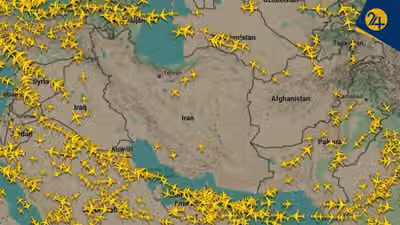
A screengrab from Flightradar24 shows Iran's airspace

Iran’s rapidly narrowing international air connections are forcing travelers onto longer and costlier routes while adding friction with neighboring states, as Tehran pressures regional governments over flight restrictions.

Flight-monitoring data from Flightradar24 indicate that US aviation sanctions have reduced Iran’s international flights by about half in one week. Almost all of Iran’s international flights over the past month have been operated by Iranian airlines, as foreign carriers have largely stopped flying to the country.

The latest restrictions reach beyond Iranian airlines themselves. Airports, fuel suppliers, ground handlers, ticket sellers and other companies providing services to sanctioned carriers can risk US penalties, giving businesses in third countries an incentive to stop handling Iranian flights.

Iranian-operated flights to the United Arab Emirates, Oman, Georgia and Azerbaijan have been suspended or sharply restricted, while Iranian carriers remain barred from Iraqi airports despite a limited resumption of services by Iraq’s national airline. Flights to China and Russia continue, while services to several other destinations, including Turkey and Afghanistan, have remained available.

For passengers trying to reach countries no longer served directly, that increasingly means flying through cities such as Istanbul, Islamabad, Kabul, Beijing, Dushanbe, Yerevan or Moscow before continuing to their destinations.

The detours can add hours or even days to journeys and substantially increase costs.

Turkey has become one of the most important remaining gateways. Iran Air flights between Tehran and Istanbul were still operating Monday, according to flight-tracking data, although Mahan Air has already suspended its Turkey services and Turkish Airlines has no Iran flights scheduled before March 2027.

Turkey Today reported Monday, citing two sources, that the remaining Iranian flights to Turkey were expected to be suspended in early October. No formal announcement of a complete suspension has yet been made.

Longer routes, higher costs

Mahan, a 42-year-old Iranian who has lived and worked in the United Arab Emirates for years and regularly travels to Tehran to visit her elderly mother, said her latest return journey to Dubai showed how quickly the restrictions were changing ordinary travel.

With direct options unavailable, she flew from Iran to Armenia on Sunday, spent the night at a hotel in Yerevan and continued to Dubai the following day.

Including the hotel and transportation in Armenia, she said the journey cost almost three times what she previously paid to travel between Iran and the UAE.

The trip was also more stressful, she said, because the hotel arranged for her was a considerable distance from the airport.

Other passengers she encountered had taken an even more difficult route. They told her they had traveled overland from Iran to the Armenian border and then continued roughly 400 kilometers by bus to Yerevan.

They described carrying luggage through crowded border areas and struggling to find transportation for the long journey from the crossing to the Armenian capital.

Najaf becomes test case

Iraq has emerged as one of the clearest examples of the complications created by Washington’s aviation pressure because of the volume of religious and family travel between the two countries.

Baghdad airport stopped accepting flights operated by Iranian airlines on September 22. Iranian aviation authorities initially sought to redirect some Baghdad-bound services to Najaf, one of Shiite Islam’s most important pilgrimage centers.

Najaf airport then suspended all flights to and from Iran on September 25, cutting off the alternative route and affecting large numbers of Iranian pilgrims traveling to Najaf and nearby Karbala.

The Iraqi government subsequently opened direct talks with Washington for exemptions from US Treasury measures. Prime Minister Ali al-Zaidi’s office said it was seeking exemptions allowing travel for medical treatment, education, religious visits and other civilian purposes.

Reuters reported Monday that the Trump administration was preparing a one-month waiver allowing Iraqi Airways to carry Shia pilgrims between Najaf and Iran, with a more permanent exemption potentially following. The proposed waiver applies specifically to the Iraqi national carrier.

Iraq’s state news agency later reported that Iraqi Airways had resumed flights between Najaf and Iranian airports.

Iran, however, disputed reports that Iran-Najaf flights had broadly resumed. Civil Aviation Organization spokesman Majid Akhavan said Tehran had received no official communication authorizing a resumption and said Iranian airlines remained unable to restart the route.

The two accounts refer to different operators: the Iraqi announcement concerned Iraqi Airways, while the Iranian statement addressed the ability of Iranian carriers to return to Najaf. Iraqi media also reported Monday that the ban on Iranian airlines remained in force even as Iraqi Airways resumed flights to Iranian airports.

The distinction gives Baghdad a way to restore at least some pilgrimage traffic without immediately reopening its airports to sanctioned Iranian carriers.

The disruption had already created political pressure in Iraq. Demonstrations were held in Baghdad and Najaf against the suspension, while Iranian officials warned that restrictions on air links could affect the broader relationship between the two neighbors.

Alaeddin Boroujerdi, a member of Iran’s parliamentary National Security Committee, pointed to Iraq’s reliance on Iranian electricity and gas and warned that policies obstructing bilateral ties could have consequences in other areas.

Iranian website Rouydad24 described the flight dispute as a test of relations between Tehran and Baghdad, noting Iran’s role in Iraq’s energy supplies and its past support in the fight against Islamic State.

Tehran warns its neighbors

The aviation restrictions have also produced increasingly sharp warnings from Iranian political figures toward governments cooperating with Washington.

Mohsen Rezaei, secretary of Iran’s Supreme National Security Council, warned regional countries last week that if Iranian aircraft were prevented from flying, airports elsewhere in the region could also be unable to operate.

The council’s secretariat later sought to distance itself from interpretations that Iran was threatening military attacks on regional airports, saying military retaliation over the flight restrictions was not on the agenda.

Mohammad Mokhber, an adviser to Supreme Leader Mojtaba Khamenei, nevertheless issued a separate warning Friday.

“Alignment with America in implementing hostile policies will remain in the memory of the Iranian people,” Mokhber wrote on X.

“Flights in the region are either free for everyone or for no one,” he added. “If Iran cannot fly or receive airport services, no country in the region will have this possibility either.”

The remarks prompted support from some hardline social-media users, including calls for Tehran to impose a no-fly zone over the Persian Gulf or threaten airlines serving neighboring countries.

Others criticized the approach. Amir Abbasi, an X user, compared the aviation warnings with previous Iranian threats to prevent other countries from exporting oil if Tehran was unable to do so.

“Perhaps these threats have a domestic use, but a crisis cannot be solved with slogans,” he wrote.

Iran jails hardline MP over article accusing Ghalibaf of document tampering

Sep 28, 2026, 17:50 GMT+1
100%
Hamid Rasaei

Hardline Iranian lawmaker Hamid Rasaei was transferred to Evin Prison on Sunday to begin a 10-month sentence stemming from a complaint by Parliament Speaker Mohammad Bagher Ghalibaf, Iran’s judiciary said Monday.

Mizan, the judiciary’s news agency, said a final ruling by the Special Court of Clergy’s appeals court convicted Rasaei of “publishing falsehoods with intent to harm others.” He was transferred on September 27 to Evin’s ward for clerics to serve the sentence, Mizan said.

The case dates to early 2024, when Rasaei was not an MP but editor-in-chief of the hardline weekly 9 Dey. Parliament’s legal representative referred a complaint to prosecutors on February 3, 2024, over an article alleging “manipulation by Ghalibaf in parliamentary documents.”

The case also involved a video posted on Rasaei’s Telegram channel in which he described Ghalibaf as a “parliamentary dictator.” Rasaei was acquitted over that remark but convicted over the allegation concerning parliamentary documents.

Rasaei said the headline was based on remarks by another lawmaker, but the court rejected that defense, ruling that the alleged manipulation of parliamentary documents had not been established.

The court also ordered Rasaei to publish a correction on the front page of 9 Dey using the same typeface and headline size, although the weekly has not been published for the past two years.

Fars reported that Rasaei was asked during the proceedings to apologize over the article but refused, saying he saw no reason to apologize and stood by his position.

Rasaei called the ruling “non-legal and political” in parliament but said he would comply because it was a legal judgment. He also argued that the 10-month term was excessive, saying a first-time offender convicted of publishing falsehoods should have received the minimum sentence of 91 days.

Because Rasaei is a cleric, the case was handled by the Special Prosecutor’s Office for Clergy and later the Special Court of Clergy.

Rasaei, now a Tehran lawmaker, has long been identified with the Islamic Republic’s ultraconservative wing and was formerly a member of the Paydari Front. He has said he left the party more than a decade ago because of disagreements with members of its central council, while acknowledging continued ideological closeness to it.

His conflict with Ghalibaf reflects a broader struggle within Iran’s conservative establishment. Rasaei and other ultraconservative lawmakers have repeatedly challenged Ghalibaf over his control of parliament and his role in negotiations with Washington, accusing him of crossing leadership red lines and making excessive concessions.

That confrontation intensified after Iran’s agreement with the United States. Rasaei accused Ghalibaf of backing an arrangement that prevented Tehran from retaliating for the killing of Ali Khamenei and said the deal could pave the way for a “bloodless coup.” Other Paydari-aligned and ultraconservative lawmakers have mounted similar attacks on the speaker.

Rasaei has simultaneously been a persistent opponent of President Masoud Pezeshkian and Iran’s reformist factions. He has attacked Pezeshkian over negotiations with the United States, questioned his political fitness and previously compared him to Abolhassan Banisadr, Iran’s first president, who was removed from office by parliament in 1981.

His politics therefore place him in conflict both with reformists and with more negotiation-minded conservative rivals such as Ghalibaf, highlighting divisions within the establishment over diplomacy with Washington, the use of military leverage and control of parliament.

IRGC outlet accuses reformists of feeding Trump's pressure campaign

Sep 28, 2026, 16:54 GMT+1
100%
Supporters of Iran’s government wave national flags during a rally in Tehran after authorities announced a two-week ceasefire in the war with the United States and Israel, April 8, 2026

Iranian reformists are helping sustain Washington’s pressure campaign by signaling that sanctions and other coercive measures are pushing Tehran toward negotiations and concessions, the IRGC-affiliated Fars news agency argued Monday.

In a commentary titled Reformists' Game in Trump's Sanctions Pressure Puzzle, Fars said Washington looks for political and social effects inside Iran whenever it applies economic, military or diplomatic pressure, and accused reformists of providing precisely the response US policymakers hope to see.

It argued that calls for negotiations under pressure, suggestions that Iran should suspend nuclear activities, support for what some reformists have termed an “honorable peace,” and doubts about the usefulness of measures such as closing the Strait of Hormuz all send Washington the message that pressure is working.

“When the other side sees that external pressure is also turning into a domestic political demand for retreat and concessions, it naturally has greater motivation to maintain and even intensify that pressure,” the commentary said.

Fars drew a distinction between the military and economic fronts, arguing that direct US military action had encountered Iranian resistance and failed to achieve its objectives, while Washington continued to see sanctions and economic pressure as effective because their impact was quickly reflected in domestic calls for compromise.

The outlet said this created a cycle in which each new US measure was reinforced by political arguments inside Iran that the country had little choice but to negotiate or relinquish some of its leverage. Iranian society and the economy ultimately bear the cost of that cycle, it said.

Fars also accused reformists of constructing a “false dichotomy” between war and peace by presenting themselves as supporters of negotiations while portraying their opponents as advocates of violent confrontation. It argued that negotiations were only one tool of foreign policy and invoked the establishment's longstanding formulation that diplomacy and the “field” — a term commonly used for military and regional power — should complement one another.

The commentary comes amid an increasingly public dispute over the scope of negotiations with Washington.

IRGC-affiliated outlets and hardline lawmakers have criticized Foreign Minister Abbas Araghchi's contact with US envoy Steve Witkoff in New York, questioning whether he was authorized to hold direct discussions.

At the same time, Major General Yahya Rahim Safavi, a military adviser to Iran's supreme leader, has said the government has been given room to pursue negotiations.

The dispute therefore extends beyond whether Tehran should negotiate at all, focusing increasingly on how talks should be conducted, what concessions Iran can offer and whether military, nuclear and maritime leverage should be maintained alongside diplomacy.