• العربية
  • فارسی
Brand
  • Iran Insight
  • Politics
  • Economy
  • Analysis
  • Special Report
  • Opinion
  • Podcast
  • Live TV
  • Iran Insight
  • Politics
  • Economy
  • Analysis
  • Special Report
  • Opinion
  • Podcast
  • Live TV
  • Theme
  • Language
    • العربية
    • فارسی
  • Iran Insight
  • Politics
  • Economy
  • Analysis
  • Special Report
  • Opinion
  • Podcast
  • Live TV
All rights reserved for Volant Media UK Limited
volant media logo
VOICES FROM IRAN

US blockade divides Iranians online over pressure on rulers, cost to public

Hooman Abedi
Hooman Abedi

Iran International

Sep 29, 2026, 22:15 GMT+1
A woman walks past a person using an ATM outside a Bank Saderat branch in Iran.

Iran’s deepening isolation is drawing divided reactions from Persian-language social media users, with some welcoming US pressure to weaken the country’s rulers and others warning that ordinary people will bear the cost without producing political change.

The posts reviewed by Iran International reflect individual online reactions and are not representative of public opinion in Iran. But they show how the growing economic pressure is being interpreted by people arguing both for and against the blockade.

That pressure has intensified as the US naval blockade sharply curtailed Iran’s oil exports, a major source of foreign currency. Iranian crude loadings fell from about 2 million barrels per day in March to roughly 220,000-255,000 in August, according to shipping data cited by Reuters.

“Great. An air and sea blockade, then a land blockade, will lead to the government’s fall,” one Persian-language social media user wrote.

“The economic blockade is choking it,” another wrote.

Support for continued pressure has also appeared on Reddit. “I said months ago that the blockade is a good strategy,” one commenter wrote, expressing hope that US President Donald Trump would maintain it.

Another user in the discussion described maintaining the pressure as “Great for Iran.”

Taken together, the posts illustrate a view among supporters of the blockade that restricting trade and government revenue could weaken the Islamic Republic’s ability to withstand domestic pressure.

One user argued that the blockade could erode the authorities’ ability to administer and control the country by reducing oil revenue, weakening internal cohesion and increasing economic pressure.

“The blockade is not the objective, but the instrument,” he wrote, arguing that the aim was to increase pressure until the authorities struggled to maintain stability and manage the economy.

Others say ordinary Iranians will pay

Other users rejected the idea that economic isolation would bring political change and warned that the greatest burden would instead fall on the public.

“I don’t know of an example in history where sanctions and an economic blockade caused a revolution. Ordinary people just suffer,” one user wrote on X.

Another said prolonged isolation could strengthen corruption and preferential access, leaving politically connected people better placed to profit from shortages while the wider population becomes poorer.

“This situation could continue for years,” the user wrote, adding that the authorities could blame worsening economic conditions on the blockade.

For others, the consequences are already visible far beyond politics and trade.

“You can’t leave the country by air or sea. All the language exams have sanctioned us. Eighty percent of online games are restricted for Iranians. You can’t even create a Gmail account,” another person wrote on Instagram.

“It’s as though the project to erase Iranians from the face of the earth has officially begun,” the user added.

Dark humor over growing isolation

The restrictions have also prompted sarcasm directed at official assertions of resilience.

After Turkish Airlines suspended its Iran flights until at least March 2027, one commenter ironically invoked a familiar phrase in Iranian political rhetoric: “America can’t do a damn thing.”

“They just keep announcing victories one after another,” another wrote with laughing emojis.

A longer sarcastic comment mocked rhetoric about missiles, drones and military strength before concluding: “If the blockade continues, soon we’ll have to eat grass.”

Economic hardship also featured in discussions on Reddit. One commenter said half their monthly salary went on groceries and food and the other half on rent, leaving them dependent on savings. Another described paying 15 million rials for a kilogram of cold cuts and pickles.

The rial has fallen sharply during the economic squeeze, trading at more than 2.3 million to the dollar in September.

Iran’s official minimum monthly wage is about 166 million rials, worth roughly $71 at that exchange rate, meaning the purchase described by the commenter would amount to about 9% of a minimum-wage worker’s basic monthly pay.

Most Viewed

UAE outmaneuvers Iran’s Hormuz strategy, state TV analysts say
1

UAE outmaneuvers Iran’s Hormuz strategy, state TV analysts say

2

Iran’s shrinking air links raise costs, strain regional ties

3

Iran’s rial hits another record low under economic and military pressure

4
EXCLUSIVE

Key IRGC intelligence figure in Iran’s oil sales identified: Who is Mostafa Ahadi?

5

IRGC outlet accuses reformists of feeding Trump's pressure campaign

Banner
Banner
Banner

Spotlight

  • Iranian hardliners turn on Ghalibaf and judiciary after lawmaker’s sentencing
    INSIGHT

    Iranian hardliners turn on Ghalibaf and judiciary after lawmaker’s sentencing

  • The body as a battleground: Iran's resistance etched in ink and blood
    SPECIAL REPORT

    The body as a battleground: Iran's resistance etched in ink and blood

  • Khamenei’s vision of Iranian power faces a test of reality
    ANALYSIS

    Khamenei’s vision of Iranian power faces a test of reality

  • Iran’s shrinking air links raise costs, strain regional ties

    Iran’s shrinking air links raise costs, strain regional ties

  • Why Trump said no to Iran’s Hormuz proposal
    ANALYSIS

    Why Trump said no to Iran’s Hormuz proposal

  • Iran’s oil industry has too many masters
    OPINION

    Iran’s oil industry has too many masters

  • Iran wrong to expect midterms to restrain Trump, former US official says

    Iran wrong to expect midterms to restrain Trump, former US official says

Banner
  • Tehran ‘ashamed’ as Iranians struggle to make ends meet

    Tehran ‘ashamed’ as Iranians struggle to make ends meet

  • Iranian test-takers head abroad as exam access shrinks

    Iranian test-takers head abroad as exam access shrinks

  • Turkish Airlines says all Iran flights suspended until March 2027

    Turkish Airlines says all Iran flights suspended until March 2027

•
•
•

More Stories

Iran says awaiting US response on Hormuz proposal

Sep 29, 2026, 13:28 GMT+1
100%
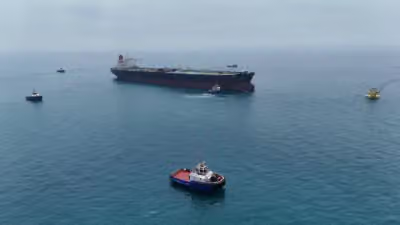
Vessels transit the Strait of Hormuz, a key route for global oil shipments.

Iran said on Tuesday it is awaiting a US response to its proposal for reopening the Strait of Hormuz, as regional oil flows continued to recover and the rial sank past 2.5 million to the dollar.

The developments put Iran’s efforts to secure relief for maritime trade alongside mounting economic pressure at home and warnings from Iranian and US officials over further confrontation.

“We are awaiting an official response from the United States through the mediators,” Foreign Minister Abbas Araghchi said.

Qatar was expected to relay Iran’s proposals to Washington and return with a response, possibly by Wednesday, Araghchi said. Iran had made no concessions and reopening Hormuz remained conditional on its demands being met, he added.

“At present, the only issue is the Strait of Hormuz,” Araghchi said. “Iran’s conditions are entirely fair and reasonable. If the Americans say they want an agreement or a peaceful solution, we have presented that solution.”

Oil flows recover despite risks in Hormuz

Persian Gulf oil exports have recovered despite disruption around Hormuz, potentially reducing the impact of restrictions on one of the world’s most important energy routes.

Oil shipments through the strait and alternative routes have returned to nearly 80% of pre-war regional levels, the Wall Street Journal reported Monday.

Crude exports from major Middle Eastern producers including Saudi Arabia, Iraq and the United Arab Emirates have climbed to almost 13 million barrels per day this month, their highest level since February, according to ship-tracking data cited by the Journal.

Risks to shipping persist. A vessel transiting Hormuz was struck by a suspected unknown projectile Monday evening, causing a fire that was later extinguished, the UK Maritime Trade Operations said. The crew was safe.

Against that backdrop, Iran tied the security of regional energy infrastructure to its own ability to export oil. “If we do not sell oil in a region, no one will sell oil there, and if our security is not guaranteed, no infrastructure will be safe,” parliament speaker Mohammad Bagher Ghalibaf said Tuesday.

Rial crosses 2.5 million per dollar

Iran’s free-market exchange rate crossed 2.5 million rials to the dollar Tuesday, extending a currency decline that has increased import costs and eroded household purchasing power.

The dollar had reached 2.418 million rials Monday before gaining more than 80,000 rials, or over 3%, in less than 24 hours.

The decline comes alongside inflation, falling production, trade restrictions, foreign-currency shortages and difficulties transferring money.

Iran is seeking alternatives to maritime trade. Rail freight from China has increased tenfold since the US naval blockade began, lawmaker Meisam Zohourian said.

Three rail routes and expanded capacity at northern ports could provide overland capacity equivalent to about 400,000 barrels of oil a day, though they could not fully replace maritime trade, Zohourian said.

Revolutionary Guards prepare message to Americans

The Islamic Revolutionary Guards have addressed the American public in a letter portraying Iran as the victor in the war with the United States and crediting Mojtaba Khamenei’s leadership for the outcome.

“This is a letter, not a propaganda effort to shape the media narrative,” IRGC spokesman Hossein Mohebbi said Tuesday.

The letter said Khamenei’s “unparalleled command” had left “the world’s two leading military powers” unable to prevail and argued that his leadership gave Iran an advantage the United States lacked.

“A God-fearing and just leader, a wise scholar and a pure and courageous ascetic — this is what your armed forces and your country lack and do not have,” the Revolutionary Guards wrote in the letter to Americans.

Mohebbi also called US President Donald Trump “a big liar” and said Washington had no choice but to acknowledge failure and leave the region.

Washington, for its part, warned Iran against targeting US interests beyond the confrontation over Hormuz. US Secretary of State Marco Rubio said Iran had openly threatened American interests around the world and would face repercussions for any attack or attempted attack.

Iran’s government, however, coupled its readiness for further conflict with an openness to diplomacy. “We are not afraid of war and we do not run away from negotiations,” government spokesperson Fatemeh Mohajerani said.

Key IRGC intelligence figure in Iran’s oil sales identified: Who is Mostafa Ahadi?

Sep 29, 2026, 00:05 GMT+1
•
Mojtaba Pourmohsen
100%

Iran International has obtained exclusive information and documents indicating that Mostafa Ahadi, a senior official in the IRGC Intelligence Organization, runs the organization’s corruption network in the sale of Iran’s oil.

Over the past two months, Iran International has published three separate reports naming the trustees — oil brokers trusted by the Islamic Republic to sell Iran’s sanctioned oil — who have failed to return billions of dollars in oil proceeds to the country.

On September 28, Judiciary Chief Gholamhossein Mohseni-Ejei criticized delays in handling cases involving trustees with outstanding debts and called for swift rulings. Iran International has obtained a confidential Supreme National Security Council document in which the council’s deputy for economic affairs confirms that oversight bodies alter the trustees’ debt figures according to their own interests, inflating some debts and understating others.

The council’s deputy has asked the Ministry of Intelligence and the IRGC Intelligence Organization to report on the missing funds. The letter makes it easier for IRGC Intelligence, the principal organization implicated in the corruption surrounding oil sales, to gain access to the case.

100%

Trustees’ case returns to IRGC Intelligence

Two informed sources in the Oil Ministry and an oversight body told Iran International that the Supreme Audit Court and the General Inspection Organization are currently pursuing the trustees’ cases. But through the maneuvering of a senior security official and an order from the Supreme National Security Council, the case has effectively returned to the IRGC Intelligence Organization.

That senior security official, whose photograph Iran International is publishing for the first time, is Mostafa Ahadi. He is now deputy head of Unit 600 of the IRGC Intelligence Organization, having previously served as its deputy for economic affairs. Through his positions in IRGC Intelligence and the Supreme National Security Council over the past decade, Ahadi has had a firm grip on Iran’s oil sales.

100%

Several months ago, Brigadier General Mehdi Sayyari appointed Ahadi deputy head of Unit 600. Sayyari served for years as deputy head of the IRGC Intelligence Organization and became acting head of one of the country’s most important security organizations following the killing of Majid Khademi.

100%

In the late 2010s, when responsibility for selling oil under sanctions was assigned to the Supreme National Security Council, Ahadi joined the council as deputy for economic affairs. Without his security background becoming known to international organizations, he attended two BRICS summits, in Russia and Brazil.

100%
100%

His involvement in Iran’s oil trade is so extensive that he even accompanies Oil Ministry officials on visits to oil terminals on Kharg Island.

While serving on the Supreme National Security Council, Ahadi sent his former deputy, Mohammad Javad Bavand, to the council’s cover committee as a representative of IRGC Intelligence, ostensibly to oversee sanctioned oil sales. His principal responsibility, however, was to secure profits from corruption in the oil trade for the IRGC Intelligence network.

Bavand, who served as a special assistant to the oil minister for oil sales during Ebrahim Raisi’s administration, returned to the role about four months ago. According to a General Inspection Organization document first published by Iran International, he assigned the sale of a large 86-million-barrel oil consignment to four trustees with outstanding debts, including Mohammad Hadi Momenin.

Bavand’s close ties to Mohammad Hadi Momenin

Iran International has obtained exclusive information indicating that the relationship between the two extends well beyond this corruption case.

A General Inspection Organization document published by Iran International revealed that the sale of 86 million barrels of Iran’s oil had been assigned to four trustees with outstanding debts.

Six years ago, Mohammad Hadi Momenin was arrested on suspicion of disrupting the foreign exchange system. He had received hundreds of millions of dollars in preferential foreign currency to import machinery for the paper industry and had failed to return the funds. At the time, Mohammad Javad Bavand used his influence to have the case closed. Momenin, who was a shareholder in Mahan Industries and Mines Development Holding, then appointed Bavand to a management position as his representative. Gardeshgari Bank is the holding company’s principal shareholder.

On Monday, September 28, Hadi Ghavami, the parliamentary representative for Esfarayen, told a plenary session: “The trustees who took oil out of the country also stole $300 million, equivalent to 69 trillion tomans, from Gardeshgari Bank, and under these circumstances, the Central Bank has given them a credit line with a 45 percent penalty.”

In June 2020, Momenin was arrested again on allegations of financial corruption and disrupting the foreign exchange system, but his case was once more closed with Bavand’s help. An investigator’s report quoted Momenin as saying that he had used his employees to register numerous shell companies in China, Taiwan, Singapore and the United Arab Emirates. The companies existed for between three and 14 months.

Another part of the case revealed that Momenin’s holding company had received large loans from Mellat Bank, Refah Bank, Karafarin Bank, Bank of Industry and Mine, Saman Bank and Middle East Bank, yet none of the banks had filed a complaint against him.

In July, the Central Bank published a list of major bank debtors showing that Mohammad Hadi Momenin owed Karafarin Bank 743 billion tomans.

Two informed sources in the Oil Ministry and an oversight body told Iran International that Ahmad Baharvandi, who became Karafarin Bank’s chief executive five years ago, was in fact an associate of Bavand within IRGC Intelligence. Both men studied at Imam Sadiq University. Mostafa Ahadi also studied there and was a member of the university’s student Basij organization.

At Bavand’s request, Baharvandi did not pursue Momenin’s 743-billion-toman debt. In turn, Momenin took Bavand on a trip to China.

Mohammad Hadi Momenin was a member of the Ministry of Intelligence’s oil sales corruption network known as Shayan, which failed to return $2 billion in oil proceeds.

Secret IRGC meeting held to counter reporting on trustee corruption

After Bavand returned to the Oil Ministry, Momenin became his trusted trustee for oil sales despite a warning from the General Inspection Organization. Over the past month, following the publication of investigative reports, Momenin and Bavand have found themselves back in the headlines against their wishes.

Mostafa Ahadi, the godfather of the IRGC Intelligence corruption network, used his new position to address the problem. Two informed sources in the Oil Ministry and an oversight body told Iran International that a secret meeting was held two weeks ago at the IRGC’s media headquarters. Those present included Abdullah Zeighami, also known as Brigadier General Moshfegh, Bavand and Ahadi.

The meeting’s objective was to prevent media coverage of trustee corruption. One result was the removal of reports about the scandal from Mehr News Agency, which is affiliated with the Islamic Propagation Organization, and Hamshahri, a newspaper owned by Tehran Municipality.

At the same time, Ahadi used the Supreme National Security Council to return responsibility for the trustees’ cases to IRGC Intelligence so that the security organization’s cycle of profits from oil sales would continue.

Iran’s shrinking air links raise costs, strain regional ties

Sep 28, 2026, 20:40 GMT+1
•
Maryam Sinaiee
100%
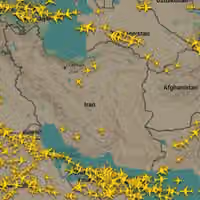
A screengrab from Flightradar24 shows Iran's airspace

Iran’s rapidly narrowing international air connections are forcing travelers onto longer and costlier routes while adding friction with neighboring states, as Tehran pressures regional governments over flight restrictions.

Flight-monitoring data from Flightradar24 indicate that US aviation sanctions have reduced Iran’s international flights by about half in one week. Almost all of Iran’s international flights over the past month have been operated by Iranian airlines, as foreign carriers have largely stopped flying to the country.

The latest restrictions reach beyond Iranian airlines themselves. Airports, fuel suppliers, ground handlers, ticket sellers and other companies providing services to sanctioned carriers can risk US penalties, giving businesses in third countries an incentive to stop handling Iranian flights.

Iranian-operated flights to the United Arab Emirates, Oman, Georgia and Azerbaijan have been suspended or sharply restricted, while Iranian carriers remain barred from Iraqi airports despite a limited resumption of services by Iraq’s national airline. Flights to China and Russia continue, while services to several other destinations, including Turkey and Afghanistan, have remained available.

For passengers trying to reach countries no longer served directly, that increasingly means flying through cities such as Istanbul, Islamabad, Kabul, Beijing, Dushanbe, Yerevan or Moscow before continuing to their destinations.

The detours can add hours or even days to journeys and substantially increase costs.

Turkey has become one of the most important remaining gateways. Iran Air flights between Tehran and Istanbul were still operating Monday, according to flight-tracking data, although Mahan Air has already suspended its Turkey services and Turkish Airlines has no Iran flights scheduled before March 2027.

Turkey Today reported Monday, citing two sources, that the remaining Iranian flights to Turkey were expected to be suspended in early October. No formal announcement of a complete suspension has yet been made.

Longer routes, higher costs

Mahan, a 42-year-old Iranian who has lived and worked in the United Arab Emirates for years and regularly travels to Tehran to visit her elderly mother, said her latest return journey to Dubai showed how quickly the restrictions were changing ordinary travel.

With direct options unavailable, she flew from Iran to Armenia on Sunday, spent the night at a hotel in Yerevan and continued to Dubai the following day.

Including the hotel and transportation in Armenia, she said the journey cost almost three times what she previously paid to travel between Iran and the UAE.

The trip was also more stressful, she said, because the hotel arranged for her was a considerable distance from the airport.

Other passengers she encountered had taken an even more difficult route. They told her they had traveled overland from Iran to the Armenian border and then continued roughly 400 kilometers by bus to Yerevan.

They described carrying luggage through crowded border areas and struggling to find transportation for the long journey from the crossing to the Armenian capital.

Najaf becomes test case

Iraq has emerged as one of the clearest examples of the complications created by Washington’s aviation pressure because of the volume of religious and family travel between the two countries.

Baghdad airport stopped accepting flights operated by Iranian airlines on September 22. Iranian aviation authorities initially sought to redirect some Baghdad-bound services to Najaf, one of Shiite Islam’s most important pilgrimage centers.

Najaf airport then suspended all flights to and from Iran on September 25, cutting off the alternative route and affecting large numbers of Iranian pilgrims traveling to Najaf and nearby Karbala.

The Iraqi government subsequently opened direct talks with Washington for exemptions from US Treasury measures. Prime Minister Ali al-Zaidi’s office said it was seeking exemptions allowing travel for medical treatment, education, religious visits and other civilian purposes.

Reuters reported Monday that the Trump administration was preparing a one-month waiver allowing Iraqi Airways to carry Shia pilgrims between Najaf and Iran, with a more permanent exemption potentially following. The proposed waiver applies specifically to the Iraqi national carrier.

Iraq’s state news agency later reported that Iraqi Airways had resumed flights between Najaf and Iranian airports.

Iran, however, disputed reports that Iran-Najaf flights had broadly resumed. Civil Aviation Organization spokesman Majid Akhavan said Tehran had received no official communication authorizing a resumption and said Iranian airlines remained unable to restart the route.

The two accounts refer to different operators: the Iraqi announcement concerned Iraqi Airways, while the Iranian statement addressed the ability of Iranian carriers to return to Najaf. Iraqi media also reported Monday that the ban on Iranian airlines remained in force even as Iraqi Airways resumed flights to Iranian airports.

The distinction gives Baghdad a way to restore at least some pilgrimage traffic without immediately reopening its airports to sanctioned Iranian carriers.

The disruption had already created political pressure in Iraq. Demonstrations were held in Baghdad and Najaf against the suspension, while Iranian officials warned that restrictions on air links could affect the broader relationship between the two neighbors.

Alaeddin Boroujerdi, a member of Iran’s parliamentary National Security Committee, pointed to Iraq’s reliance on Iranian electricity and gas and warned that policies obstructing bilateral ties could have consequences in other areas.

Iranian website Rouydad24 described the flight dispute as a test of relations between Tehran and Baghdad, noting Iran’s role in Iraq’s energy supplies and its past support in the fight against Islamic State.

Tehran warns its neighbors

The aviation restrictions have also produced increasingly sharp warnings from Iranian political figures toward governments cooperating with Washington.

Mohsen Rezaei, secretary of Iran’s Supreme National Security Council, warned regional countries last week that if Iranian aircraft were prevented from flying, airports elsewhere in the region could also be unable to operate.

The council’s secretariat later sought to distance itself from interpretations that Iran was threatening military attacks on regional airports, saying military retaliation over the flight restrictions was not on the agenda.

Mohammad Mokhber, an adviser to Supreme Leader Mojtaba Khamenei, nevertheless issued a separate warning Friday.

“Alignment with America in implementing hostile policies will remain in the memory of the Iranian people,” Mokhber wrote on X.

“Flights in the region are either free for everyone or for no one,” he added. “If Iran cannot fly or receive airport services, no country in the region will have this possibility either.”

The remarks prompted support from some hardline social-media users, including calls for Tehran to impose a no-fly zone over the Persian Gulf or threaten airlines serving neighboring countries.

Others criticized the approach. Amir Abbasi, an X user, compared the aviation warnings with previous Iranian threats to prevent other countries from exporting oil if Tehran was unable to do so.

“Perhaps these threats have a domestic use, but a crisis cannot be solved with slogans,” he wrote.

Iran’s rial hits another record low under economic and military pressure

Sep 28, 2026, 12:48 GMT+1
100%
A man displays US dollar banknotes on a street in Tehran, Iran.

Iran’s rial fell to another record low on Monday, with the dollar reaching 2.45 million rials as economic and military pressures persisted and efforts took shape for possible new indirect talks with the United States.

Mediators are expected to hold separate talks with the United States and Iran on Monday or Tuesday over an amended version of a seven-day proposal Tehran presented on the sidelines of the UN General Assembly, sources briefed on the negotiations told Reuters.

Iranian Foreign Minister Abbas Araghchi and Qatari mediators remained in the United States for the discussions, an official briefed on the negotiations said.

The diplomatic effort comes with divisions visible inside Iran over negotiations and the country’s nuclear policy, while military officials continue to warn about another confrontation with Washington.

Diplomacy meets resistance at home

A group of serving and former Iranian officials called Monday for an immediate halt to cooperation under the Nuclear Non-Proliferation Treaty and withdrawal from the pact “as soon as possible.”

“Continued membership in this treaty is not in the country’s interest, and we call for withdrawal from it as a strategic necessity,” the signatories said.

Former intelligence minister Heydar Moslehi and other former officials from the administrations of Ebrahim Raisi and Mahmoud Ahmadinejad signed the statement alongside serving lawmakers.

Hardline newspaper Kayhan also criticized Iran’s diplomatic approach, saying officials had shown excessive enthusiasm for negotiations during President Masoud Pezeshkian’s visit to New York and sent Washington “a signal of weakness.”

Supreme Leader Mojtaba Khamenei, meanwhile, emphasized Iran’s military position, describing the country as the “world’s top power” according to what he called “divine calculations” and saying enemy forces had been pushed back from waters near Iran.

Military pressure centers on Hormuz

Iranian officials continued to point to the Strait of Hormuz in their warnings to Washington.

“We are acting with authority in the northern Arabian Sea and east of the Strait of Hormuz, and we will not let anyone pass. On the other side, our IRGC brothers are also standing firm,” army deputy coordinator Habibollah Sayyari said.

Lawmaker Salar Velayatmadar said Iran could close the Strait of Hormuz and Bab al-Mandab if the United States launched another attack.

Rial falls under trade and oil pressure

The economic backdrop to the negotiations has also deteriorated, with the US dollar listed at 2.45 million rials on Iran’s open market Monday.

Iranian businesses are facing higher costs in trade with neighboring Iraq as banks tighten checks and anti-money-laundering requirements, head of the Iran-Iraq Joint Chamber of Commerce, said.

The main danger was not a complete halt in trade but a gradual loss of Iran’s share of the Iraqi market, Jahangbakhsh Sanjabi Shirazi, said.

Washington is also seeking to restrict Iran’s oil income more. Iran could have “nothing left to trade for anything” within two weeks after completing its remaining oil deliveries to China, US Treasury Secretary Scott Bessent said Sunday.

About 15 million barrels remained out for delivery, Bessent estimated.

Pressure on Iranian financial operations extends into Europe. Italy’s central bank told Iran International on Monday that the Rome branch of Iran’s Bank Sepah has remained under special administration since October 2025 following the European Union’s adoption of restrictive measures against Iran.

The weakening rial and growing obstacles to trade are adding to Iran’s economic pressure, while warnings over Hormuz and recent military exchanges keep the risk of renewed conflict hanging over the country and the region.

UAE outmaneuvers Iran’s Hormuz strategy, state TV analysts say

Sep 28, 2026, 08:47 GMT+1
100%

The UAE has found ways to blunt Iran’s ability to disrupt oil traffic through the Strait of Hormuz by exploiting its maritime tactics, Iranian state television commentators said in a recent broadcast.

Four people appeared on IRIB’s Be Vaght-e-Iran (Iran Time) program, with three speaking during an exchange on how Abu Dhabi has adapted its oil shipments to Iran’s approach to the strategic waterway.

One participant suggested Iran could target the smaller shuttle vessels moving through the strait or strike their point of origin. Another rejected that approach as insufficient.

“It makes no sense to just hit these vessels. That is not an adequate response to this change in logic,” he said.

A third participant laid out the central argument: Abu Dhabi has sought to change the economics behind Iran’s maritime leverage rather than directly challenge its military capabilities.

  • Mideast oil flows recover while Iran exports vanish, tracker says

    Mideast oil flows recover while Iran exports vanish, tracker says

“The UAE has attacked the logic of closing the Strait of Hormuz,” he said.

Cheap ships change the calculation

Iran’s strategy, according to the panel, had relied partly on the vulnerability of very large crude carriers, or VLCCs, whose high value meant the prospect of an Iranian strike could make voyages commercially prohibitive as insurers withdrew coverage.

The UAE has sought to remove that pressure by creating a state-backed logistics chain and using smaller, cheaper vessels that can be readily replaced.

“It is defining a battlefield that has been designed to its advantage,” the commentator said. “It says: fight me here. You hit these small ones, and I keep replacing them.”

Abu Dhabi is also using ageing VLCCs that would otherwise be destined for scrapping because they no longer meet environmental or safety standards required at many ports, according to the discussion.

The ships can be worth considerably less than the oil they carry, reducing the economic loss if Iran damages them.

The broadcast also described a pattern in Iranian operations that the UAE could anticipate. Iranian forces radio vessels, fire warning shots if they continue and then target the bridge rather than immediately sinking the ship, giving crews around 30 to 40 minutes to evacuate.

Abu Dhabi has responded by positioning tugboats to recover damaged vessels and tow them to Sohar in Oman, where their cargo can still be unloaded, the main contributor said.

100%

“The tugboat comes and attaches itself right there to the ship that has been hit,” he said. “They tow it to Sohar and unload it there on the Omani coast.”

The result, he argued, is that Iran can damage a vessel without preventing its oil from reaching port.

Iran’s military logic questioned

Simply striking greater numbers of replaceable vessels would not restore Iran’s leverage, the discussion suggested.

“They have attacked our military logic,” the main contributor said. “You have to hit this logic.”

The participant who opened the exchange said Iran’s problem was not a lack of political will, but its continued reliance on an approach that was no longer producing the intended outcome.

“There really is the political will to confront them. But because we are confronting them within the previous framework, we are not getting the result we want,” he said.

The main contributor described the problem as a “cognitive error.”

Another researcher and Middle East commentator Mustafa Najafi separately accused the UAE on X of spending weeks trying to reduce Iran’s leverage over the Strait of Hormuz and seeking to move oil belonging to other countries through the waterway.

Najafi also accused Abu Dhabi of obstructing an Iran-Oman agreement on managing the strait and lobbying in the United States and Israel for attacks on Iran.

  • Saudi Arabia, UAE urge Trump to maintain pressure on Iran - WSJ

    Saudi Arabia, UAE urge Trump to maintain pressure on Iran - WSJ

“After Israel, no actor dreams of weakening and disintegrating Iran as much as the UAE does,” Najafi wrote, arguing that Tehran should move beyond a solely political and diplomatic response.

The remarks reflect concern among Iranian pro-system experts that the UAE is seeking not to overcome Iran’s military power in the Strait of Hormuz, but to diminish the strategic leverage that power is intended to provide.