• العربية
  • فارسی
Brand
  • Iran Insight
  • Politics
  • Economy
  • Analysis
  • Special Report
  • Opinion
  • Podcast
  • Live TV
  • Iran Insight
  • Politics
  • Economy
  • Analysis
  • Special Report
  • Opinion
  • Podcast
  • Live TV
  • Theme
  • Language
    • العربية
    • فارسی
  • Iran Insight
  • Politics
  • Economy
  • Analysis
  • Special Report
  • Opinion
  • Podcast
  • Live TV
All rights reserved for Volant Media UK Limited
volant media logo
PODCAST

Trump may be buying time on Iran until after the midterms

Negar Mojtahedi
Negar Mojtahedi

Iran International

Sep 26, 2026, 03:24 GMT+1
US President Donald Trump speaks to reporters in front of the Marine One

President Donald Trump may be putting off a difficult choice over Iran until after the US midterm elections, a former senior US diplomat told Iran International.

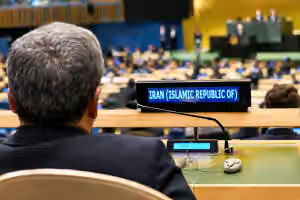
Trump used his address to the United Nations General Assembly this week to call for Iran's “complete economic isolation,” while saying he believed a deal could come after the November midterm elections.

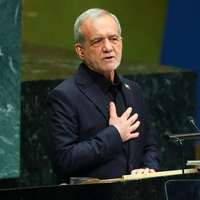
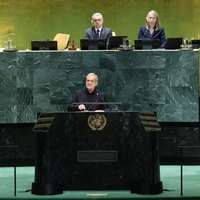
Iranian President Masoud Pezeshkian, meanwhile, said Tehran would not surrender to US pressure but remained open to diplomacy.

The two sides held their first indirect talks in months on the sidelines of the UN gathering but remained far apart on how to end the war, including over Iran’s conditions for reopening the Strait of Hormuz.

Ludovic Hood, a senior fellow at the Hudson Institute who spent two decades as a US diplomat and previously served as special adviser for the Middle East to Vice President Mike Pence, told Iran International's Eye for Iran that the approaching elections may help explain the current pause.

“We have elections coming up in America that I think have partly bounded President Trump’s willingness to be more confrontational at this point in time,” Hood said.

He described the conflict as a “standoff” with “more chapters to be written,” saying Trump could face a decision over whether to escalate again after the midterms or as the United States enters the new year.

“He may seek to escalate again militarily,” Hood said.

Potential targets could include commercial and economic assets inside Iran owned by or directly linked to the Islamic Revolutionary Guard Corps, he said, if Trump chooses to intensify the campaign.

Pressure without political change

Iran has suffered major military losses while contending with a US naval blockade and an expanding sanctions campaign. Yet nearly seven months into the war, those pressures have not produced fundamental political change in Tehran.

Hood cautioned against assuming that battlefield losses automatically translate into political change. Instead, he pointed to the cumulative impact of declining revenues, sanctions, domestic discontent and potential strains within the institutions responsible for protecting the state.

He described the Islamic Republic as “about as vulnerable as it’s been in 47 years,” pointing in particular to questions about the government's ability to continue paying salaries, including those of security forces.

“To me, a fifth uprising is a question of when, not if,” he said.

Hood said some people advising Trump have made the case that the collapse of the Islamic Republic is possible, while emphasizing that he was not predicting whether or when that would happen.

Washington has continued tightening economic pressure even as negotiations resumed in New York. New US restrictions on Iran's aviation sector have contributed to the loss of international routes, with additional Iraqi destinations restricting Iranian connections this week.

Saudi Arabia and the United Arab Emirates are also urging Washington to maintain sanctions and the naval blockade rather than make concessions prematurely, according to a Wall Street Journal report.

Both governments nevertheless oppose further US military escalation, according to the report.

Hood said the significance of Washington's economic campaign lies not simply in announcing additional sanctions, but in enforcing existing measures and steadily reducing the resources available to Tehran.

Despite the resumption of diplomacy in New York, no breakthrough has emerged. A senior Iranian official told Reuters this week that the two sides remained far apart.

That leaves Washington confronting a larger question: whether the pressure already imposed can fundamentally alter Tehran’s behavior, or whether the current pause will ultimately give way to another round of military escalation.

The answer may become clearer after November—when both Washington and Tehran appear to believe the political calculus could change.

Most Viewed

US-Iran talks focused on phased deal to reopen Hormuz
1

US-Iran talks focused on phased deal to reopen Hormuz

2
INSIGHT

Pezeshkian straddles Iran’s divide at UN as US talks test balance

3
ANALYSIS

From Hormuz to Indian Ocean: Iran threatens to redraw the map of the war

4
VOICES FROM IRAN

'Bully at home, victim abroad': Iranians on Pezeshkian's UN speech

5

China shipments help sustain Iran’s weapons programs despite US pressure - WSJ

Banner
Banner

Spotlight

  • US and Iran want a deal, but neither wants to move first
    ANALYSIS

    US and Iran want a deal, but neither wants to move first

  • Rushdie returns to the fatwa that nearly cost him his life

    Rushdie returns to the fatwa that nearly cost him his life

  • Iranians report SIM cards blocked over political posts and likes
    VOICES FROM IRAN

    Iranians report SIM cards blocked over political posts and likes

  • Pezeshkian straddles Iran’s divide at UN as US talks test balance
    INSIGHT

    Pezeshkian straddles Iran’s divide at UN as US talks test balance

  • 'Bully at home, victim abroad': Iranians on Pezeshkian's UN speech
    VOICES FROM IRAN

    'Bully at home, victim abroad': Iranians on Pezeshkian's UN speech

  • War deepens Iran’s energy crunch ahead of winter
    ANALYSIS

    War deepens Iran’s energy crunch ahead of winter

Banner
Banner
  • Iran threatens regional air travel as US sanctions cut its flight links

    Iran threatens regional air travel as US sanctions cut its flight links

•
•
•

More Stories

Iranians report SIM cards blocked over political posts and likes

Sep 25, 2026, 02:47 GMT+1
•
Saba Heidarkhani
100%

Social media users in Iran say their phone lines have been cut off after posting political content or liking posts on Instagram, extending a practice previously reported among political activists and journalists.

Messages received by Iran International describe SIM cards being blocked without warning, demands for written pledges and difficulty finding out which authority can restore service.

The reports include a 70-year-old woman in Tehran who said she was summoned several times after posting a WhatsApp story supporting the Pahlavi dynasty. Her SIM card was blocked, and she was eventually required to sign a pledge not to publish similar content again.

The woman said she does not have an Instagram account and is not otherwise active on social media.

The use of SIM card blocking to pressure social media users has been reported before. On September 12, Iran International reported that political and civil activists in several cities had lost access to their phone lines without prior notice and had been unable to resolve the restrictions.

Phone lines blocked without warning

Other citizens said their phone lines were disconnected after they liked political posts on Instagram. Many said they received no explanation or advance notice.

One person told Iran International that his sister and brother-in-law had moved to Finland about three years ago, but his sister’s Hamrah-e Aval SIM card, which he had kept in Iran, was deactivated “by order of the cyber police.”

Another Iranian wrote to Iran International that all his phone lines had been blocked for two months.

“I went to the telecommunications office, and they said it was on the prosecutor’s orders. No matter which authority I approach, they won’t tell me what I’m supposed to do,” he wrote.

He said he was directed to call a number that he later learned belonged to the Revolutionary Guards’ Intelligence Organization.

“I’ve called many times, and no one answers. My entire life has been paralyzed,” he added.

A Tehran resident responding to his account said his SIM card had also been blocked in February or March and that he had gone to a prosecutor’s office in the capital to seek its restoration.

Written pledges

Iran International has previously reported that some citizens had their SIM cards blocked after publishing content critical of the Islamic Republic online.

Some were referred to the prosecutor’s office’s cyberspace division or Gerdab to seek restoration of service. In certain cases, they said they were required to sign written pledges to refrain from further critical activity.

Several families of people killed in the January 2026 crackdown in Iran have also said their SIM cards were blocked in recent weeks without notice after they shared information about their loved ones.

Daily life disrupted

Reports received by Iran International describe how SIM card blocking has disrupted citizens’ daily lives.

Many said mobile phones and phone lines are essential for everyday activities and that losing access can disrupt banking, ride-hailing and other online services.

Citizens also said they had received no clear explanation for why their lines were blocked or how to have them restored.

They described confusion and severe disruption to their lives, saying the restrictions had been imposed without judicial proceedings.

Pezeshkian gets the generals' applause, and no word from the man above them

Sep 24, 2026, 11:18 GMT+1
•
Niloufar Goudarzi
100%
Iran's President Masoud Pezeshkian addresses the 81st United Nations General Assembly (UNGA) at UN headquarters in New York City, US, September 23, 2026.

Iran's generals and hardliners spent the week warning Masoud Pezeshkian not to smile in New York. After his UN speech they lined up to praise him. He had not changed their minds about talking to Washington. He had given a speech that did not require them to.

The one voice that could settle what Tehran wants from the diplomacy under way in New York has not been heard at all. Supreme Leader Mojtaba Khamenei has said nothing publicly about the contacts with Washington, the attacks on his foreign minister, or the speech itself.

He did not receive the president before the trip. And this is the first UN General Assembly in 37 years at which his father was not Iran's supreme leader.

What changed, and what did not

Before the speech, the hardline press was hostile to the trip itself. Kayhan warned that "New York is not a place for smiles and negotiations" and that the General Assembly should be turned into "a court for US crimes." Fars, affiliated with the Revolutionary Guards, wrote that Pezeshkian should not have gone at all.

Moderates pushed the other way: the daily Etemad recalled the meetings Iranian presidents failed to hold with Bill Clinton in 2000 and Barack Obama in 2013, and the reformist Mehdi Karroubi urged Pezeshkian to meet Donald Trump.

  • 'Killers in suits': Iranians ask New York's mayor why Pezeshkian walks free

    'Killers in suits': Iranians ask New York's mayor why Pezeshkian walks free

Pezeshkian did neither. After Trump used the UN podium to threaten to "annihilate" Iran, the president said he had rewritten his speech. He held up photographs of children killed in the strike on a school in Minab in the war's first hours alongside a portrait of the late Ali Khamenei, said Iran had defended itself "powerfully," said it remained open to negotiation, and said it would not accept "the language of coercion."

There was no offer in it, no gesture toward a meeting, nothing a hardliner could call weakness.

The praise followed within hours, and it praised the defiance.

Revolutionary Guards spokesman Hossein Mohebbi said the president had "at the heart of the system of arrogance, reproduced the message of power, pride, dignity and hope of a nation," in a statement carried by IRNA.

Iran would rely on unity "from the country's highest executive official to the brave fighters in the field and the people in the streets," he said.

  • Pezeshkian squeezed at home over meeting Trump in New York

    Pezeshkian squeezed at home over meeting Trump in New York

  • New US-Iran talks run into old question of who speaks for Tehran

    New US-Iran talks run into old question of who speaks for Tehran

  • Threats and counter-threats complicate new US-Iran diplomacy

    Threats and counter-threats complicate new US-Iran diplomacy

Mohammad Mokhber, an adviser to the supreme leader, called Pezeshkian "a worthy representative and the voice of all Iranians" who had been "decisive, reasoned and logical."

The message, he wrote on X, was clear: "we will not bow our heads before a bully, we will not forget our martyrs and we will make the aggressors regret their actions."

Ali Abdollahi, chief of staff of the armed forces and commander of the Khatam al-Anbiya Central Headquarters, Iran's wartime command, said the people "through Dr. Pezeshkian, slapped the criminal president of the United States before the eyes of the world," and that the armed forces stood "in harmony and in one voice with the people and the respected president."

Army commander Amir Hatami followed on Thursday. "Mr. President, well done. We sincerely thank you," he said, calling the address "a manifestation of the unity and coordination of all Iran against the bullying enemy."

  • Khamenei adviser says Tehran can negotiate, hardliners say it must not

    Khamenei adviser says Tehran can negotiate, hardliners say it must not

Parliament speaker Mohammad Bagher Ghalibaf wrote that Pezeshkian "spoke not just for a government, but for a 3,000-year-old civilization."

Every one of those statements praised the speech for what it refused. None mentioned the talks.

The missing voice

In previous years, state media made a point of showing the president meeting the supreme leader before a major trip, including before the General Assembly. The meeting was the signal: the president traveled with the leader's mandate, and everyone in Tehran knew it. No such meeting was announced this year. Mojtaba Khamenei has not been seen or heard in public since he was named to succeed his father in March, and he has issued nothing on New York.

The closest anyone has come to speaking for him was Major General Yahya Rahim Safavi, one of his military advisers, on Wednesday. "If the Supreme Leader has deemed it expedient and left the government's hands open in the negotiations, that is an important act of prudence," Safavi said on state television. Even the adviser spoke in the conditional.

That leaves the generals' applause doing a job the leader's meeting used to do. Their statements told Tehran that the speech was approved. What they did not tell anyone is whether the contacts around it are.

The fight that did not stop

The argument over those contacts continued through the praise, and it is an argument about authorization, not about whether to talk.

Ebrahim Rezaei, of parliament's National Security and Foreign Policy Committee, challenged Foreign Minister Abbas Araghchi on Wednesday over his meeting in New York with US envoy Steve Witkoff. "

On the basis of which authorization and policy did the foreign minister meet the representative of the aggressor enemy?" he wrote on X. Iran's seven conditions had already been conveyed to Washington, he said, and "nothing comes from such an illegal meeting except a sign of weakness."

Tasnim, also affiliated with the Guards, called Araghchi's explanation "childish and vile" and, citing Mohsen Rezaei, the secretary of the Supreme National Security Council, said the approved plan had been to pass the conditions through mediators, not to meet Witkoff. It called the meeting "a major error." Fars argued the contact had eased pressure on Washington without securing anything.

On Thursday Ali Khezrian, another member of the Committee, said Araghchi had not been authorized to hold direct talks and that MPs had registered a motion to impeach him. "Araghchi must, after returning from his trip, answer in parliament on what basis this conversation with the American side took place," he said.

The foreign minister had defenders. MP Mojtaba Zarei said his own inquiries showed Araghchi had been authorized to meet Witkoff. "There was and is no negotiation," he wrote; the seven conditions had been delivered directly to Trump's envoy. Mohebbi, for the Guards, had already set the terms: "We don't reject diplomacy, but we impose our own conditions. Our defensive power will be proven in the field."

The man who stayed in his seat

A second row concerned Nasser Asadi, a member of Iran's UN mission who remained in the hall during Trump's address. Hossein Ali Haji-Deligani, deputy head of parliament's Article 90 Committee, which handles public complaints against state bodies, called it "a source of shame and regret" and said MPs would use "all supervisory tools, including the impeachment of Araghchi." Hardline accounts contrasted Asadi with delegations that walked out.

Foreign Ministry spokesman Esmail Baghaei defended him. "Iran's seat in a place such as the United Nations General Assembly is our trench," he said. "If we are supposed to leave this trench because of the harsh words, hostility and insults of others, then we certainly have not done our duty."

Khamenei adviser says Tehran can negotiate, hardliners say it must not

Sep 23, 2026, 13:41 GMT+1
100%
Iranian President Masoud Pezeshkian disembarks from his plane after arriving in New York for the United Nations General Assembly on September 22, 2026.

A military adviser to Iran's supreme leader said the government has room to deal with Washington, and within hours a lawmaker and Guards-affiliated outlets condemned reported contact with it. The split surfaced as the Guards were reported to be directly engaged in Yemen.

Major General Yahya Rahim Safavi said Supreme Leader Mojtaba Khamenei’s decision to leave the government’s “hands open” in negotiations reflected significant strategic judgment.

“If the Supreme Leader has deemed it expedient and left the government’s hands open in the negotiations, that is an important act of prudence,” Safavi said in a televised interview.

  • Tehran sets out terms as US-Iran talks intensify in New York

    Tehran sets out terms as US-Iran talks intensify in New York

He also pointed to coordination between Iran’s military and political leadership and said he hoped decisions by the Supreme National Security Council would help prevent another war.

The remarks provided rare public confirmation from a senior military figure that Pezeshkian’s government has the leadership’s approval to pursue negotiations. They followed a day of indirect exchanges between Iranian and US delegations in New York, though major differences remain over Washington’s naval blockade and Tehran’s conditions for ending the conflict.

The prospect of diplomacy also exposed competing views inside Iran over how far Pezeshkian should go.

Lawmaker Ebrahim Rezaei and the IRGC-affiliated Tasnim and Fars news agencies criticized Foreign Minister Abbas Araghchi’s meeting with US envoy Steve Witkoff. Rezaei questioned its authorization and called it a “sign of weakness,” while the outlets argued that it rewarded Washington and eased pressure on the United States.

Reformist politician Gholamhossein Karbaschi, meanwhile, said the president should meet Trump to help resolve the country’s problems, echoing a similar appeal from senior reformist figure Mehdi Karroubi.

Lawmaker Ahmad Bakhshayesh Ardestani went further, predicting that a Pezeshkian-Trump meeting would take place in New York.

“In my view, the meeting between Pezeshkian and Trump will take place,” he said. “Last year, Pezeshkian decided to meet, but the Americans did not show up.”

Bakhshayesh Ardestani, a member of parliament’s national security and foreign policy committee, also advocated acquiring a nuclear weapon before leaving the Nuclear Non-Proliferation Treaty.

“Buy or build the atomic bomb, then say you are withdrawing from the NPT,” he said, while acknowledging that senior officials were not currently seeking withdrawal.

The competing statements illustrated the political constraints surrounding the New York diplomacy: Pezeshkian is said to have received apparent backing to negotiate, but officials and political factions remain divided over direct contact with Trump and the concessions Iran should seek or offer.

Those talks are unfolding as US economic pressure begins to narrow Iran’s international connections. Iranian airlines continued operating some foreign services Wednesday after a US deadline aimed at grounding the country’s fleet by threatening sanctions against companies providing fuel, ground handling, ticketing and other services.

Bloomberg cited flight-tracking data showing at least six flights leaving Iran for destinations including Bangkok, Phuket, Shanghai and Kabul after the restrictions took effect.

But the pressure appeared to be uneven rather than ineffective. Iran’s Civil Aviation Organization said flights to Baghdad and Muscat had been canceled, while Azerbaijan suspended Iranian airline services and Turkish Airlines halted its flights to Iran until at least March 2027.

  • The price of US pressure moves up Iran’s social ladder

    The price of US pressure moves up Iran’s social ladder

The restrictions add urgency to Tehran’s diplomacy by extending the economic confrontation beyond shipping and oil into civilian aviation. At home, however, authorities sought to show that wartime damage was being repaired.

An Oil Ministry official said around half of the damaged capacity at the South Pars gas field had returned to service and that the remaining planned restoration work would be completed before winter.

At the same time, a report of a deeper Iranian military role in Yemen showed how the conflict continues to extend across the region. IRGC personnel were on the ground helping the Houthis seize Yemen’s Red Sea coast from pro-government forces, the Associated Press reported, citing 10 officials and soldiers.

The report said Iranian personnel helped direct a rapid 115-kilometer offensive, marking Tehran’s most direct intervention on behalf of the Houthis since Yemen’s civil war began in 2014. Houthi forces also penetrated the communications of the National Resistance, allowing them to monitor movements and sow confusion.

That reported intervention could complicate efforts to contain the conflict while Tehran and Washington negotiate. Iran is signaling that its government has authority to pursue an agreement, but its regional military posture and the expanding sanctions campaign continue to generate pressure that could either drive diplomacy forward or deepen the confrontation.

Iran warns oil pollution spreading along southern coast could last years

Sep 23, 2026, 12:30 GMT+1
100%

Oil pollution has spread along parts of Iran’s Hormozgan coast and reached the entrances of shrimp farming channels in Sirik, with environmental officials warning that some of the contamination could remain in the marine environment for years.

Tar balls have been reported in several parts of Hormozgan province, including Soro and Golshahr in Bandar Abbas, with additional sightings reported in Hormuz and Minab, ISNA said.

Habib Masihi Taziani, head of Hormozgan’s environmental protection department, told ISNA that the amount found in Sirik was substantial and that experts were still assessing the extent of the contamination.

“The volume of tar balls in Sirik is significant,” he said, adding that authorities had begun work to manage the pollution with fisheries officials, port authorities, the Sirik governor’s office and the provincial crisis management agency.

Pollution reaches shrimp farming channels

The spread to the entrances of shrimp farming channels in Sirik has raised concern because aquaculture facilities there are directly connected to coastal waters.

Masihi Taziani told ISNA that conventional suction equipment was not effective for removing the tar balls.

“Collecting these oil masses with suction equipment is difficult,” he said. “Efforts are continuing to contain them and collect them using absorbent pads and other equipment.”

Tar balls are weathered remnants of petroleum products that can travel across the sea before washing ashore.

Officials warn pollution could persist for years

Ahmadreza Lahijanzadeh, deputy head of Iran’s Department of Environment for marine affairs, told ISNA the tar balls could cause significant damage to coastal and marine ecosystems.

“These oil masses can cause considerable environmental damage, and the resulting pollution can affect coastal and marine ecosystems,” he said.

Lahijanzadeh said organic compounds and heavy metals contained in the material could gradually enter the water and spread through the marine environment.

“The effects of this type of pollution are not limited to the period when the tar balls are visible on the coast,” he told ISNA.

“The entry and accumulation of these materials can cause pollution to remain in the sea for a long time, even for years,” he added, calling for continued monitoring and measures to identify and contain it.

  • Oil slicks hit Qeshm mangroves and Oman coast in mounting war fallout

    Oil slicks hit Qeshm mangroves and Oman coast in mounting war fallout

The latest sightings follow several oil pollution incidents along Iran’s southern coastline in recent weeks.

In August, Iranian state news agency IRNA reported that oil had reached mangrove forests on Qeshm island after slicks appeared near Suza and Shib Deraz. Authorities said at the time that the source had not been determined.

Mehr news agency reported that the pollution had initially been detected along about one kilometer of coast near Suza before spreading toward Shib Deraz.

TankerTrackers.com later said the Qeshm pollution appeared to have come from an Iranian attack on the bulk carrier Minoan Pioneer off Oman on August 3, with the spill drifting across the Strait of Hormuz toward Iran. Iranian authorities did not confirm that assessment.

Tanker spills add to pollution concerns

A separate spill was reported off Oman after the tanker Caroline Bezengi, carrying Russian crude, ran aground.

The UN’s International Maritime Organization said oil from the vessel had begun reaching Oman’s mainland, while Oman’s Environment Authority said the slick covered about 150 square miles near the Hallaniyat Islands.

Reuters, citing maritime security sources, reported that the vessel’s crew had first reported difficulties off Yemen in June and that initial assessments pointed to an onboard blast.

Iran executed IT expert after months in isolation and forced confession

Sep 23, 2026, 10:10 GMT+1
•
Pooya Jahandar
100%
Hossein Pedaaran

Iranian authorities executed IT expert Hossein Pedaran after what sources familiar with his case described as months of solitary confinement, severe physical and psychological pressure and a forced confession.

Pedaran, born on June 26, 1985, was married and had two children, aged 15 and 11. He was arrested in July 2025 and executed on September 19 at Isfahan Central Prison, also known as Dastgerd Prison.

One informed source told Iran International that plainclothes agents raided Pedaran’s home when he was arrested and seized his personal and work belongings, along with electronic devices belonging to him and members of his family.

The source said Pedaran was then held for months in solitary confinement and in detention facilities run by security agencies, where he faced severe physical and psychological pressure.

Prolonged detention in dark conditions and deprivation of sunlight caused injuries and sores on his toes, the source said. Interrogators also pressured and threatened Pedaran and his wife to force him to make statements against himself, according to the source.

100%

Iran Human Rights previously reported that Pedaran spent four months at the Isfahan Intelligence Department’s detention center before being transferred to an intelligence detention facility in Tehran. He was returned to Isfahan a month later.

Work in information technology

Information obtained by Iran International shows that before his arrest, Pedaran worked in information technology at a company called Gostareh Tarahan Naghsh Almas.

His work included designing and setting up USSD codes and developing digital businesses.

Iran’s judiciary said after his execution that Pedaran had been sentenced to death for “espionage and intelligence cooperation in favor of Israel” and that the sentence was carried out after being upheld by the Supreme Court.

The judiciary accused him of providing Mossad with information about military and missile facilities in Isfahan province.

100%

An informed source rejected the judiciary’s account that Pedaran had access to military or missile information, telling Iran International that his professional work was commercial and focused on information technology and digital services.

Iranian authorities have executed dozens of people in recent months on charges including involvement in the January uprising and espionage.

Trial process

A source familiar with Pedaran’s case told Iran International that Judge Mohammadreza Tavakoli of the Isfahan Revolutionary Court issued the death sentence and that defense submissions filed by the family’s lawyer were not considered.

The family had appointed lawyers at different stages of the case, the source said.

According to the source, one of the lawyers told the family on the night before the execution that no notice confirming the final approval of the sentence or setting an execution date had appeared in the judiciary’s Sana electronic system.

Pedaran’s family therefore did not know when he would be executed until the sentence was carried out, the source said.

Security agencies had also pressured Pedaran’s wife from the time of his arrest not to publicize the case and had told the family that he might receive a pardon, according to the source.

100%

Body handed over after two days

The source said Pedaran’s family faced obstacles when trying to recover his body after the execution.

His body was handed over to the family late in the day after about two days of attempts to obtain it, the source said.

Pedaran was buried under security restrictions at Bagh-e Rezvan cemetery in Isfahan, and his family was not allowed to hold a public mourning ceremony, according to information obtained by Iran International.

Relatives described Pedaran as calm, disciplined, kind and hopeful about life. They said he remained hopeful until his final family visit before the execution.

Mizan, the judiciary-affiliated news agency, did not provide details about when Pedaran was arrested, his access to legal counsel or the conditions of his detention in its report on his execution.

After his death, state media also broadcast excerpts of what authorities described as Pedaran’s “confessions.”