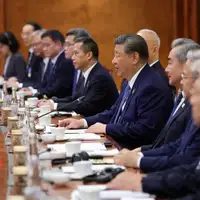
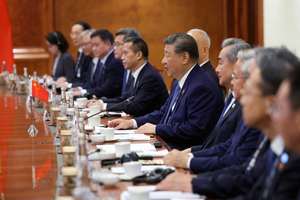
Chinese President Xi Jinping said on Saturday that Beijing was willing to work with other BRICS members to help restore peace and stability in the Persian Gulf and the Middle East, offering a four-point proposal aimed at reducing tensions, ending hostilities and promoting peace.
Xi’s remarks at the opening of the 18th BRICS summit in New Delhi marked China’s first public signal since the Iran-US war began six months ago that it was willing to take an active role in addressing the crisis through a coordinated BRICS effort.
Beijing has so far stopped short of directly involving itself in mediation over the conflict. It has condemned attacks on Iran, issued a broad four-point proposal during Xi’s visit to Cairo in April and called on the parties to return to negotiations. Some analysts have also said China has quietly supported mediation efforts by Pakistan and Qatar in recent months.
Mixed reactions in Iran
Former Iranian foreign minister Mohammad-Javad Zarif welcomed China’s offer on Sunday in a post on X, describing it as an opportunity to reduce tensions.
He said the move provided a “timely opportunity to ease tensions” and added that multilateral diplomacy was the only viable path to achieve peace.
Ramin Mehmanparast, a former Iranian foreign ministry spokesman, told Donya-e Eqtesad that China had clear economic and strategic interests in stability in the Persian Gulf.
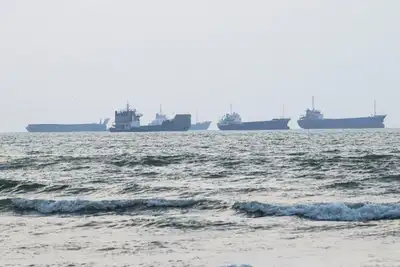
“China, in addition to seeking a role in the balance of power in the world, certainly sees stability in the Persian Gulf and the Strait of Hormuz as being in line with its long-term economic interests and views tensions and conflict in this region as contrary to its interests,” he said.
He added: “The Chinese are expected to become more seriously involved and, certainly, they have the necessary capacity to exert influence.”
Rahman Ghahremanpour, a senior Middle East researcher, also said Xi’s initiative was unlikely to have been made by chance.
Xi’s comments about BRICS efforts to promote peace in the Middle East should be taken seriously, he told Donya-e Eqtesad. China has both the diplomatic capacity and the incentive to act, he said, given its concerns that a prolonged crisis could harm its economic interests and regional standing.
Ghahremanpour also wrote on X that if reports of China’s willingness to mediate were accurate, they would represent a significant development that was probably not announced without coordination with Tehran.
He suggested that US President Donald Trump’s comments about an end to the war after the US midterm elections could potentially be connected to reports of China’s interest in mediation.
But not all Iranian reactions were positive.
Heshmatollah Falahatpisheh, a former chairman of parliament’s National Security and Foreign Policy Committee, accused Xi of seeking closer alignment with Washington.
“By presenting a plan for negotiations, Xi Jinping is trying to please Trump and, in return, obtain concessions from the United States over new trade tariffs,” he told Nameh News.
Reformist politician Abbas Akhoundi, who views the US-Iran war partly through the lens of US-China competition over resources transported through the Persian Gulf, argued that Tehran would ultimately need to engage with Beijing over regional security.
“I believed, and still believe, that achieving a security regime in the Persian Gulf can be achieved through dialogue with China,” he wrote on X. “Between the lines of Mr Xi’s recent positions, I understand that if we do not move towards a mechanism for the security of the Strait of Hormuz in coordination with China, we will come under pressure from China and conditions will become harder for the Iranian government and people.”
Was Xi offering to mediate?
Some Iranian media outlets and analysts have cautioned against interpreting Xi’s remarks as a formal offer to mediate between Tehran and Washington.
They argue that Xi did not explicitly refer to mediation between Iran and the United States. Instead, he stressed cooperation among BRICS members in efforts to restore peace and stability in the Persian Gulf and Middle East.
Hamed Vafaei, a professor of Chinese literature at the University of Tehran and a China researcher, said the interpretation of Xi’s remarks as a Chinese offer to mediate was “a free interpretation” of his comments.
In a note titled “What did Xi Jinping say in India and what did we hear in Iran?” he published on X, Vafaei said the remarks should not be regarded as a sudden development or an official announcement by Beijing that it would mediate between Tehran and Washington.
Rather, he said, they should be viewed as part of a gradual evolution in China’s West Asia diplomacy that began in the early stages of the 12-day war and has continued since.
“Xi Jinping’s position today, for experts who have closely monitored and analysed Beijing’s positions over the past months, contains only one important signal, several emphases and, in his own words, a kind of pioneering declaration of responsibility for the times — not a new position announcing mediation between Iran and America,” Vafaei wrote.
Why Beijing is cautious
Ghahremanpour said China was likely to proceed cautiously because it faced risks on both sides.
“On the one hand, the Chinese are concerned that Iran may not accept their demands, and on the other, they are worried that the United States may not welcome their initiative, and therefore they are acting very cautiously,” he told Donya-e Eqtesad.
“If China tries to mediate but the problem is not resolved, differences between Iran and the countries of the region will intensify and China will be regarded as one of those responsible,” he said. “If it also enters at the global level and faces a negative response from either Iran or the United States, its credibility will be called into question.”
Canada-based analyst Shahir Shahid-Saless said Xi’s caution was understandable given the need to simultaneously manage China’s relations with the United States and Israel while preserving its important strategic and economic relationships with Iran and the Arab states of the Persian Gulf.
A failed Chinese mediation effort, he said, could impose a significant political and reputational cost on Xi personally and seriously damage his credibility.
“By placing the issue within BRICS, Xi spreads the responsibility and avoids making China, and himself, the sole owner of a possible failure,” he wrote.
“There is also a fundamental obstacle: it is difficult to imagine Washington entrusting negotiations over the Iran war to BRICS, an organization increasingly presented as an alternative to Western-led institutions and one in which Iran itself is a member,” he added.