• العربية
  • فارسی
BrandBrand
  • Iran Insight
  • Politics
  • Economy
  • Analysis
  • Special Report
  • Opinion
  • Podcast
  • Live TV
  • Iran Insight
  • Politics
  • Economy
  • Analysis
  • Special Report
  • Opinion
  • Podcast
  • Live TV
  • Theme
  • Language
    • العربية
    • فارسی
  • Iran Insight
  • Politics
  • Economy
  • Analysis
  • Special Report
  • Opinion
  • Podcast
  • Live TV
All rights reserved for Volant Media UK Limited
volant media logo
VOICES FROM IRAN

Toxic air chokes Iranian cities, residents report health problems

Baharan Azadi
Baharan Azadi

Iran International

Nov 15, 2026, 12:41 GMT+0
File photo: Tehran’s skyline shrouded in thick smog, with Milad Tower barely visible through the polluted air.

Worsening air pollution across Iran has left citizens reporting headaches, nausea and breathing difficulties, with many criticizing authorities for keeping schools open, according to accounts received by Iran International.

People in Isfahan, Tehran, Mashhad, Urmia, Arak, Karaj and Kermanshah described worsening air quality and its effects on public health, particularly among elderly people and those with underlying medical conditions.

"Fuel oil burning and air pollution have become so severe in Isfahan that most of our family suffers from headaches much of the time," a citizen wrote.

Another person in Urmia described persistent headaches affecting family members.

"Our city has become extremely polluted, and we have headaches every day. We take painkillers, but they don't help," the resident said.

"The city smells like burning tires. We can barely breathe in this air, and it hasn't even turned cold yet. Imagine what winter will be like," a Mashhad resident said.

Tehran residents report breathing difficulties

Tehran's air quality index reached 153 on Friday evening, November 13, a level considered unhealthy for all groups.

By Sunday morning, November 15, the index stood at 125, indicating conditions unhealthy for sensitive groups.

Citizens reported reduced visibility, burning eyes, headaches and respiratory problems.

"Tehran has become like Chernobyl," one person said in a video sent to Iran International.

Another compared the pollution to Nazi gas chambers, accusing authorities of gradually killing people through exposure to polluted air.

A Tehran resident described a sudden deterioration in air quality over several days and accused authorities of contributing to the pollution.

Another reported overcrowding at Tehran's Milad Hospital, saying many patients were seeking treatment for shortness of breath and severe coughing.

"Which problem are we supposed to endure? Inflation, petrol shortages or being unable to breathe?" another citizen asked, describing severe headaches and nausea.

Anger over schools remaining open

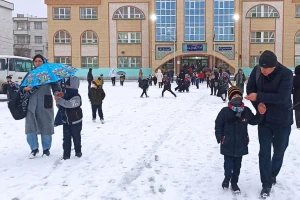
Parents and students also criticized authorities for keeping schools open despite worsening air quality.

A Tehran student reported coughing and experiencing breathing difficulties while returning home from school.

A person in Shahr-e Qods, west of Tehran, criticized the continuation of classes despite severe pollution and reduced visibility.

"These officials don't care about people in the slightest," the resident wrote.

"Are you aware of Tehran's pollution, or are you asleep? We can't breathe. Why aren't you closing schools?" another citizen asked.

Fuel oil burning continues

The complaints come alongside official confirmation that mazut, a heavy fuel oil, continues to be used in industrial facilities and power plants because of natural gas shortages.

Gas supplies to cement factories have been cut, forcing producers to switch to mazut, a situation likely to continue until March, Ali-Akbar Alvandian, secretary of the Cement Industry Employers Association, said on November 3.

A citizen in Pardis, near Tehran, previously reported severe pollution and white smoke covering the western part of the city, attributing the conditions to a nearby cement factory burning mazut.

Securing sufficient fuel for power plants will become more difficult during winter, and mazut will continue to be used as an alternative, Mostafa Rajabi Mashhadi, deputy energy minister for electricity, confirmed on November 14.

People had also raised concerns about mazut burning during the summer.

A Karaj resident reported sharply reduced visibility and worsening pollution, linking the conditions to fuel oil use at power plants.

Another person in Kermanshah said the Bisotun power plant had burned mazut in two generating units for more than two months, producing substantial pollution.

  • Tehran faces worsening smog as officials issue new health warning

    Tehran faces worsening smog as officials issue new health warning

  • Students shiver in classrooms as Iran government warns of gas cuts

    Students shiver in classrooms as Iran government warns of gas cuts

  • Air pollution claimed 6,000 lives in Tehran over the past year, officials say

    Air pollution claimed 6,000 lives in Tehran over the past year, officials say

Most Viewed

Iran's oil output plunges below pre-war domestic needs
1
ANALYSIS

Iran's oil output plunges below pre-war domestic needs

2

Iran state TV says modified missile could reach US base in Britain

3

Cash-strapped Iranians put multiple organs up for sale

4
ONE-ON-ONE

Iranians and Israelis can defeat the IRGC together, says Arab-Israeli activist

5
INSIGHT

Iranian hardliners urge Iraq to push back against US pressure

Banner

Spotlight

  • Can higher fuel prices curb Iran’s smuggling problem?
    ANALYSIS

    Can higher fuel prices curb Iran’s smuggling problem?

  • Canadian MP to flag paintball gun findings after Iran protest blindings
    PODCAST

    Canadian MP to flag paintball gun findings after Iran protest blindings

  • Locks for cash: inside Iran's booming hair trade

    Locks for cash: inside Iran's booming hair trade

  • Seven years after ‘Bloody November,’ Iran rations gasoline it dares not reprice

    Seven years after ‘Bloody November,’ Iran rations gasoline it dares not reprice

  • Iranians and Israelis can defeat the IRGC together, says Arab-Israeli activist
    ONE-ON-ONE

    Iranians and Israelis can defeat the IRGC together, says Arab-Israeli activist

  • Iran's oil output plunges below pre-war domestic needs
    ANALYSIS

    Iran's oil output plunges below pre-war domestic needs

Banner
Banner
Banner
Banner
Banner
Banner
•
•
•

More Stories

2019 crackdown failed to break cycle of Iran street protests

Nov 15, 2026, 11:45 GMT+0
•
Ata Mohamed Tabriz
100%
People protest against increased gas price, on a highway in Tehran, Iran November 16, 2019.

Iran's deadly crackdown on protests in November 2019 failed to prevent successive uprisings, fueling a cycle of unrest driven by economic hardship, restrictions on personal freedoms and increasingly forceful repression.

The November 2019 protests marked a turning point in Iran's political landscape, widening the divide between the Islamic Republic and much of society.

Authorities sought to deter further demonstrations through mass arrests, lethal force and nationwide internet shutdowns. But the grievances that brought people into the streets persisted, and new sources of discontent accumulated.

  • Grieving Mothers Speak Out On Anniversary Of Iran’s Bloody November

    Grieving Mothers Speak Out On Anniversary Of Iran’s Bloody November

The cycle continued through protests in 2021, the Woman, Life, Freedom uprising in 2022 and another nationwide wave in January 2026, which began over economic hardship and faced the deadliest crackdown in recent decades.

November 2019: From fuel prices to mass killings

The November 2019 protests erupted against a backdrop of rising inflation, regional inequality and growing poverty on the outskirts of major cities.

On November 15, authorities announced overnight increases of 200 percent in the price of unsubsidized gasoline and 50 percent for subsidized fuel, without prior public notice.

The decision triggered demonstrations that rapidly expanded beyond opposition to fuel prices into a broader rejection of the political system and Supreme Leader Ali Khamenei.

Within 48 to 72 hours, protests had spread to between 100 and 200 cities across 22 to 28 provinces, with major centers in Khuzestan, the outskirts of Tehran, Alborz and several western and central provinces.

Many participants came from what sociologists describe as the impoverished middle class: residents of smaller cities and urban peripheries whose expectations resembled those of the middle class but whose economic circumstances were closer to those of lower-income groups.

The demonstrations lacked established organizations and coordinated leadership, contributing to their rapid, decentralized spread.

The rejection of Iran's political establishment had already emerged during protests in December 2017 and January 2018, when demonstrators chanted that both reformists and conservatives had exhausted their political relevance.

  • Anatomy of a massacre, and the mothers who refuse to let November end

    Anatomy of a massacre, and the mothers who refuse to let November end

By November 2019, opposition to the Islamic Republic itself was evident from the beginning.

The government, backed by reformist political forces, implemented the fuel price increase and internet shutdown before distancing itself from responsibility for the consequences.

Officials described protesters as "thugs" and characterized the demonstrations as "urban warfare," presenting the crackdown as necessary to protect national security and public order.

Authorities imposed a nationwide shutdown of international internet access under a decision by the country's security council.

Special police units, the Revolutionary Guards and the Basij militia deployed alongside armed personnel using live ammunition. Between 7,000 and 8,600 people were arrested.

In Mahshahr, southern Iran, security forces fired bursts from heavy weapons at protesters and residents who had sought refuge in nearby marshlands.

Reuters subsequently reported, citing sources familiar with the decision-making, that Khamenei had ordered the protests stopped at any cost.

The scale of the killings became a central source of public anger, compounded by the absence of accountability for those responsible.

"Well, shots were fired at their legs too," then-Interior Minister Abdolreza Rahmani Fazli said when questioned about why protesters had been shot in the head, according to former lawmaker Mahmoud Sadeghi.

The remarks did not lead to the prosecution of officials who ordered the crackdown. An effort to impeach Rahmani Fazli also failed to advance in parliament.

Mojtaba Zolnouri, then head of parliament's national security committee, defended the minister's actions as implementation of presidential orders and decisions by the country's security authorities.

Estimates of the death toll varied widely. Then-Interior Minister Abdolreza Rahmani Fazli put the figure at between 200 and 225, while Amnesty International documented hundreds of deaths. Reuters, citing Iranian Interior Ministry officials, reported that approximately 1,500 people had been killed.

The wide differences between official and independent estimates of the death toll, coupled with the lack of accountability, helped sustain demands for justice long after the protests had subsided.

How the memory of 2019 shaped the 2022 uprising

The legacy of November 2019 extended beyond the immediate political consequences of the crackdown.

Cultural sociologist Jeffrey Alexander argues that suffering can become a collective trauma when a wider community identifies with the victims through a shared narrative of their suffering and those responsible.

Families seeking justice for those killed in November 2019 helped construct such a narrative.

Annual commemorations, repeated publication of victims' names and accounts shared by grieving mothers on social media transformed the losses of hundreds of families into a wider public concern.

The protest slogan "Aban continues," referring to the Iranian calendar month in which the killings occurred, captured the persistence of that memory.

The anniversary of the crackdown helped determine the timing of protest calls in November 2022, during the Woman, Life, Freedom uprising.

Families of those killed in 2019 also provided a model for relatives seeking accountability after subsequent crackdowns.

In April 2025, Kamelia Sajadian, whose son Mohammad Hassan Torkaman was killed during the 2022 protests, launched the "I too am someone's mother" campaign.

The initiative drew on words associated with Pouya Bakhtiari, killed in November 2019, and subsequently repeated by his mother, Nahid Shirpisheh. Mothers of victims from both the 2019 and 2022 protests joined the campaign.

But the persistence of protest cannot be explained by collective memory alone.

Economic conditions that helped fuel the 2019 demonstrations deteriorated over the following three years.

Persistent inflation, the declining value of the national currency and shrinking household purchasing power pushed more middle-class Iranians toward poverty and deepened hardship among those already struggling.

The Islamic Republic also consolidated political power following the 2021 presidential election, leaving reformist political forces with little remaining capacity to mediate between the state and society.

At the same time, authorities intensified restrictions on personal freedoms, particularly women's clothing.

A July 2022 decision tightening enforcement of mandatory hijab rules, alongside an expanded presence of morality police patrols, increased pressure on women.

  • Iran's Raisi Orders Strict Enforcement Of Hijab Amid Crackdown

    Iran's Raisi Orders Strict Enforcement Of Hijab Amid Crackdown

The death of Mahsa Amini in September 2022 after her detention by morality police triggered another nationwide uprising.

Unlike the initial fuel-price protests of 2019, the 2022 movement brought together women, young people, middle-class Iranians, lower-income communities and protesters from different ethnic backgrounds.

Its demands centered on personal freedom, dignity and opposition to compulsory hijab, alongside rejection of the Islamic Republic's political structure.

A younger generation with limited attachment to official ideology or traditional political organizations occupied a central role.

The decentralized character of the demonstrations resembled November 2019, although tactics such as nighttime rooftop chanting also drew on earlier protest movements, including those of 2009.

Repression contains protests but leaves grievances unresolved

The November 2019 crackdown did not end nationwide protest in Iran.

Demonstrations over water shortages in Khuzestan in 2021, the 2022 uprising and the protests of January 2026 demonstrated the continued importance of the streets as a place of confrontation between citizens and the state.

Each wave involved different immediate grievances, but all unfolded against a backdrop of accumulated economic and political dissatisfaction.

Authorities repeatedly used arrests, violence and communications restrictions to contain demonstrations.

  • Tehran quelled street protests but economic troubles persist

    Tehran quelled street protests but economic troubles persist

Those measures increased the risks of participation and disrupted protesters' ability to organize, without addressing the conditions that had brought them into the streets.

The January 2026 protests followed the same broader trajectory.

Beginning with economic grievances, the demonstrations developed into a wider challenge to the political establishment and were met with the deadliest crackdown in decades.

The recurrence of protest also highlights the limits of interpreting the absence of demonstrations as public acceptance of existing conditions.

Participation depends not only on the depth of dissatisfaction but also on people's assessment of personal risk, their ability to communicate and their expectations about whether others will join them.

Lethal repression raises the perceived cost of taking to the streets, while internet shutdowns make it harder to coordinate gatherings or learn where protests are taking place.

Such measures can temporarily reduce demonstrations even when the underlying grievances remain.

Economic hardship continues to affect access to basic necessities, while restrictions on clothing and personal behavior sustain another source of dissatisfaction.

Authorities have also linked opposition to some of these restrictions with espionage or cooperation with foreign adversaries, extending security enforcement into everyday life.

That approach can increase the consequences of dissent while generating additional resentment over state interference.

The continuing economic strain, restrictions on personal freedoms and reliance on security measures have left the conditions for renewed protest largely intact.

From November 2019 to January 2026, the Islamic Republic has repeatedly demonstrated its capacity to suppress demonstrations, but not to prevent the emergence of new ones.

The central pattern remains unchanged: authorities can regain control of the streets through force, but suppressing a protest movement has not eliminated the grievances that brought it into being.

Petrol restrictions spark public anger, fears of rising prices in Iran

Nov 15, 2026, 09:55 GMT+0
100%
A motorist refuels his car at a petrol station in Iran.

New restrictions on petrol sales have made fuel harder to access across Iran, prompting public complaints and warnings from transport operators that rising fuel costs could push up the prices of goods, officials and industry representatives said on Sunday.

Petrol stations' shared fuel cards, which allow motorists to buy fuel without using their own government-issued cards, have been withdrawn in 11 provinces. Unlike personal fuel cards, which provide access to subsidized petrol quotas, station cards allow drivers to refuel outside their individual allocations.

The restrictions have fueled public dissatisfaction, Abdolhossein Hemmati, secretary of parliament's energy committee, told ILNA news agency on November 15.

Under the allocation system, each vehicle receives 60 liters of petrol at 15,000 rials (about 0.6 US cents) per liter, 50 liters at 30,000 rials (1.1 cents) and another 50 liters at 100,000 rials (3.7 cents). Only the first allocation can be carried over to subsequent months, Hemmati said.

The restrictions come as Iran faces a deepening economic crisis, with inflation, declining purchasing power and rising living costs making basic necessities increasingly difficult to afford.

  • Inflation pushes Iranians to buy food in installments

    Inflation pushes Iranians to buy food in installments

Messages received by Iran International indicate that some households have resorted to installment payments for groceries, including bread, meat, chicken and eggs.

Higher fuel costs raise concerns for motorists

Motorists traveling longer distances could face substantially higher fuel bills once their allocations run out, Hemmati warned.

Drivers who exhaust their 100,000-rial allocation during a journey may have to purchase premium petrol costing 1.03 million rials per liter, a price many households cannot afford, he said.

A proposal to allow unused 30,000-rial petrol allocations to accumulate and permit motorists to draw on future months' quotas is under consideration, Hemmati added.

Esmail Saghab Esfahani, a vice president and head of Iran's Energy Optimization and Strategic Management Organization, previously said only the first petrol allocation could be stored for up to three months.

Motorists should plan their journeys and save fuel in advance, Saghab Esfahani said, confirming that station fuel cards had been withdrawn in some provinces and that the process had begun in several border provinces.

Parliament Speaker Mohammad Bagher Ghalibaf attributed public concern to repeated comments about petrol policy, saying Sunday that any decision must be accompanied by efforts to secure public understanding.

  • Iran weighs gasoline rationing as fuel deficit widens

    Iran weighs gasoline rationing as fuel deficit widens

The remarks followed criticism of Saghab Esfahani's comments by Iranian media.

News website Khabar Online accused him of unsettling the public, while the Khorasan newspaper, which is close to Ghalibaf, called his remarks personal and irrational.

Khorasan nevertheless supported removing station cards and identifying purchases made without personal fuel cards.

100%
A motorist refuels a car at a petrol station in Iran.

First Vice President Mohammad Reza Aref said Saturday that announcements concerning petrol and petroleum products should come exclusively from the government spokesperson or the head of the National Iranian Oil Refining and Distribution Company.

Transport operators warn of higher prices

The restrictions could also increase the cost of transporting goods, placing further pressure on household budgets.

Fuel allocations for pickup trucks are insufficient, and higher petrol costs could raise freight charges and consumer prices, Davoud Mohammadi, head of Tehran's urban light freight and motorcycle courier association, told Tasnim news agency on Sunday.

Commercial pickup trucks have been assigned quotas similar to private cars despite being used by drivers to earn their livelihoods, Mohammadi said.

Some drivers could exhaust monthly allocations of 100 or 200 liters within a week, even with careful fuel management, he added.

Removing unrestricted station cards would further limit access to petrol, with additional costs gradually passed on to consumers, Mohammadi warned.

Insufficient fuel for motorcycle couriers and pickup drivers could disrupt deliveries and slow urban transport operations, he said.

Officials deny new policy as petrol queues grow

The government has made no new decision on petrol, Mohammad Sadegh Azimifar, deputy oil minister and head of the National Iranian Oil Refining and Distribution Company, said Saturday evening.

A system requiring identification before using station fuel cards remains experimental, with technical problems being addressed before any decision on wider implementation, Azimifar said.

  • Seven years after ‘Bloody November,’ Iran rations gasoline it dares not reprice

    Seven years after ‘Bloody November,’ Iran rations gasoline it dares not reprice

Despite those assurances, videos sent to Iran International showed long queues at petrol stations, while motorists expressed concern about restrictions on unrestricted fuel purchases.

The Mehr news agency questioned why authorities were placing the burden of fuel shortages on consumers despite inefficient vehicles and inadequate public transport.

Access to petrol directly affects employment, commuting, medical treatment and the ability to live outside major urban centers, Mehr wrote Sunday.

Some citizens suspect the restrictions are intended to prepare the ground for higher petrol prices.

The government's ultimate objective is to gradually increase petrol prices, remove fuel subsidies and raise revenue, economic analyst Masoumeh Taherkhani told Iran International.

Economic and energy journalist Ata Hosseinian similarly described the restrictions as preparation for petrol prices reaching between 500,000 and 700,000 rials (about 19 to 26 US cents) per liter.

Can higher fuel prices curb Iran’s smuggling problem?

Nov 15, 2026, 08:28 GMT+0
•
Umud Shokri
100%
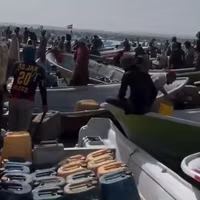
Screengrab from a viral video showing a large gathering of fuel smugglers aboard boats in Iran’s southeastern Sistan and Baluchestan province.

Long queues and empty pumps have brought Iran’s fuel shortages into sharper focus, raising a difficult question: how much would charging consumers more change where the country’s subsidized fuel ends up?

Esmail Saghab Esfahani, a vice president who heads the state energy efficiency agency, acknowledged this week that “we really have a supply problem.” He told Iranians they could no longer count on fuel stations to cover their needs and should save part of their monthly ration before traveling.

“All the gasoline the government has, it has given to the people,” he said. “Nothing has been held back to supply more.”

On Thursday night, residents of Bandar Abbas, the main port on the Persian Gulf, blocked a road near a fuel station in the city’s Rajaei district with their cars, protesting long lines and empty pumps. Drivers on the Minab–Bandar Abbas route had protested earlier over the lack of fuel.

The economic argument for higher prices is straightforward. Fuel is inexpensive domestically and costly abroad, making it profitable to move illegally. Narrowing that gap could reduce the incentive to smuggle.

But the price difference alone does not explain how large volumes leave a state-controlled distribution system, who obtains them or why enforcement so often focuses on those transporting the fuel. Nor should gasoline shortages and diesel diversion be treated as interchangeable problems.

Where fuel leaves the system

Journalist Yashar Soltani, in a recent interview, alleges that approximately 30 million liters of fuel are smuggled out of Iran daily with assistance from people within state institutions. That would represent roughly 11 billion liters annually. His estimates and allegations of official involvement have not been independently verified.

The allegations nevertheless raise a question that deserves investigation. Transporting millions of liters requires more than individual drivers willing to cross a border. It requires access to supplies, storage, vehicles, financing and buyers. The people carrying the fuel are visible; those deciding where it comes from and who receives the proceeds may be much harder to identify.

Soltani’s November 2024 investigation into a southern Iranian smuggling case described the alleged use of forged delivery documents, reused permits and payments to secure passage through checkpoints. If those mechanisms operate as described, the decisive breach occurs before the border, when fuel is released or diverted under false pretenses.

Higher prices could affect the profitability of that trade. They would not, by themselves, repair the controls that allowed the diversion.

The Razzaq scheme requires particular care. It is reportedly an authorized fuel allocation program intended to support border communities. Its existence does not establish that every shipment made through it is illegal. Equally, official authorization does not remove the need to examine who controls allocations, how transactions are recorded and how much income reaches households.

Conflating authorized trade with smuggling would make reform less credible. Authorities should distinguish legal exports, administrative discrepancies and proven diversion, then publish comparable figures. Otherwise, seizure statistics and alarming estimates can obscure the basic question of where public resources go.

Who would pay more?

The incentive created by price differences is substantial. In December 2025, Financial Tribune reported diesel selling domestically for around 300 tomans per liter while fetching nearly 50,000 tomans across the border. These were reported prices at that time, rather than current quotations, but they illustrate the potential margins.

The effect of a price increase depends on its size, currency movements, operating costs and how traders obtain supplies. Someone buying fuel lawfully faces a different calculation from an organizer acquiring it through a fraudulent allocation or an unrecorded transfer.

Small increases may leave lucrative margins intact. Larger increases could reduce them, but would also raise costs for legitimate freight operators and farmers, with consequences for household budgets. A subsequent fall in the rial could widen the international price gap again.

The distinction between fuels is equally important. Evidence of large-scale diesel diversion does not, on its own, establish that higher gasoline prices for motorists would address it. Officials should explain which fuel is disappearing, where losses occur and how each proposed adjustment would tackle that specific problem.

The distinction between participants matters, too. A household carrying fuel because other income is scarce does not exercise the same control as someone managing bulk supplies, financing and distribution. Enforcement should examine responsibility and financial benefit rather than assume that the easiest person to arrest is the most consequential.

Removing a driver’s livelihood may leave an organizer able to recruit somebody else. It can also deepen local dependence on whoever controls access to work. Alternative employment should therefore be part of enforcement policy, rather than postponed until restrictions have made families poorer.

Iran’s earlier subsidy reform provides a practical lesson. An IMF working paper on the 2010 reform describes compensatory payments deposited before higher prices took effect. That experience does not establish a lasting solution to smuggling, but it shows that household protection can be prepared before costs rise.

Following the fuel and the money

Soltani’s allegations of official involvement need independent investigation. Authorities should trace fuel from refineries and depots to its intended customers, comparing deliveries with quotas and transport records. When fuel goes missing, investigators should examine who approved its release, who received it and who benefited.

Tracking devices are useful only if someone acts on the evidence. They cannot prevent diversion on their own if records are altered or officials facilitate it. Any investigation must also be able to scrutinize politically connected operators.

Authorized border programs should make clear what households are entitled to receive, account for the money paid to them and provide a way to challenge unfair deductions. Families need realistic alternatives, including access to legal trade, support for local businesses and training that leads to paid work.

Higher prices can help narrow the margins that make smuggling profitable. But if the opaque allocations and protection arrangements described in these reports persist, households and legitimate businesses could face higher costs while those controlling diverted supplies continue to profit.

The test of reform is therefore more demanding than whether it raises revenue or produces more arrests. It is whether less fuel disappears, investigations reach those organizing its diversion, and vulnerable households receive support before their costs rise. Without those changes, consumers could end up paying more without knowing whether the next station will have fuel.

Canadian MP to flag paintball gun findings after Iran protest blindings

Nov 14, 2026, 23:46 GMT+0
•
Negar Mojtahedi
100%
Iranian protesters who lost one or both eyes to brutality by security forces.

Canadian lawmaker Ali Ehsassi has pledged to refer findings that Iranian security forces possessed paintball guns from a Canadian-owned brand during the 2022 protest crackdown, which left scores of demonstrators blinded, to federal authorities.

The report identified Tippmann guns, a brand owned by Montreal-based KORE Outdoor, in the possession of Iranian security personnel. Investigators could not establish whether the guns were responsible for any of the blinding injuries.

“We’ll take this report. I was not aware of it, and we’ll send it to the appropriate authorities,” Ehsassi told Iran International’s Eye for Iran.

Ehsassi, a Liberal who represents Willowdale, said he did not know whether Global Affairs Canada had reviewed the investigation, published in September 2025 by IranWire and the Iran Human Rights Documentation Center.

Asked what Canada could do about the equipment reaching Iranian security forces, he pointed to federal funding to strengthen sanctions enforcement.

Iran International contacted Global Affairs Canada and KORE Outdoor for comment. Neither responded by the deadline for this report.

How did Tippmann guns reach Iran?

Shahin Milani of the Iran Human Rights Documentation Center told Iran International that researchers found photographs showing Iranian security personnel with paintball guns bearing the Tippmann logo.

One photograph from 2018 shows a member of the Fatehin special unit holding a Tippmann marker. The report also includes a screenshot of the Iranian Paintball Association’s website offering a Tippmann marker for sale.

Some paintball guns seen in footage from the 2022 protests resembled Tippmann models, the researchers said, but image quality and distance made the brand difficult to confirm. Milani said investigators could not link a specific case of blinding to a Tippmann gun.

In October 2022, KORE Outdoor CEO Billy Ceranski condemned the use of the company’s paintball products to suppress protests in Iran. He said KORE complied with US import and export laws and had never sold goods directly or indirectly to countries on the US arms embargo list, including Iran.

Milani said Canadian authorities could start by asking KORE to identify its buyers and then ask those buyers where the equipment went next.

“You cannot just sell such devices and not care as to who actually ends up owning them,” Milani told Iran International.

100%
The sales page for Tippmann Empire BT-4 Combat paintball marker in the official website of Paintball Association of the Islamic Republic of Iran. Source paintball.ir

Hundreds suffered eye injuries

A separate investigation by the Human Rights Center at the University of California, Berkeley found that about 120 people suffered partial or total blindness during the 2022–23 crackdown.

Researchers documented close-range shots to the face involving shotguns, paintball guns and tear gas canisters.

By November 2022, ophthalmologists at three Tehran hospitals had reported at least 500 serious eye injuries, while doctors in Kurdistan province reported at least 80 more.

In its investigation, IranWire and the Iran Human Rights Documentation Center documented 134 people injured by weapons described as less lethal across 47 cities in 24 provinces. At least 114 were injured by shotgun pellets and nine by paintball projectiles. Most of the injuries were to the head, face or eyes.

In one video from December 2022, a plainclothes agent fires a paintball gun at the face of a person being detained in Tehran’s Ekbatan neighborhood.

Blinding injuries documented again in January

Severe eye injuries were also reported during Iran’s January 2026 crackdown, although no link has been established between those cases and Tippmann guns.

Dr. Sarah Raza, a trauma and vascular interventional radiologist who advised wounded protesters remotely, told Iran International that patients feared their wounds would identify them as protesters if they sought medical care.

Raza cited reports of more than 400 gunshot-related eye injuries at a single Tehran hospital during the January 8 and 9 crackdown.

The report Ehsassi pledged to forward examined the 2022 crackdown. The weapons used in the January cases remain a separate question.

Democrats push to end Iran war, Republicans dig in

Nov 14, 2026, 20:42 GMT+0
100%
Newly elected democratic members of Congress, who have flipped Republican seats gather for photos at the US Capitol in Washington, DC, US, November 12, 2026.

US Democratic lawmakers are stepping up efforts to end the war with Iran after their sweeping midterm election victory, promising legislative action when they take control of Congress in January.

Democrats won control of both chambers of Congress in the November 3 elections, a defeat for Republicans that President Donald Trump and Vice President JD Vance acknowledged was driven in part by public dissatisfaction with the war.

“Last week, voters were loud and clear: Trump’s economy doesn’t work for Americans,” Senate Democrats said in a statement on X on Friday.

“When Senate Democrats are back in the majority next year, we will take immediate action to end Trump’s war in Iran, stop his reckless tariffs, and lower costs for everything from energy to groceries to housing.”

A Reuters/Ipsos poll released Tuesday found that 71 percent of Americans wanted Congress to pass legislation ending the conflict, including 93 percent of Democrats and 51 percent of Republicans.

The growing pressure has reached the current Republican-controlled Congress, where Representative Thomas Massie of Kentucky, a frequent critic of Trump, has pledged to force another vote on ending the war before his term expires.

Massie introduced a War Powers resolution on November 10 directing the president to remove US forces from hostilities with Iran.

In a post on X Saturday, Massie said he could force a vote by mid-December, provided House Speaker Mike Johnson does not cancel scheduled legislative days. He added that two other resolutions seeking to end the war could reach the House floor even sooner.

But Republican lawmakers, including some who have criticized the conflict, remain reluctant to use congressional powers to force its conclusion.

“A Republican Congress is not going to send bills to a Republican president that he's going to veto,” Representative Tom Cole of Oklahoma, chairman of the House Appropriations Committee, told reporters this week.

The disagreement is expected to become a central issue in negotiations over government funding, which expires on December 11, raising the possibility of another shutdown confrontation.

Several Republicans have previously joined Democrats in attempts to restrict Trump's military operations, although most of the party has remained aligned with the president.

A war that was supposed to last weeks

The pressure has intensified as the conflict approaches its ninth month, far exceeding the administration's initial expectations.

“We are now in week 37 of Trump’s ‘2 to 3 week’ war with Iran,” Democratic Representative Jason Crow of Colorado wrote on X.

Representative Jimmy Panetta, a California Democrat, also accused Defense Secretary Pete Hegseth of continuing the war in violation of the War Powers Resolution of 1973 and failing to provide transparency over deadly strikes on civilians, including an elementary school in Iran.

“Congress will exercise its constitutional authority to hold him accountable,” Panetta said.

Democrats will have several options when they take control of Congress on January 3, including legislation restricting military operations, limits on war funding and congressional investigations into the administration's conduct.

But their ability to compel an end to the conflict remains uncertain. Trump could veto legislation passed by Congress, requiring two-thirds majorities in both chambers to override him.