Iran facing one of fastest economic collapses ever, Bessent says
A man walks past a currency exchange office displaying foreign exchange rates in Tehran, Iran.
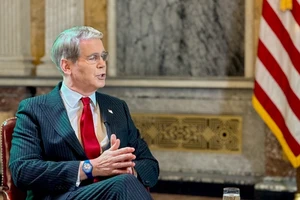
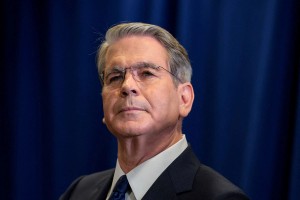
US Treasury Secretary Scott Bessent said on Sunday that Iran was experiencing one of the fastest economic collapses in history, as Washington expanded its pressure campaign beyond a naval blockade to target the country's land-based supply routes.
Speaking to Fox News, Bessent predicted that Iran's rial would lose 25% of its value between March 2026 and March 2027, comparing the pace of the decline with the economic turmoil that followed the Soviet Union's collapse.
"To put that in perspective, the Russian economy went down 22% over three years when the Soviet Union collapsed," Bessent said. "So this is one of the fastest collapses in history."
Bessent argued that the deteriorating conditions were putting increasing pressure on Iran's political and military establishment, even as senior officials remained insulated from the consequences.
"A lot of the leadership, they're like rats in a sewer pipe," he said. "They are in underground bunkers, and they don't see how bad it is up top."
He also said US restrictions had severely limited Iranian officials' ability to travel abroad.
"And we have them completely isolated. We have an airline quarantined," Bessent said.
"They can't fly to London to see their family, Paris to see their girlfriends, Geneva to visit their money."
Bessent suggested that the economic pressure was beginning to cause concern within the Islamic Republic's leadership.
"We could see from the public statements, the public statements from the politicians began in the summer. Now we're seeing the IRGC get worried," he said, referring to Iran's Revolutionary Guards.
US expands blockade to target Iran's land routes
Bessent's remarks came just over a week after the US military announced Task Force Iron Gate, an initiative designed to expand Washington's economic pressure campaign beyond its existing naval blockade.
Announced by US Central Command on November 7, the task force aims to disrupt the movement of advanced weapons, dual-use technologies, sanctioned materials and illicit revenue across Iran's land borders and the Caspian Sea.
The 20-member team, based in Tampa, Florida, will coordinate with US government agencies to restrict Tehran's access to military supplies and financial resources.
"The establishment of Task Force Iron Gate reinforces the success of our ironclad blockade against Iran at sea," CENTCOM commander Admiral Brad Cooper said.
The US military said its naval blockade had prevented Iran from exporting more than $25 billion worth of crude oil, an estimate that could not be independently verified.
President Donald Trump declared the new task force operational on November 8, saying it would further restrict Iran's access to international trade.
"Task Force Iron Gate is in full force and effect in the Islamic Republic of Iran," Trump wrote on Truth Social. "Coupled with history's greatest Naval Blockade, very little gets into, or out of, Iran!"
Pence says ending military campaign was a mistake
Former Vice President Mike Pence said on Sunday that the United States had halted its military campaign against Iran too soon and disputed Vice President JD Vance's assessment of why Republicans suffered losses in the midterm elections.
"Vice President Vance is wrong," Pence said on NBC's Meet the Press.
Pence argued that American forces had achieved substantial military successes during Operation Epic Fury, including destroying much of Iran's navy, establishing air superiority and attacking thousands of military targets.
He criticized the administration's decision to suspend operations after five weeks, describing the move as an embrace of the "politics of appeasement."
"There's an old saying that you don't make peace with your enemy, you make peace with your defeated enemy," he said.
Pence pointed to continued Iranian military activity in the Persian Gulf as evidence that Tehran remained willing to confront Washington.
Vance has attributed Republican electoral losses to the Iran war and its economic consequences, including higher fuel prices. President Donald Trump, meanwhile, said on Thursday that Washington no longer needed a deal with Tehran and directed Vance to shift his attention from Iran diplomacy to domestic corruption investigations.
Bahrain reports fresh attacks as Iran vows retaliation
The dispute over Washington's strategy came as Bahrain reported intercepting further Iranian aerial attacks on Sunday, highlighting the continuing risk of military escalation despite the suspension of large-scale US strikes.
Bahrain's military said its air defenses destroyed several aerial threats before they reached their targets, following the interception of two drones Friday.
The country's Foreign Ministry condemned the attacks as violations of its sovereignty and urged the UN Security Council to take action against Tehran.
"These attacks constitute a blatant aggression against Bahrain's sovereignty and territorial integrity," the ministry said.
Iranian Foreign Ministry spokesperson Esmaeil Baghaei, asked about the strikes, said Tehran would continue responding to attacks against it.
"We have previously said that we will not leave any attack unanswered, and we will continue this approach from now on," Baghaei said on Sunday.
Former British Prime Minister Tony Blair's sister-in-law attended a conference in Iran that US authorities later identified as a platform for intelligence recruitment by the Islamic Revolutionary Guard Corps (IRGC), The Telegraph reported on Sunday.
Lauren Booth, the half-sister of Blair's wife Cherie, was a guest speaker at the New Horizon conference in Mashhad in 2018, a year before Washington sanctioned its organizers over alleged intelligence-gathering activities.
The Telegraph identified several British activists who had attended conferences organized by New Horizon, an Iranian organization that US authorities say helped the IRGC's Quds Force recruit foreign nationals and collect intelligence.
The newspaper stressed that there was no suggestion Booth or the other British attendees had been recruited as spies or worked with Iranian intelligence.
US sanctioned conference organizers over intelligence recruitment
The US Treasury sanctioned the New Horizon Organization and four associated individuals in February 2019, saying its international conferences had provided Iranian intelligence officers opportunities to recruit attendees.
The Treasury said the events served "as a platform for the IRGC-QF to recruit and collect intelligence from attendees."
It also said organizers had facilitated contact between the Revolutionary Guards and American citizens, while promoting antisemitism and Holocaust denial.
Among those sanctioned was Nader Talebzadeh, the organization's chairman and a prominent Iranian filmmaker who helped organize the conferences.
The events were also linked to the recruitment of Monica Witt, a former US Air Force counterintelligence specialist who defected to Iran in 2013 after attending New Horizon conferences.
US prosecutors subsequently charged Witt with espionage-related offenses, alleging that she disclosed classified information and assisted Iranian intelligence operations.
A 2025 report by Britain's parliamentary Intelligence and Security Committee concluded that the IRGC had almost certainly used New Horizon conferences to gain access to and recruit foreign nationals.
British activists attended Iranian conferences
The Telegraph reported that Booth was among several British figures who participated in New Horizon events.
Others included former Church of England vicar Stephen Sizer, who attended a conference in 2014, and Rabbi Ahron Cohen, a member of the anti-Zionist Neturei Karta movement, who attended in 2012.
In a 2018 blog post, Booth described the Mashhad gathering as a "rare opportunity" for journalists, former diplomats, politicians and activists to discuss geopolitical issues.
The newspaper also examined connections between conference attendees and Abrar House, a charity-owned building in London's Marylebone district that has hosted talks by several of the individuals.
Roger Macmillan, a former security director at Iran International, told The Telegraph that Western figures promoting Tehran's positions were a "gift horse" to the Islamic Republic because they could repeat the government's messaging to foreign audiences.
Jonathan Hackett, a former US intelligence agent, said Iran sought Western voices who could influence audiences more effectively than Iranian officials.
"These people can be completely unwitting and can still be just as useful to the regime," he said.
Booth rejects criticism as UK charity regulator examines concerns
Booth rejected criticism of her participation and accused The Telegraph of promoting Israeli government narratives.
She called the newspaper a "mindless mouthpiece" for Israel, challenging its characterization of Western conference attendees as unwitting promoters of Iranian propaganda.
The Abrar Islamic Foundation, which owns Abrar House, rejected suggestions that it had provided a platform for antisemitism or extremism.
It said it had no connection to the New Horizon conferences and that Booth and Cohen had spoken at events organized by third parties.
The foundation also stressed that the individuals had attended New Horizon conferences before the organization was sanctioned by Washington.
Britain's Charity Commission confirmed that it had an active regulatory compliance case involving the foundation and was examining additional information to determine whether further concerns had arisen.
The Telegraph reported that the commission had received a dossier concerning speakers and events hosted at Abrar House.
The regulator has not announced findings of wrongdoing in connection with the latest information.
At least 12 workers from a major Iranian gas processing project were killed when their bus overturned in western Iran, as authorities launched an investigation into the cause of the deadly crash.
The bus, carrying 27 workers and a driver from the Dehloran gas processing project, overturned on Saturday evening on a road between Dasht-e Abbas and Murmuri in Ilam province, near Iran's border with Iraq.
Behzad Nourmohammadi, governor of Abdanan county, told the state-run IRNA news agency that three passengers died after being transferred to medical facilities, bringing the death toll to 12.
He warned that the toll could rise because several injured passengers remained in critical condition.
Sixteen people were hospitalized, including 10 in Dezful, five in Abdanan and one in Ilam.
Investigation launched into cause of crash
Abdanan prosecutor Amrollah Misai said investigators were examining the cause of the crash and whether negligence by individuals or responsible government agencies had contributed to the accident.
The bus was transporting personnel working on the Dehloran NGL 3100 project, a natural gas liquids processing facility in southern Ilam province.
The cause of the crash has not yet been established. Iranian media quoted a driver familiar with the route as saying the bend where the bus overturned had a history of accidents.
Crash highlights Iran's road safety crisis
The accident comes amid persistently high traffic fatalities in Iran, where more than 19,000 people have died in road crashes annually for four consecutive years.
According to figures from Iran's Forensic Medicine Organization cited by the ILNA news agency, 10,357 people died in traffic accidents during the first six months of the current Iranian calendar year, which began in March.
Of those killed, 1,868 were between the ages of 18 and 24.
Iranian police officials have repeatedly raised concerns about vehicle safety and hazardous roads, calling for improvements in manufacturing standards, road infrastructure and enforcement.
The country's industry minister, Mohammad Atabak, recently requested a delay of at least one year in implementing new vehicle safety standards, citing currency shortages, emergency conditions and automakers' financial constraints.
File photo: Tehran’s skyline shrouded in thick smog, with Milad Tower barely visible through the polluted air.
Worsening air pollution across Iran has left citizens reporting headaches, nausea and breathing difficulties, with many criticizing authorities for keeping schools open, according to accounts received by Iran International.
People in Isfahan, Tehran, Mashhad, Urmia, Arak, Karaj and Kermanshah described worsening air quality and its effects on public health, particularly among elderly people and those with underlying medical conditions.
"Fuel oil burning and air pollution have become so severe in Isfahan that most of our family suffers from headaches much of the time," a citizen wrote.
Another person in Urmia described persistent headaches affecting family members.
"Our city has become extremely polluted, and we have headaches every day. We take painkillers, but they don't help," the resident said.
"The city smells like burning tires. We can barely breathe in this air, and it hasn't even turned cold yet. Imagine what winter will be like," a Mashhad resident said.
Tehran residents report breathing difficulties
Tehran's air quality index reached 153 on Friday evening, November 13, a level considered unhealthy for all groups.
By Sunday morning, November 15, the index stood at 125, indicating conditions unhealthy for sensitive groups.
Citizens reported reduced visibility, burning eyes, headaches and respiratory problems.
"Tehran has become like Chernobyl," one person said in a video sent to Iran International.
Another compared the pollution to Nazi gas chambers, accusing authorities of gradually killing people through exposure to polluted air.
A Tehran resident described a sudden deterioration in air quality over several days and accused authorities of contributing to the pollution.
Another reported overcrowding at Tehran's Milad Hospital, saying many patients were seeking treatment for shortness of breath and severe coughing.
"Which problem are we supposed to endure? Inflation, petrol shortages or being unable to breathe?" another citizen asked, describing severe headaches and nausea.
Anger over schools remaining open
Parents and students also criticized authorities for keeping schools open despite worsening air quality.
A Tehran student reported coughing and experiencing breathing difficulties while returning home from school.
A person in Shahr-e Qods, west of Tehran, criticized the continuation of classes despite severe pollution and reduced visibility.
"These officials don't care about people in the slightest," the resident wrote.
"Are you aware of Tehran's pollution, or are you asleep? We can't breathe. Why aren't you closing schools?" another citizen asked.
Fuel oil burning continues
The complaints come alongside official confirmation that mazut, a heavy fuel oil, continues to be used in industrial facilities and power plants because of natural gas shortages.
Gas supplies to cement factories have been cut, forcing producers to switch to mazut, a situation likely to continue until March, Ali-Akbar Alvandian, secretary of the Cement Industry Employers Association, said on November 3.
A citizen in Pardis, near Tehran, previously reported severe pollution and white smoke covering the western part of the city, attributing the conditions to a nearby cement factory burning mazut.
Securing sufficient fuel for power plants will become more difficult during winter, and mazut will continue to be used as an alternative, Mostafa Rajabi Mashhadi, deputy energy minister for electricity, confirmed on November 14.
People had also raised concerns about mazut burning during the summer.
A Karaj resident reported sharply reduced visibility and worsening pollution, linking the conditions to fuel oil use at power plants.
Another person in Kermanshah said the Bisotun power plant had burned mazut in two generating units for more than two months, producing substantial pollution.
A motorist refuels his car at a petrol station in Iran.
New restrictions on petrol sales have made fuel harder to access across Iran, prompting public complaints and warnings from transport operators that rising fuel costs could push up the prices of goods, officials and industry representatives said on Sunday.
Petrol stations' shared fuel cards, which allow motorists to buy fuel without using their own government-issued cards, have been withdrawn in 11 provinces. Unlike personal fuel cards, which provide access to subsidized petrol quotas, station cards allow drivers to refuel outside their individual allocations.
The restrictions have fueled public dissatisfaction, Abdolhossein Hemmati, secretary of parliament's energy committee, told ILNA news agency on November 15.
Under the allocation system, each vehicle receives 60 liters of petrol at 15,000 rials (about 0.6 US cents) per liter, 50 liters at 30,000 rials (1.1 cents) and another 50 liters at 100,000 rials (3.7 cents). Only the first allocation can be carried over to subsequent months, Hemmati said.
The restrictions come as Iran faces a deepening economic crisis, with inflation, declining purchasing power and rising living costs making basic necessities increasingly difficult to afford.
Messages received by Iran International indicate that some households have resorted to installment payments for groceries, including bread, meat, chicken and eggs.
Higher fuel costs raise concerns for motorists
Motorists traveling longer distances could face substantially higher fuel bills once their allocations run out, Hemmati warned.
Drivers who exhaust their 100,000-rial allocation during a journey may have to purchase premium petrol costing 1.03 million rials per liter, a price many households cannot afford, he said.
A proposal to allow unused 30,000-rial petrol allocations to accumulate and permit motorists to draw on future months' quotas is under consideration, Hemmati added.
Esmail Saghab Esfahani, a vice president and head of Iran's Energy Optimization and Strategic Management Organization, previously said only the first petrol allocation could be stored for up to three months.
Motorists should plan their journeys and save fuel in advance, Saghab Esfahani said, confirming that station fuel cards had been withdrawn in some provinces and that the process had begun in several border provinces.
Parliament Speaker Mohammad Bagher Ghalibaf attributed public concern to repeated comments about petrol policy, saying Sunday that any decision must be accompanied by efforts to secure public understanding.
The remarks followed criticism of Saghab Esfahani's comments by Iranian media.
News website Khabar Online accused him of unsettling the public, while the Khorasan newspaper, which is close to Ghalibaf, called his remarks personal and irrational.
Khorasan nevertheless supported removing station cards and identifying purchases made without personal fuel cards.
A motorist refuels a car at a petrol station in Iran.
First Vice President Mohammad Reza Aref said Saturday that announcements concerning petrol and petroleum products should come exclusively from the government spokesperson or the head of the National Iranian Oil Refining and Distribution Company.
Transport operators warn of higher prices
The restrictions could also increase the cost of transporting goods, placing further pressure on household budgets.
Fuel allocations for pickup trucks are insufficient, and higher petrol costs could raise freight charges and consumer prices, Davoud Mohammadi, head of Tehran's urban light freight and motorcycle courier association, told Tasnim news agency on Sunday.
Commercial pickup trucks have been assigned quotas similar to private cars despite being used by drivers to earn their livelihoods, Mohammadi said.
Some drivers could exhaust monthly allocations of 100 or 200 liters within a week, even with careful fuel management, he added.
Removing unrestricted station cards would further limit access to petrol, with additional costs gradually passed on to consumers, Mohammadi warned.
Insufficient fuel for motorcycle couriers and pickup drivers could disrupt deliveries and slow urban transport operations, he said.
Officials deny new policy as petrol queues grow
The government has made no new decision on petrol, Mohammad Sadegh Azimifar, deputy oil minister and head of the National Iranian Oil Refining and Distribution Company, said Saturday evening.
A system requiring identification before using station fuel cards remains experimental, with technical problems being addressed before any decision on wider implementation, Azimifar said.
Despite those assurances, videos sent to Iran International showed long queues at petrol stations, while motorists expressed concern about restrictions on unrestricted fuel purchases.
The Mehr news agency questioned why authorities were placing the burden of fuel shortages on consumers despite inefficient vehicles and inadequate public transport.
Access to petrol directly affects employment, commuting, medical treatment and the ability to live outside major urban centers, Mehr wrote Sunday.
Some citizens suspect the restrictions are intended to prepare the ground for higher petrol prices.
The government's ultimate objective is to gradually increase petrol prices, remove fuel subsidies and raise revenue, economic analyst Masoumeh Taherkhani told Iran International.
Economic and energy journalist Ata Hosseinian similarly described the restrictions as preparation for petrol prices reaching between 500,000 and 700,000 rials (about 19 to 26 US cents) per liter.
Iranian protesters who lost one or both eyes to brutality by security forces.
Canadian lawmaker Ali Ehsassi has pledged to refer findings that Iranian security forces possessed paintball guns from a Canadian-owned brand during the 2022 protest crackdown, which left scores of demonstrators blinded, to federal authorities.
The report identified Tippmann guns, a brand owned by Montreal-based KORE Outdoor, in the possession of Iranian security personnel. Investigators could not establish whether the guns were responsible for any of the blinding injuries.
“We’ll take this report. I was not aware of it, and we’ll send it to the appropriate authorities,” Ehsassi told Iran International’s Eye for Iran.
Ehsassi, a Liberal who represents Willowdale, said he did not know whether Global Affairs Canada had reviewed the investigation, published in September 2025 by IranWire and the Iran Human Rights Documentation Center.
Asked what Canada could do about the equipment reaching Iranian security forces, he pointed to federal funding to strengthen sanctions enforcement.
Iran International contacted Global Affairs Canada and KORE Outdoor for comment. Neither responded by the deadline for this report.
How did Tippmann guns reach Iran?
Shahin Milani of the Iran Human Rights Documentation Center told Iran International that researchers found photographs showing Iranian security personnel with paintball guns bearing the Tippmann logo.
One photograph from 2018 shows a member of the Fatehin special unit holding a Tippmann marker. The report also includes a screenshot of the Iranian Paintball Association’s website offering a Tippmann marker for sale.
Some paintball guns seen in footage from the 2022 protests resembled Tippmann models, the researchers said, but image quality and distance made the brand difficult to confirm. Milani said investigators could not link a specific case of blinding to a Tippmann gun.
In October 2022, KORE Outdoor CEO Billy Ceranski condemned the use of the company’s paintball products to suppress protests in Iran. He said KORE complied with US import and export laws and had never sold goods directly or indirectly to countries on the US arms embargo list, including Iran.
Milani said Canadian authorities could start by asking KORE to identify its buyers and then ask those buyers where the equipment went next.
“You cannot just sell such devices and not care as to who actually ends up owning them,” Milani told Iran International.
The sales page for Tippmann Empire BT-4 Combat paintball marker in the official website of Paintball Association of the Islamic Republic of Iran. Source paintball.ir
Hundreds suffered eye injuries
A separate investigation by the Human Rights Center at the University of California, Berkeley found that about 120 people suffered partial or total blindness during the 2022–23 crackdown.
Researchers documented close-range shots to the face involving shotguns, paintball guns and tear gas canisters.
By November 2022, ophthalmologists at three Tehran hospitals had reported at least 500 serious eye injuries, while doctors in Kurdistan province reported at least 80 more.
In its investigation, IranWire and the Iran Human Rights Documentation Center documented 134 people injured by weapons described as less lethal across 47 cities in 24 provinces. At least 114 were injured by shotgun pellets and nine by paintball projectiles. Most of the injuries were to the head, face or eyes.
In one video from December 2022, a plainclothes agent fires a paintball gun at the face of a person being detained in Tehran’s Ekbatan neighborhood.
Blinding injuries documented again in January
Severe eye injuries were also reported during Iran’s January 2026 crackdown, although no link has been established between those cases and Tippmann guns.
Dr. Sarah Raza, a trauma and vascular interventional radiologist who advised wounded protesters remotely, told Iran International that patients feared their wounds would identify them as protesters if they sought medical care.
Raza cited reports of more than 400 gunshot-related eye injuries at a single Tehran hospital during the January 8 and 9 crackdown.
The report Ehsassi pledged to forward examined the 2022 crackdown. The weapons used in the January cases remain a separate question.