• العربية
  • فارسی
Brand
  • Iran Insight
  • Politics
  • Economy
  • Analysis
  • Special Report
  • Opinion
  • Podcast
  • Live TV
  • Iran Insight
  • Politics
  • Economy
  • Analysis
  • Special Report
  • Opinion
  • Podcast
  • Live TV
  • Theme
  • Language
    • العربية
    • فارسی
  • Iran Insight
  • Politics
  • Economy
  • Analysis
  • Special Report
  • Opinion
  • Podcast
  • Live TV
All rights reserved for Volant Media UK Limited
volant media logo

Iranian weapons, Chinese supplies fuel Houthi advance in Yemen - WSJ

Oct 1, 2026, 10:24 GMT+1
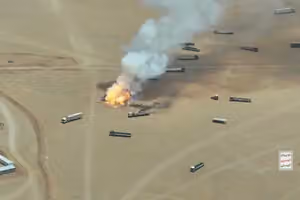
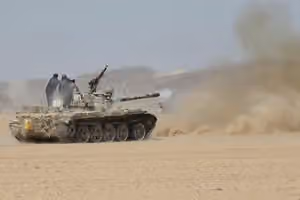
Iran-aligned Houthi fighters occupy a firing position in a screengrab from a video said to show Houthi fighters attacking Saudi-backed forces in the location given by the source as al Jawf governorate, Yemen, in this screengrab taken from a video released by Houthi Military Media on September 15, 2026.

Iranian weapons and growing supplies of Chinese dual-use components have helped Yemen's Houthis expand their territory and strengthen their ability to threaten shipping through the Red Sea, the Wall Street Journal reported.

The Iran-backed group has seized Red Sea islands and expanded along Yemen's mainland coast in recent weeks, including taking the port city of Mokha, according to the report. It has also asserted control over the Bab al-Mandeb Strait, a key route for global trade and energy shipments.

The Houthis, estimated to have about 350,000 fighters, had prepared for the offensive for months, moving weapons and thousands of troops toward Mokha in August and using their control of telecommunications networks to monitor opponents, the Journal said.

Iranian technology at the core

The Houthis lack a conventional navy but use Iranian-designed missiles, explosive drones, sea mines, armed fast boats and drone boats to project power along Yemen's coast.

Their arsenal includes ballistic and cruise missiles, anti-ship weapons and drones drawing heavily on Iranian technology and components, according to the report.

Around 2015, Iran's Quds Force began sending components for Iranian-designed missiles and drones and dispatched trainers to help the Houthis build weapons themselves, the Journal said.

The assistance helped turn the group into a force capable of attacking Saudi oil infrastructure, disrupting Red Sea shipping and threatening US forces.

100%
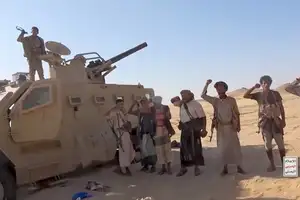
Houthi fighters stand in front of what they say is a downed Saudi jet, at a location given as Yemen, in this still image from a handout video released on September 16, 2026.

China becomes another supply source

"The Houthis now have a new source for the supplies they need to launch their attacks: China," the Journal reported.

Chinese companies are supplying dual-use goods that can serve civilian and military purposes, including components important to Houthi drone programs, according to UN reports and arms experts cited by the newspaper.

The shift comes as traditional Iranian smuggling routes have faced greater disruption. For years, Iran's Revolutionary Guards used small fishing boats to move arms, drone components and missile parts to the Houthis, but many shipments have been intercepted by US forces and Yemeni groups opposed to the Houthis.

Red Sea threat grows

The Houthis have also used Djibouti as a transit point for weapons and traded small arms with al-Shabaab in Somalia, according to UN reports cited by the Journal.

Since announcing a blockade on Saudi shipping on July 20, the group has struck seven vessels in the Red Sea and one in the Gulf of Aden, the report said. Four of the ships were Saudi-flagged.

The Houthis have also targeted Saudi energy infrastructure with missiles and drones, although Riyadh has reported no damage from those attacks.

Most Viewed

Iranian hardliners turn on Ghalibaf and judiciary after lawmaker’s sentencing
1
INSIGHT

Iranian hardliners turn on Ghalibaf and judiciary after lawmaker’s sentencing

2
INSIGHT

US ‘feedback’ leaves Iran debating the price of diplomacy

3

Iran's Guards urge Americans to vote out their leaders in 26-page letter

4

Iran says awaiting US response on Hormuz proposal

5

German-based aid worker gets 10-year prison sentence in Iran

Banner
Banner

Spotlight

  • Iran turns to younger children in postwar ideological push
    ANALYSIS

    Iran turns to younger children in postwar ideological push

  • US ‘feedback’ leaves Iran debating the price of diplomacy
    INSIGHT

    US ‘feedback’ leaves Iran debating the price of diplomacy

  • ‘I never asked about regime change’: Student speaks out after El-Sayed exchange

    ‘I never asked about regime change’: Student speaks out after El-Sayed exchange

  • Iranian hardliners turn on Ghalibaf and judiciary after lawmaker’s sentencing
    INSIGHT

    Iranian hardliners turn on Ghalibaf and judiciary after lawmaker’s sentencing

  • The body as a battleground: Iran's resistance etched in ink and blood
    SPECIAL REPORT

    The body as a battleground: Iran's resistance etched in ink and blood

  • Khamenei’s vision of Iranian power faces a test of reality
    ANALYSIS

    Khamenei’s vision of Iranian power faces a test of reality

Banner
Banner
  • Iran-backed Houthis attack Saudi cities and energy facilities, wounding at least 73

    Iran-backed Houthis attack Saudi cities and energy facilities, wounding at least 73

  • US officials met Iran-aligned Houthis in Oman - Reuters

    US officials met Iran-aligned Houthis in Oman - Reuters

  • Iran’s weakened axis still bites as Houthis escalate against Saudi Arabia

    Iran’s weakened axis still bites as Houthis escalate against Saudi Arabia

  • Iran-backed Houthis advance near key Red Sea shipping route as Yemeni forces retreat

    Iran-backed Houthis advance near key Red Sea shipping route as Yemeni forces retreat

•
•
•

More Stories

Iran turns to younger children in postwar ideological push

Oct 1, 2026, 07:53 GMT+1
•
Negar Mojtahedi
100%
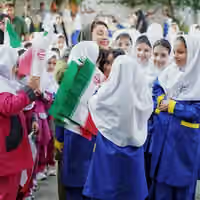
A teacher hugs elementary schoolgirls carrying Iranian flags on the first day of the new academic year, in Iran's southern port city of Bushehr, September 23, 2026

The Basij has long maintained a presence in Iran's high schools and universities. Its growing visibility among much younger children is drawing attention to a new front in the Islamic Republic's effort to shape a generation that has repeatedly challenged its authority.

As millions of students returned to classrooms this month, Iran's paramilitary Basij appeared prominently in elementary schools as authorities rolled out an education campaign infused with military and ideological messaging.

Iran's Education Ministry announced over the summer that material related to the recent war and the country's military and nuclear capabilities would be incorporated into educational content.

The push comes at a precarious moment for the Islamic Republic, following war, economic turmoil and nationwide unrest—and four years after schoolgirls became some of the youngest and most visible participants in the Woman, Life, Freedom uprising.

“Iran is obviously right now at sort of a crossroads,” historian Arash Azizi told Iran International, as the Islamic Republic struggles to command the loyalty of generations born decades after the 1979 revolution.

“We're talking about much younger people, people under 13,” Azizi said, adding that the Basij had some involvement in primary schools during the early years after the revolution, but considerably less in recent decades.

The memory of Woman, Life, Freedom

Historian Shahram Kholdi said the increased attention to schools cannot be separated from what happened inside them four years ago.

“We should remember that during the Woman, Life, Freedom movement we saw a huge wave of solidarity with this movement, especially in girls' schools in Iran,” he said.

The nationwide protests in January served as another warning. “It was again a wake-up call, harkening back to Woman, Life, Freedom, that they have to control schools,” Kholdi said.

After the death of Mahsa Jina Amini in morality police custody in September 2022, protests spread into schools.

Videos showed schoolgirls removing their headscarves, chanting against the Islamic Republic and removing or defacing images of its leaders. Some were barely teenagers.

The protests turned schools into one of the most visible arenas of youth opposition to the Islamic Republic.

Kholdi argues that the significance of a Basij presence extends beyond ideological instruction. Schools can provide authorities with greater visibility into students and, through them, their families at a time of considerable social and economic discontent.

The Basij's role in policing students also has a history. Kholdi recalled his own high-school years, when Basij members searched students' backpacks each morning for what he described as “contraband cultural material.”

What stands out now, he said, is how far down the age ladder the attention appears to be moving.

The Islamic Republic's concern about losing younger Iranians predates the latest unrest and war. In a January 2025 interview with Iran International, Iran specialist Holly Dagres said the establishment was already looking beyond an increasingly alienated Generation Z.

“They've been actually looking at the next generation, which is Gen Alpha,” she said.

‘North Korea scenario’

Azizi sees the push into younger age groups as part of a broader argument within the establishment over how to respond to a society that has moved away from some of the ideological positions that have defined the Islamic Republic.

“The regime has been trying to sort of bolster its base amongst the youth because it's lost them and it knows they're the future,” Azizi said.

One tendency, he said, favors a return to a more rigid and intensely ideological state—what he described as a “North Korea scenario”—drawing on mass mobilization of its remaining supporters to reinforce mandatory hijab and Islamist social rules.

In that vision, the Basij becomes an instrument not only for building support but for imposing what Azizi called “societal submission.”

But he said such an approach carries its own risk.

“If the regime wants to go toward bringing back Iran to the 1980s and then North Korea,” Azizi said, such policies could “lead to more social protests and social resistance.”

That tension is now reaching further into Iran's classrooms.

During Woman, Life, Freedom, schoolgirls who had spent their entire lives under the Islamic Republic turned some of those classrooms into places of protest. Four years later, the children entering elementary school belong to an even younger generation.

Iran official warns Starlink could end state control of internet

Oct 1, 2026, 02:38 GMT+1
100%
The silhouette of Elon Musk and Starlink logo are seen in this illustration taken June 11, 2026. REUTERS

The spread of Starlink could deliver the “final nail in the coffin” of Iran’s ability to control cyberspace, Deputy Communications Minister Mohammad Hafez Hakami said Wednesday, even as authorities seek to suppress the technology through arrests, seizures and criminal penalties.

Hakami said Starlink had fundamentally changed that equation. “Our control over cyberspace is no longer based on our domestic network. It is based on Starlink,” Hakami said.

He said officials had warned for more than two years that wider use of the satellite internet service could eventually render existing methods of controlling communications ineffective, but had failed to produce an adequate policy response.

“I sometimes joke that we might as well turn the Ministry of Communications and the Supreme Council of Cyberspace into amusement parks, because they will no longer serve any purpose,” Hakami said.

Iran has repeatedly restricted internet access during periods of unrest. Hakami said the government’s response has grown progressively more restrictive, from blocking a single platform in 2017 to shutting down internet access during the 2019 protests, blocking two major platforms after the 2022 protests and ultimately disconnecting the entire network during the bloody crackdown on nationwide protests in January 2026.

Starlink poses a challenge to that approach because its terminals connect to satellites rather than relying on Iran’s domestic telecommunications network.

Hakami said even measures such as mandatory mobile phone registration could become ineffective with Direct-to-Cell technology, which allows ordinary mobile phones to connect directly to satellites.

“I don’t want to create ‘Starlink-phobia,’ but nothing will remain of our ability to control cyberspace,” he said.

Arrests and seizures
Iranian authorities have intensified their crackdown on Starlink as its use has expanded. Iran’s Economic Security Police said in August that authorities had seized 997 Starlink devices and related equipment and arrested 163 people during the four months through July. Police also impounded 15 vehicles carrying the equipment.

The crackdown has extended to individual users and sellers. Two men from Bukan were sentenced to two years in prison each for buying and selling Starlink equipment.

Iran also criminalized unlicensed satellite internet equipment under legislation adopted in 2025. The law prohibits the use, possession, purchase, sale and import of devices such as Starlink and provides for prison terms and confiscation. It permits the death penalty for specified activities involving the equipment when carried out for espionage or to confront the state and the perpetrator is deemed an enemy force.

Amnesty International said Iran’s Intelligence Ministry announced in March that “hundreds” of Starlink devices had been seized. The rights group said authorities had portrayed the use of alternative satellite connections as potential espionage or collaboration with hostile states and threatened users with prosecution.

Death after Starlink-related arrest
The crackdown has also been linked to a reported death in custody.

Hesam Alaeddin, a 40-year-old man detained in Tehran over his alleged use of Starlink equipment to bypass an internet blackout, died after he was severely beaten by government agents, a source familiar with the case told Iran International in May.

Alaeddin had gone to a hospital to check on his brother, Hamid, who had been shot during protests, when some of his electronic devices were seized, according to the source.

A week later, he went to retrieve the devices and was arrested. Agents took him to his home for questioning and a search, where they severely beat him with various objects and he died, the source said. Authorities concealed his death and continued to treat him as a living detainee before eventually telling his family to collect his body.

Amnesty International later documented Alaeddin’s death but said the precise timing and circumstances remained unclear. The rights group said his arrest was connected to an investigation involving his brother and alleged possession of a Starlink device.

Despite the enforcement campaign, Hakami said Starlink had already reached a significant level of use in Iran and questioned whether existing policies could keep pace with the technology.

“Tell me: What policy have we adopted to protect the country against Starlink?” he said.

UK points to Iran role in suspected plot near RAF Fairford

Sep 30, 2026, 20:31 GMT+1
100%

British Prime Minister Andy Burnham said on Wednesday there are “strong indications” Iran played a role in a suspected plot near RAF Fairford airbase used by US forces to carry out strikes on the Islamic Republic.

“But of course, it remains an ongoing, complex and serious police investigation,” he told BBC. “We are working closely with our colleagues in the United States of America.”

Five British men in their 20s were arrested on suspicion of terrorism and explosives offenses after three white vans were found near the base.

Police recovered petrol but found no viable explosives, and all five suspects were later released on bail as the investigation continued.

The base is home to the US Air Force’s 501st Combat Support Wing and also serves as a forward operating site for Air Force Global Strike Command.

Fairford has supported major US military operations, including the 1991 Persian Gulf War, the 2003 invasion of Iraq and this year’s US-Israeli strikes on Iran.

US Secretary of State Marco Rubio subsequently said a foreign state was involved, without naming it, while President Donald Trump said the men had planned "big damage."

Iran has denied involvement. Iran’s Revolutionary Guards (IRGC) said in July that bases used for attacks on Iranian territory could be considered legitimate targets.

Before Burnham’s remarks, British authorities had not publicly linked the incident to Iran, though counter-terrorism police said they were investigating possible foreign state involvement, including whether proxies may have been “knowingly or unknowingly working on behalf of a foreign state.”

Police said Tuesday that petrol, but no improvised explosive device, was found in the vans used by the men. They also defended releasing the suspects on bail after criticism, including from Trump.

The Times reported that one suspect called emergency services shortly before his arrest, with investigators considering whether the incident was surveillance, a “dry run” or an attempt to send a message to the British government.

Britain said in January that its services had tracked more than 20 potentially lethal Iran-backed plots over the previous year targeting dissidents, journalists and members of the Jewish community.

In June, 24 Western governments accused Iran’s IRGC intelligence apparatus, the Quds Force and Iran’s intelligence ministry of plotting attacks in Europe, North America and Australia, including against Iranian dissidents and Jewish and Israeli interests.

‘I never asked about regime change’: Student speaks out after El-Sayed exchange

Sep 30, 2026, 15:54 GMT+1
•
Negar Mojtahedi
100%
Iman Dashti is a Senior at The University of Michigan College of Engineering

An Iranian-American student who pressed Michigan Democratic US Senate nominee Abdul El-Sayed to state his position on Iran’s Revolutionary Guards says he and his family have faced threats and harassment after a video of the exchange went viral.

At a University of Michigan town hall, Iman Dashti said his cousin had been pursued through the streets over her hijab and his uncle sentenced to death and given 50 lashes under the Islamic Republic, before asking whether El-Sayed stood “unequivocally against the IRGC.”

El-Sayed responded that he would “always stand with movements for freedom and democracy” and later told Dashti, “I want freedom and democracy for the people of Iran, no question,” while stressing that political change should come from Iranians themselves rather than through US-led regime change.

He did not directly answer Dashti’s question about whether he stood unequivocally against the IRGC.

Dashti told Iran International he shares El-Sayed’s opposition to US-imposed regime change, but said that was never the question he was asking.

“I never asked about regime change. I never asked about his stance on the war,” Dashti said. “I asked him about the people.”

“I wanted to hear from him. I wanted to hear that he stood with us, I really did want to,” he said. “If Abdul were to win, at least we’d have an advocate for the Persian people, for the American people in the US Senate.”

El-Sayed’s campaign has defended his response.

“As he noted in his response, Abdul will always stand with movements for freedom and democracy and he condemns government anti-free speech violence,” campaign spokesperson Roxie Richner told Fox News.

The campaign also reiterated El-Sayed’s opposition to US-funded regime-change wars.

Iran International separately contacted El-Sayed’s campaign seeking an interview or written response about the exchange and his position on the IRGC but did not receive a response before publication.

Threats after the exchange

Dashti said the atmosphere inside the town hall became tense, with audience members applauding when El-Sayed rejected US-led regime change, a position Dashti said he agreed with.

“The tension was very high in that room,” he said. “You could cut it with a knife.”

Since the exchange spread online, Dashti says he has received threats and that his friends and family have been targeted.

“Since that day, people have threatened me, doxxed my friends, even harassed my family,” he said in a video posted after the town hall.

Dashti told Iran International the past several days had been anxious but said the hostile reaction had also been accompanied by considerable support.

“For every negative comment I’ve gotten, for every negative sort of threat, I’ve gotten a lot of beautiful positive messages,” he said.

Scrutiny of Dashti’s politics

The attention has also brought scrutiny of Dashti’s own politics. He describes himself as a “proud Christian conservative,” belongs to the College Republicans and has previously met Mike Rogers, the Republican nominee running against El-Sayed in November.

Dashti said he does not work for Rogers and was not sent to the town hall on behalf of his campaign.

“Am I a Zionist plant? Do I work for the Rogers campaign?” he said in his follow-up video, recounting accusations circulating online. “I don’t work for anyone. I’m just a Persian student and my family was hunted in the streets of Iran.”

The son of Iranian immigrants, Dashti said he sees speaking about repression in Iran as a way of advocating for people who cannot freely do so themselves.

“The least I can do is give a voice to the people who literally don’t have a voice,” he said. “I love my people, my heritage. It’s a beautiful, beautiful culture.”

Washington designated the IRGC a Foreign Terrorist Organization in 2019. The force is a central part of the Islamic Republic’s security apparatus and has been involved in suppressing anti-government protests.

Dashti said the criticism has not deterred him from continuing to raise the issue during the remaining weeks of the Senate campaign.

“I’m going to keep going, whether that means showing up at future events, mobilizing friends,” he said. “This is just the beginning.”

Flydubai flight diverts to Saudi Arabia after suspected cockpit stabbing

Sep 30, 2026, 12:03 GMT+1
100%

Both pilots of a flydubai flight from Dubai to Tel Aviv were injured after what Israeli officials said may have been an attempted terror attack in the cockpit, forcing the aircraft to make an emergency landing in Saudi Arabia on Wednesday.

Prince Sultan bin Abdulaziz International Airport in Tabuk said it was alerted at 8:44 a.m. local time after air traffic control received a distress call from flydubai flight FZ1073 requesting an emergency landing.

The Boeing 737 landed safely at 9:45 a.m., the airport said. The captain and first officer were taken to hospital, while passengers were assisted at the terminal.

Flydubai was working to arrange a replacement aircraft, the airport said, adding that the relevant authorities were investigating the incident.

What happened in the cockpit?

Three Israeli officials said the co-pilot was believed to have stabbed the captain in what was being investigated as a possible attempted terror attack.

The officials said cabin crew entered the cockpit and took control of flydubai flight FZ1073 before it diverted to Saudi Arabia while flying over Jordanian airspace. One of the officials identified the co-pilot as an Omani national.

Israeli authorities were still investigating the circumstances and had not reached a final conclusion about the motive.

Flydubai said the aircraft had experienced an "incident" while flying to Tel Aviv and diverted to Tabuk. The airline said all passengers were safe and accounted for but gave no details about what had happened.

Neither Saudi authorities nor flydubai had publicly explained the cause of the incident.

Passenger reports screaming and knife

Yasmin Abu Kasis, whose daughter Miriam was among the passengers, told Reuters that her daughter had heard screaming and said a man holding a knife forced one of the pilots to the floor.

She also said there was blood inside the aircraft.

Israeli media published a photograph said to have been taken aboard the plane showing what appeared to be a passenger with blood on his shirt. Reuters could not independently verify the image or the passenger's account.

The airport statement confirmed that both pilots had been injured but did not say how they were hurt.

Emergency signals and sudden descent

The flight had been traveling from Dubai to Tel Aviv when it diverted from Jordanian airspace toward Saudi Arabia, according to flight-tracking website Flightradar24.

The aircraft first transmitted a general emergency signal and several minutes later sent another signal indicating possible unlawful interference, Flightradar24 said. It later transmitted the general emergency signal again.

Flight data also appeared to show the plane dropping nearly 14,000 feet in less than 30 seconds before the first emergency alert, according to Flightradar24.

The signals prompted a major security response in Israel.

Israeli media said about 150 Israeli passengers were aboard the flight. The Israeli prime minister's office said the situation was "under control" and that authorities were taking steps to bring the passengers back to Israel.