• العربية
  • فارسی
Brand
  • Iran Insight
  • Politics
  • Economy
  • Analysis
  • Special Report
  • Opinion
  • Podcast
  • Live TV
  • Iran Insight
  • Politics
  • Economy
  • Analysis
  • Special Report
  • Opinion
  • Podcast
  • Live TV
  • Theme
  • Language
    • العربية
    • فارسی
  • Iran Insight
  • Politics
  • Economy
  • Analysis
  • Special Report
  • Opinion
  • Podcast
  • Live TV
All rights reserved for Volant Media UK Limited
volant media logo

Iran-backed Houthis attack Saudi cities and energy facilities, wounding at least 73

Sep 8, 2026, 10:06 GMT+1
Smoke rises from a burning truck during what the Houthis say was an attack targeting trucks coming from Saudi territory, at Al-Wadiah border crossing near Al-Wadiah, on the Saudi-Yemen border, in this still image obtained from a handout video released September 7, 2026.

Yemen’s Iran-backed Houthis attacked energy facilities and cities in southern Saudi Arabia on Tuesday, wounding at least 73 people and raising fears of a wider regional war.

The strikes targeted civilian and economic sites in Abha, Khamis Mushait, Jizan and Najran, according to Turki al-Maliki, spokesperson for the Saudi-led coalition in Yemen. He said women and children were among those injured.

Yahya Saree, the Houthi’s military spokesman, also said that the group launched a “broad military operation” deep inside Saudi territory with drones and ballistic missiles to target Saudi energy sites belonging to oil giant Aramco.

Saudi Arabia’s Energy Ministry said the attacks caused fires at several energy facilities and utilities, temporarily halting some operations. Emergency crews were working to extinguish the fires, secure the affected sites and assess the damage.

“The coalition will take all necessary operational measures to deter this terrorist militia,” Maliki said, pledging a firm response.

The attacks came after Iranian officials warned that energy infrastructure across the Persian Gulf, including US oil and gas interests, was vulnerable following renewed exchanges of attacks involving vessels around the Strait of Hormuz.

Houthi attacks helped push oil prices to their highest levels in more than six weeks, according to Reuters. Shipping through the Strait of Hormuz and the Red Sea has already slowed amid threats to commercial vessels and uncertainty over access to the two critical waterways.

The Houthis, who control Yemen’s capital and much of the country’s north, declared a naval blockade against Saudi Arabia in July and have since attacked vessels in the Red Sea and targets inside the country.

100%

The GCC denounced the strikes, describing them as a threat to regional security and backing measures taken by Riyadh to protect its territory and population. Qatar, Kuwait, Bahrain, Egypt and Jordan also issued separate condemnations.

The attacks mark a further escalation in the war that began with US and Israeli strikes on Iran on February 28. Repeated missile and drone strikes, along with attacks on shipping and energy infrastructure, have punctuated lulls in the fighting.

US President Donald Trump said on Monday that oil prices would fall sharply once the United States won the war, adding that “Iran will never have a nuclear weapon.”

Most Viewed

Iran, where eggs are a better bet than cash
1
PODCAST

Iran, where eggs are a better bet than cash

2

Iran oil workers protest pay conditions at offshore platforms, Assaluyeh

3

US carried out covert four-month Hormuz mine-clearing mission - FT

4
ANALYSIS

Starlink next door could loosen Iran’s grip on internet

5

Iran doubles gasoline price amid fears of renewed unrest

Banner
Banner
Banner

Spotlight

  • Europe’s third-way ambitions on Iran give way to alignment with Washington
    ANALYSIS

    Europe’s third-way ambitions on Iran give way to alignment with Washington

  • The gamble behind US attacks on Iran’s oil tankers
    ANALYSIS

    The gamble behind US attacks on Iran’s oil tankers

  • Iran, where eggs are a better bet than cash
    PODCAST

    Iran, where eggs are a better bet than cash

  • Starlink next door could loosen Iran’s grip on internet
    ANALYSIS

    Starlink next door could loosen Iran’s grip on internet

  • Satellite images show Iran’s key ports falling quiet under US blockade
    EXCLUSIVE

    Satellite images show Iran’s key ports falling quiet under US blockade

  • Iran's appliance industry is collapsing, and so is the market it was built for
    INSIGHT

    Iran's appliance industry is collapsing, and so is the market it was built for

  • Houthis more effective Iran ally than Hezbollah, Yemen expert says

    Houthis more effective Iran ally than Hezbollah, Yemen expert says

•
•
•

More Stories

Iran’s new war strategy seeks to turn blockade into broader economic confrontation

Sep 8, 2026, 02:44 GMT+1
•
Maryam Sinaiee
100%
Mohsen Rezaei, secretary of Iran's Supreme National Security Council, was interviewed by the state television .

Iran has signalled a sharper military posture after threatening US warships and energy interests, while seeking to extend its control of shipping beyond the Strait of Hormuz.

The escalation marks a potentially significant shift in Iran’s approach to the conflict. Iranian officials and hardliners are increasingly describing a strategy that goes beyond defending Iranian territory or simply maintaining the Strait’s closure, seeking instead to impose costs on US forces and economic interests across the region.

The shift followed a series of tit-for-tat attacks involving Iranian and US-linked shipping. On Saturday, Iran’s Revolutionary Guards (IRGC) said it had fired ballistic missiles at a US aircraft carrier and destroyer. Washington said none of the missiles hit the vessels.

After US forces attacked three Iranian oil tankers, US Defence Secretary Pete Hegseth warned that any further Iranian attacks on American ships would be met with the destruction of Iranian oil tankers. Tehran subsequently said the Revolutionary Guards had targeted three tankers traveling through what it called unauthorized routes in the Strait of Hormuz and three US-linked vessels elsewhere.

“The rules of the game have changed”

The exchanges have fuelled increasingly explicit threats from senior Iranian officials.

Mohammad-Bagher Ghalibaf, Iran’s parliament speaker and head of its negotiating team with the United States, said after the attacks that Washington needed to understand that “the rules of the game have changed” and that any future attack on “Iran’s interests and security” would face “a faster, heavier and more painful response.”

On Monday, Ghalibaf escalated his warning by threatening US oil and gas companies in the region. Responding to Hegseth’s threat to sink Iranian oil tankers if Iran attacked American ships, he wrote: “The oil and gas chain here is sprawling, accessible, and exposed. American oil and gas companies across these waters and facilities share that exposure. Strike our assets and you get struck. We’ve already proven it. Ask the bases that are no longer viable.”

Ebrahim Rezaei, a member of parliament’s National Security and Foreign Policy Committee, said Iran would henceforth respond forcefully to US naval vessels, equipment, destroyers and bases “anywhere.” He claimed Iranian missiles had become more advanced and intelligent than they were a year ago, increasing their ability to strike American warships. He concluded that the side that would eventually have to back down would be “the Americans.”

Mojtaba Zarei, another member of the parliamentary security committee, similarly warned that the withdrawal of US warships from the range of Iranian ballistic missiles would not end the confrontation. “This is not defence; it is decisive entry into a military confrontation,” he wrote, describing the new policy as one based on “pre-emptive operations” aimed at breaking the economic blockade.

The widening confrontation has also prompted warnings that attacks on tankers could open a much more dangerous phase of the conflict.

Heshmatollah Falahatpisheh, a former chairman of parliament’s National Security and Foreign Policy Committee, warned that attacks on Iranian tankers could trigger retaliation against Iran’s energy infrastructure. “The attack on the tankers is the prelude to setting fire to Iran’s energy and civilian infrastructure,” he wrote.

“What we are seeing is not war, but the killing of a nation and a civilisation,” Falahatpisheh added. “A regional initiative is needed to bring an end to the bloodshed and fire.”

New mechanism for controlling commercial traffic

At the same time, Tehran appears to be developing a more elaborate mechanism for controlling commercial traffic around Hormuz.

Mohsen Rezaei, secretary of Iran’s Supreme National Security Council, said on state television on Sunday night that Iran considered the Strait closed and said it would establish a new “prohibited zone” outside the waterway. The zone would begin at the US blockade line and extend into parts of the Persian Gulf, with ships entering it to reach the Strait potentially subject to sanctions.

Rezaei stressed that Iran had not decided to sink oil tankers, citing the environmental consequences for the region. He also claimed that Iran had, for the first time, tested an anti-ship missile directly over a US warship.

Rezaei said Iran and Oman had also agreed on maps for a new shipping corridor through the Strait of Hormuz, which he said should be signed in the coming days. He said Iran would only commit to keeping the Strait open once the United States ended what Tehran calls sabotage, threats and attacks against Iran.

On Monday, Rezaei said Washington had received a “clear warning” from Iran’s new missiles and that economic warfare would be met with a maritime exclusion zone extending across the Persian Gulf to the US blockade perimeter. He said Iran’s operational posture toward US warships and bases had been “fundamentally recalibrated.”

Washington disputes Tehran’s description of the maritime balance. The White House said Monday that the Strait of Hormuz remained open and under US control, while the US military said it had redirected 94 commercial vessels, disabled three and boarded two as of Sept. 7 while enforcing the blockade.

Rezaei’s comments were interpreted by Nour News, a website close to the Supreme National Security Council, as evidence that Iran’s strategy was moving from restricting traffic through the Strait to establishing rules governing which vessels could pass through it.

Hardline analyst Mostafa Najafi described the emerging policy as a three-layer strategy: establishing an Iran-Oman middle corridor to manage traffic through Hormuz, entering an offensive phase against the US fleet, and imposing a sanctions-based prohibited zone between the blockade line and the Strait.

“In other words, Tehran, rather than simply closing or opening Hormuz, is defining a new equation for controlling traffic, deterrence and economic warfare,” Najafi wrote.

That approach may reflect the limits of Iran’s ability to sustain a conventional confrontation at sea.

Mohammad Ghaedi, an international relations lecturer at George Washington University, told Iran International that political considerations and Tehran’s relationships with countries such as China, India and Pakistan made it difficult or undesirable for Iran to fire on all oil tankers. The proposed sanctions regime, he said, could provide an alternative to attacking them directly.

Ghaedi nevertheless warned that Iran could eventually expand its attacks to smaller shuttle vessels that carry oil from Abu Dhabi to supertankers outside the Strait, which Iran has so far largely avoided targeting.

Hardliners push for escalation

The emerging strategy has been welcomed by some hardliners, who see attacks on US warships as evidence that Iran is overcoming its defensive posture.

Hardline commentator Nezameddin Mousavi said the missile attack sent “two clear messages”: that Iran’s missile technology had advanced to the point where US warships were now “easy prey for ballistic missiles,” and that Iran would not allow President Donald Trump to play “cat and mouse” until the November elections. “The blockade must be broken,” he wrote.

Javad Mirgalouye-Bayat went further, arguing that an attack on US warships was a political decision equivalent to extensive bombing of Tel Aviv or an attack on US territory. He said Iran should be prepared for a response “at the level of using a tactical nuclear bomb” and argued that effective attacks on warships were necessary to change the equation of the war.

But the increasingly aggressive rhetoric has also exposed a broader concern among some Iranians: whether Tehran has the military capacity to sustain the escalation it is threatening.

One social-media user warned that starting an oil-tanker war without a functioning navy would be reckless, arguing that Iran no longer had even a frigate capable of protecting tankers at sea. The user also questioned Iran’s ability to defend its own energy infrastructure if it began attacking energy facilities in the Persian Gulf.

Another critic accused the government of celebrating a failed operation after losing three tankers without hitting its intended targets, arguing that Tehran was effectively telling its adversary: “Make concessions or I will suffer more defeats.”

That criticism highlights the central risk facing Iran’s new strategy. Expanding the confrontation may allow Tehran to demonstrate that the cost of attacking Iran extends beyond Iranian territory. But each additional target also creates opportunities for a stronger US military response.

The strategy therefore appears to rest on a difficult calculation: that Iran can raise the economic and military costs for Washington without triggering a level of retaliation that its weakened military and economic infrastructure cannot absorb.

The emphasis on a prohibited maritime zone, sanctions on vessels and threats against regional energy infrastructure suggests Tehran is trying to find a middle ground between reopening Hormuz and indiscriminately attacking commercial shipping. But the more Iran seeks to enforce its new rules, the greater the risk that isolated incidents at sea will develop into a wider regional confrontation.

The result is a potentially more volatile phase of the conflict. Iran is no longer presenting the closure of Hormuz simply as a defensive response or a bargaining chip. Increasingly, officials are portraying control of maritime traffic, attacks on US forces and pressure on regional energy infrastructure as parts of a broader offensive strategy designed to break the economic blockade.

Canada vows action against transnational repression after Iran threats

Sep 8, 2026, 01:06 GMT+1
•
Mahsa Mortazavi
100%
Abolfazl Shekarchi, senior spokesperson for Iran’s armed forces, who has threatened Persian-language journalists abroad with being included on a list of military targets.

Canada says its security and intelligence agencies are using a full range of tools to counter foreign interference and transnational repression after a senior Iranian military spokesman threatened Persian-language journalists abroad.

In a response to Iran International, Public Safety Canada said authorities continuously monitor such threats and can respond through investigations, criminal charges and disruption activities.

“Canada takes allegations of foreign interference, including transnational repression, extremely seriously,” the department said, adding that protecting Canadians, safeguarding democratic institutions and defending the country’s national interests remain top priorities.

The response came after Abolfazl Shekarchi, senior spokesperson for Iran’s armed forces, accused Iran International, BBC Persian and Radio Farda of links to foreign intelligence services and described their journalists as “soldiers of Israel and the United States.”

He said journalists working for the outlets could be included in a “bank of military targets” because Tehran did not regard the organizations as media outlets.

Public Safety said Canada remained vigilant against transnational repression “by any state” and that the RCMP investigates reports of foreign interference regardless of their country of origin. Canada’s security and intelligence agencies, it said, employ “a full range of tools” to protect people in Canada and Canadians abroad from threats including terrorism, organized crime, foreign interference and transnational repression.

The department pointed to measures taken against Iran in recent years, including the designation of the Revolutionary Guards as a terrorist entity under the Criminal Code, sanctions and Iran’s continued designation as a state supporter of terrorism.

Canada has also expanded its legal framework for countering foreign interference. The Countering Foreign Interference Act, adopted in 2024, strengthened authorities under the Canadian Security Intelligence Service Act and updated offences related to foreign interference and sabotage.

A foreign influence registry established under separate legislation came into force in August, requiring greater disclosure of certain activities undertaken on behalf of foreign principals.

Global Affairs Canada earlier condemned Shekarchi’s remarks in a separate response to Iran International, saying journalists must be able to work without fear of reprisals, political interference or intimidation.

“Journalists, activists, and media workers are the cornerstone of fair, strong, and vibrant societies and must be free to do their work without fear of reprisals, political interference, or intimidation,” Global Affairs said.

The government said it would continue informing the public and supporting communities that may be disproportionately targeted by transnational repression.

Baghdad urges action after Iraqi students attacked in Iran over assault claim

Sep 7, 2026, 20:50 GMT+1
100%
Screengrabs from videos shared on social media from the attack on Iraqi students in Semnan on Sept. 6, 2026.

Iraq’s Foreign Ministry called for legal action against those behind an attack on Iraqi students in Iran’s Semnan province after a confrontation reportedly triggered by unconfirmed allegations that several Iraqi students assaulted an Iranian woman.

Iraq’s Foreign Ministry said Monday it was following the attack by “a group of Iranian citizens” with “utmost concern” and was coordinating with Iranian authorities to investigate the incident. Foreign Minister Fuad Hussein ordered the Iraqi embassy in Tehran to examine the circumstances surrounding the violence.

Iranian judicial authorities said two people involved in the confrontation had been identified, while investigations were continuing to identify others.

Baghdad Today, citing its correspondent in Semnan, reported that more than 150 people attacked accommodation used by Iraqi students at Semnan University, entered the compound and beat students, leaving several seriously injured.

[@portabletext/react] Unknown block type "telegram", specify a component for it in the `components.types` prop

The outlet said some Iraqi students remained inside the building as the crowd prevented them from leaving. Police arrived and sought to stop the violence but made no arrests, according to the report.

Videos circulating on social media showed disturbances inside the residence and a crowd gathered outside.

Conflicting accounts of what triggered violence

Iranian news website Rouydad24 said some local reports claimed the confrontation began after Iranian students alleged that several Iraqi students, described in those accounts as affiliated with Iraq’s Popular Mobilization Forces, or Hashd al-Shaabi, had forcibly taken an Iranian woman into the residence.

Social media users also alleged that several Iraqi students had sexually assaulted an Iranian female student, triggering the attack on their accommodation.

No official source has confirmed the allegation, and neither Iranian nor Iraqi authorities have said that sexual assault caused the confrontation.

Semnan University said the incident occurred outside a privately operated residence housing international students and that authorities were investigating its origin.

“There was no confrontation or clash between Iranian students and international students in this incident,” the university said.

Iraq’s ambassador to Tehran, Yasser Abdulzahra, described the episode as a “misunderstanding and verbal altercation” involving Iraqi students that escalated into an assault, according to Iraq’s state news agency.

He said an embassy delegation was sent to the university and stressed that Baghdad would not tolerate attacks on Iraqi students. He also urged Iraqi students to respect Iranian social norms and demonstrate “discipline, academic awareness and mutual respect.”

The Iraqi Foreign Ministry welcomed measures taken by Iranian authorities to protect the students and transport them safely to their university for examinations, but called for legal action against the attackers and safeguards to prevent similar incidents.

Iranian judiciary identifies two people

Mohammad Sadegh Akbari, chief justice of Semnan province, said two people involved in the confrontation had been identified and summoned by police.

He described the incident as a clash between “a number of citizens and some Iraqi students” and said judicial and law enforcement authorities were continuing their investigation.

Akbari also accused what he called “hostile media” of publishing accounts inconsistent with preliminary findings but did not say which claims he was disputing.

The incident comes amid broader debate over the growing number of foreign students in Iran. Science Minister Hossein Simayi Sarraf said in August that more than 50,000 Iraqis were studying at Iranian institutions, more than 95% of them at postgraduate level.

On Saturday evening, Semnan’s Friday prayers leader, Morteza Motiei, said the presence of large numbers of foreign students in the province should not be treated solely as an academic matter and called for a “cultural framework” to accompany it.

He said economic and social issues associated with foreign students had created challenges across Semnan province and required a broader approach.

In 2024, the University of Tehran announced an increase in the admission of members of Hashd al-Shaabi, the Iranian-backed Shiite militia in Iraq, without the need for entrance exams.

The influx of the Hashd al-Shaabi members into Iranian universities, particularly the University of Tehran where admission for Iraqis has doubled, is part of a broader plan, the University’s president said at the time.

Tensions over Iraqi students have surfaced before. In October 2025, students and residents in Hamadan protested after an Iraqi student was accused of harassing a female student at Bu-Ali Sina University. Protesters also complained about students they said were affiliated with Hashd al-Shaabi.

Iranian security forces later prevented another planned gathering, while Hamadan prosecutors described the harassment allegation as unproven and warned protesters against unauthorized demonstrations.

Iran oil workers protest pay conditions at offshore platforms, Assaluyeh

Sep 7, 2026, 17:35 GMT+1
100%
Oil workers protesting their pay conditions on an offshore platform on Sept. 7, 2026.

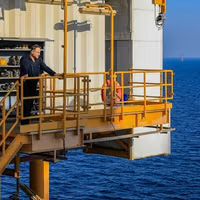
Employees of Iran’s oil industry held protests Monday at offshore platforms operated by Pars Oil and Gas Company and in the southern energy hub of Assaluyeh, demanding changes to pay, taxes and benefits as US economic pressure weighs on Iran’s oil exports and wider economy.

Afkar-e Naft, a Telegram channel which reports on issues affecting permanent oil industry employees, said the demonstrations were part of protests held every Monday.

Images published by the channel showed workers at several offshore installations holding placards calling for the removal of salary caps, full payment of wages and benefits, fairer compensation and changes to the tax system for offshore employees.

“Full payment of wages and benefits,” read one placard, while another said, “Fair pay is our right, not an extra privilege.”

Other signs called for an overhaul of the wage system for operational oil workers and the removal of what protesters described as “unfair restrictions” on salary payments.

1 / 5
100%
1 / 5

Several workers also highlighted the conditions under which oil production has continued during the war. One placard read, “Uninterrupted production in a war zone,” while another referred to “uninterrupted production in border areas.”

The protesters are also seeking payment of outstanding compensation under Article 10 of the law governing the duties and powers of Iran’s Oil Ministry.

The so-called Article 10 back pay refers to accumulated payments employees say they are owed following implementation of provisions governing compensation and employment conditions for Oil Ministry personnel.

The protests come as Iran’s economy faces mounting pressure from the regional war and a US maritime blockade that was reimposed in mid-July. Satellite imagery reviewed by Iran International shows a sharp decline in visible vessel activity at Shahid Rajaee and Imam Khomeini, two of the country’s most important commercial ports, since the blockade resumed.

  • Satellite images show Iran’s key ports falling quiet under US blockade

    Satellite images show Iran’s key ports falling quiet under US blockade

The impact has been particularly severe on Iran’s oil trade, a crucial source of government revenue and foreign currency. Kpler tanker-tracking data reviewed by Iran International showed Iranian crude loadings averaging about 287,000 barrels per day in August through Aug. 21, compared with roughly 2 million barrels per day before the war — a fall of about 85%.

Washington has simultaneously intensified its financial campaign against Tehran. On Aug. 24, the US Treasury launched Operation Economic Outcast, dubbed an “Economic D-Day,” saying it aimed to sever Iran’s remaining financial and commercial connections and increase the risks for foreign banks and companies doing business with Tehran. The campaign has since targeted financial channels in countries including the United Arab Emirates and Türkiye.

The pressure has coincided with a steep deterioration in household purchasing power. Iran’s rial has fallen to a record low of about 2.2 million to the US dollar this month, compared with roughly 958,000 a year earlier.

Official figures for July showed average annual inflation at around 62%, year-on-year inflation at 82% and food inflation at 134%, adding to the pressure on wages and living standards.

The gamble behind US attacks on Iran’s oil tankers

Sep 7, 2026, 03:56 GMT+1
•
Umud Shokri
100%
CENTCOM handout purporting to show Iranian tanker M/T Kylo sinking in the Gulf of Oman

US attacks on Iranian oil tankers could make it far harder and more expensive for Tehran to keep selling its crude, but the strategy carries a potentially much larger cost: turning the Persian Gulf’s energy infrastructure into an expanding battlefield.

The latest US strikes on three Iranian oil tankers mark a significant escalation in Washington’s economic campaign against Tehran, moving beyond sanctions and blockade to the physical destruction of vessels used to export Iranian oil.

US forces on September 5 disabled two tankers near Kharg Island and Jask and destroyed a third in the Gulf of Oman, according to US Central Command, which described the vessels as part of a “multibillion-dollar shadow network” supporting the IRGC and its regional partners.

The strikes followed Iranian ballistic missile attacks on US naval forces that caused no American casualties. CENTCOM commander Adm. Brad Cooper warned Washington was prepared to impose an “even higher economic cost” on Tehran.

The significance of the strikes lies less in the loss of three ships than in the change in tactics. Washington has spent years trying to make Iranian oil harder to sell through sanctions, restrictions on financial transactions and pressure on buyers and shipping networks. Since mid-July, the US naval blockade has added a physical barrier.

Now, the vessels themselves are becoming targets.

From financial to physical risk

The shift comes as Iran’s oil exports are already under severe pressure.

Ship-tracking data indicated Iranian crude loadings fell to roughly 220,000–255,000 barrels per day in August, from about 740,000 bpd in July and peaks close to 2 million bpd before the conflict.

For weeks, no meaningful Iranian crude cargoes were able to reach China through the Strait of Hormuz, leaving more oil in floating storage inside the Persian Gulf.

Iran has spent years building a shadow shipping network capable of operating around Western sanctions, relying on opaque ownership structures, reflagging, manipulation of vessel-tracking systems and ship-to-ship transfers to move crude, particularly to China.

Those methods are useful when the main challenge is avoiding financial sanctions or detection. They offer far less protection if the vessels themselves become military targets.

Sanctions forced Iran to find ships willing to evade Washington. The new strategy may force it to find ships and crews willing to risk being attacked.

That could make the shadow fleet more expensive and difficult to operate. Many of its tankers are aging vessels already working outside conventional Western insurance and maritime-service networks.

If owners, crews and operators come to regard Iranian-linked voyages as carrying a serious risk of attack, some may demand greater compensation or decide the trade is no longer worthwhile.

Washington cannot, however, simply eliminate the shadow fleet overnight. The network is dispersed and adaptable. Ships can change names, flags and ownership structures, while Tehran can alter loading patterns or move ship-to-ship transfers farther from areas dominated by US forces.

But every vessel lost imposes another cost. Iran must replace it, find another operator willing to accept the risk or leave more crude stranded in storage.

Floating storage offers only temporary relief. Oil held offshore does not generate revenue until it reaches a buyer, and prolonged disruption can eventually force producers to cut output as storage fills.

The question is therefore not whether three tanker strikes can dismantle Iran’s export system. They cannot. It is whether repeated physical losses can gradually undermine the commercial network that has allowed Tehran to keep selling oil despite years of sanctions.

A wider energy battlefield

That strategy carries an obvious risk: once Washington treats Iran’s oil-export system as a military target, Tehran has a stronger incentive to widen the energy battlefield.

Iran has already used attacks and threats against maritime traffic as a means of imposing costs on its adversaries. The Strait of Hormuz remains central to that strategy because of the enormous volumes of oil and liquefied natural gas that normally pass through it.

Further reducing Iranian export revenues could weaken Tehran’s ability to finance the IRGC and allied armed groups while increasing the economic cost of continued confrontation.

But direct attacks on tankers could also reinforce the Iranian leadership’s argument that compromise will not end US pressure and that imposing costs on regional energy flows is one of Tehran’s remaining forms of leverage.

That matters well beyond Iran.

Saudi Arabia and the United Arab Emirates have invested heavily in export routes that partially bypass Hormuz, including Saudi pipelines to the Red Sea and the UAE’s link to Fujairah. But those alternatives cannot fully replace normal flows through the Strait, while Kuwait and Iraq remain particularly dependent on the waterway.

Even without major damage to regional infrastructure, greater insecurity can raise war-risk insurance premiums, freight rates and other costs for commercial operators.

The tanker strikes therefore strengthen Washington’s leverage only if they can impose additional costs on Tehran without triggering a broader contest over the region’s energy infrastructure.

Physical attacks may hurt an Iranian oil-export system that has spent years learning to circumvent sanctions. But they also give Tehran stronger incentives to retaliate against the system through which its neighbors export their own energy.

The strategic gamble for Washington is therefore not simply whether tanker strikes can further squeeze Tehran’s oil revenues. It is whether Iran can be made to bear those costs without deciding that its adversaries’ energy exports should bear them too.