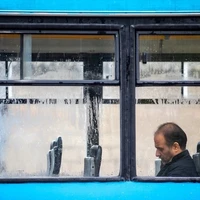
File photo: A man sits alone on a bus on a rainy day in Tehran, Iran.
Iranians struggling with mounting debts and soaring living costs are offering multiple organs and body tissues for sale, including testicles and corneas, in an online market where even finding a prospective buyer can come at a price.
An Iran International examination of more than 600 advertisements posted on a Telegram channel between late May and late October found that roughly one in three offered more than one organ or tissue.
One man who advertised several parts of his body, including a testicle, told Iran International: “I can still live after losing these organs.” He appeared unaware that some of the procedures he was proposing were not established transplant options in Iran.
Kidneys remained the most frequently advertised organ, appearing in 498 advertisements. But bone marrow was mentioned in 279, liver in 51, testicles in 15 and corneas in two.
In 142 advertisements, kidneys and bone marrow were offered together, while another 26 listed kidneys, bone marrow and liver. In 110 advertisements, kidneys were not mentioned at all, with sellers offering only other organs or tissues.
Prospective sellers interviewed by Iran International described financial pressures ranging from bankruptcy and mounting debts to the struggle to provide for their children.
One man said he was prepared to give up even vital organs to secure the financial future of his young daughter.
Another, who previously owned a clothing business, said he had accumulated debts and bounced checks after going bankrupt. Unable to meet his financial obligations, he hoped selling an organ would allow him to repay at least some of what he owed.
A third man, exhausted by years of renting and moving between homes, hoped the proceeds would enable him to buy a property of his own.
A woman raising two daughters on her own said she was looking for a buyer simply to cover her family's everyday expenses.
Year-on-year inflation reached nearly 89 percent in October, further eroding household incomes and pushing up the cost of housing and basic necessities.
A 2024 academic study of 215 people in Tehran's kidney market found that approximately 83 percent had entered the market to meet longer-term financial needs, including repaying debts and purchasing durable goods. Nearly three-quarters were renters.
The amounts sought by prospective sellers have also risen dramatically over the past decade, although advertised prices do not necessarily reflect completed transactions.
In 2016, kidneys were commonly advertised for around 20 million to 30 million tomans. By 2020, media reports cited asking prices of 100 million to 150 million tomans, rising to 150 million to 200 million tomans in 2021.
Some advertisements examined in the latest investigation listed kidneys for as much as 30 billion tomans, around 1,000 times the upper end of the asking-price range reported a decade earlier.
Asking prices for liver also reached 30 billion tomans, while bone marrow was advertised for up to 23 billion and testicles for up to 10 billion tomans. Sellers offering corneas generally said prices would be negotiated.
There is no evidence that transactions were completed at these prices, or that prospective sellers received the amounts they requested. Medical expenses and subsequent care could also reduce any proceeds.
Not everything being advertised, however, can be transplanted from a living donor.
Living donors can donate a kidney or part of their liver, although both procedures carry health risks, particularly the more extensive surgery required for liver donation.
Bone marrow donation involves collecting blood-forming stem cells rather than removing an entire organ. Corneas are ordinarily obtained from deceased donors, while the investigation found no evidence of an established procedure in Iran for transplanting testicles purchased from living sellers.
The investigation also found that prospective sellers may be charged simply to advertise their organs or reach potential buyers.
The administrator of one Telegram channel asked an Iran International investigator for 200,000 tomans to publish an organ-sale advertisement.
For an additional 400,000 tomans, the administrator offered to circulate the seller's details through what he described as an association connecting prospective donors with patients awaiting transplants in hospitals.
The combined fee of 600,000 tomans was payable before any buyer had been found. The administrator provided a bank card number for payment.
Iranian media have previously reported that some Telegram intermediaries demand around four million tomans to register prospective sellers and help them find buyers. Some sellers, meanwhile, seek out brokers who claim they can secure higher prices for their organs.
The investigation did not establish whether these intermediaries successfully arranged transplants or whether their advertised services were genuine.
For the people interviewed by Iran International, selling an organ represented a possible escape from debts, insecure housing or the struggle to provide for their families—even though none could be certain of finding a buyer, receiving the money they sought or escaping the hardship that drove them to advertise.
A sculpture depicting a large family riding a motorcycle, installed in Tehran to promote childbirth and encourage larger families.
Iran's population could shrink from 87 million to 31 million over the next 75 years, a senior population official warned Thursday, citing a projection far more pessimistic than United Nations estimates.
Marzieh Vahid Dastjerdi, secretary of the National Population Headquarters, said at an international fertility conference that Iran's fertility rate had fallen to 1.34 children per woman, well below the replacement level of about 2.1, despite years of government efforts to encourage larger families.
Dastjerdi attributed the population forecast to the World Health Organization, but the UN's World Population Prospects 2024 projects Iran's population at around 80 million by 2100 under its medium-variant scenario.
The assumptions behind the substantially lower figure cited by Dastjerdi were not immediately clear.
Fertility below replacement level does not necessarily translate into immediate population decline. The pace of any contraction also depends on a country's age structure, life expectancy and migration.
Dastjerdi warned that continued demographic decline could leave Iran surrounded by neighboring countries with populations in the hundreds of millions.
Iran's fertility rate stood at six to seven children per woman in 1986 but fell to 1.34 in the Iranian calendar year ending March 2026, she said.
A mother holds her newborn baby in a maternity ward in Iran, where birth rates continue to decline despite government campaigns and financial incentives encouraging families to have more children.
Economic pressures undermine birth incentives
The decline has continued despite years of government campaigns, financial incentives and appeals by senior officials and religious leaders encouraging couples to have more children.
Inflation, high housing costs, cultural changes, delayed marriages and difficulties balancing employment with motherhood are among the main obstacles to childbearing, Dastjerdi said.
She attributed more than 75 percent of the decline to rising education levels and social development without corresponding economic progress.
A September Instagram poll conducted by Iran International found that 97 percent of more than 18,000 respondents said conditions in Iran had prompted them to postpone major life decisions, including marriage and having children. The self-selected survey was not representative of the Iranian population.
According to Dastjerdi, Iran has approximately 7.3 million unmarried men aged 20 to 54 and between 6.5 million and seven million unmarried women aged 15 to 49.
The average age of women having their first child has reached 27 years and six months nationwide and 30 years and eight months in Tehran.
Couples now wait an average of four years and six months after marriage before having their first child, contributing to fertility challenges, she said.
Annual marriages have fallen from 900,000 in 2010 to 431,000 in the Iranian year ending March 2026, while the proportion of women remaining permanently unmarried has risen sevenfold, from 1.1 percent in 1996 to 7.7 percent.
A cleric poses with a large family and a newborn baby. The Islamic Republic has promoted childbearing and larger families through government campaigns and financial incentives.
Aging population raises concerns
Beyond the long-term risk of population decline, Iran faces a more immediate challenge from an aging population.
The share of people aged over 60 is projected to rise from 13 percent to 32 percent by 2051, increasing elderly care costs and reducing the number of younger caregivers, Dastjerdi warned.
Successive leaders of the Islamic Republic have made population growth a strategic priority.
Mojtaba Khamenei, Iran's third supreme leader, called for higher birth rates in a May message, linking population growth to the government's long-term strategic objectives and the creation of a new Islamic Iranian civilization.
Khamenei described increasing the population as one of the most important concerns of his predecessor, Ali Khamenei, who was killed earlier this year.
The government has also introduced financial incentives under its Family Protection and Youthful Population Law in an effort to reverse declining birth rates.
Dastjerdi said a new maternal support program, backed by 500 trillion rials (approximately $188 million), provides eligible mothers with monthly purchasing credits of 20 million rials (about $7.50) for 24 months after childbirth.
She also called for full insurance coverage of infertility treatment and expanded screening services, noting that 79 secondary-level and 130 tertiary-level fertility treatment centers operate nationwide.
Despite these measures, official figures continue to show declining fertility and marriages, raising concerns about the country's long-term demographic and economic outlook.
Trucks queue at the Bazargan border crossing between Iran and Turkey, one of Iran’s main overland trade routes
Tehran has dismissed US plans to restrict Iran’s overland trade routes as ineffective propaganda, but Iranian businesses report sharp increases in transportation costs and insurance premiums.
Some say these costs have multiplied several-fold, though it remains unclear how much of the increase can be attributed to the new operation.
Operation Iron Gate follows two earlier US initiatives, Economic Fury and Economic Outcast, which introduced a naval blockade and expanded secondary sanctions across five sectors: digital assets, technology, gold, aviation and shipping.
Iron Gate, by contrast, is a CENTCOM task force rather than a full-scale operation. Established on November 7 and operating with roughly 20 personnel based in Tampa, Florida, its long-term impact remains difficult to assess.
The economic damage
The International Monetary Fund projects a 5.4% economic contraction and 68.9% inflation for 2026.
CENTCOM asserts its blockade has prevented more than $25 billion in crude exports, although the figure has not been independently verified.
While CENTCOM has not specified the total volume of trade Iron Gate aims to block, its stated targets cover weapons, dual-use technology, sanctioned materials and illicit revenue moving through land and Caspian routes.
Ordinary trade is not explicitly targeted, but the scale of Iran's regional commerce illustrates the challenge of enforcing such restrictions.
Regional trade
Iraq has more land crossings with Iran than any other neighbouring country. On November 9, Washington reportedly requested that Baghdad close all but two crossings.
Iraq's Trade Ministry put bilateral trade at $12.5 billion in 2024, while Iranian customs figures showed Iraq purchased $11.9 billion in Iranian exports during the last Iranian calendar year, making it Iran's second-largest export market after China.
Smaller crossings have also expanded rapidly, with Mehran alone handling $453 million in exports over six months.
Reports by Alhurra, the US-funded Arabic-language broadcaster, have highlighted IRGC-supervised smuggling through militia-controlled routes into Iraq, potentially making these networks a particular target for Iron Gate.
Along the Turkish border, six-month bilateral trade reached $7.04 billion, according to Mehr News. Petrochemicals accounted for 48% of Iranian exports and oil products another 33%.
Bazargan remains a major bottleneck, with Iranian officials reporting that Turkey permits only 200 trucks a day, against the 500 requested by Tehran.
To the north, industry estimates published in Iranian economic media project Russia–Iran Caspian cargo volumes of approximately 10 million tonnes in 2026, nearly double the previous year's level.
Iranian exports to Pakistan and Afghanistan amount to roughly $2.4 billion each, alongside extensive informal fuel smuggling on which an estimated 2.4 million people in Pakistan's Baluchistan depend.
Internal strain
Many observers, including some Iranian officials, argue that additional restrictions are unlikely to bring about economic collapse, pointing to Iran's adaptation to nearly five decades of sanctions.
Assessments reported by Reuters have also suggested that renewed military strikes may be unlikely to change Tehran's negotiating position or destabilize its leadership.
Yet the ability of the Iranian state to withstand pressure does not mean its population can absorb the costs. Iranians contacting foreign-based Persian-language outlets, including Iran International, consistently describe the growing hardship facing ordinary households.
Iron Gate may prove more effective at raising trading costs and disrupting specific networks than at restricting Iran's overall commerce.
Oil-product flows through Iraq and Turkey, along with military-related shipments across the Caspian, could face additional scrutiny. But the task force's limited size and the geographical scale of its mission make its eventual impact uncertain.
Caspian maritime traffic, in particular, remains difficult for Washington to reach directly.
Iran may therefore be able to withstand further restrictions, even at the cost of prolonged economic hardship. Tehran could ultimately prefer what amounts to more pressure on ordinary Iranians over geopolitical concessions.
IRGC commanders tour an underground missile facility lined with missiles and military transport vehicles.
The Revolutionary Guards' unveiling of a new underground missile facility has sparked public anger over military spending, with citizens questioning government priorities amid growing poverty, energy shortages and a lack of civilian shelters.
Iranian media released images on November 10 showing Ali Abdollahi, chief of staff of the armed forces, and Majid Mousavi, commander of the Revolutionary Guards' Aerospace Force, touring what was described as a new underground "missile city."
Neither the facility's location nor the date of the officials' visit was disclosed.
"They have drilled holes into mountains for missile cities, but they have left even bigger holes in people's dinner tables," a resident of Shiraz wrote to Iran International.
Another criticized the focus on expanding missile capabilities rather than addressing economic hardship.
"They either inaugurate missile cities or compete to threaten the region, Europe and the US. The only thing that does not matter to them is the people and their problems," the person wrote.
The unveiling followed remarks by lawmaker Ghasem Ravanbakhsh on November 7 calling for longer-range missiles and discussing the potential ability to target military bases and infrastructure in European countries, including Britain.
Missile facilities and shrinking household budgets
Several citizens questioned the allocation of resources to underground military infrastructure while living standards continue to deteriorate.
"Now we know where the money meant for people's livelihoods is being spent," one person wrote.
Another compared Iran's growing missile infrastructure and the Revolutionary Guards' influence to North Korea, pointing to declining household purchasing power and economic hardship.
Year-on-year inflation reached 88.7 percent in October, the Statistical Center of Iran announced on October 28.
"Regional power and strength are not demonstrated by unveiling missile cities, but by providing people with essential goods and fuel so they do not face shortages," another wrote.
Others questioned the construction and operating costs of underground facilities, including their electricity and gas consumption.
One person estimated construction costs at $50 million per kilometer and questioned why households were being urged to conserve energy while military facilities consumed substantial resources.
The criticism coincided with fresh government warnings about possible winter gas shortages.
Iran faces a gas supply shortfall of approximately 430 million cubic meters, government spokesperson Fatemeh Mohajerani said on November 10, warning of possible interruptions and urging households to reduce consumption.
Some respondents also accused the Revolutionary Guards of controlling access to foreign currency and import permits through affiliated companies, arguing that resources needed for food and medicine were being directed toward missile development and regional allied groups.
Underground missile bases but no public shelters
Another major concern raised by the citizens was the lack of civilian shelters and emergency protection facilities in the event of war.
"I wish that instead of unveiling missile cities, you would unveil underground shelters for the people. Everything matters to the Islamic Republic except the lives of Iranians," a resident of Karaj wrote.
The criticism follows an Iran International report published on November 3 examining civilian preparedness for possible conflict.
Many said they could neither afford emergency supplies nor identify a safe place to shelter during military strikes.
Some also questioned the government's decision to publicize images of facilities presumed to be sensitive military sites while providing no recent images of Supreme Leader Mojtaba Khamenei.
They contrasted the publicity surrounding underground missile infrastructure with the continued absence of new public images of the country's leader.
Workers struggling with mounting debts and rising living costs are offering their kidneys, liver tissue and bone marrow for sale to repay debts and keep their homes, the labor-focused ILNA news agency reported on November 11.
Advertisements offering organs for sale cover walls, metal doors and buildings along some streets in central Tehran, where ILNA interviewed workers and other residents whose earnings no longer cover their basic expenses.
Farhang Hosseini Street, widely known as "Kidney Street," has become a gathering point for people seeking buyers, partly because of its proximity to a municipal medical facility and a charity supporting kidney patients.
The advertisements extend beyond kidneys to liver tissue, bone marrow and other body parts, according to ILNA.
Workers seek billions of rials for kidneys
Most people advertising kidneys for sale are workers and individuals facing serious financial difficulties, an employee at Sadra Hospital told ILNA.
Asking prices generally range from 30 billion to 40 billion rials ($11,500 to $15,300), although kidneys from people with O-positive blood may be offered for eight billion rials ($3,100). Prices for rarer blood groups can reach 50 billion rials ($19,200), the employee said.
A 30-year-old motorcycle courier in Tehran said he had rejected an offer of 15 billion rials ($5,750) for his kidney, plus an expected two billion rials ($770) from insurance, but the amount would not cover his debts.
The courier is now seeking at least 35 billion rials ($13,400).
Another man, a self-employed worker aged about 58, said he needed between seven and eight billion rials ($2,680 to $3,070) to settle an outstanding check and was prepared to sell an organ for 20 to 30 percent below the usual asking price.
The accounts come as financial pressures leave growing numbers of households struggling to afford basic necessities.
Around eight million people have fallen into absolute poverty and malnutrition because of the government's mishandling of preferential currency subsidies, parliamentary social affairs committee chairman Ali Babaei Karnami said on November 8.
An Iranian woman walking past a wall displaying an advertisement for the sale of body organs.
Up to 50 million more people face difficulties affording food, Babaei Karnami said.
Multiple organs advertised for sale
Some workers are advertising several organs simultaneously in hopes of securing enough money to settle their debts.
A 33-year-old construction worker told ILNA he wanted 40 billion rials ($15,300) for his bone marrow and had also advertised his kidney and liver tissue for sale.
"I have advertised my liver and kidney for sale as well. I have all my medical examination results and health documents, and I am completely healthy," the worker said.
Another worker had advertised his kidney, liver tissue and testicle for sale, saying his financial difficulties had left him with few options.
After an ILNA reporter explained that testicular transplantation was not performed in Iran, the worker said he had been unaware of that and was willing to sell whichever organ attracted a buyer first and offered the highest payment.
The advertisements highlight the widening gap between earnings and household expenses.
Minimum-wage workers typically earn between 200 million and 300 million rials ($77 to $115) a month, including benefits, while independent labor activists estimate that a household needs around one billion rials ($383) monthly to cover basic living costs, according to ILNA.
Workers on temporary or seasonal contracts face additional difficulties, including unstable employment and earnings below the minimum wage.
Financial hardship forces difficult choices
Reports of people selling organs to cover living expenses have emerged repeatedly in recent years.
In March 2024, Tejarat News reported that young Iranians, including teenagers, were offering kidneys and bone marrow for sale to meet their financial needs.
Financial difficulties have also affected access to medical treatment.
Two retirees died after abandoning medical treatment because they could no longer afford it, Jalal Hashemi, chairman of the Homa retirees' association, said on October 26.
In January 2022, Hossein Biglari, head of the Kermanshah Kidney Patients Support Association, said some Iranians were traveling to Iraq to sell their kidneys for higher prices in dollars.
For construction workers and motorcycle couriers, physical health is essential to earning a living.
Selling an organ may temporarily relieve financial pressures but could undermine their health and ability to work in the future, ILNA wrote, highlighting the longer-term consequences for workers turning to their own bodies to repay debts.
Students and parents walk through a snow-covered schoolyard outside a school in Iran.
Students across Iran are attending classes without adequate heating despite freezing temperatures and heavy rainfall, as the government warns of possible gas shortages but insists on keeping schools open, according to accounts received by Iran International.
Government spokesperson Fatemeh Mohajerani warned on November 10 of possible gas cuts in Tehran and other parts of the country but said the government's policy remained focused on maintaining in-person education.
The warnings come as families face growing school expenses, including demands to cover utility bills, while unreliable internet access and the cost of online learning complicate alternatives to classroom teaching.
Students bring blankets to freezing classrooms
Students and parents from several cities told Iran International that schools had refused to turn on heating systems despite falling temperatures.
"We are shivering from the cold at school, but they tell us they need an Education Ministry directive before turning on the heaters," one student said.
A student in the northwestern city of Ardebil said radiators remained off despite snowfall on November 9, with school officials citing energy shortages.
"Things have reached the point where some students are bringing travel blankets with them," the student said.
In Tabriz, northwestern Iran, where temperatures fell to minus five degrees Celsius, students said school officials refused to switch on radiators and told them to warm classrooms with their breath.
Students in the northern city of Chalus, northwestern Miandoab and Abyek near Tehran described similar conditions, including heavy rainfall, flooding and unheated classrooms.
A parent in the northern city of Amol said students at a private school had fallen ill after attending classes in severe cold.
"If these children catch a cold, how can we afford to treat even a simple cold at these prices?" the parent asked.
Broken heating systems and school fees
Accounts from students suggest the problem extends beyond restrictions on heating use to deteriorating infrastructure and insufficient funding.
A student in Gilan province, northern Iran, said radiators at their high school had remained broken since last year, except in the principal's office.
In Tehran, students described classrooms without heating, while one said their school lacked both electricity and gas. Another said officials blamed budget shortages for keeping radiators off.
A student in Karaj said the school, attended by approximately 500 students, had no classroom heating despite collecting substantial enrollment fees.
In Borujerd, Lorestan province, a student questioned spending priorities after the school installed two surveillance cameras in every classroom without providing adequate heating or cooling.
More than 500 schools in Chaharmahal and Bakhtiari province were undergoing heating upgrades and other repairs, Tabnak reported on November 6, citing earlier comments by a provincial school infrastructure official.
Heating problems had also delayed the opening of five or six educational projects.
Families face rising education costs
School closures offer no straightforward solution for families struggling with internet disruptions, expensive data packages and limited access to equipment for online education.
An Iran International Instagram poll published on August 27 found that 61 percent of approximately 55,500 respondents preferred online learning, citing concerns including student safety and financial pressures.
The remaining 39 percent favored classroom education, pointing to poor internet connectivity, electricity outages and declining educational quality online.
Financial demands from schools have added to families' difficulties.
Iran International reported on November 1 that some public schools were asking parents to contribute toward electricity, water and gas bills, maintenance and classroom equipment.
A student in Ahvaz said school officials demanded 1000,000 rials per pupil for examination papers and warned that those who failed to pay would receive a minus grade.
Another parent said a public elementary school in Tehran demanded 2,500,000 rials for a routine examination.
The charges add to the financial burden on families in a country where the minimum monthly wage stands at about 166 million rials, equivalent to roughly $61 at the current exchange rate.