UN says Iran committed crimes against humanity, US committed war crimes
Bodies of protesters killed during Iran’s January 2026 crackdown are seen at a morgue in Tehran.
Iranian authorities committed crimes against humanity in suppressing nationwide protests in January while two US strikes on civilian sites in February amounted to war crimes, the UN fact-finding mission on Iran told the Human Rights Council on Monday.
The Independent International Fact-Finding Mission on Iran said the Islamic Republic’s response to protests that began in December 2025 amounted to a widespread and systematic attack on civilians involving unlawful killings, torture, arbitrary detention, enforced disappearances and severe restrictions on freedom of expression.
“The Iranian Government’s repression of the recent protests has led the Mission to find Iran responsible for gross human rights violations,” mission chair Sara Hossain told the council in Geneva, saying many amounted to crimes against humanity, including murder, imprisonment, torture and other inhumane acts.
The mission said the crackdown marked a significant escalation from previous patterns of repression, citing the scale of killings and violence, internet shutdowns, mass arrests and the use of the death penalty. It said it could not independently verify the overall toll but believed the number of people killed and injured was likely far higher than the government’s figures of 3,038 deaths and 25,000 injuries.
Classified government documents, field reports and accounts from medical workers, witnesses and victims’ families reviewed by Iran International’s Editorial Board showed that more than 36,500 people were killed by security forces on January 8 and 9 alone.
However, independent verification has been impossible amid communications restrictions and government pressure.
The unrest began on December 28 with protests over worsening economic conditions before spreading nationwide and turning into a broader challenge to the Islamic Republic.
In her Monday speech, Hossain said Iranians were now confronting both continued domestic repression and the large-scale US-Israeli military campaign that began on February 28.
She said Iranian authorities had also used the war to intensify persecution of protesters, describing the conflict as “a pretext for and accelerator of repression.”
Iran rejected the mission’s findings about its own conduct. Ambassador Ali Bahreini argued that economic pressure against Iran, combined with what Tehran describes as foreign manipulation and militarization of domestic unrest, amounted to crimes against humanity and accused the mission of ignoring those issues.
US war crime
The mission then turned to two US strikes carried out on the opening day of the war.
The United States and Israel launched attacks across Iran on February 28 in an operation Washington said was intended to severely weaken Iran’s military and prevent it from developing a nuclear weapon. President Donald Trump said at the outset that US forces would destroy Iran’s missile industry and navy, while Tehran denies seeking nuclear weapons. The attacks triggered Iranian retaliation against Israel and US-linked targets across the region.
Against that wider military campaign, the mission examined a US strike on the Shajareh Tayyebeh Primary School in Minab, Hormozgan Province.
Hossain said two cruise missiles hit the school, killing 157 people, including 123 boys and girls, according to sources the mission considered credible. She described it as a readily identifiable civilian building and said investigators found reasonable grounds to believe the strike amounted to the war crime of making a civilian object the object of an attack.
The school was adjacent to an Islamic Revolutionary Guard Corps naval complex, but investigators found no evidence that the building itself was being used for military purposes. The mission said the United States had failed to update information about the school in its targeting databases or adequately establish that it was a military objective, conduct it said amounted to more than mere negligence.
The mission reached a separate war-crimes finding over a US strike on a sports center in a residential area of Lamerd, Fars Province. Local authorities said 22 people — 10 women and 12 men — were killed. Investigators concluded there were reasonable grounds to believe the strike constituted an indiscriminate attack resulting in civilian deaths or damage to civilian property.
Hossain said repeated airstrikes and threats of further attacks continued to endanger civilians, destroy homes and livelihoods and disrupt access to education and healthcare. She called on all sides to conduct independent investigations into alleged violations of international humanitarian law, specifically urging Washington to investigate the two strikes and provide accountability and reparations where warranted.
Washington’s reaction
Washington rejected the conclusions. The Pentagon said its own investigation remained underway and that it had nothing further to announce, while White House spokeswoman Anna Kelly dismissed the Human Rights Council’s work and said Iran was the only party in the conflict to have committed war crimes.
US officials have maintained that American military operations comply with the law of armed conflict.
US Ambassador to the UN Mike Waltz also said Trump was expected to challenge the findings when he addresses the UN General Assembly on Tuesday, saying the president would continue to “call out the ridiculous.”
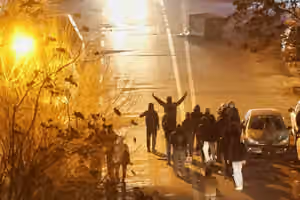
Protesters gather on a street during anti-government demonstrations in Iran in January 2026.
A local network tied to state-backed cultural and media groups helped Iranian authorities identify protesters during the January crackdown, with footage passed to Revolutionary Guards intelligence, sources familiar with the operation told Iran International.
The network operated in Fariman in northeastern Iran. Sadegh Maloul, a local figure with a background in cultural and media activities connected to the Basij and Revolutionary Guards, coordinated teams that filmed protesters, according to the sources.
Images gathered by the network were sent to the Islamic Revolutionary Guard Corps (IRGC) Intelligence Organization in Fariman and Mashhad and used to identify people who had taken part in demonstrations and add evidence to security cases against them, the sources said.
Iran International’s investigation indicates that the process contributed to the arrest of 23 people.
Maloul has been identified as the head of the Basij Artists Center in Fariman and had previously collaborated with the IRGC’s public relations department.
Local media material reviewed by Iran International identifies him with the Fariman Basij Artists Center, while biographical information attributed to him described him as an “honorary reporter” cooperating with the IRGC’s public relations department.
These records link Maloul’s cultural and media activities to organizations affiliated with the Basij and IRGC.
From culture to surveillance
At the Basij Artists Center, Maloul organized members to produce cultural and media content aligned with the Islamic Republic’s messaging.
In late 2024 or early 2025, he called on young people he described as “soft-war officers” to produce films on subjects including Basij security activities, hijab and online activity.
The center’s performance and training programs also brought it into contact with teenagers and young adults interested in art and filmmaking.
Sadegh Maloul headed an informant network used for repression
During the January protests, the teams coordinated by Maloul recorded demonstrators, according to sources familiar with the operation.
The footage was subsequently transferred to IRGC intelligence offices in Fariman and Mashhad, where it was used to identify demonstrators and add evidence to security cases against them.
Iran International could not independently determine how many people took part in the filming teams or whether everyone involved in the cultural organizations knew how the material would later be used.
Crackdown across Razavi Khorasan
The operation unfolded during a wider crackdown across Razavi Khorasan, where protests spread to at least 20 counties in January.
Mashhad, the provincial capital, was a major center of protests, while Fariman also saw demonstrations and arrests.
Iran International has previously reported that security forces used live fire against protesters in several parts of Mashhad and restricted internet access and communications in areas where demonstrations were taking place.
The Fariman case indicates how surveillance may extend beyond formal security agencies into local cultural and media networks.
New role after protests
Several months after the January protests, Maloul became head of the Sadaqat charitable center.
His new role indicates that he continued to hold positions within organizations connected to the Islamic Republic’s institutional network after the crackdown.
The Fariman case offers a glimpse into a less visible part of Iran’s protest-control machinery: not only the forces deployed in the streets, but local networks capable of recording demonstrators, identifying them and passing information to security agencies after the crowds disperse.
Children carrying rifles take part in a Janfada mobilisation rally in Iran, September 18, 2026
The spokesman for Iran’s mass mobilisation campaign said children under 15 could be introduced to military concepts, while denying that minors were receiving formal weapons training as authorities expand a civilian defence drive launched during the war.
Sasan Zare, spokesman for the Janfada campaign, said the main organisation of volunteers would be based around adults aged 18 and over, but acknowledged that younger people were also being brought into the initiative.
“The stronger their value system is formed from childhood, and the more familiar they become with concepts such as patriotism and self-sacrifice, the more significant the impact can be on their future,” Zare told the Iranian news agency ILNA.
Those registered with the campaign were over 15, he said, while women taking part in its training courses were over 18. For children below that age, Zare said the emphasis should be on patriotism, responsibility, first aid, safety and what he called a “culture of self-sacrifice and resistance.”
The Islamic Republic has stepped up a broad campaign to mobilise civilians since the US-Israeli war began in February.
The Janfada initiative was launched in late March, and authorities have since promoted registration through mosques, Basij bases and public events, alongside plans for military and emergency-response training.
The campaign has drawn scrutiny over the involvement of minors, with rights groups accusing Iranian authorities of recruiting children into the Basij and using them at checkpoints.
Amnesty International said in April that Iranian law allows children under 15 to join as ordinary Basij members, while those aged 15 and over can become active Basij members and collaborate with the Revolutionary Guards on assigned missions.
The rights group said it had verified evidence of children as young as 12 deployed at checkpoints and patrols, including some carrying rifles.
Iran International has separately received accounts from several provinces describing children and teenagers taking part in checkpoint operations and handling weapons at state-sponsored gatherings.
Asked specifically about teenagers being used at checkpoints, Zare said he did not know how such deployments were being carried out because checkpoints fell under the authority of local police and security bodies.
His campaign, he said, provided training related to urban and public security, while the units deploying volunteers would decide whether they were used at checkpoints.
Iran has executed a man it accused of passing information about missile sites in Isfahan to Israel's Mossad, the judiciary said on Saturday, the latest in a series of espionage executions that rights groups say rest on confessions extracted in detention.
The judiciary's news agency, Mizan, identified him as Hossein Pedaran and said he had been convicted of espionage and intelligence cooperation with Israel and sentenced to death, with the sentence upheld by the Supreme Court. He had been arrested in Isfahan on charges related to the war.
Mizan published a long account of what it described as Pedaran's confessions. According to that account, he first messaged the CIA offering to cooperate and received no reply, then contacted Mossad and was answered days later by an officer who introduced himself as "Ben" using a Dutch WhatsApp number.
The agency said he sent encrypted reports on military facilities and on staff who worked at them, including personal details and their spouses' phone numbers, used numerous SIM cards registered to others, and was given a remote-control device capable of taking hidden photographs.
It said he was paid in euros collected from a magnetic box behind a guardrail near a Tehran bridge and, on another occasion, from a coffee shop bathroom, and that a notebook on missile subjects marked "highly confidential" was found at his home.
Mizan said Pedaran had cut contact before the war and tried to reach Mossad again by Telegram once it began, and was arrested. It said he had a lawyer, that a forensic examination found no impairment of his judgment, and that the court held his information had contributed to strikes in which personnel were killed or wounded.
None of these claims can be independently verified, and Mizan did not provide any evidence for the allegations.
Iran's espionage cases are heard by Revolutionary Courts, which operate without public scrutiny of the evidence, and the state routinely broadcasts and publishes confessions that defendants and their families have later said were obtained through torture, prolonged solitary confinement and threats against relatives.
Rights organizations have documented the pattern for years, and have recorded cases in which people detained during protests were subsequently charged with working for Israel.
Iran has executed at least a dozen people on espionage or Mossad-collaboration charges since the June 2025 war with Israel, according to human rights groups, and the pace has increased since the recent war began in February.
Those executed this year include Ali Ardestani in January, Mehdi Farid, a former employee of the atomic energy organization, in April, and Omid Behzad and Pouria Safvat in August. Iran Human Rights recorded at least 1,639 executions in the country in 2025, the highest annual total since 1989.
Twin sisters: one sentenced to death, the other to decades in prison in Iran.
An Iranian woman sentenced to death over January’s anti-government protests is struggling to walk but has been denied hospital treatment despite a prison doctor saying she urgently needs an MRI, her family told Iran International.
Taraneh Rahimi, 20, is being held alongside her twin sister Romina at Dowlatabad Prison in Isfahan. Their cousin, Masoud Nourmohammadi, told Iran International’s Eye for Iran that Taraneh’s condition has deteriorated as her lawyers race to appeal her death sentence.
“Taraneh could not walk,” Nourmohammadi said. “The (hospital) doctor says you have to go to the hospital and be hospitalized and get an MRI to see what’s going on with your leg because it is in bad shape,” he said.
Nourmohammadi said the doctor considered the treatment urgent, but prison authorities refused to allow Taraneh to leave for hospital.
Her family also purchased medical equipment and medication for her and brought the supplies to the prison, he said, but authorities did not allow them to reach her.
The allegations come days after Nourmohammadi told Iran International that prison authorities had stopped providing Taraneh with food, forcing her to rely on leftovers shared by other prisoners.
“They stopped giving Taraneh food a few days back,” he said. “They ask her to use other people’s leftovers and eat those. Who does that?”
‘If you don’t confess, we’re going to rape your sister’
The new allegations come as lawyers for the twins have finally been given access to their case file after months of waiting, according to Nourmohammadi.
He said the lawyers found no substantive evidence tying Taraneh or Romina to violence during the January protests and are now preparing an appeal.
“Their consensus is that there’s no evidence against those two girls in the case,” he said. “The only thing that is left … is basically their confession.”
The family says those confessions were obtained through torture and threats of sexual violence.
“They told Taraneh, ‘If you don’t confess, we’re going to rape your sister in front of you,’” Nourmohammadi said.
He said lawyers are also filing a complaint over the alleged torture and sexual abuse of the sisters while in custody.
Human Rights Watch and the Abdorrahman Boroumand Center for Human Rights in Iran have documented allegations of torture, coerced confessions and serious due-process violations involving defendants in the Shohada Square case.
Taraneh and Romina were among 16 defendants prosecuted over events surrounding protests in Isfahan in January. Ten of the defendants, including Taraneh, received death sentences, while Romina was sentenced to decades in prison.
The defendants faced charges including moharebeh, or “waging war against God,” destruction of public property, assembly and collusion against national security and propaganda against the state.
Rights groups have said none of the 16 defendants was charged with murder, despite prosecutors linking the case to incidents in which two people died.
‘A few days left’ to appeal
Nourmohammadi said the family believes only days remain in the formal window for lawyers to appeal Taraneh’s death sentence, adding that the family remains deeply concerned that authorities could move more quickly.
“You never know with that regime,” he said. “Anything can happen. It’s unpredictable.”
The sisters were 19 when security forces arrested them separately on January 24, weeks after they joined demonstrations around Isfahan’s Shohada Square. They have since turned 20 in prison.
Before her arrest, Taraneh was an equestrian and horse trainer. She had previously undergone surgery on her leg following a riding injury, according to her family.
Nourmohammadi alleges interrogators knew about the injury and deliberately targeted the same leg during torture.
When the twins’ mother was eventually permitted to see her daughters after roughly three months without knowing where they were being held, Nourmohammadi said Taraneh was already limping.
He said she also had broken fingers and knuckles and alleged that both sisters had lost much of their hair after being dragged between cells by their hair.
‘She wanted a life for her kids’
The twins’ mother raised Taraneh and Romina as a single parent.
For roughly three months after their arrests, she did not know where her daughters were being held. Family members searched hospitals, courthouses and prisons, at times waiting outside detention facilities seeking information.
When their mother was eventually allowed to see them, Nourmohammadi said the twins had swollen faces, bruises and significant hair loss.
After Taraneh was sentenced to death, he said his aunt was so devastated that she has barely been able to speak.
Instead, she wrote a message about raising her daughters and working to give them a future.
“She was a single mom. She worked really hard for her kids,” Nourmohammadi said. “She wanted a life for her kids. She didn’t want a prison or execution and a rope around their neck.”
Women sit beside mock-ups of Iranian missiles during the state-organized Janfadayan-e Iran parade in Tehran on September 18, 2026.
Iran's Revolutionary Guards paraded uniformed volunteers, Basij paramilitaries and children through Tehran on Friday in a state-organized show of force, two days after the anniversary of the 2022 protests.
The event, named Janfadayan-e Iran, roughly "those ready to give their lives for Iran," began in the morning on the order of Hassan Hassanzadeh, commander of the Guards' Tehran corps, with the password "Labbaik ya Khamenei," at your service, Khamenei.
State media put the number on the streets at more than 300,000 and said 600,000 had registered for military training. None of the figures could be independently verified. State television had spent several days urging Iranians to sign up.
The organizers billed it as a 313,000-strong parade, a number with religious rather than statistical meaning. Shiite tradition holds that 313 companions will rise alongside the Hidden Imam, the twelfth imam of Shiite Islam, who is believed to have vanished in the ninth century and to be destined to return.
Women carry models of Iranian missiles during the state-organized Janfadayan-e Iran parade in Tehran on September 18, 2026.
Hassanzadeh said the purpose of the exercise was to counter "the propaganda and media operations of the enemies of the Islamic Republic."
Hossein Taeb, the former Revolutionary Guards intelligence chief who now heads the Basij, described the marchers as "resistance battalions" ready for "full-fledged defense" and called the campaign "the biggest popular movement in the history of the world's wars."
Similar parades would follow in every province, he said, and the United States would soon be defeated and leave the region.
President Masoud Pezeshkian attended and described the display as "a magnificent manifestation of solidarity, cohesion and national loyalty."
Footage from the event showed, alongside Basij units and supporters organized by the Guards, children and teenagers marshalled by the Basij, and members of Iran-backed groups from the region, including Houthis.
Children hold rifles during the state-organized Janfadayan-e Iran parade in Tehran on September 18, 2026.
Women from the Guards carried rifles beneath a banner showing Donald Trump in crosshairs above the words "We will kill." Participants trampled US and Israeli flags. Anti-aircraft batteries, truck-mounted machine guns and the drones used against shipping in the Strait of Hormuz were put on display.
The parade closed a week in which the rial fell past 2.3 million to the dollar under a US naval blockade and new sanctions, and came two days after the fourth anniversary of the death of Mahsa Amini in morality police custody, which set off the 2022 protests.
Police and the Guards had increased patrols in Tehran and Isfahan ahead of the date.