• العربية
  • فارسی
Brand
  • Iran Insight
  • Politics
  • Economy
  • Analysis
  • Special Report
  • Opinion
  • Podcast
  • Live TV
  • Iran Insight
  • Politics
  • Economy
  • Analysis
  • Special Report
  • Opinion
  • Podcast
  • Live TV
  • Theme
  • Language
    • العربية
    • فارسی
  • Iran Insight
  • Politics
  • Economy
  • Analysis
  • Special Report
  • Opinion
  • Podcast
  • Live TV
All rights reserved for Volant Media UK Limited
volant media logo

Hormuz oil flows rise despite Iran threats against shipping

Sep 27, 2026, 16:16 GMT+1
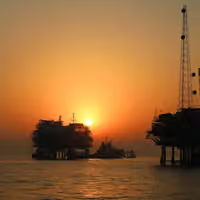
Vessels at the Strait of Hormuz, as seen from Musandam, Oman, on September 23, 2026.

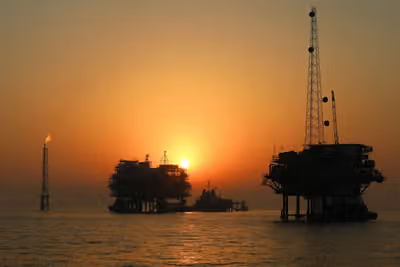
Oil flows through the Strait of Hormuz have climbed despite the conflict, with Washington pointing to rising exports as Iran warns shipping companies against unauthorized passage and threatens US forces with retaliation if fighting resumes.

US Energy Secretary Chris Wright said on Sunday that oil flows through the strait were averaging nearly 13 million barrels a day, with shipments exceeding pre-conflict levels on at least one day last week.

“There was a day just this last week where over 20 million barrels of oil, more than pre-conflict levels, flowed out of the strait,” Wright told Fox News. The current average was “almost 13 million barrels a day,” he added.

Wright attributed pressure on energy prices more to limited refining capacity than to the volume of oil moving through Hormuz.

Iran warns shipping companies

Iran, meanwhile, portrayed the strait as a closely controlled corridor where vessels must comply with rules set by its authorities.

Iran’s Persian Gulf Strait Authority warned charterers against directing ships through routes it considers unauthorized, saying companies that do so could be placed on a non-compliance list and vessels associated with them could face restrictions.

The authority also published a letter it said came from the owners of an unnamed vessel apologizing for an unauthorized transit. According to the letter, the charterer instructed the ship to proceed without completing required declarations and approvals, putting the master under commercial pressure to comply.

The warnings were accompanied by threats from Iranian military officials. Armed forces spokesman Abolfazl Shekarchi said the United States would be “slapped” if it intervened in Hormuz.

A Revolutionary Guards Navy official challenged US President Donald Trump to send a warship near the strait if Washington believed it controlled the waterway, threatening US warships as far away as the Indian Ocean if fighting resumed.

Iranian army chief Amir Hatami also said the war was not over and that the military must remain prepared for further fighting.

Regional calls for safe passage

The dispute has drawn responses from countries concerned about commercial shipping and energy supplies.

Oman’s Foreign Minister Badr Albusaidi told the UN General Assembly that Muscat would continue working to safeguard navigation through Hormuz, urging restraint, dialogue and political solutions.

US Ambassador to the UN Mike Waltz said 146 countries had condemned Iran over attacks on civilian shipping, describing the Islamic Republic as increasingly isolated.

The rising oil flows point to increased movement through one of the world’s most important energy corridors, but warnings to shipping companies and threats of renewed military action show that control and security in Hormuz remain central to the conflict.

Most Viewed

Iran’s oil industry has too many masters
1
OPINION

Iran’s oil industry has too many masters

2
INSIGHT

Pezeshkian’s Fox News nuclear overture draws hardline backlash

3
PODCAST

Trump may be buying time on Iran until after the midterms

4

Tehran seeks negotiated way out as Washington maintains pressure

5
ANALYSIS

Why Trump said no to Iran’s Hormuz proposal

Banner
Banner

Spotlight

  • Iran’s oil industry has too many masters
    OPINION

    Iran’s oil industry has too many masters

  • Iran wrong to expect midterms to restrain Trump, former US official says

    Iran wrong to expect midterms to restrain Trump, former US official says

  • Trump may be buying time on Iran until after the midterms
    PODCAST

    Trump may be buying time on Iran until after the midterms

  • Pezeshkian’s Fox News nuclear overture draws hardline backlash
    INSIGHT

    Pezeshkian’s Fox News nuclear overture draws hardline backlash

  • US and Iran want a deal, but neither wants to move first
    ANALYSIS

    US and Iran want a deal, but neither wants to move first

  • Rushdie returns to the fatwa that nearly cost him his life

    Rushdie returns to the fatwa that nearly cost him his life

Banner
Banner
•
•
•

More Stories

Why Trump said no to Iran’s Hormuz proposal

Sep 27, 2026, 12:22 GMT+1
•
Ardavan Roozbeh
100%
CENTCOM handout of US forces in the Middle East

US President Donald Trump’s rejection of Iran’s proposal for a swift reopening of the Strait of Hormuz may say less about Washington’s opposition to a deal than about its changing assessment of Tehran’s most important bargaining chip.

Trump publicly rejected the proposal on Saturday. The plan would have reopened the strait within seven days and resumed nuclear negotiations in return for measures including lifting the US naval blockade of Iranian ports.

The president plainly wants normal shipping restored, but he appears unwilling to pay the price Tehran is asking for it.

Iranian officials have repeatedly described Hormuz as a strategic asset and a source of leverage. Disruption of the narrow waterway affects energy markets, shipping costs and inflation far beyond the region.

That importance has not disappeared. What may be changing is Iran’s ability to convert that disruption into immediate political concessions from Washington.

The US military has spent months trying to reduce Iran’s ability to attack shipping while expanding escorts for commercial vessels. CENTCOM commander Adm. Brad Cooper said last week that US forces had facilitated the transit of more than 2,000 commercial vessels and more than one billion barrels of crude oil through the strait.

The operation has not restored normal shipping, but it has allowed substantial volumes of oil to move without an agreement with Tehran, helping Washington turn Hormuz from an Iranian energy veto into what it increasingly appears to regard as a manageable risk.

Why Trump can wait

If Washington believes it can keep significant quantities of oil moving without Tehran’s cooperation, there is less incentive to lift the naval blockade and ease economic pressure simply to secure the full reopening of the strait.

Trump’s rejection also comes as his administration is increasing rather than reducing that pressure. At the UN General Assembly this week, he called for Iran’s “complete economic isolation” and said he expected an agreement after the November midterm elections

The administration has expanded restrictions on Iranian banking and aviation. Iranian airlines have lost access to several international destinations, while companies servicing sanctioned Iranian carriers face the threat of secondary US sanctions.

Trump’s rejection therefore suggests Washington believes time is, for now, working more in its favor than Tehran’s.

Hormuz still matters

None of this means Iran’s Hormuz strategy has failed.

Keeping commercial traffic moving requires a major US military operation, while shipping and insurance costs remain elevated and the threat of attacks has not disappeared. Washington is paying a price for managing the disruption.

But the balance may have shifted. Tehran still views reopening Hormuz as something it can exchange for relief from economic and military pressure. Washington appears to believe it has reduced the costs of disruption enough that it does not yet need to meet Iran’s asking price.

Seen that way, Trump’s “no” becomes more significant. He has not necessarily rejected diplomacy: contacts through mediators continue, and Iran says it is still awaiting Washington’s formal response to its proposal. US officials have also described indirect discussions as continuing.

What Trump has rejected, for now, is Tehran’s price for ending the Hormuz crisis.

Iran still holds the Hormuz card. Washington’s calculation appears to be that it no longer has to pay as much to take it off the table.

Tehran seeks negotiated way out as Washington maintains pressure

Sep 27, 2026, 03:52 GMT+1
100%
A father and daughter walk together on a street in Tehran, Iran, September 23, 2026

Iran says a negotiated settlement remains the only way out of the war and is awaiting a formal US response to its latest proposal, despite President Donald Trump saying he has rejected Tehran’s offer.

Iranian Foreign Minister Abbas Araghchi said Sunday that Tehran had seen an initial reaction from Trump but was still waiting for Washington’s formal response through mediators before deciding its next step.

“Only a negotiated solution can get them out of this deadlock. That is our position,” Araghchi said, according to Iranian state media. He reiterated that reopening the Strait of Hormuz depended on Iran’s conditions being met.

Trump said Saturday that he had rejected Iran’s proposal, which envisaged a phased process involving relief from the US blockade and economic pressure and the reopening of Hormuz.

The exchange leaves diplomacy in an unusual position: Washington says the Iranian offer is unacceptable, while Tehran says it is still awaiting a formal answer through the diplomatic channel.

The proposal emerged from contacts around the UN General Assembly in New York, where Trump called for Iran’s “complete economic isolation” while saying he expected an agreement after the November 3 US midterm elections.

Iranian President Masoud Pezeshkian has said Tehran would prefer an agreement before the vote. But Pezeshkian has also stressed how little trust remains between the two sides.

“We have talked with them four or five times already,” he told Al Jazeera. “We no longer trust these talks, because however much we negotiate, after a while they start attacking, imposing sanctions and doing the things they have done so far.”

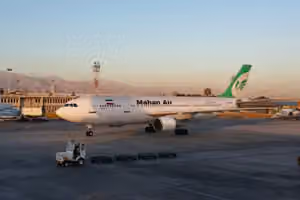
US Treasury Secretary Scott Bessent said Sunday that Turkey and Oman had stopped Mahan Air flights, the UAE had halted flights by Iranian airlines and major banks in Turkey and the UAE had stopped transactions with Iran following US pressure.

Bessent thanked the governments of Turkey, Oman, the UAE and the UK for their cooperation, saying the campaign was “delivering results.” The measures further restrict Iran’s access to regional aviation and banking networks as the rial trades at record lows.

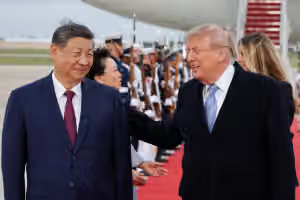
China, meanwhile, has sought to keep diplomacy alive. President Xi Jinping told Trump last week that Beijing supported a return to the June Islamabad agreement aimed at ending the war and reopening Hormuz.

For now, the central dispute remains one of sequencing. Iran wants relief from the US blockade and economic pressure before relinquishing its leverage over Hormuz. Washington wants the waterway reopened on acceptable terms before offering Tehran the relief it seeks.

Trump may be buying time on Iran until after the midterms

Sep 26, 2026, 03:24 GMT+1
•
Negar Mojtahedi
100%
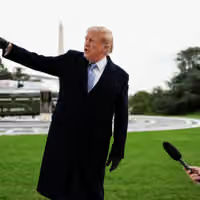
US President Donald Trump speaks to reporters in front of the Marine One

President Donald Trump may be putting off a difficult choice over Iran until after the US midterm elections, a former senior US diplomat told Iran International.

Trump used his address to the United Nations General Assembly this week to call for Iran's “complete economic isolation,” while saying he believed a deal could come after the November midterm elections.

Iranian President Masoud Pezeshkian, meanwhile, said Tehran would not surrender to US pressure but remained open to diplomacy.

The two sides held their first indirect talks in months on the sidelines of the UN gathering but remained far apart on how to end the war, including over Iran’s conditions for reopening the Strait of Hormuz.

Ludovic Hood, a senior fellow at the Hudson Institute who spent two decades as a US diplomat and previously served as special adviser for the Middle East to Vice President Mike Pence, told Iran International's Eye for Iran that the approaching elections may help explain the current pause.

“We have elections coming up in America that I think have partly bounded President Trump’s willingness to be more confrontational at this point in time,” Hood said.

He described the conflict as a “standoff” with “more chapters to be written,” saying Trump could face a decision over whether to escalate again after the midterms or as the United States enters the new year.

“He may seek to escalate again militarily,” Hood said.

Potential targets could include commercial and economic assets inside Iran owned by or directly linked to the Islamic Revolutionary Guard Corps, he said, if Trump chooses to intensify the campaign.

Pressure without political change

Iran has suffered major military losses while contending with a US naval blockade and an expanding sanctions campaign. Yet nearly seven months into the war, those pressures have not produced fundamental political change in Tehran.

Hood cautioned against assuming that battlefield losses automatically translate into political change. Instead, he pointed to the cumulative impact of declining revenues, sanctions, domestic discontent and potential strains within the institutions responsible for protecting the state.

He described the Islamic Republic as “about as vulnerable as it’s been in 47 years,” pointing in particular to questions about the government's ability to continue paying salaries, including those of security forces.

“To me, a fifth uprising is a question of when, not if,” he said.

Hood said some people advising Trump have made the case that the collapse of the Islamic Republic is possible, while emphasizing that he was not predicting whether or when that would happen.

Washington has continued tightening economic pressure even as negotiations resumed in New York. New US restrictions on Iran's aviation sector have contributed to the loss of international routes, with additional Iraqi destinations restricting Iranian connections this week.

Saudi Arabia and the United Arab Emirates are also urging Washington to maintain sanctions and the naval blockade rather than make concessions prematurely, according to a Wall Street Journal report.

Both governments nevertheless oppose further US military escalation, according to the report.

  • Iran threatens regional air travel as US sanctions cut its flight links

    Iran threatens regional air travel as US sanctions cut its flight links

Hood said the significance of Washington's economic campaign lies not simply in announcing additional sanctions, but in enforcing existing measures and steadily reducing the resources available to Tehran.

Despite the resumption of diplomacy in New York, no breakthrough has emerged. A senior Iranian official told Reuters this week that the two sides remained far apart.

That leaves Washington confronting a larger question: whether the pressure already imposed can fundamentally alter Tehran’s behavior, or whether the current pause will ultimately give way to another round of military escalation.

The answer may become clearer after November—when both Washington and Tehran appear to believe the political calculus could change.

US and Iran want a deal, but neither wants to move first

Sep 25, 2026, 18:17 GMT+1
•
Behrouz Turani
100%
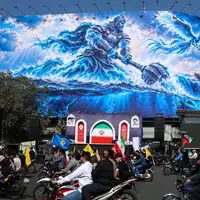
Participants ride motorcycles during a Janfada mobilisation rally in Tehran, beneath a billboard depicting a warrior emerging from the sea and confronting a burning ship, September 25, 2026

Talks between Iranian and US diplomats have continued in New York despite increasingly harsh rhetoric from both capitals, but the emerging dispute is less over whether to negotiate than over who must move first.

The discussions have increasingly focused on sequencing: Iran wants the United States to lift its economic blockade before Tehran reopens the Strait of Hormuz, while Washington is seeking movement on the strait before surrendering its principal source of leverage.

Neither side appears willing to go first despite the mounting economic and political costs of the deadlock.

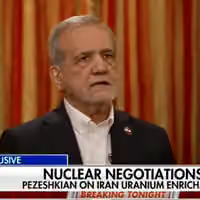
On the sidelines of the UN General Assembly, Iranian President Masoud Pezeshkian said in an interview with Fox News that Tehran was willing to relinquish its stockpile of uranium enriched to 60% within the framework of international law and its obligations under the Nuclear Non-Proliferation Treaty.

The choice of Fox News may also have reflected an effort to reach President Donald Trump and his political audience more directly, given the network’s close relationship with the president.

Pezeshkian also said Tehran hoped to revive its June ceasefire understanding with Washington before the US midterm elections in November.

“We don't want it to get to the midterm elections,” he told reporters.

Trump has suggested the opposite timetable, saying in his UN General Assembly address that an agreement with Iran would likely be reached after the elections.

Who moves first?

Although both sides insist they seek peace, they remain divided over how an agreement would be implemented and in what order each should make concessions.

Tehran insists that no agreement can be reached before the United States lifts its economic blockade, while Washington and its European allies favour the opposite approach.

The disagreement is compounded by the collapse of the Islamabad Memorandum of Understanding.

From Tehran’s perspective, returning to an agreement that Washington previously failed to honour requires guarantees upfront. From Washington’s perspective, reviving the June arrangement risks appearing to reward Iran for using the Strait of Hormuz as leverage.

Supporters of diplomacy on both sides, along with mediators including Pakistan and Qatar, continue to urge the replacement of military rhetoric with political dialogue.

The problem is that each side is making a different calculation about timing and sequencing, while political considerations discourage either from moving first.

Iran’s demand that “all fronts” be addressed further complicates the equation, linking any agreement to Israel’s actions in Lebanon and elsewhere, while the widening confrontation in the Red Sea and around Bab el-Mandeb has added another layer of uncertainty to negotiations.

The midterms

The competing timetables reveal another dimension of the deadlock: both capitals have now openly linked a potential agreement to the November elections, but appear to be drawing opposite conclusions about who benefits from waiting.

It remains unclear whether Pezeshkian’s remarks will materially alter the course of negotiations. For now, each side appears to calculate that time is placing greater pressure on the other.

Trump’s threat to “annihilate Iran” raises the domestic political cost for Tehran of making concessions and increases the risk that any flexibility will be portrayed by Pezeshkian’s hardline opponents as capitulation.

Washington has political constraints of its own, with congressional hawks and influential regional lobbying groups likely to raise the political cost of concessions to Tehran ahead of the midterm elections.

The view from Tehran

The reformist daily Sharq argued on Thursday that the resumption of contacts offered an opportunity to prevent further escalation, but that significant differences between the two governments and political opposition at home made an immediate breakthrough unlikely.

“The mere continuation of mediation, or even a direct meeting between the presidents of Iran and the United States, lacks the capacity to overcome the current deadlock,” it said. “Changing this situation requires practical and reciprocal decisions from both Tehran and Washington that go beyond diplomatic messaging.”

That assessment points to the constraints facing Pezeshkian, including opposition from hardline parliamentary factions and Iran’s powerful security establishment.

For Iran’s leadership, the principal risk of an agreement is surrendering strategic leverage without guaranteed sanctions relief. For the Trump administration, moving first could expose it to accusations of appeasement ahead of the midterm elections.

The contacts in New York therefore suggest that diplomacy itself is not the missing ingredient. The harder question is whether either side is prepared to move first — and accept the political cost of doing so.

Iran threatens regional air travel as US sanctions cut its flight links

Sep 25, 2026, 12:25 GMT+1
100%
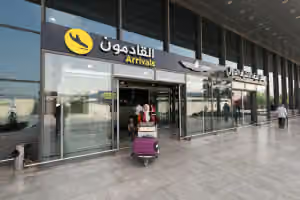
An Iranian passenger carrying luggage leaves Najaf International Airport after arriving on an AVA Airlines flight, in Najaf, Iraq, September 23, 2026.

Iran threatened to disrupt regional air travel if its airlines lose access to flights and airport services, as Iraq's Najaf, Erbil and Sulaimaniya joined other destinations restricting Iranian connections under mounting US sanctions pressure.

“If Iran cannot fly and receive airport services, no country in the region will have that possibility either,” supreme leader adviser Mohammad Mokhber wrote in a post on Friday. He did not explain how Tehran would enforce the threat.

His remarks echoed Supreme National Security Council secretary Mohsen Rezaei, who warned Wednesday that neighboring airports would be unable to operate if they cooperated with Washington’s campaign. Rezaei also warned neighboring countries against joining further US military action.

Airports in Najaf, Erbil and Sulaymaniyah have suspended flights to and from Iran, further narrowing air links with Iraq following restrictions at Baghdad airport. Najaf’s suspension took effect at 2 a.m. Friday until further notice, closing an alternative Iranian authorities had considered for diverted Baghdad-bound services.

  • Flying to or from Iran? What to know as US pressure squeezes air links

    Flying to or from Iran? What to know as US pressure squeezes air links

  • Iran warns it would disrupt regional airports if its flights are barred

    Iran warns it would disrupt regional airports if its flights are barred

Flights to Baghdad and Muscat were canceled on September 23. Iraqi aviation sources told Reuters that Baghdad’s suspension followed government instructions; Iranian aviation spokesman Majid Akhavan said Tehran was discussing Muscat’s restrictions with Oman.

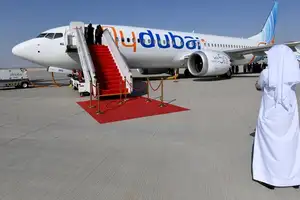
The UAE suspended Iranian airlines’ flights Thursday, explicitly citing US sanctions. Azerbaijan halted services by Iranian carriers Tuesday, while affected airlines stopped flying to Georgia from September 21.

A Tehran-Dushanbe flight also turned back Thursday after Turkmenistan denied permission to cross its airspace. Mahan Air suspended Turkey and Oman services; travel agencies said it had lost ground-handling access in Turkey.

Washington sanctioned 36 aviation-related targets on September 8, including 27 carriers it described as Iran’s remaining unsanctioned airlines and three Turkey-based companies accused of serving Mahan. Treasury says Iranian aviation networks transport weapons, military personnel and illicit cargo.

  • Iran cancels Baghdad, Muscat flights as regional restrictions tighten

    Iran cancels Baghdad, Muscat flights as regional restrictions tighten

  • UAE says it suspended Iranian airline flights over US sanctions

    UAE says it suspended Iranian airline flights over US sanctions

Treasury Secretary Scott Bessent warned that foreign airports, fuel suppliers, ground handlers and ticket sellers servicing sanctioned carriers risked US penalties, including exclusion from the dollar system. He said Iranian airlines would effectively lose international operations from September 23.

Those measures do not automatically close foreign airspace. Their effect depends on governments and service providers, and some flights continued. Bloomberg reported at least six departures Wednesday to destinations including Bangkok, Phuket, Shanghai and Kabul.

Foreign carriers have separately withdrawn services. Turkish Airlines told Iran International it had no Iran flights scheduled before March 2027, with no guaranteed restart. Earlier Iranian announcements of continuing Istanbul flights referred to other carriers.

Emirates no longer serves Tehran. Lufthansa and Austrian suspended Iran flights through October 24, while Qatar Airways cited airspace restrictions and tentatively listed November 29 for resumption. Those dates remain uncertain.

Four travel agencies contacted September 21 reported unavailable services across several other routes. Some Pegasus bookings were subsequently canceled, although booking-platform listings were not guarantees of operation.

The disruption affects family visits, business and pilgrimage to Najaf and Karbala. Agencies described travelers flying to Turkey, then taking roughly 17 hours by bus to Van and another 16–17 hours onward to Tehran, excluding border delays.

The UAE also barred Bank Melli branches from Iran-related transactions Wednesday, including trade finance and transfers.

  • China shipments help sustain Iran’s weapons programs despite US pressure - WSJ

    China shipments help sustain Iran’s weapons programs despite US pressure - WSJ

Rezaei linked the aviation warning to Tehran’s broader negotiating position, giving Washington four to five days to accept conditions already sent to mediators before talks or Hormuz’s reopening. He did not list them, saying Foreign Minister Abbas Araghchi would convey them again in New York, and presented control of the strait as negotiating leverage.