Netanyahu warns enemies against attacks ahead of October election

Israeli Prime Minister Benjamin Netanyahu said on Tuesday there were signs Israel's enemies could try to attack as the country's election approaches, warning that Israel could reach its adversaries "anywhere, anytime."
"We have indications that ahead of the elections our enemies will try to attack us," Netanyahu said in a video message. He did not identify the countries or groups he was referring to or give details of the indications.
"Don't mess with us, not now and not ever," he said. "Our long arm will reach you anywhere, anytime."
Netanyahu said Israel was operating "without pause on all fronts," pointing to recent military operations in Gaza and Lebanon.
He said more than 100 people he described as "terrorists" had been killed in Gaza in recent weeks.
Netanyahu also said Israel was under "heavy pressure" to pull back and give up military gains, adding that he would not allow that to happen.
Israel's parliamentary election is scheduled for Oct. 27.




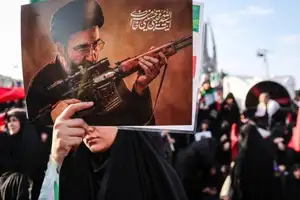
The letter, published by Iranian media on Tuesday in English and Persian, presents the Islamic Revolutionary Guard Corps as a force for the people, portrays Iran as victorious and the United States as a power in decline, and returns repeatedly to a single instruction: that Americans turn against the politicians they elected.
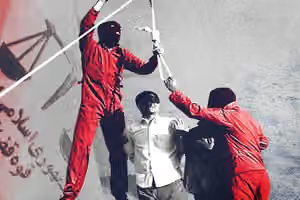
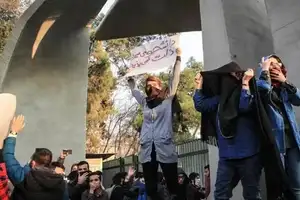
The Guards and their Basij volunteer force led the suppression of nationwide protests in January, in which security forces killed tens of thousands of people in two days. A UN fact-finding mission said this month that the crackdown involved crimes against humanity.
Signs of 'decline'
"Tyranny, an excessive tendency to behave violently and murderously, relying on and promoting falsehoods, giving precedence to the vulgar elements of society over the wiser elements in occupying positions of power, and an inordinate preoccupation with inessential matters at the expense of society's essential affairs" are the signs of a state in decline, the letter says.
"The United States government today exemplifies all of these flaws."

'Not a single verifiable instance'
The United States designates the Guards as a foreign terrorist organization. The letter rejects the label.
"There is not a single verifiable instance where the IRGC has committed an act of violence against civilians," it says. "In fact, it would not be an overstatement to assert that the Guards are the world's most effective organization in combating terrorism."
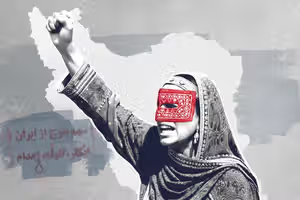
Amnesty International said this month that Iranian authorities carried out a systematic campaign of killings, torture and sexual violence to crush the Woman, Life, Freedom uprising of 2022. It named 87 officials, including senior Guards and police commanders, whom it said should be investigated for crimes against humanity, and documented 377 protest-related deaths, 56 of them children.
The UN fact-finding mission's report on the January 2026 crackdown cited unlawful killings, torture, arbitrary detention and enforced disappearances, and said the scale of the violence was a sharp escalation from earlier repression.
The Guards' Quds Force arms and funds Hezbollah in Lebanon, the Houthis in Yemen and militias in Iraq. Since the war began in February, Guards naval forces have attacked commercial shipping in the Strait of Hormuz.
'Take back control'
The letter tells Americans they are responsible for their government.
"You are the ones who empower, with your votes, the government and allow it to do what it does," it says. "Although American politicians often win your votes through deception and false promises, as Trump did, you can change the makeup of the government."
"The United States of America is a great nation," it adds. "To allow vulgar and immoral individuals to continue steering your politics and policies will only further humiliate and undermine the US. Take back control."
In Iran, candidates for president and parliament are vetted by the Guardian Council, an unelected body, before they can stand. The supreme leader is not elected by voters. Official turnout in the 2024 presidential election was about 40 percent.
The letter also explains the slogan "Death to America." "The true meaning of 'Death to America' is 'Death to the crimes perpetrated by the American elite,'" it says. "It is, in a word, not an expression of ill will toward the American people."
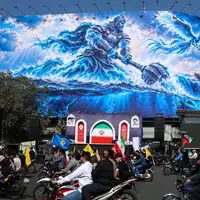
The slogan is chanted at state-organized rallies and Friday prayers across Iran and appears on murals maintained by the state in central Tehran, including on the walls of the former US embassy.
'The dam will break'
The letter attacks Donald Trump and tells Americans their economy is failing.
"The US economy is on the precipice of collapse, and yet he keeps on telling Americans that the economy is booming and the prices will soon start coming down," it says. "This is, perhaps, his biggest lie. Soon, the dam will break, and the economy will implode, causing, unfortunately, great pain for Americans for many many years."
"The US economy will be hit by a massive economic earthquake that will affect the lives of all Americans," it adds. "You, the American people, have the power to forestall this grim fate."
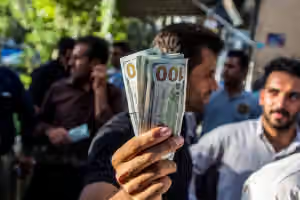
On the day the letter circulated, the dollar traded above 2.5 million rials on Iran's open market. Iran's minimum monthly wage of 166 million rials is worth about $66 at that rate.
'We can live together'
The letter closes by asking Americans to press Washington to distance itself from Israel.
"We can live together in peaceful coexistence," it says. "Remove from power the evil, deceitful, and violent politicians who are responsible for America's current state. Entrust your affairs to the wise, not the wily. Make sure your politicians understand that the world has changed."
Khamenei described Iran as enjoying “progress, dignity and independence” and its highest standing in the Muslim world and beyond in a written message marking the anniversary of the Iran-Iraq War on Monday.
“Today, some consider us the world’s fourth superpower,” Khamenei wrote. He went further, saying that according to “divine calculations,” Iran is the “world’s top power.”
The depiction comes more than six months after Khamenei became supreme leader without making a public appearance.
No new photograph, video or audio recording of Khamenei has been released since his elevation to the post. Islamic Republic officials have said he remains in charge and has stayed out of public view for security reasons.
His absence extended to the days-long funeral and burial ceremonies for his father and predecessor, Ali Khamenei.
That absence creates a contrast at the heart of a message centered on national strength and retreating adversaries. Khamenei invokes “millions” of Iranians taking to the streets and a country growing in power while remaining unseen by the public himself.
The ‘fourth superpower’ by what measure?
Khamenei does not identify those who regard Iran as the world’s fourth superpower or explain what measure produces that ranking.
Military spending offers one measurable comparison.
Iran spent an estimated $7.4 billion on its military in 2025, according to the Stockholm International Peace Research Institute. The United States spent about $954 billion, China $336 billion and Russia $190 billion.
SIPRI says Iran also finances some military activities outside its regular budget, meaning actual expenditure could be higher. Even allowing for that, the available figures leave a wide gap between Iran and the world’s largest military spenders.
Economic measures offer another comparison. The International Monetary Fund estimates Iran will account for around 0.8% of the global economy on a purchasing-power-parity basis in 2026.
Khamenei moves his larger assertion outside such measurable criteria by invoking “divine calculations” to describe Iran as the world’s top power.
Military expenditure, economic output, trade, industrial capacity and the outcome of military operations can be measured. “Divine calculations” provide no equivalent benchmark for determining what outcome would confirm or contradict the assertion.
‘Progress’ meets inflation and contraction
Khamenei portrays pre-revolutionary Iran as an era of “backwardness, humiliation and disgrace,” contrasting it with a present filled with “progress, dignity and independence.”
Measured through economic conditions and everyday living standards, however, progress presents a more complicated picture.
The IMF projects average inflation of 68.9% in Iran in 2026 and a 5.4% contraction in the economy.
The World Bank has also pointed to pressure from war and sanctions, water and energy shortages, weak investment and rising poverty.
Those indicators raise a basic question about Khamenei’s broad description of progress: what is being measured, and for which part of Iranian society?
The enemy that supposedly stops at the Arabian Sea
One of the most readily testable parts of Khamenei’s message concerns foreign military activity in waters around Iran.
Waters south of the country were once a domain for enemy forces, Khamenei wrote, but “painful blows” by Iranian forces and the “defenders of the Strait of Hormuz” mean those adversaries now advance no further than the Arabian Sea.
Military activity in recent months presents a more complicated geographical picture.
US officials told Axios in August that the American military had established a shipping route through the Strait of Hormuz, with around 15 to 20 tankers entering or leaving each night. The operation allowed roughly 10 million barrels of oil to move through the waterway each day, according to the officials.
The US military presence in waters around Iran continued in September.
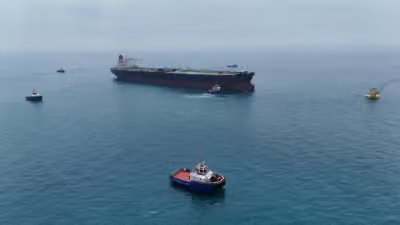
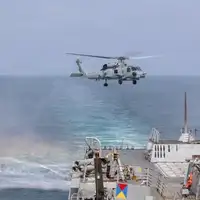
The Revolutionary Guards fired ballistic missiles toward a US aircraft carrier and destroyer in early September, according to US military accounts. American forces also struck Iranian oil tankers near Kharg Island and in the Gulf of Oman.
US Central Command said on September 8 that an American warship continued patrolling regional waters after being targeted twice by Iranian missiles over two days. US forces struck five Iranian tankers during the same operation in the Gulf of Oman and near Kharg Island.
The maritime pressure has also become part of negotiations between the two countries. Iran would be prepared to reopen the Strait of Hormuz if Washington reduced military pressure and lifted its blockade of Iranian ports, a senior Iranian official told Reuters on September 22.
US operations in the Strait of Hormuz, Gulf of Oman and waters close to Iran therefore do not fit an absolute geographical reading of Khamenei’s assertion that adversaries no longer advance beyond the Arabian Sea.
‘Millions of supporters’ and the Iranians left out
Khamenei also presents pro-establishment mobilization over the past seven months as evidence of domestic strength and cohesion.
“More than 30 million Iranians have declared themselves ready for self-sacrifice,” he wrote, adding that more than 500,000 people filled the available capacity of one registration drive in just 100 minutes.
Even if those figures are accepted, mobilizing millions of people does not by itself measure support across Iranian society.
Iran during the same period witnessed nationwide protests that began over economic grievances in late December 2025, spread rapidly across the country and developed into direct protests against the political establishment. The demonstrations subsided after a sweeping crackdown.
The government put the death toll at 3,117. Iran International’s Editorial Board estimated that more than 36,500 people were killed, based on classified security documents, field reports and information from medical workers, with most deaths occurring on January 8 and 9.
In Khamenei’s account, government supporters filling streets provide evidence of national unity and strength. Opponents occupying those same public spaces are not given comparable weight in assessing the state of Iranian society.
Khamenei’s own absence again becomes relevant. He invokes millions of Iranians gathering in streets and squares, but more than six months after becoming supreme leader has yet to appear among them or release a public video or audio message.
‘Victory’ and Hezbollah’s losses
Khamenei applies a similar conception of power to Iran’s regional allies.
He describes “victory and triumph” as the constant companions of late Hezbollah leader Hassan Nasrallah and presents his successor, Naim Qassem, as continuing the same path.
Hezbollah’s present position complicates a narrative of uninterrupted victory.
Nasrallah was killed and Hezbollah lost a significant number of senior commanders. Israel’s operation against the group’s communications network also exposed the extent of Israeli intelligence penetration into its structures.
Inside Lebanon, Hezbollah’s weapons have become central to one of the country’s major political disputes. The Lebanese government has pursued a process aimed at bringing the group’s weapons under state control, which Hezbollah opposes.
The death of a leader and senior commanders, combined with political pressure to transfer control of a group’s weapons to the state, sits uneasily alongside a historical description centered on permanent “victory and triumph.”
A definition of power with little room for defeat
The central issue in Khamenei’s message may be less any single assertion than the way power itself is defined.
In his account, the Islamic Republic emerged stronger from the eight-year Iran-Iraq War. Subsequent pressure, he said, made it stronger. More recent wars have made the Islamic Republic’s “phoenix” larger, while its future will be “far more glorious.”
Such a framework can absorb sharply different outcomes without altering its conclusion.
If an adversary retreats, that demonstrates strength. If fighting continues, that demonstrates resistance. Economic pressure becomes the cost of independence. If a regional ally loses leaders and commanders, the continuation of its cause takes precedence. Government supporters in the streets demonstrate popular backing, while opponents filling those streets are given no equivalent role in measuring political strength.
Within such a definition, defeat becomes increasingly difficult to identify.
National power can also be examined through observable outcomes: a country’s capacity to protect its territory and infrastructure, influence an adversary’s behavior, maintain economic stability, achieve foreign policy objectives, preserve regional influence and retain domestic support.
Measured against such indicators, Iran’s ability to impose costs on its adversaries does not by itself establish the status invoked by Khamenei when he describes the country as the “fourth superpower” or, according to “divine calculations,” the world’s top power.
That leaves the central question running through his message: if decades of war, pressure and confrontation have elevated Iran to such a position, which military, economic, social or regional measures demonstrate it?
The question takes on additional weight when this portrait of national power comes not from a leader addressing the public, but through a written message from a supreme leader who, more than six months after taking Iran’s highest office, has yet to be seen or heard by Iranians in a public appearance.
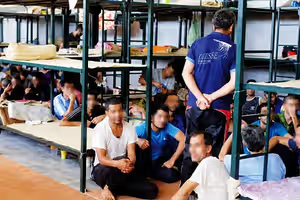
The accounts from Dastgerd Prison in the central city of Isfahan describe crowded wards, poor sanitation and severe obstacles to treatment, with several people familiar with conditions there describing the spread of meningitis and other infections.
“Meningitis and colds are rampant in the prison, and there are no pills or medicine,” a former prisoner told Iran International.
Around 10,000 people are being held at Dastgerd, compared with a standard capacity of about 4,000 to 5,000, according to information.
Food shortages compound overcrowding
Nutrition is so poor that many prisoners have become physically weak and more vulnerable to illness.
Breakfast is not distributed on some days, and lunch and dinner are rationed. Food can also be difficult to obtain from the prison shop, even as cigarettes remain consistently available and various drugs are easily accessible inside.
Some wards hold between 1,300 and 1,500 prisoners, another person familiar with conditions at Dastgerd said. The combination of overcrowding and inadequate sanitation has helped diseases spread.
Prisoners, particularly political ones, in some cases deprived of phone calls, treatment, medicine, adequate food, sanitation, correspondence and some judicial rights.
Iran International reported on July 21 that prisoners must register to visit the medical center. In rooms housing around 40 people, only two are allowed to seek medical attention each week.
Meningitis spreads as prisoner deaths mount
Several accounts received in recent months point to the spread of meningitis at Dastgerd. Iran International previously reported that the disease had reached several wards and that a number of prisoners were transferred to hospital.
Two prisoners had meningitis when one former inmate arrived at Dastgerd. One suffered a seizure in the admissions section and died, while the other died after being transferred to hospital.
The former inmate said prisoners had in previous years received meningitis and tetanus vaccines upon arrival, but the vaccinations were no longer being administered during the person's recent detention.
More than 70 prisoners have died from illnesses over roughly the past five months, according to another person familiar with conditions at the prison. At least 15 of those who had died by September 21 were from a single ward.
Prisoners suspected of having meningitis have in some cases been sent to hospitals for spinal fluid testing. Some were returned to Dastgerd before completing treatment and recovering.
The prison is also infested with bedbugs and other pests, according to accounts. Recent Iran International coverage documented bedbugs, fleas and ticks alongside increasing skin conditions and infections in the wards.
Blankets and bedding are heavily contaminated, one former prisoner said, with some inmates developing serious eye infections that leave them unable to open their eyes in the morning.
The person needed nearly two months of treatment after being released on bail, including regular injections and intravenous fluids during the first two weeks.
Fever, chills, body aches and infections of the lungs, throat, eyes and ears were widespread. Some prisoners contracted several illnesses at once, leaving them severely weakened.
Medicine shortages restrict treatment
Severe medicine shortages have compounded the health problems, while political prisoners can face particular difficulties gaining access to the prison clinic.
Denial of treatment has in some cases been used to exert pressure on political prisoners, according to one former inmate.
Prison authorities told inmates that the clinic had burned down, that medicine was unavailable and that there was no budget to buy supplies.
One prisoner offered to deposit 500 million rials into a prison account to pay for medicine. The offer was accepted, but most of the supplies subsequently purchased were acetaminophen and basic cold remedies, with insufficient antibiotics available for serious infections.
Families have also tried to bring necessary medication into the prison, only for authorities in some cases to refuse delivery or confiscate part of the medicine during inspections.
Sedatives, sleeping pills and drugs, by contrast, are widely available among prisoners, according to the former inmate.