• العربية
  • فارسی
Brand
  • Iran Insight
  • Politics
  • Economy
  • Analysis
  • Special Report
  • Opinion
  • Podcast
  • Live TV
  • Iran Insight
  • Politics
  • Economy
  • Analysis
  • Special Report
  • Opinion
  • Podcast
  • Live TV
  • Theme
  • Language
    • العربية
    • فارسی
  • Iran Insight
  • Politics
  • Economy
  • Analysis
  • Special Report
  • Opinion
  • Podcast
  • Live TV
All rights reserved for Volant Media UK Limited
volant media logo

Iran publishes purported handwritten Mojtaba Khamenei letter to IRGC general

Sep 22, 2026, 16:50 GMT+1

Iranian state media on Tuesday published what they said was a handwritten letter from Iran’s Supreme Leader Mojtaba Khamenei to a military commander, potentially offering the first physical indication that he survived the February attack on his father’s office.

Khamenei has not been seen or heard publicly since the strike that killed his father and predecessor, Ali Khamenei. Statements and messages have repeatedly been issued in his name, but no authenticated photograph, video or audio recording of him has emerged since the attack.

The newly released letter, addressed to IRGC Aerospace Force commander Majid Mousavi and dated August 1, praises a report submitted by Mousavi and calls for continued efforts on the force’s supply chain.

“Efforts regarding the supply chain should, God willing, continue, and reports on it should be regularly conveyed to me,” the letter says.

It also urges Mousavi to protect himself and his personnel, saying: “Taking care of your dear life and all the brothers is my emphatic request.”

The document bears the name “Seyed Mojtaba Khamenei.” Its authenticity could not immediately be independently verified.

If genuine, the letter would indicate that Khamenei was alive and able to write as of August 1, more than five months after the February attack. His prolonged absence from public view has fueled questions about his condition even as Iranian state institutions continue to publish written statements attributed to him.

100%
Banner

Most Viewed

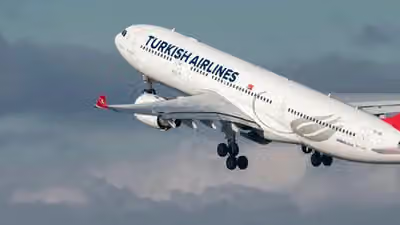
Turkish Airlines says all Iran flights suspended until March 2027
1

Turkish Airlines says all Iran flights suspended until March 2027

2

Iran diplomacy intensifies at UN as Hormuz crisis keeps pressure on region

3

Trump weighs Iran options; Tehran signals Hormuz leverage

4

Flying to or from Iran? What to know as US pressure squeezes air links

5

Economic crisis puts Iran’s coal miners at greater risk

Banner
Banner

Spotlight

  • Flying to or from Iran? What to know as US pressure squeezes air links

    Flying to or from Iran? What to know as US pressure squeezes air links

  • Iran factories face deepening raw material shortages
    ANALYSIS

    Iran factories face deepening raw material shortages

  • Will shutdowns forced by US blockade damage Iran’s oil wells?
    ANALYSIS

    Will shutdowns forced by US blockade damage Iran’s oil wells?

  • Tehran sees ‌Beijing as potential bridge to Washington
    ANALYSIS

    Tehran sees ‌Beijing as potential bridge to Washington

  • Tehran ‘ashamed’ as Iranians struggle to make ends meet

    Tehran ‘ashamed’ as Iranians struggle to make ends meet

  • Iran faces postwar winter with major gas capacity still offline
    ANALYSIS

    Iran faces postwar winter with major gas capacity still offline

Banner
•
•
•

More Stories

Iranian hardliners talk up nuclear weapons before Pezeshkian's UN trip

Sep 22, 2026, 13:56 GMT+1
•
Behrouz Turani
100%
President Masoud Pezeshkian waves as he boards his plane in Tehran before departing for New York on September 22, 2026.

Iranian hardliners spent the day before President Masoud Pezeshkian left for the UN General Assembly talking publicly about nuclear weapons, leaving the treaty that restrains them, and preparing for a long war with the United States.

The statements came within hours of each other, from MPs, a Tehran city council official and military figures, and they map the mood in the hardline camp on the eve of the president's departure.

It came as Donald Trump said he was willing to meet Pezeshkian in New York while warning that "something big" could happen to Iran.

Kamran Ghazanfari, a hardline MP, told Didban Iran that if the existence of the Islamic Republic came under serious threat, the new supreme leader could reconsider the question of nuclear weapons. Some MPs favor a nuclear deterrent to end the recurring threats against Iran, he said, though any decision would rest with senior officials and the Supreme National Security Council.

Parviz Sarvari, deputy chairman of Tehran city council, said he would welcome news that Iran had moved toward building nuclear weapons for deterrence. Membership of the Non-Proliferation Treaty had brought Iran no benefit, he said, while its adversaries threatened it from a position of nuclear superiority.

The push has gone beyond words. Hossein-Ali Haji-Deligani, an MP, submitted a triple-urgency bill for Iran's withdrawal from the NPT, arguing that membership had become more costly since the IAEA Board of Governors referred Iran to the UN Security Council. Similar proposals have circulated for months and the leadership of parliament has kept them off the floor. Haji-Deligani said the presidium has now acknowledged receipt of this one.

Military figures spoke the same day. Army commander Amir Hatami said the armed forces were at full readiness. Esmail Kowsari, of parliament's national security committee, said Iran's growing capabilities would eventually push American forces out of the region.

Revolutionary Guards spokesman Hossein Mohebbi said the war with the United States and Israel was not over and that the Guards had prepared for a long one, citing assessments that Washington may be considering fresh strikes.

What the day was for

Three things were happening at once.

The first is the argument about the last war. The ceasefire that ended the 12-day conflict left hardliners needing it not to look like a defeat at home, and insisting the war is unfinished keeps the account open.

The second is pressure on Pezeshkian. The NPT bill and the nuclear talk arrived alongside renewed parliamentary criticism of his government for allowing IAEA inspectors access, in a dispute over how far Iran should engage Washington and the monitors.

The third is the IAEA referral and the threat of snapback sanctions, which is the immediate cause of the NPT bill and the reason the timing is not a coincidence.

The language stayed inside limits. Ghazanfari attached any reconsideration of weapons to an existential threat. Sarvari's endorsement was of a hypothetical. Neither said Iran should build a bomb now, and neither Mojtaba Khamenei nor the Supreme National Security Council has said anything on the question.

The risk is how it reads elsewhere. Open parliamentary discussion of leaving the NPT and of nuclear contingencies is the kind of material Washington and Israel have previously cited as evidence that Iran is moving toward a weapon, and the United States struck Iranian nuclear sites during the last war. On the same day, the Guards said they expected it to happen again.

Journalist ties tanker attacks to oil middlemen, drawing treason accusations

Sep 22, 2026, 10:24 GMT+1
•
Maryam Sinaiee
100%
Vessels in the Strait of Hormuz, as seen from Musandam, Oman, August 3, 2026.

Iranian investigative journalist Yashar Soltani says the middlemen who move Iran's sanctioned oil revenues had a financial motive to wreck the June deal with Washington, and that the tanker attacks weeks later served it. Hardline outlets have answered with accusations of treason.

Speaking on an online program last week, Soltani said networks built to evade oil sanctions stood to lose from the June memorandum between Tehran and Washington, because implementing it would have cut their role in oil sales.

Three Saudi and Qatari tankers were attacked in the Strait of Hormuz less than three weeks after the memorandum was signed. Soltani said the attacks served to derail the agreement and prevent sanctions on Iranian oil from being lifted for good, keeping the networks in business.

The people he described as trustees are not the traders who sell the oil, he said, but the intermediaries who move the money. He named Ruhollah Razavi, son-in-law of Majid Motaghifar, spokesman for the hardline Paydari Party, as one of four who control much of the trade.

The margins are the point. Moving the proceeds of a single tanker carrying about $90 million of oil costs roughly $4 million through these intermediaries, Soltani said. Through SWIFT, the international banking system Iran is cut off from, it would cost about $500.

He also said the four had run monthly debts to the government in the hundreds of millions of dollars while using the money for other business, putting the monthly average attributed to Hossein Shamkhani, son of the late security chief Ali Shamkhani, at about $800 million.

Iranian outlets have recently named Razavi, Shamkhani and two others as the network's main trustees, and asked how they were chosen and how the system works.

The backlash

Fars News Agency, affiliated with the Revolutionary Guards, said Washington had violated the memorandum, particularly its provision on the Strait of Hormuz, and rejected any suggestion that Iran bore responsibility for its collapse.

"Recent reports, including material published by Yashar Soltani and affiliated media, seek to switch the roles of victim and culprit and portray Iran as responsible for the failure of the memorandum," Fars wrote. "The narrative that vigilantes broke the agreement is simple and attractive, but when placed alongside the successive violations by the United States, it falls apart."

Tasnim, also linked to the Guards, called it performative justice-seeking. "If a nation is told that the war with the United States and Israel is not the product of the wickedness and crimes of these two regimes, but rather the result of the mischief of some people inside the country seeking to continue benefiting economically, what incentive will remain there for unity?" it asked.

The state broadcaster's political program Be Vaght-e Iran argued on social media that no commercial network could have carried out the attacks whatever its motive.

"Trustees have neither a military structure, nor anti-ship cruise missiles, nor links to the command levels of the IRGC and army," the post said. "This type of narrative is not only unprofessional, but also a dangerous and disturbing game aimed at discrediting the defenders of the country's security who have stood by this land for years."

A military analyst in an accompanying video said that while the United States had violated the memorandum, only Iran's wartime command, the Khatam al-Anbiya Central Headquarters, could have ordered missile strikes.

The accusations

Hardline users have accused Soltani of serving those who want to pressure Iran's armed forces.

Ehsan Hosseini, who edits the hardline publication Khat-e Energy, said Soltani was trying to swap one set of trustees for another: "The project Yashar Soltani has launched is not against the trustees; it seeks to oust some and replace them with other trustees, those who failed to return $13 billion in oil revenues and caused the January protests."

Majid Shakeri, an adviser to parliament speaker Mohammad-Bagher Ghalibaf, called the revelations a propaganda campaign by one group of trustees against another. Both groups, he said, had contributed to two wars and to last year's protests, and anyone attributing Iran's response to the American violation to this rivalry deserved a "field trial for wartime treason."

Journalist Davoud Modarresian put the blame on the government, which he said had neither the nerve to leave the dollar-based financial order nor the ability to control the trustees.

"By implementing currency shocks and releasing the dollar exchange rate in December, they pushed the economy to the brink of collapse and created the conditions for the enemy's military greed," he wrote.

Not all of it was hostile. "If oil is sold without obstruction or sanctions by the ministry under the memorandum, and its money returns through transparent channels, the profits of the trustees and the IRGC will be cut," one user wrote, arguing that this pointed to collusion between the two.


Iran mobilisation drive extends to children under 15

Sep 20, 2026, 02:56 GMT+1
100%
Children carrying rifles take part in a Janfada mobilisation rally in Iran, September 18, 2026

The spokesman for Iran’s mass mobilisation campaign said children under 15 could be introduced to military concepts, while denying that minors were receiving formal weapons training as authorities expand a civilian defence drive launched during the war.

Sasan Zare, spokesman for the Janfada campaign, said the main organisation of volunteers would be based around adults aged 18 and over, but acknowledged that younger people were also being brought into the initiative.

“The stronger their value system is formed from childhood, and the more familiar they become with concepts such as patriotism and self-sacrifice, the more significant the impact can be on their future,” Zare told the Iranian news agency ILNA.

Those registered with the campaign were over 15, he said, while women taking part in its training courses were over 18. For children below that age, Zare said the emphasis should be on patriotism, responsibility, first aid, safety and what he called a “culture of self-sacrifice and resistance.”

The Islamic Republic has stepped up a broad campaign to mobilise civilians since the US-Israeli war began in February.

The Janfada initiative was launched in late March, and authorities have since promoted registration through mosques, Basij bases and public events, alongside plans for military and emergency-response training.

The campaign has drawn scrutiny over the involvement of minors, with rights groups accusing Iranian authorities of recruiting children into the Basij and using them at checkpoints.

Amnesty International said in April that Iranian law allows children under 15 to join as ordinary Basij members, while those aged 15 and over can become active Basij members and collaborate with the Revolutionary Guards on assigned missions.

The rights group said it had verified evidence of children as young as 12 deployed at checkpoints and patrols, including some carrying rifles.

Iran International has separately received accounts from several provinces describing children and teenagers taking part in checkpoint operations and handling weapons at state-sponsored gatherings.

Asked specifically about teenagers being used at checkpoints, Zare said he did not know how such deployments were being carried out because checkpoints fell under the authority of local police and security bodies.

His campaign, he said, provided training related to urban and public security, while the units deploying volunteers would decide whether they were used at checkpoints.

Iran’s nightly pro-state rallies become factional battleground

Sep 18, 2026, 09:45 GMT+1
•
Maryam Sinaiee
100%
Supporters of the Islamic Republic wave Iranian flags during the 200th consecutive night of pro-state rallies in Tehran, September 17, 2026.

Iran’s nightly pro-government rallies have become an increasingly visible show of political force, occupying streets and squares for 200 consecutive nights and, more recently, turning their fire on rivals within the Islamic Republic itself.

For critics of the government, the gatherings have long carried a message beyond support for Iran during the war: that the street belongs to supporters of the Islamic Republic.

Coming after the mass protests of January, critics have viewed their nightly presence as a form of intimidation and a way of denying public space to potential dissent. For many, the effect is more mundane but relentless: late-night loudspeakers, road closures and disruption to daily life.

But the rallies have increasingly taken on another function. Participants have chanted against Parliament Speaker Mohammad-Bagher Ghalibaf, Foreign Minister Abbas Araghchi, President Masoud Pezeshkian and former presidents Hassan Rouhani and Mohammad Khatami.

Some gatherings have also featured demands for strict enforcement of Iran’s controversial hijab law, whose implementation has been held back following a decision by the Supreme National Security Council amid concerns over public backlash.

The shift has prompted warnings that gatherings promoted as demonstrations of national unity are becoming arenas for political score-settling.

The Supreme National Security Council-linked Nour News website described videos showing increasingly harsh slogans at recent gatherings as a “worrying shift in Iran’s political scene.”

“When street gatherings become a place for ‘death to’ and ‘down with’ slogans against domestic political figures, the first sign of a shift in the direction of popular reactions—from the foreign enemy to the domestic rival—becomes apparent,” Nour News wrote.

That shift is particularly significant because hardline media have portrayed the nightly gatherings as a measure of national opinion.

The hardline Hamshahri newspaper marked the 200th night with an article titled “200 Nights of Referendum,” presenting continued participation as an answer to politicians who have called for the public to be consulted over the country’s direction.

“Two hundred nights of participation in nighttime gatherings are a completely clear response to the doubts of some politicians who believe that the people should be consulted and a referendum held in order to continue the resistance,” it wrote.

The article was referring to Rouhani’s recent suggestion that continuing the war and confrontation with the United States and Western countries should be subject to consultation with the public.

The reformist Shargh newspaper warned that a social gathering that began in the name of “patriotism” could acquire a different meaning if it became a place for deciding “who has the right to speak about the country’s policies and who does not.”

Even the conservative daily Khorasan, considered close to Ghalibaf, called for a review of how the gatherings are organised in an article titled “200 Nights of Taking the Field.”

It questioned the use of the gatherings to promote hijab-related demands that it said exacerbate social divisions. It also highlighted complaints about the disruption the gatherings cause to residents and traffic.

“What image of these gatherings forms in citizens’ minds when the sound of loudspeakers keeps a sick person in a nearby home awake late into the night, or when hastily organized vehicle convoys create severe traffic jams and leave a driver exhausted after a day’s work stuck in traffic?” the newspaper asked.

Similar complaints have appeared on social media.

One X user urged supporters of the rallies to ask shopkeepers, residents and taxi drivers what they thought of the disruption, asking: “What has that taxi driver done to deserve sitting in traffic because of 30 government supporters?”

Another user, Morteza Rezazadeh, pointed to the changing targets of the slogans: from Israel and the United States to Iran’s president and parliament speaker. Mossad can “rest easy,” he quipped, because those chanting were doing its work for it.

After 200 consecutive nights, the dispute over the gatherings is therefore no longer simply about noise, traffic or even demonstrations of support for the state. It has become a dispute over who controls the street, who can claim to speak for the public and who inside the Islamic Republic is considered a legitimate political voice.

Why Iran’s hardliners keep talking of ousting Pezeshkian

Sep 17, 2026, 17:29 GMT+1
•
Behrouz Turani
100%
Iran's president Masoud Pezeshkian attends an event celebrating pensioners in Tehran, Iran, September 14, 2026

Renewed talk among Iranian hardliners of removing President Masoud Pezeshkian has revived comparisons with Iran’s only presidential impeachment, but there is little evidence so far of a coordinated effort capable of unseating him.

Instead, the latest speculation fits a pattern that has followed Pezeshkian since taking office in 2024: recurring calls for resignation or impeachment that intensify during periods of political, economic or geopolitical pressure.

The latest round was partly triggered by cryptic comments from Qom MP Mojtaba Zarei referring to a possible “coup” or coordinated political move against Pezeshkian.

Rouydad24 examined whether hardline networks, particularly Sharyan—the Persian acronym for the Strategic Network of Islamic Revolution Supporters—and allies of Saeed Jalili, Pezeshkian’s rival in the 2024 presidential election, were seeking early presidential elections.

The outlet presented no formal evidence of such a plan but pointed to repeated calls by radical lawmakers to invoke Article 89 of the Constitution, under which parliament can declare a president politically incompetent.

Mohsen Gharavian, a seminary and university lecturer, described the campaign to portray Pezeshkian as politically incompetent as a “targeted political conspiracy” and a soft “coup.”

Writing for Khabar Online, he argued that ultra-conservatives angered by their 2024 electoral defeat were using political networks and sustained media pressure to weaken the government.

In a separate Khabar Online report, moderate politician Hassan Rasouli criticised proposals to impeach Pezeshkian or transfer executive authority to First Vice President Mohammad Reza Aref.

Rasouli said such moves, particularly amid heightened national security pressures, amounted to “a direct attack on high-level governance cohesion.” He dismissed comparisons with the 1981 removal of Iran’s first president, Abolhassan Banisadr, as political theatre rather than a serious legal pathway.

Threats to use parliament against sitting presidents have a long history in the Islamic Republic.

During Akbar Hashemi Rafsanjani’s second term from 1993 to 1997, conservative opponents mounted sustained pressure on his government, including the impeachment of cabinet ministers.

Hassan Rouhani also faced repeated impeachment threats during his presidency, particularly from opponents of his diplomatic engagement with Washington.

The only successful precedent remains Banisadr in 1981. Parliament declared him politically incompetent during the Iran-Iraq war, after which Ayatollah Ruhollah Khomeini formally dismissed him.

Banisadr’s removal has since become a recurring reference point in disputes over presidential authority. Hardline lawmakers have invoked his case in attacks on Pezeshkian, particularly over diplomacy, economic policy and the conduct of the war.

But invoking Article 89 and successfully removing a president are different things. There is currently no indication that Pezeshkian’s opponents have assembled the parliamentary support required to declare him politically incompetent.

Opposition to Pezeshkian has nevertheless persisted since he took office following Ebrahim Raisi’s death in 2024. Calls for his resignation, comparisons with Banisadr and threats to invoke Article 89 have resurfaced during periods of economic turmoil, currency volatility and war.

The repeated threat of impeachment can serve a political purpose even without enough votes to remove the president: keeping his competence under question and constraining his room for manoeuvre on economic and diplomatic policy.

This week’s talk of a “coup” and renewed debate over presidential competence therefore appears less a new escalation than the latest iteration of a political struggle that has accompanied Pezeshkian for much of his presidency.