UAE outmaneuvers Iran’s Hormuz strategy, state TV analysts say
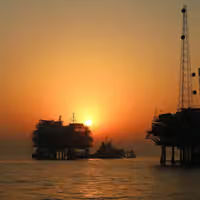
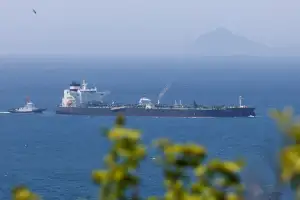
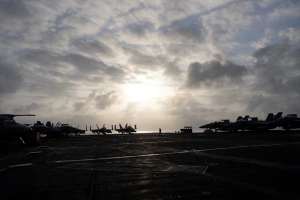
Drone view of oil tanker HELGA berthed at one of Iraq's southern offshore oil terminals near Basra as it prepares to load crude oil, becoming the second vessel to arrive since the closure of the Strait of Hormuz, April 24, 2026.
The UAE has found ways to blunt Iran’s ability to disrupt oil traffic through the Strait of Hormuz by exploiting its maritime tactics, Iranian state television commentators said in a recent broadcast.
Four people appeared on IRIB’s Be Vaght-e-Iran (Iran Time) program, with three speaking during an exchange on how Abu Dhabi has adapted its oil shipments to Iran’s approach to the strategic waterway.
One participant suggested Iran could target the smaller shuttle vessels moving through the strait or strike their point of origin. Another rejected that approach as insufficient.
“It makes no sense to just hit these vessels. That is not an adequate response to this change in logic,” he said.
A third participant laid out the central argument: Abu Dhabi has sought to change the economics behind Iran’s maritime leverage rather than directly challenge its military capabilities.
“The UAE has attacked the logic of closing the Strait of Hormuz,” he said.
Cheap ships change the calculation
Iran’s strategy, according to the panel, had relied partly on the vulnerability of very large crude carriers, or VLCCs, whose high value meant the prospect of an Iranian strike could make voyages commercially prohibitive as insurers withdrew coverage.
The UAE has sought to remove that pressure by creating a state-backed logistics chain and using smaller, cheaper vessels that can be readily replaced.
“It is defining a battlefield that has been designed to its advantage,” the commentator said. “It says: fight me here. You hit these small ones, and I keep replacing them.”
Abu Dhabi is also using ageing VLCCs that would otherwise be destined for scrapping because they no longer meet environmental or safety standards required at many ports, according to the discussion.
The ships can be worth considerably less than the oil they carry, reducing the economic loss if Iran damages them.
The broadcast also described a pattern in Iranian operations that the UAE could anticipate. Iranian forces radio vessels, fire warning shots if they continue and then target the bridge rather than immediately sinking the ship, giving crews around 30 to 40 minutes to evacuate.
Abu Dhabi has responded by positioning tugboats to recover damaged vessels and tow them to Sohar in Oman, where their cargo can still be unloaded, the main contributor said.
“The tugboat comes and attaches itself right there to the ship that has been hit,” he said. “They tow it to Sohar and unload it there on the Omani coast.”
The result, he argued, is that Iran can damage a vessel without preventing its oil from reaching port.
Iran’s military logic questioned
Simply striking greater numbers of replaceable vessels would not restore Iran’s leverage, the discussion suggested.
“They have attacked our military logic,” the main contributor said. “You have to hit this logic.”
The participant who opened the exchange said Iran’s problem was not a lack of political will, but its continued reliance on an approach that was no longer producing the intended outcome.
“There really is the political will to confront them. But because we are confronting them within the previous framework, we are not getting the result we want,” he said.
The main contributor described the problem as a “cognitive error.”
Another researcher and Middle East commentator Mustafa Najafi separately accused the UAE on X of spending weeks trying to reduce Iran’s leverage over the Strait of Hormuz and seeking to move oil belonging to other countries through the waterway.
Najafi also accused Abu Dhabi of obstructing an Iran-Oman agreement on managing the strait and lobbying in the United States and Israel for attacks on Iran.
“After Israel, no actor dreams of weakening and disintegrating Iran as much as the UAE does,” Najafi wrote, arguing that Tehran should move beyond a solely political and diplomatic response.
The remarks reflect concern among Iranian pro-system experts that the UAE is seeking not to overcome Iran’s military power in the Strait of Hormuz, but to diminish the strategic leverage that power is intended to provide.
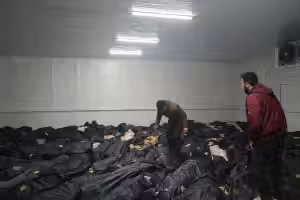
The bodies of slain protesters at an unnamed morgue in Iran (January 2026)
Relatives of protesters killed during Iran’s January crackdown challenged President Masoud Pezeshkian’s portrayal of the unrest as foreign-driven, saying their family members were unarmed and had no links to foreign governments, after his UN General Assembly address on Wednesday.
Pezeshkian accused protesters of being incited by the United States and Israel and receiving weapons to disrupt Iran’s security. He also defended system supporters who took to the streets during the unrest.
The sisters of Sina Kazemi, Emad Mavedatipour and Babak Sadeghi Mohseni responded on X, saying their brothers were unarmed when they were killed on January 8 or 9 and were not acting on behalf of any foreign government.
“I testify that my brother was unarmed when he was killed by the Islamic Republic of Iran’s forces on January 8, 2026,” Kazemi’s sister wrote. “He was not acting on behalf of any foreign government. I seek truth, justice, and accountability.”
Mavedatipour’s sister posted the same account of her brother, saying he was unarmed when he was killed on January 9 and denying that he acted for a foreign government.
Sadeghi Mohseni’s sister said her brother was unarmed when he was killed on January 8 and also called for “truth, justice, and accountability.”
The sister of Ahmad Khosravani, a 21-year-old professional basketball player, said her brother was completely unarmed when Iranian forces killed him on January 9.
“He was not acting on behalf of any foreign government,” she wrote. “They shot him directly in the heart.”
Fathers challenge Pezeshkian
Two other bereaved fathers challenged the government's account in separate video messages sent to Iran International.
The father of Erfan Abdipour, an architecture student who also worked at his brother’s restaurant, called on Pezeshkian to publish evidence if authorities had any showing that his son had received military training or carried a weapon.
“My request is that if you have evidence showing that he received military training, was instructed or had a weapon, or anything else that night, publish it,” Abdipour’s father said.
Abdipour had gone to protest on the night he was killed, his father said, questioning what his son could have been trying to seize in an area he described as having no military barracks or security facility.
The father of Pouria Bagheri separately rejected the government's explanation for the scale of the killings.
“I categorically reject the overall argument that such widespread killing was foreign actors work.”
Bagheri’s father questioned why authorities shut down the internet and electricity and said that security agents removed surveillance cameras from shops. He also asked why officials brought government supporters onto the streets two days later if foreign-backed armed groups posed the extensive threat described by authorities.
“Why did you bring your own supporters into the streets two days later? With what guarantee?” he said. “Was it not because you were in control?”
January crackdown
The protests began on December 28, 2025, following a sharp fall in the rial and rising prices before spreading across all 31 provinces and developing into a broader challenge to the Islamic Republic.
The deadliest violence came on January 8 and 9. Amnesty International said verified videos and eyewitness testimony showed security forces using rifles and shotguns against protesters, frequently firing at heads and torsos.
Iran International’s Editorial Board concluded in January that more than 36,500 people were killed by security forces on January 8 and 9 after reviewing classified government documents, field reports and accounts from medical workers, witnesses and victims’ families.
The UN Fact-Finding Mission on Iran later said security forces used lethal force against protesters and bystanders, including children, who posed no imminent threat of death or serious injury.
Iranian authorities initially put the death toll at 3,117. The government subsequently published 3,038 names, according to the UN mission, which said it believes the actual number may be significantly higher.
US President Donald Trump cited increasingly higher death tolls from Iran’s January protest crackdown in successive remarks, putting the number at 32,000 on February 20, 42,000 in later comments and subsequently 45,000.
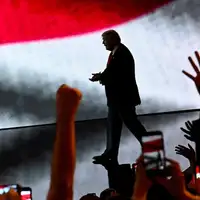
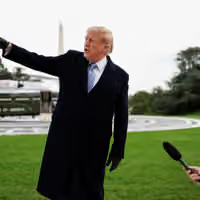
President Trump at the Republican National Midterm Convention in Dallas, September 10, 2026.
Tehran is making a “total miscalculation” if it believes the US midterm elections will constrain President Donald Trump’s actions against Iran, former senior US official Morgan Ortagus told Iran International.
Ortagus pointed to Trump’s first term, when Democrats took control of the House in the 2018 midterms but his administration continued its “maximum pressure” campaign against Tehran and ordered the 2020 killing of Qasem Soleimani.
“Any fallacy that they have that President Trump is going to limit his decision-making authority… based off a change in the Congress is a miscalculation by a regime who still fundamentally does not understand this president.”
Congressional debate over war powers was “healthy for our democracy,” Ortagus said, but did not change the president’s authority “to take any action against Iran that he deems necessary for the safety and the security of the American people.”
Ortagus, who held senior roles in both Trump administrations, said the United States has been in a conflict with the Islamic Republic “not for seven months, but for 47 years,” and argued that economic pressure alone would not have prevented the current military confrontation.
She described Trump’s first-term maximum pressure campaign as “incredibly effective,” but said it was interrupted during Joe Biden’s presidency and has amounted to less than four years in total.
“Sanctions are not a silver bullet,” she said. “Sanctions are a tactic. They’re a way in which you pursue a larger strategy.”
That strategy, she said, should prevent Iran from obtaining a nuclear weapon, cut funding to its proxy groups and stop Tehran from becoming “the next North Korea,” with missiles capable of threatening US bases, regional states and the American homeland.
Ortagus said Trump ordered military action beginning in June last year because Iran was “intransigent” in negotiations and “weeks away from getting a nuclear weapon.” The president had given Tehran a deadline, she said, and Iranian leaders may have believed he was bluffing.
“They learned pretty quickly that he wasn’t.”
Asked whether the campaign would have happened without a closely aligned Israeli government, Ortagus said it would have. Israeli operations had “complemented” US action, she said, but “these have been American decisions and American decisions alone.”
She cited Trump’s decision to order the killing of Soleimani in 2020 as an example of an action he took “by himself.”
On diplomacy, Ortagus said Trump had “always… extended the hand of diplomacy” during both administrations.
“It’s the regime that keeps rejecting that hand.”
She was skeptical that an agreement signed with Iranian officials in New York would hold if the real decision-makers remained in Tehran, echoing Secretary of State Marco Rubio’s doubts about the authority of Iran’s UN delegation.
Former senior US official Morgan Ortagus in an interview with Iran International's Kambiz Tavana in Washington DC on September 24, 2026.
“What you have to do is to make the thugs in the IRGC understand that everything, their livelihoods, everything that they possess, is going to be put at risk,” Ortagus said.
Trust was not the issue, she added. The question was what mechanisms Washington would establish “so they know… if you backtrack on this, there actually will be a consequence.”
She said she did not see how any future arrangement could work “without some sort of American verification process.”
Hezbollah and Lebanon
Ortagus rejected the argument that Hezbollah should be accepted as part of Lebanon’s social and political fabric.
“Bullshit,” she said.
She said the group was led by the Islamic Revolutionary Guard Corps, had been “indoctrinated, trained, equipped and brainwashed” by Tehran and had dragged Lebanon into “perpetual war,” with Shia communities among the main victims.
President Joseph Aoun and Prime Minister Nawaf Salam had been “very clear,” she said, that Hezbollah must be disarmed and that Lebanon cannot have “a parallel state within a state.”
Dismantling that structure would take time, Ortagus added.
“It wasn’t created overnight, and it won’t be expunged overnight.”
Ortagus said the Abraham Accords had endured the turmoil since October 7, pointing to a meeting of Accords countries on the sidelines of the UN General Assembly this week.
By contrast, she said a Mecca-centered regional alignment “looks pretty weak right now,” after Houthi attacks on Saudi Arabia, including toward holy sites, drew no meaningful response from its signatories.
“Anybody who does that and says they speak in the name of Islam are the worst hypocrites imaginable,” she said.
She declined to discuss current private exchanges between Riyadh and Washington but warned against seeking security through accommodation with Tehran.
“Pacifying this regime is not going to protect you in the long run,” she said. “It will buy you time. It might be a temporary salve, but it won’t heal the wound.”
Ortagus also described the current blockade of Iran as a harder form of enforcement than previous sanctions.
“Nothing’s coming in, and nothing’s going out.”
Asked about the broader US endgame, she listed four goals: preventing Iran from obtaining a nuclear weapon; curbing its ballistic missiles, drones and conventional arms; cutting funding to proxy groups; and supporting the Iranian people.
A final conversation about Iran
Ortagus closed the interview by recounting an unpublished story about the late Senator Lindsey Graham.
In January, she said, she had “Make Iran Great Again” hats overnighted to Graham at Mar-a-Lago so he could give one to Trump on the golf course.
She said she spoke to Graham an hour or two before his death, and that their last conversation was about Iran.
“He never stopped believing in the people of Iran,” she said.
Salman Rushdie writes in a notebook in a frame from Alex Gibney’s documentary Knife: The Attempted Murder of Salman Rushdie.
Salman Rushdie says he never intended The Satanic Verses to provoke the reaction that followed its publication, in a new documentary revisiting Ayatollah Ruhollah Khomeini’s 1989 fatwa calling for his death and the attempt on his life 33 years later.
Rushdie argues that fiction should not be treated as a literal statement of reality. If a novelist writes that a horse can fly, he says, it is an act of imagination and does not mean that a horse is actually flying.
The documentary traces the decades-long consequences of the fatwa, from the controversy surrounding The Satanic Verses and the years Rushdie spent in hiding to the 2022 knife attack that nearly killed him.
Directed by Alex Gibney and based on Rushdie’s bestselling memoir Knife, Knife: The Attempted Murder of Salman Rushdie includes previously unseen footage of his recovery and reflections on a threat that appeared to have receded after Iran publicly distanced itself from efforts to kill him in 1998.
Among the most affecting images are those filmed by Rushdie’s wife, poet and writer Rachel Eliza Griffiths, as he lies in hospital after the attack. When he regains consciousness, despite his condition, Rushdie gives permission for the filming to continue.
“This isn’t just about me; it’s about freedom,” he says.
The documentary returns repeatedly to Iran, showing archival footage of Khomeini’s fatwa being announced on Iranian radio and demonstrations in London where protesters carried photographs of the Iranian leader.
It also recalls the multimillion-dollar reward offered for Rushdie’s killing. The man who attacked him in 2022 later told a court that he admired Khomeini.
Rushdie reflects on people who condemned a book they had barely read and remarks that many devils pretend to believe in God.
He also places the fatwa in the political circumstances of Iran at the time, saying the revolution had not gone well and that the war with Iraq had left the government in a difficult position. He says he ultimately became a casualty of that situation.
For years, Rushdie lived under protection and in hiding. That appeared to change in 1998, when Iran and Britain reached an understanding that paved the way for improved relations.
Iran’s foreign minister publicly declared that the government would neither threaten Rushdie’s life nor encourage others to do so. Two years later, Rushdie moved to the United States and gradually began leaving behind the security arrangements that had defined much of his life.
Looking back after the attack, he asks: “Did I make a mistake?”
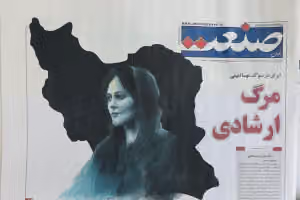
The documentary also shows how the 2022 stabbing was received in Iran, including a front page of the newspaper Jam-e Jam depicting Rushdie in the form of the Devil.
The attack itself is initially reconstructed, with the actual footage appearing only near the end. Rushdie was repeatedly stabbed while preparing to speak at an event in New York state, leaving him blind in one eye and with severe injuries.
Rushdie later returns with Griffiths to the site of the attack and stands where he was nearly killed.
“Now I am standing in the place where I once fell,” he says, adding that he does not believe in miracles but describes his survival as “miraculous.”
The contrast with his attacker is one Rushdie also reflects on: he has continued to live and write, while the man who attacked him at the age of 24 is now in prison.
More than three decades after Khomeini’s fatwa transformed his life, the documentary finds Rushdie still defending the freedom at the heart of the original controversy: the freedom of a novelist to imagine.
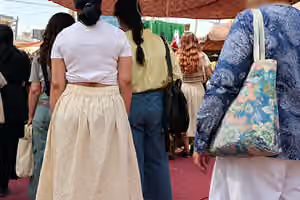
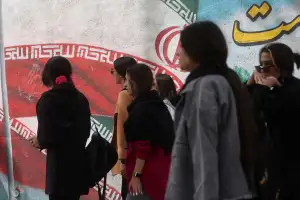
Iranian mothers accompany their daughters on the first day of school in Tehran in September. The image was reframed using AI to extend the background horizontally.
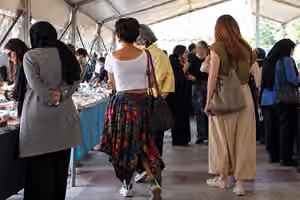
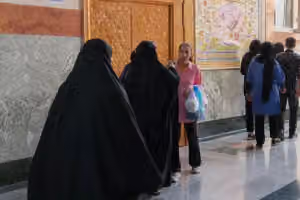
Mothers without headscarves walked daughters in regulation hoods to school in Iran this week. Women who remember 1980 describe the same scene from the year the state began imposing hijab. The picture is identical. What has changed is the society around it.
Among the images of the first day of the school year on September 23 were mothers who had dropped their daughters at the gate with their own hair uncovered, beside girls wearing the maghnaeh, the fitted hood that covers the hair, neck and shoulders and has been part of the girls' uniform in Iranian schools for four decades.
The scene is not new to the Islamic Republic. In the oral histories of women who remember the first years after the 1979 revolution, the same picture appears: mothers who still left the house without a headscarf, walking daughters who had to cover for school, because school was where the new state was making the rule stick first.
In the Islamic Republic's early years, compulsory hijab was established first in the spaces the state controlled most directly, government offices and schools, and only afterward extended to the street and the whole of public life.
Today the rules in schools and offices remain, and the law on compulsory hijab has not been repealed or even amended. But outside those spaces, part of the female population has been living differently for some time. This time, society has moved ahead of the rules.
Before the hood became the uniform
This summer an image of two designs for girls' school uniforms from 1979, first published by the popular weekly Javanan-e Emrooz, circulated again. Neither design includes the maghnaeh that later became a fixed part of the girls' uniform.
That interval did not last. In 1980, as the new state Islamized government offices and institutions, the dress code for schoolgirls changed too. For the 1980-81 school year, the requirement became a long-sleeved smock, loose trousers and a headscarf. In 1983, appearing in public without what the state called "sharia hijab" was made a crime.
The note to Article 638 of the Islamic Penal Code later became the legal basis for action against women who appear in public without the hijab the state requires.
So the history of compulsory hijab cannot be read from the street alone. School and office were among the first places it was enforced, and only later did the requirement settle across public space.
The regulation and the mandatory hood
In schools, much of that structure still stands. Article 85 of the schools' executive regulation, adopted in 2021, says students' clothing should be "simple, beautiful, varied, neat and cheerful," appropriate to Islamic-Iranian culture and identity, social custom, the student's age and the climate. The choice of style and color is left to each school's council, with the participation of the student council.
But the note to the same article fixes the range for girls. A female student's dress is either "chador, manteau, trousers and maghnaeh" or "manteau, trousers and maghnaeh," the chador being the full-length cloak and the manteau the long coat worn over trousers.
The chador is not compulsory. The maghnaeh is. The regulation provides no option for a girl to attend school with her hair uncovered.
The requirement begins in primary school. A girl of six or seven may walk to the gate hand in hand with a mother whose hair is uncovered, and must then cover her own to go in.
The distance between society and the rules can hardly be seen more clearly than in those few meters.
The fight reaches the uniform itself
This year the argument over girls' dress did not stop at the hood. The uniform itself made news.
On the eve of the new term, a message circulated about a girls' primary school in Saadat Abad, an affluent district in northwest Tehran, saying pupils would wear a shirt or blouse with trousers in place of the usual smock or manteau. Because the school is state-run, the message spread widely and reached state television.
The education office for Tehran's District 2 denied it, saying the images being shared had nothing to do with that school's uniform.
So the case cannot be treated as a confirmed change to a state school's uniform. But that such a report could circulate about a state school, and that the ministry felt obliged to answer it, shows the argument over girls' dress has reached the definition of the uniform itself.
Official policy has not moved. This year's directives asked schools to avoid unnecessary changes to the design and color of uniforms.
The result is a split. Outside school, the way women dress has changed quickly in recent years. Inside it, the manteau, trousers and maghnaeh of the official regulation remain exactly where they were.
Today's girls are not the girls of 1980
The most important difference between the two identical pictures may be the girls themselves.
The dress rules of 1980 were imposed on a society in which the Islamic Republic was still building its political, educational and cultural institutions. Today the same rules have to be enforced on a generation whose experience of how women around them dress is entirely different.
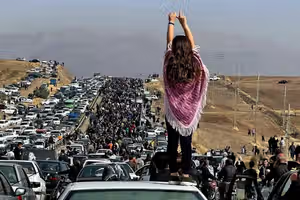
The protests of 2022 carried that difference into the schools. Among the most repeated images of the Woman, Life, Freedom uprising were teenage girls in school uniform who had taken off their hoods, in the schoolyard, the classroom and the street.
Reports of action against students over hijab followed. Amnesty International recorded the account of a 17-year-old who, after being seen with her hair uncovered on the school's cameras, was suspended and threatened with being reported to the security agencies.
That is a different experience from 1980. A student today may see bareheaded women on her way to school in the morning, be dropped off by a bareheaded mother, put on the hood to enter, and take it off again when school lets out.
For part of this generation, the maghnaeh is no longer a continuation of how they dress outside. It is a rule that applies on entering a controlled space, and stops applying on leaving it.
The law has not moved
None of this social change has become legal change.
The note to Article 638 still makes it a crime for a woman to appear in public without sharia hijab. Article 85 still lists the maghnaeh as part of a girl's dress.
The law known as Protection of the Family through the Promotion of the Culture of Chastity and Hijab, passed in December 2024, which would have widened the punishments and the means of enforcing compulsory hijab considerably, is not being implemented for now. Its suspension did not repeal the laws that came before it.
So what has happened in Iran's streets is not, in law, hijab becoming optional. The law has not recognized a right to choose. Part of society has made a different choice in practice.
A woman without a headscarf in Iran today is not uncovered because the law gave her that right. The law can still treat what she is doing as a crime, even if it is not enforced at every time and in every place.
The administrative structure behind hijab policy has not gone either. The budget for the Iranian year that began in March 2025 set aside 2.592 trillion rials, about $1.1 million at market rates, for the Headquarters for Enjoining Good and Forbidding Evil, the state body charged with policing public morality, for which hijab has been a principal concern. That is roughly the annual minimum wage of 1,300 workers.
In the budget for the year that began this March, the line was written differently: 6.284 trillion rials, about $2.7 million, in a single shared allocation for three bodies, the headquarters, Soureh University, which is run by the state's Islamic propaganda organization, and the Islamic Propagation Coordination Council, which organizes official rallies. Because the shares are not separated, the full figure cannot be described as the headquarters' budget, still less as a hijab budget.
The education ministry and other state bodies also retain duties under the existing law on dress. The retreat of enforcement in parts of public space has not removed the law, the institutions or the money behind it.
In 1980, the bareheaded mother was walking her daughter toward a rule that would soon reach her too. In 2026 she walks her daughter toward the last place the rule still holds. The picture has not changed. Its direction has. The few meters between her uncovered hair and her daughter's hood are no longer the distance between two generations, but between a society that has changed and a law that still says it hasn't.
An Iranian passenger carrying luggage leaves Najaf International Airport after arriving on an AVA Airlines flight, in Najaf, Iraq, September 23, 2026.
Iran threatened to disrupt regional air travel if its airlines lose access to flights and airport services, as Iraq's Najaf, Erbil and Sulaimaniya joined other destinations restricting Iranian connections under mounting US sanctions pressure.
“If Iran cannot fly and receive airport services, no country in the region will have that possibility either,” supreme leader adviser Mohammad Mokhber wrote in a post on Friday. He did not explain how Tehran would enforce the threat.
His remarks echoed Supreme National Security Council secretary Mohsen Rezaei, who warned Wednesday that neighboring airports would be unable to operate if they cooperated with Washington’s campaign. Rezaei also warned neighboring countries against joining further US military action.
Airports in Najaf, Erbil and Sulaymaniyah have suspended flights to and from Iran, further narrowing air links with Iraq following restrictions at Baghdad airport. Najaf’s suspension took effect at 2 a.m. Friday until further notice, closing an alternative Iranian authorities had considered for diverted Baghdad-bound services.
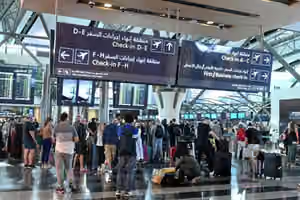
Flights to Baghdad and Muscat were canceled on September 23. Iraqi aviation sources told Reuters that Baghdad’s suspension followed government instructions; Iranian aviation spokesman Majid Akhavan said Tehran was discussing Muscat’s restrictions with Oman.
The UAE suspended Iranian airlines’ flights Thursday, explicitly citing US sanctions. Azerbaijan halted services by Iranian carriers Tuesday, while affected airlines stopped flying to Georgia from September 21.
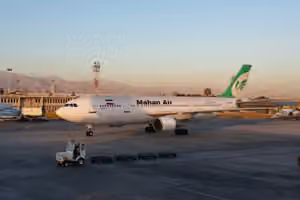
A Tehran-Dushanbe flight also turned back Thursday after Turkmenistan denied permission to cross its airspace. Mahan Air suspended Turkey and Oman services; travel agencies said it had lost ground-handling access in Turkey.
Washington sanctioned 36 aviation-related targets on September 8, including 27 carriers it described as Iran’s remaining unsanctioned airlines and three Turkey-based companies accused of serving Mahan. Treasury says Iranian aviation networks transport weapons, military personnel and illicit cargo.
Treasury Secretary Scott Bessent warned that foreign airports, fuel suppliers, ground handlers and ticket sellers servicing sanctioned carriers risked US penalties, including exclusion from the dollar system. He said Iranian airlines would effectively lose international operations from September 23.
Those measures do not automatically close foreign airspace. Their effect depends on governments and service providers, and some flights continued. Bloomberg reported at least six departures Wednesday to destinations including Bangkok, Phuket, Shanghai and Kabul.
Foreign carriers have separately withdrawn services. Turkish Airlines told Iran International it had no Iran flights scheduled before March 2027, with no guaranteed restart. Earlier Iranian announcements of continuing Istanbul flights referred to other carriers.
Emirates no longer serves Tehran. Lufthansa and Austrian suspended Iran flights through October 24, while Qatar Airways cited airspace restrictions and tentatively listed November 29 for resumption. Those dates remain uncertain.
Four travel agencies contacted September 21 reported unavailable services across several other routes. Some Pegasus bookings were subsequently canceled, although booking-platform listings were not guarantees of operation.
The disruption affects family visits, business and pilgrimage to Najaf and Karbala. Agencies described travelers flying to Turkey, then taking roughly 17 hours by bus to Van and another 16–17 hours onward to Tehran, excluding border delays.
The UAE also barred Bank Melli branches from Iran-related transactions Wednesday, including trade finance and transfers.
Rezaei linked the aviation warning to Tehran’s broader negotiating position, giving Washington four to five days to accept conditions already sent to mediators before talks or Hormuz’s reopening. He did not list them, saying Foreign Minister Abbas Araghchi would convey them again in New York, and presented control of the strait as negotiating leverage.