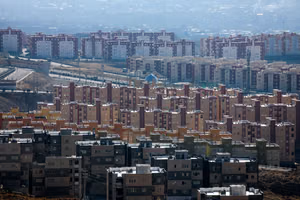
Two men look out over residential buildings in Tehran, Iran.
Nearly half of respondents to an Iran International Instagram poll said they would not buy a home in Iran even if they had enough money, with comments pointing to economic insecurity, emigration plans and concerns over keeping wealth in the country.
Around 20,400 people participated in the online poll, with 44% saying they would not invest in property in Iran even if they could afford to do so. Only around half said they would buy a home.
Of those who participated, 67% were men and 33% women.
People aged 25 to 34 made up the largest group of respondents at 36.6%, followed by those aged 35 to 44 at 30.1%. People aged 45 to 54 accounted for 12.8%, while those aged 18 to 24 made up 11.4%.
Participants also left around 2,000 comments explaining their choices, offering a broader picture of the considerations shaping their decisions.
The responses centered on attachment to Iran, hopes for political change, plans to emigrate, economic hardship and concerns over the security of their savings.
‘If I had enough money, I wouldn't be in Iran’
For many of those opposed to buying a home, having enough money would provide an opportunity to leave Iran rather than invest more heavily in the country.
“If I had enough money, I wouldn't be in Iran at all,” one respondent wrote.
“Having enough money in this situation means having the best life abroad,” another wrote.
The responses mirror the findings of an earlier Iran International Instagram poll in which 83% of participants said they would leave Iran if given the opportunity.
Around 100,000 people participated in that poll over 24 hours. Thousands of comments cited economic problems, social restrictions, political conditions and uncertainty over the future among the reasons for wanting to emigrate.
Some participants in the latest poll associated remaining in Iran with insecurity, sanctions, inflation, power outages and difficulties meeting basic needs, saying they would rather put their money into a more stable country.
One described owning a home as inseparable from the wider conditions in which a person lives.
Residential and high-rise buildings across the Tehran skyline, Iran.
“A home needs a blue sky above it, a thriving tree with bright green leaves in its yard, air without lead coming through its windows, a meal in its kitchen that doesn't come with guilt or selling your dignity, and peace of mind because you feel safe,” the respondent wrote.
“Home is where I can look at the stars at night without waking up the next morning choked with sadness and humiliation.”
Gold and currency offer a way out
Others focused on the financial risks of property ownership.
Unlike in previous years, when buying a home was widely viewed as a relatively secure investment for the future, some said they would now prefer to keep their wealth in gold or foreign currency because those assets are more liquid and easier to take out of the country.
“Investing in a bankrupt economy is certainly a mistake because prices are unrealistic, artificial and like a hollow bubble,” one respondent wrote.
Housing has for years served as a means of preserving wealth in Iran's chronically inflationary economy, and property can provide protection against inflation over the longer term.
But international reporting has also documented a move toward assets that can be carried and quickly converted into cash during periods of uncertainty.
The Associated Press described the trend as a turn toward “portable wealth” during the 12-day war, while the World Gold Council recorded a sharp increase in investment demand for gold in Iran in 2025.
The poll comes as Iranians continue to contend with high inflation. Iran's Statistical Center put year-on-year inflation in July at nearly 88%.
‘I wouldn't trade Iran for anywhere’
For respondents who said they would buy a home, attachment to Iran and a sense of national identity emerged as leading reasons.
Some described owning a home as more than a financial investment, linking it to family, personal history and their connection to the country.
“Yes, I wouldn't trade Iran for anywhere in the world,” one wrote.
“Iran is our mother; you don't abandon your mother when times are difficult,” another wrote.
Others said the country's problems would not persuade them to build a life elsewhere.
“Iran is my first and last choice. I believe good days are ahead of us,” one participant wrote.
Some would buy only after political change
A number of respondents made their willingness to buy a home conditional on political change, greater freedoms or improvements in the country's circumstances.
“When Iran is free, 100%,” one wrote. “After Iran is free, yes, but not under these conditions,” another wrote.
Others questioned the premise of the poll itself, saying the prospect of having enough money to purchase a home was increasingly detached from the economic reality facing many people.
They pointed to difficulties paying for food, rent, medical treatment and other daily necessities, describing home ownership as an unattainable aspiration.
“We are renters, and we'll take the dream of buying a home to the grave,” one respondent wrote.
The findings follow another Iran International Instagram poll in which 90% of respondents said they did not want to marry or have children.
A Revolutionary Court in Isfahan has sentenced 10 protesters to death and six others to prison terms of up to 25 years over the nationwide demonstrations in the central Iranian city, according to an activist-run Telegram news channel.
Khabaraneha, run by Iranian political activist Mehdi Mahmoudian, said Branch 1 of the Isfahan Revolutionary Court issued the initial verdicts against 16 people detained in connection with the protests that began in late December 2025.
Those sentenced to death are Taraneh Rahimi, Navid Elyasi, Mehrdad Boeri, Abolfazl Dadgostar, Armin Gholami, Mehdi Mansouri, Ahmadreza Saeedi, Mohammadmehdi Asadi, Parsa Jafari and Mehdi Jafari, also known as Mehdi Khosravi.
Romina Rahimi and Milad Boeri were each sentenced to 25 years in prison, while Hamed Mehralian received a 15-year term. Setayesh Saedi, Sajjad Abedi and Ali Boeri were each sentenced to five years, Khabaraneha reported.
In addition, all 16 defendants were sentenced to five years for “assembly and collusion,” five years for “incitement” and one year for “propaganda against the establishment,” according to the report.
The case has become known as the “Isfahan Shohada Square” case and stems from protests in the area during the January uprising.
Khabaraneha said one of the female defendants was assaulted while in detention and filed a complaint over the incident, but that the court issued its verdict without examining the complaint.
Ahmadreza Saeedi also told judges during the trial that he had been tortured during interrogation, the channel reported. Khabaraneha said there had previously been reports of restrictions on lawyers’ access to the case file and of defendants being tortured to extract confessions.
Radio Farda reported in July that the case was connected to the deaths of Abbas Kamrani, a 37-year-old Revolutionary Guards colonel, and another person described in case documents as “homeless.” It said the 16 defendants mostly worked around Shohada Street in Isfahan.
Exiled prince urges international action
The office of Iran’s exiled prince Reza Pahlavi condemned the verdicts on Sunday, calling them “brutal and unjust” and saying they reflected an intensifying crackdown by the Islamic Republic.
Pahlavi’s communications office alleged that defendants had been denied legal representation and subjected to severe torture, including sexual violence against female detainees, to extract forced confessions.
“The world cannot stay silent in the face of these atrocities,” the office said.
The verdicts come amid a wave of death sentences against protesters in Isfahan. In a separate case known as the Alikhani Square case, Iranian authorities have executed five defendants since July.
Ghaem Hosseini was executed on Aug. 20, Abolfazl Sepahi Badjani and Amirhossein Safari Hosseinabadi on July 28, and Golmohammad Mohammadi and Erfan Esfandiari on July 19. The July 28 executions were carried out publicly in Alikhani Square.
Iranian police arrested a person accused of owing the country’s banking system more than €300 million after receiving foreign currency generated by exports, state media reported on Sunday.
Police identified the detainee only by the initials “A.L.” and described the person as one of the leaders of a network of financial intermediaries, known in Iran as “trustees,” used to transfer export revenues outside the formal banking system.
Authorities said the suspect had received foreign currency proceeds from exports over several years but failed to meet obligations to the banking system. The individual had gone on the run before being located and arrested by economic security police and sent to prison.
Majidreza Hariri of the Iran-China Chamber of Commerce said on X that the detainee had served as secretary of the Iranian Association of Money Changers, a description that may point to Ahmad Lavasani, a former head of the group.
Iran’s central bank dissolved the Association of Money Changers in 2023, citing what it called violations and deviation from its objectives.
So-called trustees became increasingly important as sanctions restricted Iranian banks’ access to the international financial system. Individuals or companies with bank accounts or financial links abroad have been used to receive oil revenues, pay for imports and transfer foreign currency outside formal banking channels.
Zabihollah Khodaeian, head of Iran’s General Inspection Organization, told state broadcaster IRIB in July that some trustees had “betrayed” the country and that one intermediary had failed to return $200 million before leaving Iran.
The Tehran-based Sazandegi newspaper reported at the time that at least 15 trustees had become unreachable while holding billions of dollars in Iranian oil revenues, according to Hariri.
Sazandegi said the judiciary had opened 59 cases involving managers of trustee companies and issued prosecution orders in 43 of them. Authorities were also seeking Interpol Red Notices for 15 trustees who had fled.
Details about trustees’ identities, contracts, fees, financial guarantees and oversight are generally not made public.
Separately, an Iran International investigation found that relatives of some of Iran’s most powerful security figures, including the son of Mohsen Rezaei, were among nine people linked to an oil-sales network that sources said failed to return about $11 billion in proceeds to Iran.
Iranian students take an exam at a testing center.
Iranians described cancelled language tests, soaring costs, visa hurdles and internet restrictions as obstacles increasingly putting study abroad beyond reach, in messages sent to Iran International following new US sanctions.
“Are Trump’s sanctions targeting the Iranian people or Islamic Republic officials? We are looking for a way to escape this situation, but it seems all the doors of the world have been closed to us,” one citizen wrote.
Iran International asked its audience to share their experiences of barriers to studying abroad after new sanctions led to restrictions affecting international language tests for Iranians.
An analysis of responses on Instagram showed that the cost of studying and moving abroad, compounded by the falling value of Iran’s currency, and the cancellation of international language tests were the most frequently cited concerns.
The US Treasury Department’s Office of Foreign Assets Control, or OFAC, indefinitely suspended General License G on August 24 as part of the Trump administration’s latest campaign to intensify economic pressure on the Islamic Republic.
Students take an exam at a testing center in Iran.
The license had since 2014 provided the legal basis for US universities, testing companies and other American entities to offer a range of educational services to Iranian people.
The Duolingo English Test subsequently announced that it would stop providing services from September 1 to people residing in Iran and holders of Iranian identification documents.
Rising costs narrow options
Financial pressures were the most common concern raised in responses to Iran International.
Respondents cited the rising cost of foreign currency, language tests, university applications, tuition, airline tickets and exit bonds as major obstacles to pursuing education overseas.
“With the euro at 2,400,000 rials, visas not being issued to Iranians, war and rising prices, the very high cost of exit bonds, terrible airline ticket prices, internet problems and language tests are all barriers to migration for us in Iran,” one respondent wrote.
Another described being caught between the expense of leaving Iran and the cost of remaining.
“We are imprisoned in Iran. We have neither the money to leave Iran nor the money to live in it,” the respondent wrote.
Some respondents also pointed to rising living expenses after reaching their destination countries, adding another financial hurdle even for those able to secure admission and leave Iran.
Years of preparation disrupted
The suspension or restriction of international language tests was the second major theme to emerge from the messages.
Some respondents said they had switched to TOEFL or the Duolingo English Test after IELTS became unavailable at various periods in Iran, only to see those alternatives restricted as well.
“After several years of studying for TOEFL, getting a high GPA and working to build a good résumé, I was one step away from taking TOEFL, and now the test is no longer being held,” one respondent wrote.
Another said the cancellation of a TOEFL exam was announced on the morning it was due to take place, after years of preparation and with an embassy appointment approaching.
The Duolingo English Test, launched in 2016, has become an alternative to TOEFL and IELTS for some Iranian applicants. The online test can be taken from home and costs less than some other international English proficiency exams.
Several respondents said the latest restrictions showed how sanctions were affecting ordinary Iranians seeking academic opportunities abroad.
“Why should ordinary people be targeted by sanctions? People in Iran are not allowed to take TOEFL and Duolingo tests inside Iran; they are not even allowed to escape this country,” one respondent wrote.
Iranian passport adds to barriers
Some identified their Iranian nationality and passport as another obstacle to academic opportunities abroad.
They described university positions being closed to Iranian applicants or applications being rejected without what they considered serious consideration of their academic records.
“I think the first problem for many people in Iran who want to migrate is the financial cost, followed by the barriers to being accepted as an Iranian,” one respondent wrote.
Another pointed to lengthy security screening of Iranian applicants at embassies, saying delays can prevent students from reaching universities in time to begin their programs.
Internet disruptions cost opportunities
Internet restrictions inside Iran were another recurring concern in the messages, particularly because applications depend on access to university websites, email and international financial services.
One said Iran’s internet was cut off on January 8, a day after an admissions interview with a university in Britain.
The respondent said two weeks without access to email or the university’s website ultimately resulted in the loss of the study opportunity.
Iranian kolbars carry heavy loads through deep snow in a mountainous border area in western Iran.
Economic hardship and a lack of stable jobs are driving children and teenagers in Iran’s border regions into kolbari, the hazardous practice of carrying goods across mountainous frontiers for money, Iran's labor-focused news agency ILNA reported on Sunday.
“The fact that a teenager sets out on a route where there is a risk of being shot, a mine explosion or an accident, either to help their family or cover school and living expenses, should be a serious warning to society,” labor activist Abdollah Belvasi told ILNA. “A child should be sitting at a school desk, not on a kolbari route.”
Poverty and unstable household incomes are increasingly affecting children in families living along Iran’s borders, Belvasi said.
A shortage of jobs has also left many young people, including university graduates and accomplished athletes, facing a choice between kolbari, with its risk of death, or migration away from their homes and families, according to Belvasi.
Unemployment and a lack of prospects have prompted many young people in Kordestan to consider leaving their cities or even Iran, Belvasi added.
Economic pressures deepen
Iran has faced years of high inflation, a weakening currency and unemployment, eroding purchasing power and making basic living costs increasingly difficult for many households.
An Iranian kolbar carries a heavy load through snow in a mountainous border area.
Residents of some border communities have turned to kolbari to earn a living. Kolbars typically carry heavy loads on foot across difficult mountainous terrain, and some have been killed in shootings by Iranian security forces or died in accidents and mine explosions.
The growing gap between wages and living costs, reduced working hours and skilled workers moving into informal employment have highlighted the depth of Iran’s employment problems in recent weeks.
Hormozgan Workers’ House said on Friday that around 20,000 workers had lost their jobs because of an economic slowdown and business closures.
Kolbar deaths risk becoming routine
Deaths among kolbars are gradually being treated as routine news, receiving attention and prompting protests for several days before fading from public discussion, Belvasi warned.
“When a kolbar is killed, a family suffers,” he said. “A breadwinner may be lost, children may be left without a father, or a family may have to contend with medical expenses and disability. If we see kolbari only in terms of numbers and statistics, we ignore the human dimension of the tragedy.”
Government promises have failed to address the underlying conditions driving people into the work, Belvasi went on to say.
“The issue of kolbari cannot be solved simply by confronting the kolbar,” Belvasi added. “If the main causes – poverty, unemployment and the lack of stable job opportunities –are not addressed, the issue will emerge again. The root causes must be addressed.”
Discrimination, uneven development and a lack of employment opportunities remain fundamental problems in Iran’s border regions despite their economic, human and natural resources, according to Belvasi.
Venezuela's interim President Delcy Rodriguez, U.S. Energy Secretary Chris Wright and U.S. Charge d'Affaires for Venezuela Laura Dogu visit oil production facilities at the joint venture between Chevron and state oil company PDVSA in the Orinoco Oil Belt, following an agreement to pursue long-term energy cooperation on Feb. 12, 2026. / Photo by Reuters
The emerging US-Venezuela oil partnership could offer a model for how Iran’s vast but underinvested energy industry might be revived under a future government able to restore ties with the West, while also reshaping oil flows in Europe.
The significance of closer US-Venezuela energy cooperation lies not only in the scale of Venezuela’s oil reserves, but also in the complementary qualities of the two countries’ crude — and in what international capital, technology and access to Western markets could mean for an oil industry weakened by years of isolation.
Most US shale crude is light and sweet, while Venezuela’s Merey 16 is an extra-heavy, high-sulfur grade. A technical estimate suggests that a blend of roughly 60% light US crude and 40% Venezuelan Merey 16 could produce a crude with an API gravity of around 31 to 32 degrees and sulfur content of roughly 1.5%, depending on the specific US grade used.
Those characteristics are close to Russia’s Urals, a medium-sour crude with an API gravity of around 31 degrees and sulfur content of about 1.4%. Before Russia’s full-scale invasion of Ukraine, Urals was one of the main feedstocks for European refineries.
The United States could therefore potentially offer European refiners three options: its own light crude, Venezuelan heavy crude for plants capable of processing it, and tailored blends suited to refineries that previously relied heavily on Russian medium-sour crude. Complex US Gulf Coast refineries could also process Venezuela’s heavy oil and export diesel, jet fuel and other refined products needed by Europe.
The United States is already the European Union’s largest supplier of petroleum oil, accounting for 17.8% of EU petroleum-oil imports in the first quarter of 2026.
It is still too early, however, to speak of US-Venezuelan dominance of the European market. Venezuela currently produces around 1.25 million barrels per day, while rebuilding its electricity network, pipelines, processing facilities, refineries and ports will require tens of billions of dollars in investment and several years.
In the short term, the agreement is therefore more significant as a political and psychological signal to the market. In the medium term, if it results in substantially higher Venezuelan production, it could increase Atlantic Basin oil supplies, further reduce Europe’s dependence on Russian and some Middle Eastern crude, redirect some Venezuelan oil from China toward Western markets, and put additional pressure on OPEC+’s ability to manage the market.
A potential model for Iran
For Iranians, however, Venezuela may carry a broader message. Like Venezuela, Iran possesses enormous oil and gas reserves, but its energy industry faces deep problems after years of sanctions, insufficient investment, aging infrastructure, limited access to advanced technology, declining pressure in some mature fields and the constraints under which many projects were developed during the sanctions era.
If the Islamic Republic were to fall, followed by a stable political transition and the establishment of a government capable of maintaining normal and constructive relations with the United States, Europe and the global economy, Iran’s oil and gas industry could become one of the main engines of the country’s economic reconstruction.
Under such conditions, the entry of major international companies, including US oil producers and oilfield-services firms, could provide the capital, technology and managerial expertise needed to rehabilitate wells, pipelines, processing facilities, refineries, ports and Iran’s export infrastructure.
American companies have extensive experience in advanced drilling, reservoir management, enhanced oil recovery, rehabilitating low-output wells, processing heavy and sour crude and designing crude blends tailored to refinery requirements. The same basic logic that makes light US crude a useful complement to Venezuela’s extra-heavy oil could also be applied to the marketing and optimization of some Iranian crude grades.
Iran, of course, has its own broad range of light, medium and heavy crudes as well as condensates. The main opportunity would therefore not simply be to import US light crude for blending, but to use Western technology, capital and commercial networks to develop competitive export blends and regain access to global markets.
The return of established American and European companies could also create an opportunity for an independent assessment of projects carried out during the sanctions era, including those undertaken by domestic and Chinese contractors, and for facilities and equipment to be upgraded or replaced where necessary.
Such a transformation could increase Iran’s production capacity, reduce energy waste and the flaring of associated gas, improve environmental standards and create substantial direct and indirect employment.
None of this, however, would happen automatically or immediately after a change of government. The lifting of sanctions, legal protection for investors, transparent oil contracts, efforts to combat corruption, an independent judiciary and political stability would all be prerequisites for attracting investment on the required scale.
Oil revenues would also need to be managed through transparent mechanisms and directed toward rebuilding the country, its infrastructure, education, healthcare and public welfare, avoiding a repeat of Iran’s historic overdependence on oil.
The US-Venezuela partnership therefore matters to Iran for more than the possibility that a blend of light American and extra-heavy Venezuelan crude could emerge as a serious competitor to Russian Urals in parts of the European market.
The more important lesson is that vast hydrocarbon reserves can regain economic value when accompanied by investment, technology and access to international markets. Iran’s oil and gas resources could still underpin a new period of economic growth if a stable and transparent government with constructive international relations emerges after the Islamic Republic.
Cooperation with American and other major international companies could then help rebuild Iran’s aging energy industry and restore the country as a significant and reliable player in the global energy market.