• العربية
  • فارسی
Brand
  • Iran Insight
  • Politics
  • Economy
  • Analysis
  • Special Report
  • Opinion
  • Podcast
  • Live TV
  • Iran Insight
  • Politics
  • Economy
  • Analysis
  • Special Report
  • Opinion
  • Podcast
  • Live TV
  • Theme
  • Language
    • العربية
    • فارسی
  • Iran Insight
  • Politics
  • Economy
  • Analysis
  • Special Report
  • Opinion
  • Podcast
  • Live TV
All rights reserved for Volant Media UK Limited
volant media logo

Iran arrests alleged financial intermediary over €300 million bank debt

Aug 30, 2026, 16:06 GMT+1

Iranian police arrested a person accused of owing the country’s banking system more than €300 million after receiving foreign currency generated by exports, state media reported on Sunday.

Police identified the detainee only by the initials “A.L.” and described the person as one of the leaders of a network of financial intermediaries, known in Iran as “trustees,” used to transfer export revenues outside the formal banking system.

Authorities said the suspect had received foreign currency proceeds from exports over several years but failed to meet obligations to the banking system. The individual had gone on the run before being located and arrested by economic security police and sent to prison.

Majidreza Hariri of the Iran-China Chamber of Commerce said on X that the detainee had served as secretary of the Iranian Association of Money Changers, a description that may point to Ahmad Lavasani, a former head of the group.

Iran’s central bank dissolved the Association of Money Changers in 2023, citing what it called violations and deviation from its objectives.

So-called trustees became increasingly important as sanctions restricted Iranian banks’ access to the international financial system. Individuals or companies with bank accounts or financial links abroad have been used to receive oil revenues, pay for imports and transfer foreign currency outside formal banking channels.

Zabihollah Khodaeian, head of Iran’s General Inspection Organization, told state broadcaster IRIB in July that some trustees had “betrayed” the country and that one intermediary had failed to return $200 million before leaving Iran.

The Tehran-based Sazandegi newspaper reported at the time that at least 15 trustees had become unreachable while holding billions of dollars in Iranian oil revenues, according to Hariri.

Sazandegi said the judiciary had opened 59 cases involving managers of trustee companies and issued prosecution orders in 43 of them. Authorities were also seeking Interpol Red Notices for 15 trustees who had fled.

Details about trustees’ identities, contracts, fees, financial guarantees and oversight are generally not made public.

Separately, an Iran International investigation found that relatives of some of Iran’s most powerful security figures, including the son of Mohsen Rezaei, were among nine people linked to an oil-sales network that sources said failed to return about $11 billion in proceeds to Iran.

Most Viewed

Iran’s oil exports near zero as Persian Gulf flows recover
1
PODCAST

Iran’s oil exports near zero as Persian Gulf flows recover

2
ANALYSIS

Washington’s economic war on Iran starts in Dubai, not Beijing

3
ANALYSIS

Iran or the dollar? US makes an example of Banque Misr

4
ANALYSIS

Iran’s missing fuel: Can border smuggling explain it all?

5

Iranian banks remain open in UAE as US campaign squeezes Dubai trade - FT

Banner
Banner

Spotlight

  • What the US-Venezuela oil model could mean for Iran’s energy future
    ANALYSIS

    What the US-Venezuela oil model could mean for Iran’s energy future

  • Washington’s economic war on Iran starts in Dubai, not Beijing
    ANALYSIS

    Washington’s economic war on Iran starts in Dubai, not Beijing

  • Iran’s political prisoners are being executed. Why is supporting them controversial?
    PODCAST

    Iran’s political prisoners are being executed. Why is supporting them controversial?

  • Iran’s missing fuel: Can border smuggling explain it all?
    ANALYSIS

    Iran’s missing fuel: Can border smuggling explain it all?

  • Iran bets on China to blunt Trump’s economic offensive
    INSIGHT

    Iran bets on China to blunt Trump’s economic offensive

  • Iran or the dollar? US makes an example of Banque Misr
    ANALYSIS

    Iran or the dollar? US makes an example of Banque Misr

  • War or deal? Rezaei begins to define Iran’s price
    ANALYSIS

    War or deal? Rezaei begins to define Iran’s price

Banner
•
•
•

More Stories

Poverty pushes Iranian children into hazardous border work

Aug 30, 2026, 09:10 GMT+1
100%
Iranian kolbars carry heavy loads through deep snow in a mountainous border area in western Iran.

Economic hardship and a lack of stable jobs are driving children and teenagers in Iran’s border regions into kolbari, the hazardous practice of carrying goods across mountainous frontiers for money, Iran's labor-focused news agency ILNA reported on Sunday.

“The fact that a teenager sets out on a route where there is a risk of being shot, a mine explosion or an accident, either to help their family or cover school and living expenses, should be a serious warning to society,” labor activist Abdollah Belvasi told ILNA. “A child should be sitting at a school desk, not on a kolbari route.”

Poverty and unstable household incomes are increasingly affecting children in families living along Iran’s borders, Belvasi said.

  • Kurdish border couriers face snow, heavy loads, and death for $10

    Kurdish border couriers face snow, heavy loads, and death for $10

A shortage of jobs has also left many young people, including university graduates and accomplished athletes, facing a choice between kolbari, with its risk of death, or migration away from their homes and families, according to Belvasi.

Unemployment and a lack of prospects have prompted many young people in Kordestan to consider leaving their cities or even Iran, Belvasi added.

Economic pressures deepen

Iran has faced years of high inflation, a weakening currency and unemployment, eroding purchasing power and making basic living costs increasingly difficult for many households.

100%
An Iranian kolbar carries a heavy load through snow in a mountainous border area.

Residents of some border communities have turned to kolbari to earn a living. Kolbars typically carry heavy loads on foot across difficult mountainous terrain, and some have been killed in shootings by Iranian security forces or died in accidents and mine explosions.

The growing gap between wages and living costs, reduced working hours and skilled workers moving into informal employment have highlighted the depth of Iran’s employment problems in recent weeks.

Hormozgan Workers’ House said on Friday that around 20,000 workers had lost their jobs because of an economic slowdown and business closures.

Kolbar deaths risk becoming routine

Deaths among kolbars are gradually being treated as routine news, receiving attention and prompting protests for several days before fading from public discussion, Belvasi warned.

“When a kolbar is killed, a family suffers,” he said. “A breadwinner may be lost, children may be left without a father, or a family may have to contend with medical expenses and disability. If we see kolbari only in terms of numbers and statistics, we ignore the human dimension of the tragedy.”

Government promises have failed to address the underlying conditions driving people into the work, Belvasi went on to say.

  • Deadly Toll Rises For Kolbars In Iran's Western Border Regions

    Deadly Toll Rises For Kolbars In Iran's Western Border Regions

“The issue of kolbari cannot be solved simply by confronting the kolbar,” Belvasi added. “If the main causes – poverty, unemployment and the lack of stable job opportunities –are not addressed, the issue will emerge again. The root causes must be addressed.”

Discrimination, uneven development and a lack of employment opportunities remain fundamental problems in Iran’s border regions despite their economic, human and natural resources, according to Belvasi.

What the US-Venezuela oil model could mean for Iran’s energy future

Aug 30, 2026, 02:05 GMT+1
•
Mehdi Moslehi
100%
Venezuela's interim President Delcy Rodriguez, U.S. Energy Secretary Chris Wright and U.S. Charge d'Affaires for Venezuela Laura Dogu visit oil production facilities at the joint venture between Chevron and state oil company PDVSA in the Orinoco Oil Belt, following an agreement to pursue long-term energy cooperation on Feb. 12, 2026. / Photo by Reuters

The emerging US-Venezuela oil partnership could offer a model for how Iran’s vast but underinvested energy industry might be revived under a future government able to restore ties with the West, while also reshaping oil flows in Europe.

The significance of closer US-Venezuela energy cooperation lies not only in the scale of Venezuela’s oil reserves, but also in the complementary qualities of the two countries’ crude — and in what international capital, technology and access to Western markets could mean for an oil industry weakened by years of isolation.

Most US shale crude is light and sweet, while Venezuela’s Merey 16 is an extra-heavy, high-sulfur grade. A technical estimate suggests that a blend of roughly 60% light US crude and 40% Venezuelan Merey 16 could produce a crude with an API gravity of around 31 to 32 degrees and sulfur content of roughly 1.5%, depending on the specific US grade used.

Those characteristics are close to Russia’s Urals, a medium-sour crude with an API gravity of around 31 degrees and sulfur content of about 1.4%. Before Russia’s full-scale invasion of Ukraine, Urals was one of the main feedstocks for European refineries.

The United States could therefore potentially offer European refiners three options: its own light crude, Venezuelan heavy crude for plants capable of processing it, and tailored blends suited to refineries that previously relied heavily on Russian medium-sour crude. Complex US Gulf Coast refineries could also process Venezuela’s heavy oil and export diesel, jet fuel and other refined products needed by Europe.

The United States is already the European Union’s largest supplier of petroleum oil, accounting for 17.8% of EU petroleum-oil imports in the first quarter of 2026.

It is still too early, however, to speak of US-Venezuelan dominance of the European market. Venezuela currently produces around 1.25 million barrels per day, while rebuilding its electricity network, pipelines, processing facilities, refineries and ports will require tens of billions of dollars in investment and several years.

In the short term, the agreement is therefore more significant as a political and psychological signal to the market. In the medium term, if it results in substantially higher Venezuelan production, it could increase Atlantic Basin oil supplies, further reduce Europe’s dependence on Russian and some Middle Eastern crude, redirect some Venezuelan oil from China toward Western markets, and put additional pressure on OPEC+’s ability to manage the market.

A potential model for Iran

For Iranians, however, Venezuela may carry a broader message. Like Venezuela, Iran possesses enormous oil and gas reserves, but its energy industry faces deep problems after years of sanctions, insufficient investment, aging infrastructure, limited access to advanced technology, declining pressure in some mature fields and the constraints under which many projects were developed during the sanctions era.

If the Islamic Republic were to fall, followed by a stable political transition and the establishment of a government capable of maintaining normal and constructive relations with the United States, Europe and the global economy, Iran’s oil and gas industry could become one of the main engines of the country’s economic reconstruction.

Under such conditions, the entry of major international companies, including US oil producers and oilfield-services firms, could provide the capital, technology and managerial expertise needed to rehabilitate wells, pipelines, processing facilities, refineries, ports and Iran’s export infrastructure.

American companies have extensive experience in advanced drilling, reservoir management, enhanced oil recovery, rehabilitating low-output wells, processing heavy and sour crude and designing crude blends tailored to refinery requirements. The same basic logic that makes light US crude a useful complement to Venezuela’s extra-heavy oil could also be applied to the marketing and optimization of some Iranian crude grades.

Iran, of course, has its own broad range of light, medium and heavy crudes as well as condensates. The main opportunity would therefore not simply be to import US light crude for blending, but to use Western technology, capital and commercial networks to develop competitive export blends and regain access to global markets.

The return of established American and European companies could also create an opportunity for an independent assessment of projects carried out during the sanctions era, including those undertaken by domestic and Chinese contractors, and for facilities and equipment to be upgraded or replaced where necessary.

Such a transformation could increase Iran’s production capacity, reduce energy waste and the flaring of associated gas, improve environmental standards and create substantial direct and indirect employment.

None of this, however, would happen automatically or immediately after a change of government. The lifting of sanctions, legal protection for investors, transparent oil contracts, efforts to combat corruption, an independent judiciary and political stability would all be prerequisites for attracting investment on the required scale.

Oil revenues would also need to be managed through transparent mechanisms and directed toward rebuilding the country, its infrastructure, education, healthcare and public welfare, avoiding a repeat of Iran’s historic overdependence on oil.

The US-Venezuela partnership therefore matters to Iran for more than the possibility that a blend of light American and extra-heavy Venezuelan crude could emerge as a serious competitor to Russian Urals in parts of the European market.

The more important lesson is that vast hydrocarbon reserves can regain economic value when accompanied by investment, technology and access to international markets. Iran’s oil and gas resources could still underpin a new period of economic growth if a stable and transparent government with constructive international relations emerges after the Islamic Republic.

Cooperation with American and other major international companies could then help rebuild Iran’s aging energy industry and restore the country as a significant and reliable player in the global energy market.

Washington’s economic war on Iran starts in Dubai, not Beijing

Aug 29, 2026, 15:40 GMT+1
•
Kerri Bitsoff
100%
The United Arab Emirates flag flies over Dubai, which has long served as a key commercial and financial hub for Iran-linked trade and transactions.

The Treasury Department’s opener for Operation Economic Outcast, launched Monday to cut Iran’s remaining income, suggests Washington sees Dubai, Istanbul and Baghdad — not Beijing — as the critical channels for Tehran’s money.

The regime needs hard currency to defend the rial, pay its military and security forces, and keep salaries, pensions, and subsidies flowing. Reports from across the country already describe wages months in arrears, delayed pension payments, and near-daily protests by workers and retirees.

It also needs imports that can physically arrive in the country. China provides neither, with its overland rail corridor being marginal next to the seaborne trade the blockade cut off.

When the Islamic Republic sells oil to China it is paid in yuan, which it already had more than it could spend before the blockade was in place.

The lifeline that China provides to the Iranian regime has proven to be not as helpful in a crisis. While China buys almost all of Iran’s oil, is the largest supplier of the consumer goods Iran imports, and supplies the components that built the regime’s weapons systems, those transactions are entirely on China’s terms.

The relationship is structured around what China wants: the Islamic Republic isn’t paid in currency it can readily deploy. Its main revenue source is largely stuck in China in yuan and can only be swapped for imports that are blocked by the blockade.

China’s private sector is so connected to the rest of the world that it is susceptible to de-risking under pressure.

While Beijing gives cheap cover by condemning American sanctions and ordering its companies to ignore them, its real support has not escalated with the conflict, with the exception of a deniable shoulder-fired missile deal that may not have made it through.

The bank in Dubai

On Friday morning, Treasury named the bank Secretary Bessent had been promising all week, and as I predicted, it was not Chinese.

The Financial Crimes Enforcement Network proposed a rule to cut the UAE branches of Banque Misr, Egypt’s second-largest bank, off from the international financial system, saying they had processed roughly 1.8 billion dollars for 103 companies tied to Iranian shadow banking networks.

The proposal is subject to a 30-day comment period and, if finalized, would cut Banque Misr’s UAE branches off from US correspondent banking.

The choice of a UAE bank reflects that the Emirates is where the regime gets what it needs most. The hard currency comes back through Dubai, where front companies and brokers deal with the world on Iran’s behalf and exchange houses convert the proceeds into currency the regime can spend at home. Dubai functions for Iran the way Hong Kong functions for China.

The same traders supply the imports Iran cannot buy directly, Western machinery, electronics, and parts, purchased in their own name and re-exported across the Gulf. The Emirates also moved Iranian fuel oil, which it sold into the regional ship-fuel market through Fujairah, one of the world’s largest bunkering hubs, where blending stripped its Iranian identity. The blockade now cuts off the Iranian supply.

Even the oil money parked in China depends on this channel. What the regime manages to repatriate from those accounts moves through the Emirates, which is why a trade halt announced in Abu Dhabi reaches revenue earned in Shandong.

The pressure is landing on a country that has already turned against the Iranian regime. The Islamic Republic has fired missiles at the Emirates, and on August 19th, Abu Dhabi announced that all trade and financial transactions with Iran were halted.

American officials had pressed Abu Dhabi for years over the exchange houses and trading companies serving Iran, but the attacks aligned incentives between the U.S. and UAE as a shared security concern. The halt has no precedent in a country that has served as Iran’s commercial gateway for decades, and its value will be decided by enforcement.

The land border

What is of importance in Turkey is the remaining cross-border trade. Petrochemicals and metals earn less than oil, but the proceeds are in currency the regime can spend. The goods are also easier to sell, since petrochemicals and metals don’t carry the same fingerprint as Iranian crude, and can disappear across the border into Turkish plants to be resold.

Washington has designated small and mid-sized Turkish buyers of these commodities for years without meaningfully slowing the trade. The larger importers that have so far gone untouched are most susceptible to the renewed pressure campaign.

The UAE’s suspension leaves Turkey as one of the few channels the Islamic Republic has left, a major hub it can reach by land. Turkish banks are unlikely to handle displaced Iran business, especially after Halkbank’s decade-long criminal case ended this year with a deal barring Iran business that touches the U.S., after its deputy general manager went to American prison. Turkey’s banks avoid the regime’s business rather than process Iran-linked payments. After United Nations sanctions snapped back, Ankara froze the assets of dozens of Iranian entities, including Bank Sepah.

If the pressure on buyers is effective, what remains of the regime’s business in Turkey is what has always run outside the system, cash collected in Turkey and carried across the border.

Iraq’s oil and dollars

The Iran-Iraq border provides an accessible path through the blockade for the Islamic Republic to get its oil out. Iranian crude and fuel oil are blended with Iraqi cargoes, onshore and in ship-to-ship transfers at sea, and sold as Iraqi product. The smuggling earns the regime and its proxies at least a billion dollars a year. The regime collects its share of earnings from the U.S. dollars in Iraq’s own banking system.

The pressure on Iraq’s dollar system is already built and can tighten. Iraq sells its oil for dollars that are held at the Federal Reserve Bank of New York, and for years its banks drew those dollars through a central bank auction that Iranian networks used to buy hard currency. The Treasury Department and the New York Fed barred roughly two dozen Iraqi banks from that window, and at the end of 2024 the auction was shut and replaced with correspondent channels open only to vetted banks. In April, Washington reportedly blocked a shipment of nearly 500 million dollars in banknotes to Baghdad. Electronic transfers continued, and physical deliveries resumed months later.

Pressure here will take the form of policing the correspondent channel, monitoring the vetted banks and cutting off any that move money for the regime, with continued outreach to Baghdad. Iran-backed militias, which hold seats in parliament and units in Iraq’s security forces, run the oil trade across the border, a problem that has confounded policymakers for years due to the Islamic Republic’s meddling in Iraq.

But if the regime cannot turn the proceeds into dollars, the fact that oil crosses the border is less important and turns into the same problem the regime has in China.

What the Islamic Republic needs from its neighbors is what China cannot give it, money it can spend and imports that can arrive. That is why the campaign started in the Emirates rather than Beijing, and why the pressure everywhere aims at the point where the regime’s earnings become usable.

Stopping the trade at the source is not required. If the proceeds cannot be converted, the oil and goods crossing Iran’s borders earn the regime what its oil sales to China earn — money it cannot readily deploy.

The Islamic Republic has made the work easier, firing missiles at its neighbors’ cities and critical infrastructure and mining and attacking the strait its neighbors’ economies depend on. The countries that carried Iran’s business for years now have their own reasons to end it.

Iran’s political prisoners are being executed. Why is supporting them controversial?

Aug 29, 2026, 11:36 GMT+1
•
Negar Mojtahedi
100%

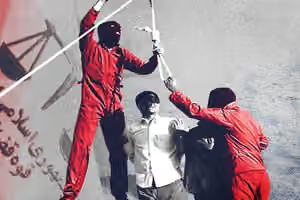
A letter expressing solidarity with Iran’s political prisoners has ignited an extraordinary ideological backlash, raising concerns among human rights advocates about how political narratives and disinformation can shape perceptions of repression in Iran.

Published in The Guardian on August 20, the open letter addressed political prisoners facing imprisonment, torture and execution under the Islamic Republic while also condemning US and Israeli military action against Iran.

“We write in solidarity with Iran’s political prisoners, who are trapped between two blades of a scissors,” the letter said, describing one blade as the Islamic Republic’s authoritarian rule and the other as the US-Israeli military assault.

The letter called for an end to executions and the release of political prisoners, arguing that opposing foreign military intervention should not mean remaining silent about repression inside Iran.

What followed was a fierce argument, particularly among figures on the political left.

Several people initially listed as signatories withdrew their names. Historian Robin D.G. Kelley said the published version was not exactly what he had initially seen.

University of Toronto professor Nisrin Elamin said she disagreed with the content and the process through which her name was added, arguing that the letter created a “false and harmful equivalency” between Iran and Israel.

Academics Rashid Khalidi and Nadia Abu El-Haj also removed their names. Other critics went further, characterizing the letter as contributing to efforts to manufacture consent for war.

Human rights lawyer Gissou Nia said the intensity of the reaction surprised her because she regarded the original statement of solidarity as “the bare minimum.”

For Nia, the dispute is about more than a single letter. She worries that ideology and disinformation can distort how international audiences understand repression inside Iran.

“There’s been a massive problem in terms of how narratives have been constructed since January of this year,” Nia told Iran International’s English language podcast Eye for Iran.

She pointed to internet shutdowns, restrictions on independent reporting and competing accounts of the January crackdown. Nia accused some commentators outside Iran of amplifying narratives that shifted responsibility for the killings away from the Islamic Republic despite evidence implicating its forces, describing some of the rhetoric as “mass atrocity denial.”

  • At least 916 executed in Iran since January - rights group

    At least 916 executed in Iran since January - rights group

The stakes are particularly high amid a dramatic rise in executions.

The Abdorrahman Boroumand Center for Human Rights in Iran documented over 900 executions in the first seven months of 2026, including 56 on political or national-security charges. Its database now lists 967 reported executions this year.

Political prisoners welcome attention, with reservations

Roya Boroumand, executive director of the Abdorrahman Boroumand Center, said some former political prisoners she works with were pleasantly surprised to see prominent figures in Western academia and on the left publicly acknowledge their plight.

But the response was not without criticism.

Some felt politics weighed too heavily in the letter and questioned comparisons between their experiences under the Islamic Republic and injustices in Western countries. Others asked why China and Russia were absent if the principle was solidarity with prisoners more broadly.

Still, Boroumand said support for Iranian political prisoners should be welcomed rather than subjected to an ideological test.

“You can't criticize people for doing the right thing because the victims they are talking about are not the right victims in your politics,” she said.

Boroumand said political imprisonment can follow Iranians long after they leave a cell. Prisoners may endure physical and psychological torture and lose jobs, educational opportunities and their health. After their release, they may remain under state surveillance, while their relatives can also face pressure over their activities.

Even exile does not necessarily end it. Former prisoners can receive calls from interrogators and see relatives inside Iran summoned over social media posts made abroad.

“You have to face the people who say you don't exist or you don't matter,” Boroumand said.

Why Iran becomes an ideological argument

Journalist and author Jay Solomon said the backlash should also be understood through the ideological legacy of Iran’s 1979 revolution.

For parts of the anti-imperialist left, he said, the revolution came to symbolize a historic defeat for US power. The Islamic Republic later cast itself as a leading opponent of the United States and Israel, creating a political framework in which criticism of Tehran can be seen as weakening that broader struggle.

Solomon said he was struck by the “callousness” of some responses, which he interpreted as effectively asking political prisoners to accept their suffering for the sake of a broader geopolitical cause.

He also pointed to a political purity test in which criticism of the Islamic Republic can quickly generate accusations that critics are serving Western or Israeli interests. Solomon compared the dynamic with other ideological movements that became increasingly intolerant of internal criticism.

That rhetoric is particularly significant in Iran, where authorities themselves have long portrayed dissidents as agents of foreign powers.

For Iran’s political prisoners, the debate is anything but theoretical. They are living through an escalating campaign of executions and repression while arguments continue abroad over how their suffering should fit into competing political narratives.

“Solidarity is really being in solidarity with people and their plight,” Nia said, “regardless of the politics.”

Iranian banks remain open in UAE as US campaign squeezes Dubai trade - FT

Aug 29, 2026, 07:17 GMT+1
100%

Iran’s trade with Dubai is showing growing signs of strain under the war and Washington’s new economic campaign, but sanctioned Iranian banks, flights and some commercial routes continue to operate despite calls for a sweeping cutoff, the Financial Times reported Saturday.

Shipping between Dubai Creek and Iranian ports has fallen sharply. At a terminal historically used by wooden dhows trading with Iran, a security guard told the FT vessels were now heading to Oman and India. “No more Iran since last week,” he said.

The disruption matters because Dubai has for decades served as one of Iran’s most important gateways to international trade and finance. Pre-war commerce between Iran and the UAE was worth nearly $30 billion annually.

“The UAE is the only avenue for Iranian imports, as Iran has access to no other major container port other than Jebel Ali in Dubai,” Esfandyar Batmanghelidj of the Bourse & Bazaar Foundation told the FT.

The effects are increasingly visible in Dubai’s traditional trading districts. But the economic break remains far from complete.

Bank Melli and Bank Saderat, both under US sanctions, continue serving customers through more than a dozen UAE branches combined, despite US Treasury Secretary Scott Bessent calling for every Bank Melli branch worldwide to be closed. The two Iranian banks have more than 12 branches between them in the UAE, according to the report.

A Bank Melli employee said daily transactions, lending and letters of credit had seen no significant disruption and that the bank had recently renewed its license with the UAE central bank.

“We’re used to this,” the employee said, referring to previous sanctions.

Iranian airlines are also still flying to Dubai, the Iranian Business Council remains operational and Iranian produce continues to reach markets in the city.

Iranian traders are meanwhile adapting. One Tehran businessman told the FT that goods had been stockpiled in Turkey, some shipments were being rerouted through Oman and cargo could still be sent from Dubai to Bandar Abbas using false destinations on shipping documents.

“We are bypassing the blockade in the same way we have been bypassing sanctions,” he said. “Not much has changed.”

Washington increased the pressure Friday by moving to cut the UAE branches of Egypt’s Banque Misr from access to US financial institutions over alleged Iran-related activity.

The campaign comes after the UAE announced it was suspending trade and financial transactions with Iran. But analysts told the FT that centuries-old commercial ties and Dubai’s reliance on trade make a complete separation difficult.