Nine out of ten shun marriage, parenthood in Iran International poll
An Iranian couple, with the woman wearing a wedding dress, walk along a street in Tehran.
Nine in 10 respondents to an Iran International Instagram poll said they did not want to marry or have children under Iran’s economic, social and political conditions, according to results gathered from about 100,000 participants.
More than 12,000 people also commented on the poll, with financial pressure, job insecurity, housing costs and concerns about children’s futures emerging repeatedly among the reasons given for putting off marriage or parenthood.
Some respondents said they wanted to marry or have children but lacked the financial or social conditions to do so. Others pointed to divorce and unsuccessful marriages as reasons for avoiding marriage.
Men accounted for 68% of respondents and women for 32%. The largest age group was 25 to 34, representing 40.3% of participants, followed by people aged 35 to 44 at 29.2%.
Respondents aged 18 to 24 made up 13.3%, while those aged 45 to 54 accounted for 9.8%.
Economic pressures weigh on family plans
Many respondents linked their reluctance to start families to the cost of everyday life, according to an examination of comments submitted with the poll.
Some wrote that meeting their own expenses had become difficult enough and that supporting a spouse or child was beyond their financial means. Others said they remained interested in marriage or parenthood but could not afford either.
Iran has faced years of high inflation and a steep decline in the value of its currency, eroding household purchasing power and making housing and other basic costs harder to meet.
The economic strain has been compounded by international sanctions and government policies at home and abroad, with their contribution to Iran’s economic problems a subject of continuing political debate.
Personal experiences of divorce and unsuccessful marriages also appeared repeatedly in the responses. Some participants described marriage under present conditions as a “high-risk decision.”
A man and a woman sit on a bench in Tehran.
Others who were already married said they had decided against having children because of economic and social conditions. Respondents also cited mistrust and difficulty finding a suitable partner.
A smaller number expressed support for marriage or having children.
Parents question children's prospects
Concerns about the conditions in which children would grow up formed another major strand of the responses.
Some said they wanted children but were unwilling to bring them into a society where they feared they could face poverty, inflation, electricity shortages, insecurity and an uncertain future.
A number used much stronger language, describing having children under present circumstances as a “crime” or a “betrayal” of the child because parents could not guarantee an adequate quality of life or future.
Iran faces severe environmental challenges including air pollution, groundwater depletion, forest fires and wider ecosystem degradation. Experts have linked such problems to a combination of poor policymaking, weak environmental protections, corruption and insufficient resources.
Political outlook feeds pessimism
Some respondents connected their decisions directly to Iran’s political and social conditions and their expectations for the country’s future.
Years of economic hardship have coincided with repeated waves of anti-government protests and deadly crackdowns, alongside restrictions on political and social freedoms.
For some participants, those pressures appeared to have turned decisions about marriage and parenthood into a broader judgment about what kind of future is possible in Iran.
The scale and substance of the responses point to a question facing many of them: not simply whether they can afford to build families, but whether they see a future in which they want to do so.
A screen grab from an Iranian state television segment depicting a hooded figure monitoring images of Barron Trump as part of a report on purported efforts to reach the US president’s son
Iranian state television has broadcast a segment describing efforts to reach President Donald Trump’s son Barron and referring to a $10 million reward, an unusually explicit threat against a member of the US president’s immediate family.
The roughly three-minute report focuses on Barron Trump and portrays attempts to identify ways of reaching him, using stylized graphics depicting surveillance, online activity and people in his surroundings.
The segment displays locations and online platforms purportedly associated with the effort and depicts attempts to map social connections around the president’s son and penetrate layers of Secret Service protection.
Iran International could not independently verify the operational claims made in the broadcast, which relies heavily on dramatized graphics and provides no evidence that any attempt to reach Barron Trump has succeeded.
But the decision to air such material on Iranian state television is significant in itself. Threats against Trump and other current and former US officials have featured for years in Iranian political rhetoric, state-linked media and rallies, alongside alleged assassination plots that US authorities have attributed to Tehran.
Similar videos have been broadcast before targeting Trump and his wife, Melania.
US prosecutors have previously accused members or associates of Iran’s Revolutionary Guards of plotting to kill former senior American officials, including former national security adviser John Bolton, in retaliation for the 2020 US killing of Quds Force commander Qasem Soleimani.
Trump himself has also been the subject of alleged Iranian assassination plots. US prosecutors said in 2024 that Tehran had tasked an operative with developing a plan to kill him, while Iranian threats have contributed to heightened security around the president.
Such rhetoric has intensified dramatically since the war began on February 28, when US-Israeli strikes killed Supreme Leader Ali Khamenei and other senior Iranian military and political figures.
Calls for revenge have since become a prominent feature of hardline messaging. Hundreds of thousands attending Khamenei’s funeral chanted against the United States and Israel, while some hardliners openly called for Trump’s assassination.
The latest broadcast marks a potentially significant escalation in that rhetoric by shifting the focus from Trump and US officials directly involved in policy toward Iran to the president’s family.
Toward the end of the segment, the narrator asserts “many would be willing” to take the $10 million reward connected to efforts targeting Barron Trump.
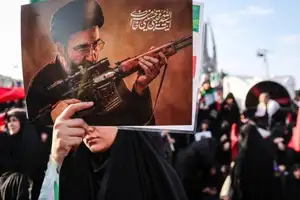
A participant holds a sign reading “Kill Trump” at a state-backed event in central Tehran, as a giant billboard depicting an avenging warrior looms over the crowd, August 21, 2026
Iran’s leadership may see an end to the war as necessary under mounting US economic pressure, but that does not mean Tehran will heed Washington’s demands, experts say, warning that the pressure could instead drive it toward further escalation.
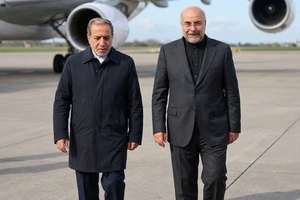
President Masoud Pezeshkian said Friday that it would be better to end the war now, while Iran remains in what he called a position of “power and dignity.” Parliament Speaker Mohammad Baqer Ghalibaf was more blunt about the stakes of a deteriorating economy.
“No matter how much military power we have, we won't survive if people are hungry and we don't have financial turnover, economic growth and national production,” Ghalibaf said, according to Iran’s official news agency IRNA.
Raz Zimmt, director of the Iran and Shiite Axis Research Program at Israel’s Institute for National Security Studies, believes the statements reflect growing recognition in Tehran that the current situation is unsustainable.
But he says there is a potentially dangerous gap between recognizing that reality and deciding to compromise.
“If they have to make a choice between taking the risk for a new round of war with the United States or making concessions which they consider to be full capitulation to the United States... I think it’s very clear that they are not going to give up,” Zimmt told Iran International’s Eye for Iran podcast.
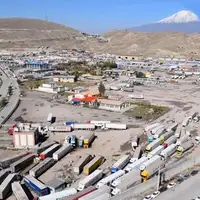
The dilemma comes as Washington prepares to intensify the pressure. US Treasury Secretary Scott Bessent has promised the “toughest sanctions in history,” alongside a naval blockade already squeezing Iranian trade.
Iran entered the war with high inflation and a weakened currency. By July, annual inflation had reached 66 percent and food prices were 128 percent higher than a year earlier, according to official data.
‘Reasons to resist’
Zimmt says Iran’s ability to use Hormuz as leverage could also erode as the United States makes military gains in opening a corridor through the strait. But he sees no evidence yet of a consensus in Tehran for a change of course.
Iran’s calculation, he argues, is shaped by what happens after any agreement as much as by what happens now. Its leaders do not appear convinced that concessions would guarantee a permanent end to the war.
Instead, they may fear reopening Hormuz and surrendering leverage in exchange for a ceasefire that Washington could abandon after the US midterm elections in November.
Washington’s own messaging may be reinforcing that distrust.
Bessent said Thursday that the combination of the blockade and new sanctions could “collapse this regime,” even as he argued that successful economic pressure could reduce the likelihood of another large-scale military campaign.
From Tehran’s perspective, Zimmt argues, such statements can strengthen those who ask why Iran should make concessions to an administration that is simultaneously talking about its collapse.
The war itself may have given Tehran another reason to resist concessions.
“The conclusion in Iran is that the United States and Israel don’t have the capability to force Iran into major concessions,” Zimmt said.
‘Escalation before negotiations’
Hormuz provides Tehran with another source of leverage. After decades of threatening to close the strategic waterway, Iran has demonstrated its ability to severely disrupt it. Only seven commodity vessels passed through on Thursday, compared with more than 130 a day before the war, according to Kpler data.
Zimmt believes Iran’s leadership may therefore calculate that it can inflict enough economic pain on its Persian Gulf neighbors and the global economy to improve its position before negotiating.
He points to Iran’s behavior after Trump withdrew from the nuclear deal during his first presidency. Tehran initially responded to maximum pressure with what it called “strategic patience” but escalated as the economic damage mounted, including through attacks on Persian Gulf shipping and the downing of a US drone.
He sees the possibility of the same logic asserting itself again.
“If the Iranians reach the conclusion that they can’t resist or they can’t handle the growing economic pressure,” Zimmt said, “their decision would actually be to escalate things even further before returning to negotiations.”
The pressure may be working. The unanswered question is what Tehran chooses to do because of it.
You can watch Eye for Iran on YouTube or listen on any podcast platform.
Iranian rials and US dollars are exchanged in Tehran. (File photo)
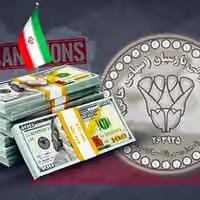
Iranians described deepening financial hardship and questioned whether economic pressure can change government policy as the dollar hit a historic 2 million rials, extending the currency's sharp decline on Sunday.
The US dollar reached 2 million rials on Iran's open market, crossing a threshold it had approached rapidly in recent days.
“We saw revolution, war, sanctions, rising prices and hardship,” one person told Iran International. “Now that we are over 50, we worry about our children, their jobs, their future, education, university and marriage costs. Pressure from outside, pressure from inside. How much can one endure?”
The dollar stood at around 1.865 million rials at the beginning of last week, putting its rise at more than 7% in less than a week. It has more than doubled from around 958,000 rials during the same period last year.
The British pound climbed above 2.72 million rials, while the euro approached 2.34 million rials. Rates can vary between sources because open-market trading is informal and fragmented.
Iranians describe pressure from all sides
The currency's latest fall comes days after US President Donald Trump announced what he called the “most crushing economic operation ever taken against any country,” warning of unprecedented economic isolation and consequences for countries whose financial institutions, businesses or government entities continue providing Tehran with an economic lifeline.
“Oil smuggling, swap lines, cash transfers, exchange houses, ship registries, front companies – it all needs to stop NOW,” Trump wrote on Truth Social, calling on US allies to join the campaign.
Messages sent to Iran International in response to a question about US economic pressure largely focused on the burden borne by ordinary people rather than its effect on the Islamic Republic.
“Iran has been under sanctions for nearly 50 years and the Islamic Republic is still governing,” one person said. “These measures do not work. They only leave the Iranian people poorer and hungrier, without medicine, healthcare or housing.”
Others questioned whether greater economic pressure could force authorities to change course.
“I don't think the government will come under pressure because it covers its budget deficit from people's pockets,” another respondent said. “The tip of the sanctions spear is aimed directly at the people; healthcare, nutrition, education and sports are all at risk.”
Rial's decline compounds daily hardship
Market participants point to high inflation, growing demand for foreign currency, declining foreign-exchange revenues and concern over sanctions as factors driving demand for dollars.
Political uncertainty, disruption to regional oil exports and the deadlock between the Islamic Republic and the United States have added to inflation expectations.
The currency slide comes alongside electricity and water shortages that have disrupted production and daily life. Further rial depreciation can raise the cost of imported raw materials and essential goods, adding to pressure on household budgets.
Some Iranians who contacted Iran International argued that economic pressure would be more effective if directed at assets held abroad by officials and their relatives.
“When they can freeze the foreign accounts of officials and their children, then you can call it pressure on the government,” one respondent said. “Seize their assets.”
A billboard in Tehran featuring Iran’s Supreme Leader Mojtaba Khamenei and senior military commanders.
Mojtaba Khamenei has not been seen or heard publicly, leaving his condition and circumstances unclear as officials govern in his name, interpret messages attributed to him and invoke his authority on questions ranging from negotiations with Washington to the conduct of the war.
Khamenei’s absence from public view has not stopped competing factions from claiming his backing. Written messages attributed to him, some open to competing interpretations, have provided material for both advocates and opponents of negotiations. But the competition to define what the supreme leader wants is not necessarily an equal one.
In wartime, military and security institutions have greater power than advocates of compromise to turn their interpretation of his wishes into action. Senior commanders occupy key decision-making positions, control the forces conducting the war and repeatedly invoke the leader’s authority in explaining military and political choices.
That imbalance has given hawkish figures greater room to portray Mojtaba as opposed to compromise, even though messages attributed to him have both permitted negotiations and called for retribution.
Iran’s leader is not only central to decisions on war and peace but also, as commander-in-chief of the armed forces, at the center of the country’s power structure during crises.
The Iran-Iraq war and last year’s 12-day war with Israel and the United States demonstrated how the supreme leader’s role extends beyond military command to political cohesion, public mobilization and connecting decisions on the battlefield with society.
Mojtaba’s absence from public view has raised a different question: how supreme authority is exercised during a war when the leader himself is neither seen nor heard.
A poster featuring Mojtaba Khamenei on a street in Tehran.
Written messages attributed to Mojtaba, alongside repeated references by officials to his views and wishes, have become a means of asserting his authority over decisions and maintaining cohesion among supporters of the Islamic Republic.
They also turn the leader’s name into a source of authority under which costly decisions can be pursued, even as responsibility for implementing them and their consequences is dispersed across the political and military establishment.
Authority without a public appearance
Mojtaba has not appeared at major political, state or personal events, including the funeral of his wife and the large funeral ceremonies for his father.
His absence has produced conflicting accounts about his health, ranging from assertions that he is completely healthy to reports that he was injured or lost a limb, creating uncertainty around a leader whose name remains central to decision-making.
Security concerns have been offered as the principal explanation for keeping him out of public view.
“Security experts have strongly advised him not to reveal himself, even through the release of his voice, let alone an image,” Mohammad-Hossein Khoshvaght, secretary of the Fararu website, said.
Hamshahri newspaper has similarly argued that releasing an audio recording could make it possible to extract some of the speaker’s physical and physiological characteristics.
The secrecy prevents an independent assessment of Mojtaba’s health, his ability to address the public or his positions on major issues. It also allows multiple officials to speak for him and attribute decisions to his authority without the leader publicly clarifying his own position.
Ambiguous message divides officials over talks
A written message attributed to Mojtaba showed how that system can produce competing interpretations.
The message used the Persian expression “Al al-osul,” broadly meaning “in principle,” in discussing negotiations, while leaving responsibility with President Masoud Pezeshkian and effectively permitting an agreement to be signed.
The wording quickly became the subject of competing interpretations among figures presenting themselves as familiar with the leader’s position.
“Some people have interpreted the phrase ‘in principle, I had a different view’ to mean that the supreme leader is fundamentally opposed to negotiations, whereas this interpretation is incorrect and does not correspond with the existing realities,” the Revolutionary Guards’ political deputy said.
Mohsen Rezaei, the new secretary of the Supreme National Security Council, offered a different interpretation.
“When the leader says, ‘in principle, I had a different view,’ it means the path he had in mind was better than the path taken by the Supreme National Security Council,” Rezaei said.
The disagreement allows one camp to present the message as opposition to negotiations and another to read it as conditional approval.
Without a public appearance or unequivocal order from Mojtaba himself, such ambiguity diffuses responsibility for policy while giving greater room to institutions with the organizational and coercive power to make their interpretation prevail.
In practice, that can favor figures who view continued war as the necessary course and promote a message of a “powerful Iran,” using the prospect of continuing conflict as leverage against the United States and Israel.
Military network invokes Khamenei’s ‘authority’
Mojtaba’s physical absence has not meant an absence of authority. Instead, officials across the military and political establishment repeatedly invoke his name to validate policy.
Ebrahim Jabbari, an adviser to the Revolutionary Guards commander, has spoken of Mojtaba’s “command and oversight” of military affairs and his management of expert meetings involving the armed forces, presenting him as directly engaged in running the country’s defense establishment.
Such accounts allow difficult military and political decisions to be presented as products of the absent leader’s orders and judgment even when no public directive has been issued.
Khoshvaght has described Mojtaba’s selection as a decision made by the political system itself, reflecting a network of authority that has increasingly operated without transparent lines of responsibility.
Iran’s adversaries have, in a different way, reinforced the portrayal of Mojtaba as the ultimate decision-maker. Israeli Prime Minister Benjamin Netanyahu has said Mojtaba is alive, while US President Donald Trump has described him as “definitely, 100 percent” involved in negotiations between Tehran and Washington and has raised the prospect of meeting him.
Those remarks allow supporters to depict Mojtaba as a leader recognized by Iran’s adversaries and standing against them, while officials around him present “resistance” and readiness for further war as expressions of Iranian power.
Command appointments strengthen war camp
The combination of an absent leader and decisions made largely through military and security institutions has blurred responsibility for Iran’s political and wartime choices.
Successes can be attributed to the judgment of the leader, while the human and economic costs are dispersed across a network of institutions and officials. Ambiguous messages can meanwhile be interpreted by rival factions to support their preferred policies.
That balance gives greater weight to military figures such as Revolutionary Guards Aerospace Force commander Majid Mousavi, whose forces carry a major share of the fighting and who has called on officials to follow the leader’s wishes.
Precisely what those wishes entail remains unclear. The same leader who permitted negotiations and an agreement has also promised retribution, leaving commanders considerable scope to determine which message takes precedence.
Recent command appointments made in Mojtaba’s name form part of the same shift. While some consolidated the existing structure, comments by Mohammad-Reza Naghdi, an adviser to Iran’s supreme leader and the Revolutionary Guards, indicated that the objective was to move Iran’s military posture from defensive to offensive.
Rezaei’s appointment to lead the Supreme National Security Council adds another military figure to a central decision-making position. He has spoken against compromise with Washington and raised the possibility of changing Iran’s nuclear doctrine.
Together, the appointments and increasingly assertive rhetoric from military figures have strengthened the camp arguing against accommodation and in favor of a more offensive posture.
War policy takes shape without public order
Iran’s current war policy is therefore taking shape without a single, unambiguous public command from its supreme leader. Instead, it is emerging through written messages open to interpretation, appointments, calls for retribution and a shrinking political space for those advocating accommodation.
An Iranian flag bearing images of senior Iranian leaders at a gathering in Tehran.
Media outlets close to the leadership have given little room to arguments for accommodation, while senior figures increasingly speak of retaliation, confrontation and obedience to the leader.
Mojtaba remains physically absent but politically ubiquitous, his name appearing beneath written messages and in the statements of officials who interpret his wishes.
The result is a system in which the supreme leader’s authority remains central even as his own voice is absent – giving a pro-war camp already strongly represented across military, security, political and media institutions greater room to define what he wants and, through that interpretation, shape the direction of the war.
IRGC commander-in-chief Ahmad Vahidi praised Iran’s state broadcaster for its performance during the war with the US, throwing his weight behind an institution that has clashed with President Masoud Pezeshkian and drawn criticism from Parliament Speaker Mohammad Bagher Ghalibaf.
In a message to IRIB chief Peyman Jebelli, Vahidi described the broadcaster’s performance as a “valuable effort” and “effective role-playing,” saying it had made an important contribution to strengthening the Islamic Republic’s “media front” during the conflict.
Vahidi’s endorsement comes against the backdrop of a broader power struggle between Pezeshkian and senior Guards commanders. Iran International reported in April, citing sources close to the presidential office, that Pezeshkian had accused Vahidi and other senior IRGC commanders of acting unilaterally during the war, undermining ceasefire prospects and pushing Iran toward economic disaster.
Pezeshkian has also repeatedly criticized IRIB. In May, he said the broadcaster presented an unrealistic picture of conditions in the country and needed a serious overhaul.
The confrontation escalated in July when Pezeshkian’s office accused IRIB of censoring part of a televised interview in which the president said the late Supreme Leader Ali Khamenei had privately instructed officials to negotiate with the United States despite publicly ruling out talks. The broadcaster did not publicly explain why the remarks were omitted.
Ghalibaf has had his own clashes with the broadcaster. In July, parliament accused IRIB of censorship after it abruptly cut short a pre-recorded interview with the speaker as he discussed the release of Iranian assets abroad.
Parliament said roughly 20 minutes covering politically sensitive issues had not been aired, including possible IAEA inspections, frozen Iranian assets, the reported $300 billion reconstruction credit in the US-Iran memorandum of understanding and Ghalibaf’s response to President Donald Trump.
IRIB said the interview had been divided into two installments, but parliament said it had received no advance notice that parts would be withheld.
This week, Ghalibaf renewed his criticism, saying IRIB had failed to achieve the necessary results in “cognitive warfare” and referring to what he called the broadcaster’s “structural, approach and performance inefficiencies.”