File photo: A man speaks on his phone beneath a market board at the Tehran Stock Exchange.
Iran’s stock market is raising eyebrows with a sustained rally even as the country’s economy struggles with dwindling foreign-currency inflows, energy shortages and uncertainty over the war.
The divergence is particularly striking after the International Monetary Fund on Tuesday forecast Iran's economy would contract 7.6% in 2026, far more sharply than the 0.3% decline expected across the Middle East and Central Asia.
Against that backdrop, the strength of Tehran's stock market raises a question: are investors betting that the worst is approaching an end, or simply running out of places to protect their money?
Recent analyses in Iranian media offer competing explanations, ranging from expectations of an Iran-US agreement to the immediate pressures of dwindling foreign currency and energy shortages.
Dollars in short supply
Iran's oil exports have effectively stopped under the US blockade, while non-oil exports including steel and petrochemicals have also fallen. Delays in repatriating export earnings have further restricted the supply of hard currency.
Fararu identifies dwindling foreign-exchange inflows, energy shortages and uncertainty as the three principal pressures on the economy. Khabar Online puts the currency shortage at the center of its analysis, pointing to a 35,000-toman rise in the free-market dollar over the past month.
The widening gap between official and market exchange rates has added to volatility, while businesses dependent on imported machinery and raw materials face higher costs and tighter access to foreign currency.
Energy shortages are compounding those problems. Years of underinvestment have left Iran struggling to meet domestic demand, while wartime damage to infrastructure has added pressure on production.
Hovering over both is uncertainty about what comes next. The economic consequences of renewed fighting would differ dramatically from those of a negotiated settlement, making long-term investment all but impossible and pushing businesses and households toward assets that can preserve value.
Why are stocks rising?
That makes the performance of Tehran's stock market more striking.
Rouydad24 interprets its wartime strength as a sign that investors increasingly expect an Iran-US agreement. On that reading, equities are looking beyond present economic conditions toward possible de-escalation, sanctions relief and improved access to international markets.
But there is another explanation that requires no assumption that investors know where negotiations are heading: they may simply have nowhere better to go.
With the rial losing value, foreign currency increasingly scarce, property relatively illiquid and bank deposits losing purchasing power to inflation, domestic equities can become attractive even when confidence in the underlying economy is weak.
A rising stock market, in other words, may say less about optimism over Iran's economic prospects than about the scarcity of alternatives for preserving wealth.
That would also help reconcile what otherwise appear to be conflicting signals. The currency market reflects immediate scarcity and fear of further deterioration, while stocks may reflect either hopes for political relief or an effort to escape the declining value of cash.
Different markets, different futures
The IMF's latest forecast represents another substantial downgrade from the 5.4% contraction it expected as recently as July. Iranian government data has meanwhile shown GDP contracting 10% year-on-year in the spring, with the downturn extending beyond the oil sector.
For businesses and investors, much now depends on which of two very different futures emerges: renewed conflict and prolonged restrictions on oil exports, or de-escalation that begins restoring access to foreign currency and international trade.
Iran's markets may therefore be pricing different risks rather than delivering contradictory verdicts. The currency market reflects a shortage that already exists. The stock market may be looking toward political relief or reflecting the capital having nowhere else to go.
File photo: A construction worker looks on at a building site in Iran
The International Monetary Fund forecast Tuesday that Iran’s economy would shrink 7.6% in 2026, a worse outlook than for its main Middle Eastern rivals amid the war, with Saudi Arabia and the UAE facing smaller contractions and Israel and Turkey expected to grow.
The IMF's latest World Economic Outlook revised Iran's forecast downward from a 5.4% contraction projected in July. The economy is now expected to shrink for a second consecutive year, following an estimated 0.9% decline in 2025.
The IMF expects the economies of the Middle East and Central Asia to contract by 0.3% this year, a sharp reversal from the 1.9% growth it forecast in April.
Several countries in the region face deeper contractions than Iran, with the IMF forecasting declines of 16.7% in Kuwait, 16% in Iraq, 15.6% in Qatar and 11.3% in Bahrain.
Saudi Arabia and the United Arab Emirates are expected to see smaller contractions of 3.3% and 3.9%, respectively. Others are projected to grow, including Egypt by 5.1%, Israel by 4.5%, Oman by 4.1%, and Jordan and Turkey by 2.7% each.
The deterioration in most regional countries reflects renewed military exchanges and prolonged disruption to shipping through the Strait of Hormuz, while Iran faces the additional pressure of the US naval blockade.
Iran's projected contraction nevertheless stands out, reflecting restrictions on its oil exports and an economy already weakened by years of sanctions and structural problems.
‘Deep recession’
Iranian government data presents a similarly bleak picture.
The Statistical Center of Iran reported last month that GDP contracted 10% in spring 2026 compared with the same period a year earlier, the sharpest quarterly decline in 15 years.
Even excluding oil, the economy shrank 4.6%, showing that the downturn extended well beyond the energy sector.
Oil and gas production fell 26.4% from a year earlier, while industry and mining contracted 14.7% and services 4.8%. Agriculture was the only major sector to expand, growing 2.3%.
Exports of goods and services fell nearly 36% and imports declined almost 15%. Household consumption dropped 4%, indicating a further weakening of domestic demand and purchasing power.
The figures contrast sharply with the global outlook, with the IMF expecting growth of just over 3% worldwide in 2026.
Officials offer rosier picture
Senior Iranian officials have continued to offer far more optimistic assessments.
Central Bank Governor Abdolnaser Hemmati told state television last week that inflationary pressures had eased during the summer and that the government had prevented the economic collapse predicted by Washington.
Former Labor Minister Hojjat Abdolmaleki went further in recent remarks that drew mockery on Iranian social media, saying inflation was effectively Iran's only economic problem.
“If you put high prices aside, you have no other economic problems,” he said.
Pressure on oil exports
Iran loaded no crude oil or condensate onto tankers throughout September, according to data from commodities intelligence firm Kpler, the first full month without loadings since the 1979 Islamic Revolution.
Washington has described its economic campaign as an effort to deprive Tehran of its remaining sources of revenue.
On October 8, the US Treasury imposed sanctions on 17 vessels and associated companies it identified as part of Iran's remaining shadow fleet.
Treasury Secretary Scott Bessent said the administration would continue targeting those facilitating Iranian oil sales.
The combination of the IMF forecast and Iran's own economic data points to a recession extending well beyond the country's energy sector.
How much deeper it becomes will depend in large part on the duration of the war, the blockade and Tehran's ability to restore oil exports.
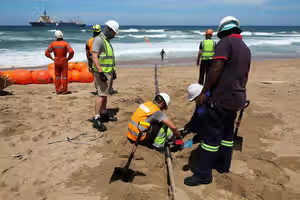
File photo shows workers toil on the 2Africa undersea cable project carried out by France’s Alcatel Submarine Networks in Amanzimtoti, South Africa on Feb. 7, 2023.
Iranian hardliners have backed security chief Mohsen Rezaei’s threat to strike data centers, undersea internet cables and artificial intelligence facilities in the Persian Gulf if the United States and Israel resume hostilities.
Rezaei, secretary of Iran’s Supreme National Security Council, told state-owned Press TV on Sunday night that Tehran was prepared for renewed conflict and could target critical technology infrastructure across the Middle East.
He said valuable American assets in the United Arab Emirates and around the Strait of Hormuz had not yet been included among Iran’s targets, but Tehran was prepared to demonstrate new capabilities to strike them. He claimed those assets and the region’s digital infrastructure were worth more than $2 trillion.
“Every miscalculation by the enemy against Iran has resulted in a heavy defeat for them; the next mistake will bring new fronts and greater surprises,” Rezaei wrote on X on Monday.
Hardliners urge pressure on US technology interests
Tasnim News Agency, which is affiliated with the Islamic Revolutionary Guard Corps, argued in an article titled “Why Is Artificial Intelligence on the Target List?” that attacks on AI centers could undermine US technological competition with China, deter investment and put pressure on US stock markets.
Hossein Shariatmadari, editor-in-chief of the hardline Kayhan newspaper and the supreme leader’s representative at the publication, welcomed Rezaei’s threat in an article titled “Well Done, Brother Mohsen!”
He called for using fiber-optic cables running through the Persian Gulf and the Strait of Hormuz to pressure Washington and its allies. He claimed that nearly seven major international cable systems pass through the region and that damage to them could disrupt more than 80 percent of commercial, banking, military and AI-related communications.
Kayhan also accused what it called “Western-oriented” political factions of double standards over internet access. It quoted Shariatmadari as predicting that politicians and parties “not fully aligned with the revolution” would oppose Rezaei’s threat and portray it as fueling war.
“The reformists had previously described internet shutdowns [in Iran] as a cause of deep dissatisfaction and called for stable, free and secure internet access for the public. But now that this same internet has become a strategic weapon for Iran against the United States, they have either remained silent or opposed it in the language of peace,” the article said.
Political analyst Ruhollah Rahimpour, however, told Iran International that while Iran could technically and operationally damage data centers and communications infrastructure in the Persian Gulf, the impact would primarily fall on regional networks rather than seriously affect the global internet.
Such attacks could raise the cost of war for other countries, he said, but also widen the conflict and impose greater security and economic costs on Iran.
Mohsen Zanganeh, a member of parliament’s knowledge-based companies and technology faction, endorsed Rezaei’s warning in an interview with ANA news agency, saying it reflected technological realities.
He said many data centers operated by major technology companies, most of them American, and the main communications routes connecting them were located in countries along the southern coast of the Persian Gulf.
Attacks could damage equipment, cloud networks and processing systems while disrupting US military operations, Zanganeh argued. Because Arab countries host both US bases and American technology infrastructure, he said, the consequences could spread to other countries and increase the global economic cost of war, as had happened in the energy sector.
WANA News described Rezaei’s remarks as an attempt to deter military action by raising its potential cost, saying a declaration of readiness did not necessarily signal a decision to launch operations.
Warnings amid strained diplomacy
Rezaei’s threats came alongside indications of continued differences between Tehran and Washington.
In a separate post on X on Sunday, he said the United States had accepted some of Iran’s seven conditions, but Tehran considered its response insufficient.
“Iran’s diplomacy has changed, and we will not return to the previous situation,” he wrote.
Mostafa Najafi, a commentator supportive of Rezaei, interpreted the remarks as a sign that the two sides remained far from an agreement.
“This position by the secretary of the Supreme National Security Council means that negotiations between Iran and the United States are a long way from an agreement and much closer to tensions,” he wrote on X.
The infrastructure threats also drew criticism on social media.
One user, Mohammad Nikbakht, questioned why Rezaei was announcing potential targets and argued that attacks would encourage Arab countries to unite against Iran.
Another commenter warned that threats without the capability to carry them out could backfire, drawing a comparison with Iran’s efforts to close the Strait of Hormuz, which the commenter said had resulted in a naval blockade of Iran.
“We are much more worried about miscalculations by our country’s executive officials than about miscalculations by the enemy,” a different user wrote.
US Secretary of State Marco Rubio speaks at the Pnyx hill, where ancient Athenians held democratic assemblies, with the ancient Parthenon temple atop the Acropolis in the background, in Athens, Greece October 7, 2026.
Marco Rubio’s invocation of ancient Persia in a speech championing Western power has given Tehran an opportunity to present itself as a defender of Iranian identity, even as critics recall the Islamic Republic’s own record of disparaging pride in the country’s pre-Islamic rulers.
The US secretary of state’s October 7 address in Athens drew on Xerxes’ invasion of Greece in 480 BC to celebrate Western resilience, before contrasting Western traditions of sacrifice with what he called the Iranian leadership’s “cult of death.”
The remarks drew objections even from critics of the Islamic Republic, who argued that opposition to clerical rule does not diminish Iranians’ attachment to their ancient history.
Iranian officials seized on that sensitivity to cast themselves as defenders of the country’s ancient heritage. Parliament speaker Mohammad Bagher Ghalibaf accused Iran’s adversaries of seeking to erase ancient civilizations and warned Washington that it would meet the fate of Persia’s defeated enemies.
“Those who chase Alexander’s legacy will share Valerian’s fate: you will kneel,” he wrote on X on Friday, referring to the Roman emperor captured by the Sasanian king Shapur I.
The history Khamenei dismissed
That embrace of ancient Persian power contrasts with slain Supreme Leader Ali Khamenei’s criticism of the very campaign Rubio recounted.
Addressing army commanders in April 2012, Khamenei cited Xerxes’ invasion of Greece as an example of military force serving rulers’ political ambitions rather than national interests. He described an army returning defeated, its ships wrecked, and associated the campaign with Iran’s historical taghut, a religious term used to condemn illegitimate or ungodly rule.
“These were not for national interests,” he said.
In 2018, Khamenei dismissed pride in the rule of the ancient Kayanian and Achaemenid dynasties as illusory, arguing that national esteem should rest on tangible achievements in contemporary society.
Those remarks complicate the authorities’ present effort to speak for Iranians offended by Rubio’s account. One Persian-language X user mocked government supporters’ sudden concern for Xerxes, contrasting it with their past ridicule of ancient Persian figures and people visiting historical sites.
The struggle over these symbols predates the current war. During Nowruz in March 2025, crowds gathered at Persepolis and the tombs of Hafez and Ferdowsi while authorities promoted religious mourning coinciding with the holiday.
After the June 2025 war with Israel and the United States, patriotic music entered the leadership’s own ceremonies: Khamenei asked eulogist Mahmoud Karimi to perform “Ey Iran Iran” at a July mourning gathering, a separate song from the better-known anthem.
Later, media reports documented a statue of the mythical archer Arash in Tehran, banners likening Iranian missiles to his legendary arrows, and a billboard depicting Benjamin Netanyahu kneeling before an ancient Persian emperor.
By November 2025, authorities had also unveiled a statue depicting Valerian’s submission to Shapur I. Such imagery associated the state’s confrontation with foreign powers with a national history reaching far beyond the Islamic Republic.
A propaganda opening
Speaking at the Pnyx with the Acropolis behind him, Rubio recounted the Persian destruction of Athens’ sanctuaries and the city’s subsequent rebuilding. He also praised the Spartans’ last stand at Thermopylae, presenting ancient Greek traditions as foundations of Western courage, ambition and duty.
His explicit attack on contemporary Iran targeted its rulers, whom he called “radical mullahs.” But placing that criticism within a speech celebrating resistance to Persian armies prompted objections to the implied continuity between ancient conflict and today’s war.
Historian Touraj Daryaee told the Tehran Times that treating the ancient wars as a confrontation between East and West misrepresented a conflict between an empire and Greek city-states. He also challenged the use of that history to frame the present conflict.
Questions about Rubio’s historical framing also came from admirers of the speech. Writing in the Spectator, Alexander Munguía praised its defense of the West but argued that its celebration of relentless ambition better resembled Alcibiades, who championed Athens’ disastrous expedition to Sicily, than Pericles, whose wartime strategy emphasized restraint.
US-based Iranian journalist and analyst Omid Memarian warned on X that Rubio “may have just handed Tehran one of the biggest propaganda gifts of this war.”
“It just reframes this war as a civilizational clash. And that plays directly into Tehran’s hands,” he wrote, arguing that the rhetoric helped authorities portray Washington as an enemy of Iran itself rather than its government.
The State Department did not immediately respond to Iran International’s request for comment on the criticism and whether Rubio intended to draw a parallel between ancient Persia and today’s Iranian government.
A distinction between Iran and its rulers
Iranian political analyst Nejat Bahrami disputed the interpretation of Rubio’s speech as an attack on Iranian civilization.
“Rubio’s speech was part of a broader theme that he, the current Trump administration and right-wing political figures in Europe have pursued in recent years: that the West must return to its roots, resist the erosion of Western civilization and preserve Western values,” he told Iran International.
“Contrary to the fuss made by the Islamic Republic, Rubio did not attack Iranian civilization in the speech. He referred to a historical event: the Persian attack on Athens and the destruction that followed, before describing how the Greeks returned and rebuilt. His point was that the West today should similarly follow their example of determination and resilience.”
Rubio had previously drawn an explicit distinction between Iranians and their rulers. At his January 2025 Senate confirmation hearing, he praised Iran’s ancient civilization and culture and Iranians’ pride in their Persian heritage, saying he knew of no country with a greater divide between its people and those governing them.
File photo: The inaugural double-stack container train linking Iran and China, July 2024
Washington’s new sanctions are unlikely to stop a China–Iran freight train at the border, but may make the route Tehran has turned to under pressure from the US naval blockade costlier and less reliable.
The blockade has sharply restricted maritime trade, while years of sanctions have squeezed Iran’s access to international finance. But not every trade channel had already closed.
Trains carrying goods from China were still reaching Iran before the latest US measures. The question now is whether sanctions on Iran’s railway companies will narrow that remaining route and complicate the flow of goods, including auto parts, carried on it.
Last week, the US Treasury designated three Iranian rail companies: the state-owned Islamic Republic of Iran Railway Company, known as RAI; Raja Passenger Trains Company; and private freight operator Railway Transportation Company.
The department said Iran had turned to rail to sustain trade and transport oil as the maritime blockade took hold.
The sanctions block the US-based property of the designated companies and prohibit US persons from dealing with them, while separate sectoral determinations give Washington wider scope to impose future designations. They do not automatically block every foreign railway, freight company or shipment connected to Iran.
The more immediate effect may be caution among companies involved in the trade. Banks may reject payments. Insurers and equipment suppliers may refuse to handle business involving designated companies. Others may charge higher fees or take longer to process shipments.
None of this would close the railway, but together it could make the route less dependable.
A useful route, with clear limits
The China–Iran rail connection is no longer just a proposal. In September, a block train bound for Iran was reported traveling through Kazakhstan, Uzbekistan and Turkmenistan before entering at Sarakhs.
A train from Xi’an to Iran’s Aprin dry port in 2025 was reported to have taken about 15 days, compared with an estimated 30 to 40 days by sea. Iranian railway officials also reported that 43 freight trains arrived from China in the first nine months of 2025.
Those figures show a route in use, although they do not indicate how much of Iran’s overall trade moves by rail.
Rail can move selected goods, industrial inputs, equipment and containerized cargo faster than shipping by sea. But it cannot replace the volume carried by tankers or bulk freighters.
Treasury says Iran is using rail to help transport oil, but its announcement provides no figures for oil moved this way. There is therefore little evidence that rail is a meaningful substitute for seaborne oil exports.
The new designations could nevertheless complicate the China route. Freight must be coordinated among operators, border agencies and terminals in several countries, making the response of Chinese and Central Asian companies important to how disruptive the sanctions ultimately prove.
Auto parts show where the sanctions overlap
The automotive sanctions create a second pressure point because auto parts from China have traveled to Iran by rail.
In 2025, Iran Khodro reportedly received an all-rail shipment through Sarakhs. The head of the local special economic zone said the route reduced transit and stockpiling time from about 50 days to 15.
Sanctions on automakers and rail operators could therefore put pressure on the same supply chain from two directions.
Procurement and payment may become harder, while freight companies and intermediaries may avoid shipments linked to designated firms.
The impact on car production, however, will depend on what parts are affected, how much stock manufacturers have and whether other suppliers or routes are available.
The trains may run, but at a price
The blockade has squeezed Iran’s maritime options; the rail sanctions raise the risks attached to an overland alternative.
They may not stop the China–Iran connection, but could make it costlier and less predictable by deterring the banks, insurers and logistics firms that keep shipments moving.
How much traffic falls will depend largely on the response of Chinese and Central Asian operators.
For now, the railway remains open. But as Iran leans more heavily on the trade routes still available to it, Washington is trying to make those routes harder to use.
Panelists discuss the impact of US sanctions and the naval blockade on Iran's economy, financial networks and political leadership during an Iran International Insight discussion hosted by Fardad Farahzad in Washington, DC.
The US blockade and tighter sanctions enforcement are cutting into Iran’s oil income and targeting financial networks that sustain the Islamic Republic, but may still fall short of forcing Tehran into concessions, experts said at an Iran International town hall in Washington.
The discussion, hosted by Fardad Farahzad, brought together Kerri Bitsoff, a former senior official at the US Treasury Department’s Office of Foreign Assets Control (OFAC); Patrick Clawson, the Morningstar senior fellow at the Washington Institute; and Mohammad Machine-Chian, a senior economist and analyst at Iran International.
“The thing about sanctions, if they’re on the books but not enforced, they only hurt the people,” Bitsoff said, arguing that the current US campaign differed from previous rounds by focusing more heavily on enforcement and the financial intermediaries sustaining Iran’s economy.
Blockade bites
Iran faces declining oil revenues alongside damage to its energy infrastructure following the war, raising the prospect of severe economic difficulties during the coming winter, Clawson said.
President Masoud Pezeshkian had acknowledged that Iran could not export oil during the initial blockade, according to Clawson, who said the country subsequently sought alternative routes for limited shipments.
Iran had also relied on oil previously stored aboard vessels and in China, but those reserves were approaching exhaustion, he said.
Damage to natural gas infrastructure could compound the difficulties, potentially forcing greater reliance on mazut, a heavily polluting fuel used for electricity generation.
Patrick Clawson, a senior fellow at the Washington Institute, discusses the impact of US sanctions and the naval blockade on Iran's economy during Iran International's Insight panel in Washington, DC.
Iran depends on natural gas for approximately 69 percent of its energy requirements, making disruptions particularly consequential for households and industry, Clawson said.
Machine-Chian estimated that between $21 and $23 billion in export proceeds had not returned to Iran and that the blockade could cost the country another $35 billion in oil revenue.
The current campaign differs from previous sanctions because Washington is concentrating on enforcement and the intermediaries sustaining Iran's economy rather than simply announcing additional restrictions, Bitsoff said.
She pointed to restrictions imposed by the United Arab Emirates, measures against Iranian airlines and Turkish action against banks connected to Iranian transactions.
Such measures could influence officials and business figures whose continued support for the Islamic Republic depends on financial privileges and access to international markets.
Kerri Bitsoff, a former senior US Treasury official and sanctions expert, discusses the impact of US economic pressure on Iran during Iran International Insight panel.
Earlier sanctions had often pushed legitimate commerce underground while allowing networks connected to the Revolutionary Guards to profit, Bitsoff said.
Machine-Chian described the emergence of wealthy intermediaries, sometimes called sanctions merchants, who benefited from moving Iranian oil and money through opaque arrangements.
Those networks subsequently became obstacles to negotiations and economic normalization because their commercial interests depended on maintaining the existing system, he said.
Machine-Chian distinguished between sanctions that impose prolonged hardship without producing results and measures designed to achieve specific objectives within a foreseeable period.
The loss of the UAE, Machine-Chian added, as a major commercial and financial intermediary has further complicated Iran's position.
Dubai previously provided an important channel for Iranian transactions, but restrictions have forced businesses to seek alternatives through Turkey, Pakistan and Afghanistan, Machine-Chian said.
Those routes, he said, have limited capacity and cannot quickly replace the financial infrastructure previously available through the Emirates.
China and regional allies face financial constraints
China remains Iran's principal oil customer, but its commercial relationship offers fewer advantages to the Islamic Republic than commonly assumed, Bitsoff said.
Independent Chinese refineries purchase Iranian crude at substantial discounts, while payments in yuan often remain in China and are largely available for purchasing Chinese goods.
Hezbollah has struggled to maintain basic financial obligations and social support programs since the blockade began, Bitsoff said.
Machine-Chian argued that Iran's relationships with allied armed groups had become increasingly transactional, making continued financial assistance essential to sustaining their loyalty.
Political survival and prospects for negotiations
Despite the mounting pressure, the panelists differed over whether the Islamic Republic would ultimately accept Washington's demands.
Economic hardship alone was unlikely to persuade Iran's leadership to abandon its objectives, Bitsoff said.
Instead sustained pressure could influence members of the security apparatus whose loyalty depends on salaries, privileges and expectations of continued stability.
Clawson considered negotiated concessions possible, pointing to previous occasions when Iran reversed positions it had presented as nonnegotiable.
He suggested Iran could accept a three-year suspension of uranium enrichment, particularly because its facilities had been damaged and were not operational.
Machine-Chian was more skeptical, arguing that abandoning regional ambitions and nuclear objectives would challenge central elements of the Islamic Republic's political identity.
Audience members attend an Iran International Insight panel discussion in Washington, DC.
The blockade's sustainability also remains a concern because maintaining naval operations places substantial demands on American ships, crews and maintenance resources, Bitsoff said, although she expected the operation to continue.
The discussion highlighted a central uncertainty: whether sustained economic pressure will produce concessions, weaken the leadership's support structures or prolong Iran's economic difficulties without fundamentally changing its political direction.