• العربية
  • فارسی
BrandBrand
  • Iran Insight
  • Politics
  • Economy
  • Analysis
  • Special Report
  • Opinion
  • Podcast
  • Live TV
  • Iran Insight
  • Politics
  • Economy
  • Analysis
  • Special Report
  • Opinion
  • Podcast
  • Live TV
  • Theme
  • Language
    • العربية
    • فارسی
  • Iran Insight
  • Politics
  • Economy
  • Analysis
  • Special Report
  • Opinion
  • Podcast
  • Live TV
All rights reserved for Volant Media UK Limited
volant media logo

‘We cannot bring America to its knees,’ former Tehran mayor says

Oct 15, 2026, 12:42 GMT+1
Former Tehran Mayor Gholamhossein Karbaschi

Iran cannot bring the United States to its knees despite inflicting damage on American forces, a former Tehran mayor said in a state television interview, arguing that Iran's military capabilities cannot match Washington's and calling for an end to the war through negotiations.

“We can bring in experts every day to say we are making America suffer, but the reality is that we cannot do that,” Gholamhossein Karbaschi, a former Tehran mayor and former secretary-general of the Executives of Construction Party, told state broadcaster IRIB.

Karbaschi criticized what he described as exaggerated portrayals of Iran's ability to inflict damage on the United States, saying the losses suffered by Iran and its population far exceeded the damage inflicted on Washington.

“The damage we have inflicted on the US is not comparable to the losses our own country and people have suffered. Fundamentally, our capabilities and capacities are not comparable to those of America,” Karbaschi said.

His remarks also addressed the Islamabad agreement, attacks on vessels and the need to release political prisoners to strengthen public support during the conflict.

Islamabad agreement and attacks on vessels

The attacks on three vessels could have been avoided had the Islamabad agreement been properly implemented, Karbaschi said, questioning who was responsible for targeting the ships.

Karbaschi argued that a distinction should be made between the actual reasons for violating an agreement and events used as a pretext to abandon it.

The agreement had been highly favorable to Iran and had surprised international observers because Washington had accepted its terms, Karbaschi said.

100%
A US Navy fighter jet approaches an aircraft carrier's flight deck as crew members watch.

Israel opposed the agreement, and the attacks on the three ships ultimately became a pretext for breaching the understanding, he added.

Karbaschi also rejected the suggestion that ending the war through negotiations would require Iran to accept every American demand, arguing that both sides' objectives needed to be examined.

Political prisoners and public support

Iran must secure the backing of its population if it wants to resist pressure from US President Donald Trump, Karbaschi said.

“If this country wants us to stand up to Trump so that he does not dare bully us, we must have the people behind us,” Karbaschi said.

The former mayor questioned the continued imprisonment of prominent reformist politician Mostafa Tajzadeh, arguing that expressing an incorrect political opinion should not justify prolonged imprisonment.

Karbaschi called for the release of Tajzadeh and political prisoner Mostafa Mehraeen as part of efforts to bring the war to an end.

Mostafa Tajzadeh, a prominent reformist politician and former deputy interior minister under President Mohammad Khatami, has been imprisoned over his criticism of the Islamic Republic's leadership and calls for political reform.

Mahraein, a sociologist, was sentenced to a total of eight years in prison, five of which are enforceable. Mahraein was arrested on June 15, 2025, after publishing a letter criticizing former Supreme Leader Ali Khamenei.

Most Viewed

Iran faces worse economic outlook than war-hit Mideast rivals, IMF says
1

Iran faces worse economic outlook than war-hit Mideast rivals, IMF says

2
ANALYSIS

Tehran raises the stakes, betting Washington will blink

3
ANALYSIS

Iran escalates Hormuz tanker attacks in gamble ahead of US midterms

4

Trump says Iran decision coming, suggests Tehran behind Houthi attacks

5

Tehran signals escalation in conflict IRGC likens to a ‘world war’

Spotlight

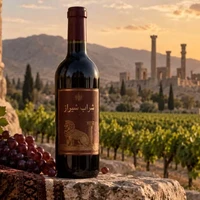
  • Shiraz and the wine industry Iran lost after 1979

    Shiraz and the wine industry Iran lost after 1979

  • Ignore prices and economy is fine, Iran ex-minister says

    Ignore prices and economy is fine, Iran ex-minister says

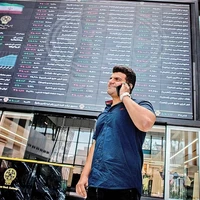
  • Nowhere else to go? The puzzle behind Iran’s stock rally
    INSIGHT

    Nowhere else to go? The puzzle behind Iran’s stock rally

  • Iran escalates Hormuz tanker attacks in gamble ahead of US midterms
    ANALYSIS

    Iran escalates Hormuz tanker attacks in gamble ahead of US midterms

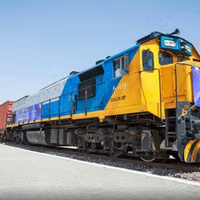
  • Can US sanctions derail Iran’s China trade route?
    ANALYSIS

    Can US sanctions derail Iran’s China trade route?

Banner
Banner
Banner
Banner
Banner
  • Tehran seeks negotiated way out as Washington maintains pressure

    Tehran seeks negotiated way out as Washington maintains pressure

  • Is the Iran-US MoU dead – or are we asking the wrong question?

    Is the Iran-US MoU dead – or are we asking the wrong question?

•
•
•

More Stories

Iran’s strikes on Persian Gulf water and power were deliberate - Reuters

Oct 15, 2026, 12:39 GMT+1
100%
A satellite image taken May 9, 2026, shows strike damage to a collection of pipes sustained in an attack on May 4, 2026. Damage to a critical oil-routing system called a matrix manifold, which was struck in March, is also visible.

Iran and its allies hit water plants, airports, refineries and a nuclear power station across the Persian Gulf with a precision that rules out the official story of falling debris, a Reuters investigation has found, showing the civilian damage was the aim, not a side effect.

Reuters counted at least 135 drone and missile strikes on at least 84 infrastructure sites in Saudi Arabia, the UAE, Iraq, Qatar, Kuwait, Oman and Bahrain since the war began on February 28. Again and again, the munitions struck the one piece of equipment a facility could least afford to lose, some of it hidden under rooftops or only a few meters across.

Iran’s parliament speaker, Mohammad-Bagher Ghalibaf, has said as much. “It’s simple: the oil and gas production chain here is sprawling, accessible, and exposed,” he wrote on X in early September.

  • Iran escalates Hormuz tanker attacks in gamble ahead of US midterms

    Iran escalates Hormuz tanker attacks in gamble ahead of US midterms

“American oil and gas companies across these waters and facilities share that exposure.” Three days later, three pumping stations on Saudi Arabia’s East-West Pipeline were hit.

Reuters based its findings on 36 interviews, imagery and satellite data.

‘Falling debris’

In at least 34 statements, the region’s governments blamed damage on debris from successful interceptions. Fourteen experts who reviewed Reuters’ imagery, 11 from the affected industries, said that was highly improbable, citing signs of explosive detonation and the importance of what was hit.

  • Iran warns of wider risks as regional attacks intensify

    Iran warns of wider risks as regional attacks intensify

Five of the states make it illegal to photograph or share certain images of strike damage.

‘Running out of water in days’

Kuwait, a desert country, draws 90 percent of its drinking water from desalination plants, most of them attached to coastal power stations because removing salt from seawater takes enormous amounts of heat and electricity.

Iran hit at least four of Kuwait’s eight combined power and desalination plants between March 2 and July 20, Reuters found, some more than once. In one four-day period in July, it struck what the government called “several” desalination plants, one of them at least twice.

“If you were to attack enough of their capacity, we’re talking about running out of water in days or weeks,” said Michael Christopher Low, director of the Middle East Center at the University of Utah. Donald Trump had threatened Iran’s water supply in March, Low said, but it was Iran that turned the threat into reality for its neighbors.

Kuwait’s government asked citizens to save water and electricity in “the spirit of shared responsibility.”

  • Tehran signals escalation in conflict IRGC likens to a ‘world war’

    Tehran signals escalation in conflict IRGC likens to a ‘world war’

The strikes also hit Kuwait’s main refineries. In April it exported no crude at all, the first time since 1991, according to TankerTrackers.

A nuclear power plant

On May 17, a drone hit an electrical substation at the UAE’s Barakah nuclear plant, about 130 meters from a reactor, forcing one of its four reactors onto emergency diesel generators, according to the International Atomic Energy Agency.

“This means whoever was or is behind this knew exactly what they were doing,” IAEA chief Rafael Grossi said.

Three officials told Reuters Iran had the plant’s floor plan. The UAE said the drone came from “armed factions in Iraq.” There was no radioactive release.

100%
A satellite image taken March 5, 2026, at the United Arab Emirates port of Fujairah after an attack on March 3, 2026, shows tanks burning.

Fujairah

The UAE’s main oil port outside the Strait of Hormuz, Fujairah was the region’s lifeline once Iran blockaded the strait. It was struck at least 19 times, and for the first three months of the war was either under attack or under repair.

  • Khamenei adviser warns UAE as tensions with Tehran escalate

    Khamenei adviser warns UAE as tensions with Tehran escalate

  • Iran's rhetoric against UAE hardens after Netanyahu visit

    Iran's rhetoric against UAE hardens after Netanyahu visit

The first strike, on March 3, left tanks burning that were still visible from space two days later. On March 9, a strike destroyed the first of the port’s two matrix manifolds, a junction of 62 pipelines that carries crude and refined products from the terminals to the ships. Emirati officials blamed debris.

“This is a wound to the brain and heart,” said Ramanan Krishnamoorti, a petroleum engineering professor at the University of Houston, who said it stretched credibility that debris had simply fallen onto the manifold.

Strikes on March 14, 16 and 17, beginning hours after a US attack on Iran’s Kharg Island oil terminal, damaged the second manifold, Reuters found, a hit not previously reported. Loadings fell to 440,000 barrels a day in the week of March 16, less than half the 2025 average, according to Kpler.

100%
A satellite image taken September 11, 2025, shows the aftermath of a September 10, 2026, attack on a pumping station on Saudi Arabia's East-West Pipeline.

“We were watching it come in and watching the helicopters blast the drones out of the sky,” said a foreign businessman who watched one wave from a nearby road. “They were sending swarms of drones and one or two got through.” American-made Patriot batteries sat about 3 kilometers away.

The port recovered to a weekly record of 3.2 million barrels a day by the end of March. Iran struck again on April 6 and May 4, the second time hitting the pipes feeding the first manifold. Refined exports essentially stopped: a single ship left between May 4 and June 1, and they did not recover until September. In at least six statements, Emirati authorities blamed debris; none admitted major damage.

The UAE’s reprieve

Strikes on UAE infrastructure stopped after May 17.

In June, four sources told Reuters, the UAE agreed to unlock at least $10 billion in frozen Iranian funds, $3 billion of which was released, and two said Iran agreed in return to stop attacking. The UAE denied any agreement. A senior Iranian official confirmed the transfer but said it reflected “the correction of the UAE’s behavior.”

In September, as Iran attacked ADNOC tankers at sea, Fujairah set a monthly export record of 2.62 million barrels a day.

  • Houthi airport strikes carry echoes of Iran’s aviation threats, experts say

    Houthi airport strikes carry echoes of Iran’s aviation threats, experts say

  • Trump says Iran decision coming, suggests Tehran behind Houthi attacks

    Trump says Iran decision coming, suggests Tehran behind Houthi attacks

The other routes

At Qatar’s Ras Laffan, which handles nearly a fifth of the world’s liquefied natural gas, two strikes destroyed the cold boxes that chill gas into liquid. QatarEnergy says repairs will take three to five years.

On September 10, the attack on the East-West Pipeline halted crude flowing across the desert to the Red Sea port of Yanbu, a route for up to 4 percent of global supply. Riyadh blamed Iran-backed militias in Iraq.

Iran-linked strikes have damaged five of Saudi Arabia’s nine biggest refineries and output fell from more than 10 million barrels a day to below 7 million, a loss of over $50 billion.

Airports in at least four countries, Amazon data centers and the UAE’s Al Taweelah aluminum smelter were also hit. The smelter will not return to normal before 2027.

“Every single target was civilian,” said Sultan Al Jaber, head of the Abu Dhabi National Oil Company. “They are targeting our infrastructure. But what they’re really targeting is our way of life.”

100%
A satellite image taken July 30, 2026, shows damage to tanks at Saudi Aramco's Abqaiq oil processing facility, which was attacked on July 27, 2026.

The Houthis and the Red Sea

After the April ceasefire collapsed, Revolutionary Guards commanders flew to Yemen on July 13 with missile and drone equipment for the Houthis, according to Reuters.

From July 16 to 18, US forces hit bridges and a tunnel on the roads to Bandar Abbas, strikes Iran International mapped in its investigation of Iran’s road and rail network.

  • 670 bridges, 380 tunnels: The network that moves Iran's army and its missiles

    670 bridges, 380 tunnels: The network that moves Iran's army and its missiles

The Houthis answered by hitting Saudi Arabia, knocking the Jazan refinery’s output to zero. The group has since declared a naval embargo on Saudi Red Sea ports, hit tankers and the airport in Najran, and taken the port of Mokha. On Saturday, a strike blamed on the Houthis killed 12 people at King Khalid International Airport in Riyadh.

Saudi Arabia’s crown prince asked Trump for military help in September and was rebuffed. Riyadh had already signed a mutual defense pact in Mecca with Turkey and Pakistan in August.

In 1983, a CIA assessment warned that “even a few attacks against well-chosen targets could do considerable damage” to the region’s oil facilities. Fujairah, which began full operations the same year, has since been struck at least 19 times.

Tehran signals escalation in conflict IRGC likens to a ‘world war’

Oct 14, 2026, 18:55 GMT+1
•
Behrouz Turani
100%
Iranian missile are displayed on the anniversary of the 1979 Revolution in Tehran, Iran, February 12, 2026

A senior Revolutionary Guards official has compared Iran’s conflict with the United States to a world war that could reshape the global order, reflecting a mindset in Tehran that appears increasingly resistant to backing down despite the risk of renewed US attacks.

IRGC political deputy Yadollah Javani said Wednesday that the conflict could have consequences comparable to the two world wars and alter the global balance of power.

His remarks capture a broader calculation among Iranian hardliners: if the confrontation is genuinely existential and its consequences historic, preserving Iran’s leverage may matter more than reducing the immediate risk of escalation.

That calculation is increasingly visible around the Strait of Hormuz, where the IRGC has intensified threats against US and commercial vessels even as officials warn that Washington may be preparing another attack.

President Donald Trump recently told an election campaign gathering in Alaska that he would call on Israel to prepare for a possible attack on Iran, while saying a decision on Iran would be announced “very soon.”

IRGC spokesman Hossein Mohebi said Washington could launch new attacks before the November midterm elections, arguing that Trump might seek a military achievement before voters go to the polls.

Pressure around Hormuz

A Singapore-flagged container ship sank near the strait after being hit by a projectile, Reuters reported Wednesday, citing maritime security sources.

IRGC Navy Rear Admiral Ali Azmaei said Iranian coastal defense and fast-attack units were “waiting for American warships to approach the Strait of Hormuz so they can be sunk.”

He also warned that commercial vessels operating under coalition naval escort should not assume they would be protected from Iranian action.

Iranian media also reported Wednesday that a small fishing boat had been attacked by an unidentified drone near the strait, killing those on board. The circumstances of the reported attack remained unclear.

Javani said Wednesday that Iran had moved beyond the danger of a surprise attack and that its armed forces were prepared to respond to further enemy action.

He said Iran's adversaries had expected the killing of former Supreme Leader Ali Khamenei to produce victory within 48 to 72 hours.

Tehran has meanwhile continued to distance itself from Houthi attacks on Saudi Arabia. Whatever their origin, attacks threatening Saudi energy infrastructure add to pressure on oil markets, increasing the economic cost of the wider confrontation.

The appeal of the grey zone

Despite the growing economic cost to Iran itself, hardline outlets including Kayhan, Javan and state television continue to champion the “neither war nor negotiation” strategy associated with former Supreme Leader Ali Khamenei.

A comprehensive agreement with Washington could require Tehran to surrender some of its nuclear and regional leverage, while another full-scale war could impose far greater costs on the country and threaten the political system itself.

Remaining between the two, hardliners argue, allows Iran to preserve its nuclear capabilities and regional influence without making irreversible concessions.

They also frequently cite the US withdrawal from the 2015 nuclear agreement, known as the Joint Comprehensive Plan of Action, as evidence that American commitments cannot be trusted and that any agreement reached today could be abandoned by a future administration.

But the escalating confrontation around Hormuz illustrates the danger inherent in that strategy. Maintaining such a grey zone requires Tehran to create enough risk to generate leverage without pushing the United States or Israel into another major attack.

Where the factions agree

Moderate, pragmatist and reformist-aligned media outlets close to President Masoud Pezeshkian and his foreign policy team have generally argued that Tehran should take advantage of diplomatic opportunities before conditions change.

Their disagreement with hardliners is substantial but does not necessarily extend to Iran's fundamental objectives.

Both sides seek to preserve the Islamic Republic and as much of its nuclear and regional leverage as possible. They differ over whether diplomacy or continued pressure offers the safer route.

For now, Tehran appears to be testing the hardline proposition that it can raise the cost of confrontation enough to make Washington compromise without pushing Trump toward war instead.

Seen from that perspective, Javani's invocation of a world war is more than bellicose rhetoric. It reflects a view of the confrontation as consequential enough that backing down carries risks of its own.

The increasingly dangerous contest around the Strait of Hormuz may determine how much room remains between compromise and another war.

Women’s Basij commander, police officer killed in southeast Iran

Oct 14, 2026, 11:54 GMT+1
100%

A women’s Basij commander and a police officer were killed in separate attacks on Wednesday in Iran’s southeastern Sistan-Baluchestan province, adding to a series of deadly shootings, bombings and armed clashes in the region.

The IRGC-linked Tasnim news agency said a commander of a women’s Basij unit in Mehrastan County was shot dead outside her home.

Tasnim attributed the killing to what it described as militants linked to the United States and Israel, but did not identify a group or provide evidence supporting that assertion.

The Basij is a paramilitary organization operating under Iran’s Islamic Revolutionary Guard Corps.

Police vehicle attacked in Mehrastan

In a separate incident in the same county, unidentified gunmen attacked a police vehicle, killing First Sergeant Mohammad Ali Shahriari, Tasnim reported.

The outlet did not provide details about the attackers, the circumstances of the shooting or whether anyone else was wounded.

The two killings came a day after major armed confrontations elsewhere in Sistan-Baluchestan that left casualties on both sides, according to Iranian authorities and local reporting.

Six killed in operation near Zahedan

The Revolutionary Guards said on Tuesday that five members of an alleged kidnapping cell and one of its personnel were killed near Zahedan, the provincial capital.

The IRGC Ground Force’s Quds regional headquarters said its forces located the group in the Kurin area after an engineer working on construction projects west of Zahedan was abducted a day earlier.

It said five members of the group were killed, the hostage was freed and one IRGC member was killed.

According to the statement, the kidnappers had links to armed groups and intended to take the engineer into a neighboring country. It did not identify the group or the country.

An earlier Tasnim report had put the number of people killed in that operation at three.

  • Iran says six killed as armed clashes intensify in southeast

    Iran says six killed as armed clashes intensify in southeast

  • Over 90 killed in six months as clashes escalate in Iran's southeast - report

    Over 90 killed in six months as clashes escalate in Iran's southeast - report

  • Iranian security forces face wave of deadly attacks in restive southeast

    Iranian security forces face wave of deadly attacks in restive southeast

More than 20 Fatemiyoun casualties reported

Separately, Haalvsh, which covers developments in Sistan-Baluchestan, said more than 20 members of the Fatemiyoun were killed or wounded Tuesday during more than seven hours of fighting in the mountainous Chah Ahmad and Arzan Tak areas of Taftan County. The figure could not be independently verified.

Citing local sources and eyewitnesses, Haalvsh said armed men who had taken positions in the mountains opened heavy fire on a group that included Fatemiyoun fighters traveling on motorcycles.

Fatemiyoun is an Iran-backed Shiite militia composed largely of Afghan fighters and organized with support from the Revolutionary Guards. Its members have fought alongside Iranian forces in regional conflicts.

Haalvsh said reinforcements later arrived with more than 40 vehicles as well as reconnaissance and combat drones. It also reported mortar and heavy-weapons fire in the surrounding mountains.

The identities and affiliation of the armed men involved in the fighting remained unclear.

Series of attacks on security personnel

Sistan-Baluchestan, which borders Pakistan and Afghanistan, has seen repeated attacks on police and military personnel in recent weeks.

On October 9, Iranian state media reported that Nosrat Eftekhari, a senior provincial police official, was killed in a roadside bombing near Zahedan.

A day earlier, a police commando was killed in an armed attack near Nosratabad, while a separate attack on a vehicle carrying Iranian Army personnel near Nikshahr killed another serviceman.

On September 23, an armed confrontation in Saravan killed Hossein Zarifi, a commander with the IRGC’s Sajjad base, according to the Guards’ Quds regional headquarters. Haalvsh separately reported that another intelligence official was killed and at least 13 other personnel were wounded.

At least five Fatemiyoun members were also reported killed in an armed attack near Zahedan on October 2.

More than 90 killed since March - HRANA

The US-based Human Rights Activists News Agency said this week that at least 94 people were killed and 33 wounded in 63 armed incidents across southeastern Iran between March 31 and October 10.

HRANA said attacks on patrol vehicles and military convoys were the most common incidents it documented, followed by targeted shootings.

It also reported increased use of mines, rocket-propelled grenades and other heavier weapons by armed groups, while forces of the Islamic Republic used drones, artillery and armored vehicles in several operations.

The group said the People’s Fighters Front, an alliance formed in December 2025 that includes Jaish al-Adl and several smaller Baluch armed groups, had taken responsibility for six of the incidents it documented. Most attacks remained unattributed or could not be reliably linked to a particular group, HRANA said.

Sistan-Baluchestan, one of Iran’s poorest provinces and home to much of the country’s Sunni Baluch minority, has long seen armed confrontations between the Islamic Republic’s security forces and Baluch armed groups. The frequency and intensity of such incidents have increased in recent months.

Iran escalates Hormuz tanker attacks in gamble ahead of US midterms

Oct 14, 2026, 03:32 GMT+1
•
Negar Mojtahedi
100%
A tanker and a container ship were hit by projectiles of unknown origin in the Strait of Hormuz.

Iran's surge in attacks on commercial shipping in the Strait of Hormuz may be an attempt to exploit US restraint ahead of the midterm elections and undermine a recovery in Persian Gulf oil shipments, experts told Iran International.

Twelve vessels were attacked between October 5 and 11, including six on Sunday alone, and on Tuesday a tanker and a container ship were struck by unknown projectiles, according to UK Maritime Trade Operations (UKMTO), marking one of the most intense periods of attacks since the war began.

Rear Admiral Ali Azmaei of Iran’s Islamic Revolutionary Guard Corps Navy warned Tuesday that Iranian forces would sink US warships approaching the Strait of Hormuz, saying they were “counting down” to a possible confrontation in the strategic waterway.

The escalation comes as the US blockade has effectively halted Iran's crude oil exports, while other Persian Gulf producers have increasingly succeeded in moving their oil through the strategic waterway, threatening to erode one of Tehran's remaining sources of leverage. Brent crude settled at $105.69 per barrel Tuesday, snapping three consecutive sessions of gains, as traders weighed continued Middle Eastern supply disruptions against other market developments.

Charlie Brown, a maritime security expert with United Against Nuclear Iran (UANI), believes the timing may be linked to President Donald Trump's announcement that Washington would not launch new attacks against Iran before the November 3 midterm elections.

"I think Trump signaled it, right? He said he wouldn't attack until the election," Brown told Iran International.

"So, you know, now they're taking that as word, I guess. And testing it and taking advantage of the situation."

Brown said the absence of direct American retaliation for the latest strikes may be encouraging Tehran to push further.

Two senior Iranian officials separately told Reuters that Tehran had changed the type and pace of its attacks, with one goal being to influence the US midterm elections and frustrate efforts to lower global oil prices.

"Every attack that goes without a response probably encourages a follow-on attack," he said.

The calculation extends beyond the military confrontation. Although the United States is less dependent on Persian Gulf oil than many Asian economies, disruptions affect global energy prices and American consumers.

Brown suggested Tehran may be exploiting that vulnerability at a politically sensitive moment, when rising gasoline prices could increase pressure on the White House.

An October surprise?

Shahram Kholdi, a historian of Iran, sees a potentially more ambitious calculation: an attempt to engineer an "October surprise" that could put Trump under pressure ahead of the elections.

Kholdi believes Tehran may have used the relative lull in hostilities to preserve its remaining military capabilities, replenish weapons stockpiles and prepare for a politically advantageous moment to escalate.

"It seems to me that they are headed towards that October surprise moment," he told Iran International.

But Kholdi warned that the strategy could backfire if Tehran moves beyond commercial shipping and attempts to strike American naval assets with advanced missiles.

The danger, in his assessment, is that Tehran may mistake temporary American restraint for an unwillingness to retaliate.

Iran threatens recovery in Persian Gulf oil flows

The latest attacks threaten to reverse a recovery in Persian Gulf oil shipments that had begun to weaken Tehran's ability to disrupt global energy supplies.

Despite the war, producers had managed to increase exports through Hormuz, aided by US protection measures, larger tankers and costly arrangements to move cargo through the threatened waterway.

Oil flows out of the Persian Gulf averaged approximately 15.5 million barrels per day in September, their highest level since the war began, according to recent data by Kpler.

But shipments have since fallen sharply. Just 2.9 million barrels passed through Hormuz on October 11, the lowest daily volume recorded this month, according to Kpler.

The figures underscore the vulnerability of the recovery, although daily flows can fluctuate significantly and do not alone establish how much of the decline resulted directly from the attacks.

Brent crude settled at $104.77 per barrel Tuesday after three consecutive sessions of gains, as traders weighed continued Middle Eastern supply disruptions against other market developments.

Tom Sharpe, a former Royal Navy commander, said the earlier recovery in oil volumes had masked the dangers facing commercial vessels.

"We're at sort of pre-war levels of oil, but in far fewer ships," he told Iran International.

Sharpe described large tankers making high-risk passages with enhanced American protection, sometimes sustaining strikes before reaching safer waters and transferring cargo to other vessels.

In some cases, he said, crews are also transferred after completing the most dangerous part of the journey.

"It's not working. Iran is still striking," Sharpe said of the enhanced protection measures.

According to the Joint Maritime Information Center, US-facilitated vessel movements through Hormuz averaged approximately 29 per day over a recent 72-hour period, compared with a historical average of roughly 138 daily transits.

Undermining confidence in shipping

Brown said Iran does not need to stop every vessel to undermine confidence in the safety of the waterway.

Exceptionally high tanker charter rates have encouraged some operators to continue despite the danger, but others may decide the financial rewards are not worth risking their vessels and crews.

"There will always be some that take the risk because the profits are so big right now," he said.

The threat has also spread beyond the strait, with vessels attacked near Oman's Sohar anchorage and elsewhere in the Persian Gulf.

Brown believes Iran continues to receive Russian and Chinese intelligence assistance, potentially including satellite imagery and vessel-tracking information that does not rely on ships' Automatic Identification System signals.

"I'm confident that that's still happening on a daily basis," he said.

The escalation comes amid renewed diplomatic contacts between Tehran and Washington, with Iranian officials saying the United States has accepted some of Tehran's conditions for de-escalation but that its response remains insufficient.

Trump said Tuesday that Washington would make a decision on Iran “very soon.”

"We'll make a decision on Iran very soon," Trump told reporters, describing Iran as a "failed country" with no economy, inflation of 300 percent and a government unable to pay its troops.

The United States continues enforcing its maritime blockade, while Trump has said Washington will not resume strikes against Iran before the November 3 elections.

Sharpe noted that the surge in attacks on shipping is occurring alongside intensified strikes by the Iran-backed Houthis against Saudi Arabia.

"There's an Iranian and Houthi escalation going on here that's not being matched. How long will that carry on for?" he said.

The simultaneous pressure on Persian Gulf shipping and Saudi infrastructure risks widening the confrontation at a time when diplomatic efforts have yet to produce a settlement.

The stakes for Tehran are particularly high.
Kpler data shows no Iranian crude oil or condensate loaded onto tankers throughout September, leaving the Islamic Republic increasingly dependent on its ability to threaten shipments from neighboring producers to maintain leverage over Washington.

But the strategy carries a significant risk: an attack causing substantial casualties or striking US military assets could trigger the kind of direct American retaliation Kholdi warned Tehran may be underestimating.


Trump says Iran decision coming, suggests Tehran behind Houthi attacks

Oct 14, 2026, 00:35 GMT+1
100%
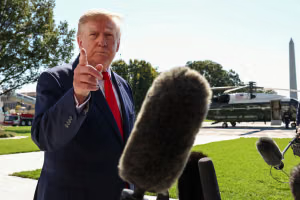
U.S. President Donald Trump speaks to reporters on the South Lawn of the White House on October 13, 2026, before departing for Alaska.

US President Donald Trump said Tuesday he would make a decision on Iran “very soon,” as fresh attacks hit commercial shipping in the Strait of Hormuz and the war between Saudi Arabia and Yemen’s Houthis escalated.

Speaking to reporters before departing for Alaska, Trump described Iran as a “failed country” with severe economic problems but did not specify what decision Washington was considering.

"Iran is a failed country. They have no economy. They have 300 percent inflation. They have no money. They're not paying their troops. They're not paying anybody. We'll make a decision on Iran very soon," Trump said.

Trump's remarks came as fighting between Saudi Arabia and Yemen's Iran-backed Houthis intensified.

In a separate Truth Social post, Trump suggested the renewed attacks were carried out “probably at the behest of Iran” and accused the Houthis of deliberately trying to drive up oil prices ahead of the November 3 US midterm elections.

"They’ve been silent for a long time, but now they’ve emerged again, probably at the behest of Iran, which is a Failing Nation, with No Navy, No Airforce, the World’s Worst Economy, and 301% Inflation, in a very nasty way, hitting Saudi Arabia, and purposefully trying to drive up Oil Prices, probably prior to the U.S. Elections — NOT NICE," Trump wrote.

“I’ll be there after the elections, and I will never forget!” he added.

Trump also said he might ask Turkish President Recep Tayyip Erdogan to help Saudi Arabia deal with the Houthis. He said the Houthis were “behaving very badly” and added, “President Erdogan, I think, would do as I ask.”

Trump said Saturday he was considering whether the United States should join Saudi Arabia's military campaign against the Houthis following the deadly attack on Riyadh's King Khalid International Airport.

Saudi Arabia intercepts Houthi missiles and drones

Houthi attacks on Saudi Arabia continued on Tuesday following a deadly strike on Riyadh's King Khalid International Airport on Saturday that killed 13 people and wounded more than 300.

The Saudi-led coalition said its air defenses intercepted and destroyed five drones and six missiles targeting Saudi Arabia on Tuesday, including Riyadh, Dhahran and the country's southern region.

Loud explosions were heard near Saudi Aramco's headquarters in Dhahran, where a fire broke out after a missile attack. A source with direct knowledge told Reuters the headquarters had been struck, though it was unclear whether the building was hit directly or by falling debris. Saudi Arabia's Energy Ministry said the fire was limited to an administrative building and caused no injuries.

As attacks continued on Saudi territory, the Saudi-led coalition carried out strikes in Yemen.

Houthi-run Al-Masirah television said the coalition struck the Yemen Petroleum Company's Al-Sabaha central station on the outskirts of Sanaa after ordering civilians to evacuate the site.

Houthi military spokesperson Yahya Saree said the group's forces were confronting Saudi fighter jets targeting Sanaa and warned that attacks on the Yemeni capital would be met with a “harsh and painful” response in Riyadh.

The fighting prompted a series of diplomatic calls across the region on Tuesday.

Turkish President Recep Tayyip Erdogan told Saudi Crown Prince Mohammed bin Salman that Turkey would continue to stand by the kingdom, strongly condemning the Houthi attacks, according to the Turkish presidency.

Egyptian Foreign Minister Badr Abdelatty called for an immediate halt to attacks on Saudi Arabia during a phone call with his Iranian counterpart Abbas Araghchi, calling the attacks unjustified and unacceptable, Egypt's Foreign Ministry said.

Araghchi also spoke with Turkish Foreign Minister Hakan Fidan on Tuesday about regional developments and efforts to resolve ongoing conflicts, according to Turkish Foreign Ministry sources.

German Chancellor Friedrich Merz urged Iran to engage in serious negotiations and stop destabilizing the region after speaking with Saudi Crown Prince Mohammed bin Salman, according to the German government.

Two more ships struck in Strait of Hormuz

A tanker and a container ship were struck by unidentified projectiles in the Strait of Hormuz on Tuesday, UKMTO said in separate notices. The latest incidents followed a sharp increase in attacks on commercial shipping, with 12 vessels reported attacked in and around the Strait of Hormuz and Persian Gulf between October 5 and 11, according to a tally of UKMTO warnings.

UKMTO said both incidents were under investigation and that details of damage or casualties had not been established.

The incidents came as Iran's Revolutionary Guards renewed threats against US naval forces operating near the strait.

IRGC Navy commander Ali Azmaei said Iranian forces were waiting for American warships to approach the Strait of Hormuz so they could be “sunk.”

Azmaei also claimed the Strait of Hormuz and Persian Gulf were under IRGC Navy control.

US Central Command rejected Azmaei's assertion, saying Tuesday that “American forces and regional partners clearly control the Strait of Hormuz.” CENTCOM said US forces had assisted Persian Gulf partners in shipping more than 19 million barrels of crude oil through the strait on Monday.

Trump weighs next steps on Iran

Trump’s comments about an impending decision on Iran came as Axios reported his administration was weighing whether to maintain pressure on Tehran or resume military action.

Axios reported Tuesday that Trump and Israeli Prime Minister Benjamin Netanyahu discussed a possible new operation against Iran last week, with Netanyahu raising concerns that Tehran was rebuilding parts of its nuclear program.

A US official told Axios that Trump told Netanyahu to prepare for a possible operation but made no commitment on whether or when military action would take place. A White House official disputed that Trump and Netanyahu discussed resuming the war and reiterated that the United States would not attack Iran before the November 3 midterm elections.

Axios said Trump had initially appeared inclined toward renewed strikes but later became more hesitant, while most of his advisers favored maintaining economic and other pressure on Iran for now.

The possibility of renewed military action has also prompted warnings from Tehran. Mohammad Reza Naghdi, a senior adviser to the commander of Iran’s Revolutionary Guards, said a US ground attack would result in large numbers of American troops being captured.

“If the United States launches a ground attack, so many of its troops will be captured that it will be forced to raise the white flag,” Naghdi said.