• العربية
  • فارسی
Brand
  • Iran Insight
  • Politics
  • Economy
  • Analysis
  • Special Report
  • Opinion
  • Podcast
  • Live TV
  • Iran Insight
  • Politics
  • Economy
  • Analysis
  • Special Report
  • Opinion
  • Podcast
  • Live TV
  • Theme
  • Language
    • العربية
    • فارسی
  • Iran Insight
  • Politics
  • Economy
  • Analysis
  • Special Report
  • Opinion
  • Podcast
  • Live TV
All rights reserved for Volant Media UK Limited
volant media logo
ANALYSIS

Iran's rhetoric against UAE hardens after Netanyahu visit

Maryam Sinaiee
Maryam Sinaiee

Iran International

Oct 2, 2026, 08:00 GMT+1
Masoud Pezeshkian and Khaled bin Mohamed bin Zayed Al Nahyan, Crown Prince of the United Arab Emirates

Iranian officials and media have sharply condemned Israeli Prime Minister Benjamin Netanyahu’s visit to the UAE, warning Abu Dhabi over its deepening ties with Israel amid renewed tensions over three disputed Persian Gulf islands.

Iran’s Foreign Ministry on Thursday condemned Netanyahu’s visit, warning of what it called the “very dangerous consequences” of an Israeli presence in the region.

The ministry said any move that provides “a platform for destabilizing actors to enter the region” would ultimately harm regional countries by fueling division and instability. It called on governments to prevent their territories from becoming “a platform for destabilizing actions” against neighboring states.

Mohsen Rezaei, secretary of Iran’s Supreme National Security Council, issued a more direct warning to the UAE on Wednesday.

“Just as hosting US military bases has not brought you security, hosting the butcher of Gaza will not have positive consequences either,” he wrote on X. “Learn from the recent war, stop starting wars and refrain from making baseless claims about the Iranian islands.”

The hardline Javan newspaper, affiliated with the Revolutionary Guards (IRGC), described Rezaei’s remarks as “a clear warning to Abu Dhabi,” saying Iran’s neighbors could pay a price for policies they believed would bring them greater security.

The rhetoric comes as the UAE’s security relationship with Israel faces fresh scrutiny following an attempted attack aboard a Flydubai flight from Dubai to Tel Aviv.

Israeli and Emirati authorities are investigating the incident, while US President Donald Trump said Thursday that investigators were examining a possible Iranian connection, although no evidence of Tehran’s involvement has been made public.

Iranian media intensify criticism

The criticism in Iranian media has increasingly gone beyond Netanyahu’s visit, with conservative outlets portraying the UAE as an active participant in efforts to contain Iran and questioning whether its cooperation with Israel extends beyond diplomacy.

Nour News, which is close to the Supreme National Security Council, accused the UAE of pursuing a two-track policy — publicly advocating de-escalation and dialogue with Iran while maintaining close security ties with the United States and Israel and pressing its claims to the disputed islands.

The website also portrayed Netanyahu’s visit as part of broader Israeli-Emirati efforts to reshape the regional security order and increase pressure on Saudi Arabia, though it offered no evidence of a coordinated plan.

Sobh-e No, considered close to parliament speaker Mohammad-Bagher Ghalibaf, warned that cooperation with a country involved in a war against Iran, whether military or intelligence-related, could affect Tehran’s security calculations.

The newspaper questioned whether the UAE’s role had been limited to hosting political meetings or whether its security cooperation with Israel had extended to the military confrontation with Iran.

Economic ties under strain

The increasingly hostile rhetoric comes against a history of extensive economic ties between Iran and the UAE, although Abu Dhabi suspended trade with Iran in August amid the war.

In 2024, around $21 billion of Iranian imports came from the UAE, accounting for roughly 30% of the total, according to World Trade Organization data. The UAE was also one of Iran’s largest destinations for non-oil exports.

The country has also long served as a hub for Iranian companies and intermediaries involved in moving goods and money around US sanctions.

Some Iranian conservatives are now arguing that those economic ties gave the UAE excessive influence over Tehran’s policy.

Conservative political activist Ali Gholhaki accused the UAE of profiting from sanctions on Iran while increasingly using its influence in Israel’s favor. He also alleged the existence of a “UAE lobby” inside Iran that had prevented Tehran from taking punitive measures against Abu Dhabi.

Calls for retaliation

The rhetoric has gone further among some figures close to Iran’s political establishment, with calls for direct retaliation against the UAE.

Mehdi Mohammadi, a strategic adviser to parliament speaker Ghalibaf, accused the UAE of cooperating with Netanyahu in launching a war against the Islamic Republic in a commentary published by the conservative Alef website.

“There is not much difference between them and the Israelis,” Mohammadi wrote.

“This time, the Emiratis should taste in Dubai, Sharjah and Ras al-Khaimah what they have brought about in Africa, Yemen, Somalia and the Arabian Peninsula. It is time for flames of light to be seen in the middle of Dubai.”

The rhetoric marks a sharp deterioration in Iranian discourse toward a neighbor with which Tehran had until recently sought de-escalation and maintained extensive commercial ties, with Netanyahu’s visit intensifying an already widening rupture over Israel, regional security and the disputed islands.

Most Viewed

Iran oil exports vanish as regional flows surpass prewar levels
1

Iran oil exports vanish as regional flows surpass prewar levels

2
INSIGHT

US ‘feedback’ leaves Iran debating the price of diplomacy

3

Trump says renewed bombing of Iran after midterms 'possible'

4

Iranian weapons, Chinese supplies fuel Houthi advance in Yemen - WSJ

5
INSIGHT

Tehran weighs what comes next if US diplomacy fails

Banner
Banner

Spotlight

  • Can the Caspian give Iran a way around Hormuz?
    ANALYSIS

    Can the Caspian give Iran a way around Hormuz?

  • An account of espionage: From banks and phone lines to Malard missile base blast
    SPECIAL REPORT

    An account of espionage: From banks and phone lines to Malard missile base blast

  • Iranian press sees diplomacy alive but narrowing after US response
    INSIGHT

    Iranian press sees diplomacy alive but narrowing after US response

  • Leaked Kremlin plan undercuts Moscow's claims on ruble-rial trade with Iran
    INSIGHT

    Leaked Kremlin plan undercuts Moscow's claims on ruble-rial trade with Iran

  • Iran oil exports vanish as regional flows surpass prewar levels

    Iran oil exports vanish as regional flows surpass prewar levels

  • 670 bridges, 380 tunnels: The network that moves Iran's army and its missiles
    SPECIAL REPORT

    670 bridges, 380 tunnels: The network that moves Iran's army and its missiles

  • Iran turns to younger children in postwar ideological push
    ANALYSIS

    Iran turns to younger children in postwar ideological push

Banner
Banner
Banner
•
•
•

More Stories

Iranian press sees diplomacy alive but narrowing after US response

Oct 2, 2026, 03:34 GMT+1
•
Behrouz Turani
100%
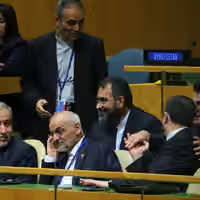
Iranian Foreign Minister Abbas Araghchi and other delegates attend the 81st United Nations General Assembly (UNGA) at UN headquarters in New York City, US, September 23, 2026.

Tehran media see diplomacy with Washington as increasingly precarious but not yet dead, with the two sides far apart over the sequencing of any deal and the window for compromise appearing to narrow.

Iran has disputed US accounts that Secretary of State Marco Rubio ordered Foreign Minister Abbas Araghchi and his delegation to leave the country after indirect negotiations in New York reached a stalemate.

Iran’s UN mission said the delegation left according to a schedule communicated to the State Department on September 17 and dismissed reports of a US-mandated departure as “baseless and worthless.”

Two US officials told the Associated Press that Rubio ordered the delegation to leave after little progress in indirect talks mediated by Qatar.

The dispute follows Washington’s response to Iran’s seven-point proposal for de-escalation and reopening the Strait of Hormuz. Araghchi has said Tehran has made no changes to the proposal, which calls for lifting the blockade and unfreezing Iranian assets as steps toward reopening maritime transit and resuming nuclear negotiations.

Iranian media have nevertheless stopped short of declaring the diplomatic process dead.

Across outlets ranging from the government’s Iran Newspaper and state broadcaster-affiliated Jam-e Jam to the moderate business daily Donya-ye Eghtesad, the negotiations are portrayed as a stalled bargaining process rather than a complete collapse.

Washington’s response, delivered through Qatar, is seen as keeping the diplomatic channel open even as the two sides remain far apart.

Across the three outlets, four broad conclusions emerge.

First, no comprehensive settlement appears close. Even the more optimistic assessments envisage, at best, a phased arrangement focused initially on crisis management rather than a broader breakthrough.

Second, trust remains a central constraint. Iran Newspaper and Jam-e Jam cite the US withdrawal from the JCPOA in 2018 and subsequent American policy, while Donya-ye Eghtesad frames the problem more neutrally as the enduring question of which side should move first.

Third, the central dispute is increasingly about sequencing. Tehran wants an end to hostilities, sanctions and blockade relief before reopening Hormuz within seven days and moving to nuclear talks. Washington wants nuclear concessions and movement on Hormuz before easing pressure.

Fourth, from Tehran’s perspective, the Islamabad Memorandum of Understanding remains the principal reference point. The Iranian press portrays the seven-day plan as an accelerated version of the June framework rather than a departure from it.

As the government’s voice, Iran Newspaper presents the seven-point proposal as a reasonable sequence that Washington is obstructing.

It also turns its attention to actors it sees as working against diplomacy, linking Benjamin Netanyahu’s visit to the UAE and his reported intelligence briefing there to efforts to build regional opposition to Iran.

Jam-e Jam similarly rejects accusations that Tehran is seeking to avoid the nuclear issue, arguing that the proposal would bring forward the start of nuclear negotiations from roughly 60 days to seven.

Donya-ye Eghtesad, however, focuses more heavily on the costs of prolonged deadlock. It treats the US response as a test of Iran’s willingness to show nuclear flexibility and argues that verifiable limits on its program would improve the prospects for an agreement.

Despite their different political orientations, the three outlets broadly treat the seven-point plan as the basis for further negotiations rather than something Tehran should abandon.

The remaining debate is largely about timing.

Iran Newspaper and Jam-e Jam argue that leverage over Hormuz, combined with US pre-election concerns about energy prices, favors Tehran holding firm. Donya-ye Eghtesad warns instead that the diplomatic window could close within weeks and that the risks of waiting until after the election may outweigh the benefits.

Trump’s rejection of key Iranian demands, Israeli intelligence activity and the UAE’s acknowledgement of Netanyahu’s visit also provide ammunition to voices in Tehran arguing against early concessions.

Jam-e Jam compared the diplomatic process to a game of Snakes and Ladders, in which every advance is followed by a setback. For now, it sees the US midterm elections as the next major variable that could alter the calculations of either side.

Iran turns to younger children in postwar ideological push

Oct 1, 2026, 07:53 GMT+1
•
Negar Mojtahedi
100%
A teacher hugs elementary schoolgirls carrying Iranian flags on the first day of the new academic year, in Iran's southern port city of Bushehr, September 23, 2026

The Basij has long maintained a presence in Iran's high schools and universities. Its growing visibility among much younger children is drawing attention to a new front in the Islamic Republic's effort to shape a generation that has repeatedly challenged its authority.

As millions of students returned to classrooms this month, Iran's paramilitary Basij appeared prominently in elementary schools as authorities rolled out an education campaign infused with military and ideological messaging.

Iran's Education Ministry announced over the summer that material related to the recent war and the country's military and nuclear capabilities would be incorporated into educational content.

The push comes at a precarious moment for the Islamic Republic, following war, economic turmoil and nationwide unrest—and four years after schoolgirls became some of the youngest and most visible participants in the Woman, Life, Freedom uprising.

“Iran is obviously right now at sort of a crossroads,” historian Arash Azizi told Iran International, as the Islamic Republic struggles to command the loyalty of generations born decades after the 1979 revolution.

“We're talking about much younger people, people under 13,” Azizi said, adding that the Basij had some involvement in primary schools during the early years after the revolution, but considerably less in recent decades.

The memory of Woman, Life, Freedom

Historian Shahram Kholdi said the increased attention to schools cannot be separated from what happened inside them four years ago.

“We should remember that during the Woman, Life, Freedom movement we saw a huge wave of solidarity with this movement, especially in girls' schools in Iran,” he said.

The nationwide protests in January served as another warning. “It was again a wake-up call, harkening back to Woman, Life, Freedom, that they have to control schools,” Kholdi said.

After the death of Mahsa Jina Amini in morality police custody in September 2022, protests spread into schools.

Videos showed schoolgirls removing their headscarves, chanting against the Islamic Republic and removing or defacing images of its leaders. Some were barely teenagers.

The protests turned schools into one of the most visible arenas of youth opposition to the Islamic Republic.

Kholdi argues that the significance of a Basij presence extends beyond ideological instruction. Schools can provide authorities with greater visibility into students and, through them, their families at a time of considerable social and economic discontent.

The Basij's role in policing students also has a history. Kholdi recalled his own high-school years, when Basij members searched students' backpacks each morning for what he described as “contraband cultural material.”

What stands out now, he said, is how far down the age ladder the attention appears to be moving.

The Islamic Republic's concern about losing younger Iranians predates the latest unrest and war. In a January 2025 interview with Iran International, Iran specialist Holly Dagres said the establishment was already looking beyond an increasingly alienated Generation Z.

“They've been actually looking at the next generation, which is Gen Alpha,” she said.

‘North Korea scenario’

Azizi sees the push into younger age groups as part of a broader argument within the establishment over how to respond to a society that has moved away from some of the ideological positions that have defined the Islamic Republic.

“The regime has been trying to sort of bolster its base amongst the youth because it's lost them and it knows they're the future,” Azizi said.

One tendency, he said, favors a return to a more rigid and intensely ideological state—what he described as a “North Korea scenario”—drawing on mass mobilization of its remaining supporters to reinforce mandatory hijab and Islamist social rules.

In that vision, the Basij becomes an instrument not only for building support but for imposing what Azizi called “societal submission.”

But he said such an approach carries its own risk.

“If the regime wants to go toward bringing back Iran to the 1980s and then North Korea,” Azizi said, such policies could “lead to more social protests and social resistance.”

That tension is now reaching further into Iran's classrooms.

During Woman, Life, Freedom, schoolgirls who had spent their entire lives under the Islamic Republic turned some of those classrooms into places of protest. Four years later, the children entering elementary school belong to an even younger generation.

Tehran weighs what comes next if US diplomacy fails

Sep 30, 2026, 23:02 GMT+1
•
Maryam Sinaiee
100%
Iranian President Masoud Pezeshkian listens to Tehran Friday prayer leader Mohammad-Hassan Aboutorabi Fard during a memorial ceremony for prominent jurist Mousa Shabiri Zanjani in Tehran, Iran, September 30, 2026

Continued contacts between Tehran and Washington, mediated by Qatar and Pakistan, have intensified debate inside Iran over whether diplomacy can still produce a deal despite President Donald Trump’s rejection of Tehran’s latest proposal and what should happen if it fails.

Foreign Minister Abbas Araghchi, speaking before leaving New York on Tuesday, rejected suggestions that Tehran had agreed to nuclear concessions, saying Iran’s immediate focus was the Strait of Hormuz.

Despite Trump’s rejection of the Iranian proposal, Araghchi said he had told Qatari mediators that Tehran would wait for an official US response through them.

The reformist newspaper Shargh said Araghchi’s remarks carried an important message: Tehran did not want its return to diplomacy to be interpreted in Washington as a retreat from its nuclear positions.

The dispute is increasingly about whether that diplomatic opening can produce an agreement before pressure gives way to another round of escalation.

An opening, but on whose terms?

President Masoud Pezeshkian reiterated on Wednesday that his government was seeking to bring the Islamabad understanding to fruition. He did not comment directly on Trump’s rejection of Iran’s proposal.

Parliament Speaker Mohammad-Bagher Ghalibaf, meanwhile, responded sharply to Trump’s recent statements, warning that Iran would retaliate against further military action.

“In a region where we do not sell oil, no one will sell oil, and if our security is not ensured, no infrastructure will be safe,” he said.

“The main issue in the coming days will not be whether Iran and the United States are talking to each other, but whether they can move from exchanging messages to an implementable formula,” Shargh wrote.

It said a US response meeting at least some of Tehran’s conditions could lead to more serious negotiations, while failure to find such a formula would return the dispute to “a logic of pressure and confrontation.”

Etemad, another reformist daily, raised a different concern: that the Strait of Hormuz could lose value as an Iranian bargaining tool the longer the confrontation continues.

It argued that if the blockade, restrictions on Iranian oil exports and pressure on Iran’s commercial networks become entrenched, Washington could increasingly rely on economic pressure rather than further large-scale military action.

Former Iranian diplomat Kourosh Ahmadi made a similar argument in Shargh, saying Iranian officials should recognize that “diplomacy is an arena of give-and-take” rather than expect progress while offering almost no concessions.

Trump’s rejection of Tehran’s proposal, he argued, showed that the dispute was increasingly about “who sets the negotiating ground and who will be forced to put more concessions on the table to get out of pressure.”

If diplomacy fails

Hardline voices have pushed in the opposite direction, warning officials against interpreting continued diplomacy as evidence that Iran should compromise.

Political analyst Mehdi Kharatian rejected arguments that the Strait of Hormuz was losing its effectiveness as leverage.

“Do not be deceived by those who these days are flooding you with false and biased reports about the ineffectiveness of oil and the Strait,” he wrote, accusing such voices of implicitly advocating surrender to the United States.

He also warned officials against sending what he described as excessive signals of willingness to negotiate, arguing that doing so could encourage Trump to resume military action.

The possibility of another confrontation was also raised by IRGC spokesman Hossein Mahdavi, who told state television that Iran was already at war. He said the United States was unlikely to launch attacks on the same scale or with the same capabilities as before.

But he added: “In the world of war, everything is possible.”

Mahdavi also claimed Iranian forces continued to target vessels attempting to transit the Strait of Hormuz and that the United States had recently refrained from responding.

The conservative Khorasan newspaper raised the possibility of Iran launching pre-emptive attacks if negotiations over the nuclear issue fail.

It argued that Iran could resort to a “Plan B” aimed at seizing the initiative before its adversaries complete their intelligence and logistical preparations, potentially triggering a period of intensified warfare before the US midterm elections.

The competing prescriptions emerging in Tehran reflect a debate that has moved beyond whether communication with Washington should continue. What the opposing camps increasingly share is a sense that the current diplomatic opening may not remain open indefinitely.

US ‘feedback’ leaves Iran debating the price of diplomacy

Sep 30, 2026, 17:18 GMT+1
•
Behrouz Turani
100%
A woman holds a Janfada flag and a photograph during a mobilisation rally in Tehran, Iran, September 18, 2026

Iran’s receipt of Washington’s response to its seven-point proposal for ending the Strait of Hormuz crisis has sharpened divisions in Tehran over whether to pursue further compromise or intensify pressure on the United States.

The response was reportedly delivered through Qatar and has been described as US “feedback” rather than acceptance or rejection of the Iranian plan.

Hardline voices have portrayed Washington’s position as evidence that further diplomacy is futile, while more pragmatic commentators argue that the fact the US responded at all shows negotiations remain alive.

President Donald Trump had publicly dismissed Iran’s proposal as insufficient. Iranian diplomats said reopening the Strait and lifting the naval blockade were discussed in indirect talks mediated by Qatar.

The dispute in Tehran is increasingly about what it should do next.

Jame Jam, affiliated with state television, published an op-ed Wednesday by hardliner Abbas Salimi-Namin titled “America’s Fear of Admitting Defeat Against Iran.”

Salimi-Namin argued that Washington’s resistance to the seven-point plan, rooted in the earlier Islamabad talks, reflected the White House’s unwillingness to acknowledge that framework as a strategic setback.

US policymakers, he wrote, still cling to the prospect of delivering a “crippling blow” to Iran and fear the domestic political cost of acknowledging failure more than continued escalation.

Kayhan went considerably further.

Editor-in-chief Hossein Shariatmadari portrayed US demands for verifiable nuclear concessions as evidence that Washington never intended to negotiate in good faith.

He argued that linking freer navigation through the Strait to nuclear concessions was an attempt to strip Iran of its principal leverage while maintaining US economic and military pressure.

Kayhan criticized what it described as the Foreign Ministry’s excessive “patience” and called for non-attributable maritime interdictions, deployment of coastal anti-ship batteries and expanded targeting of Western-escorted vessels.

Global energy markets, it argued, must face an “unbearable cost” before Washington lifts its blockade.

The moderate daily Sharq offered an almost opposite prescription.

In a commentary, Ahmad Zeidabadi argued that despite the rigidity of the US response, Washington’s decision to send detailed feedback through Qatar showed that a diplomatic off-ramp remained open.

He urged the government to preserve the Qatari channel and proposed a two-stage approach under which Iran could offer targeted technical assurances, including temporary IAEA monitoring protocols, in return for an immediate, phased easing of restrictions on commercial transit under the Islamabad memorandum.

Zeidabadi rejected calls for military escalation, warning that abandoning shuttle diplomacy as restrictions on Iranian aviation and banking intensify would push the country towards deeper economic and civilian isolation.

The contrasting reactions show how Washington’s response has shifted the argument in Tehran from whether diplomacy should continue to what price Iran should be prepared to pay for it.

Jame Jam occupies a space somewhere between the positions represented by Kayhan and Sharq: deeply skeptical of Washington’s intentions, but portraying the impasse as a product of US reluctance to acknowledge Iran’s leverage rather than as grounds for immediately abandoning negotiations.

With an actual US response now before Tehran, those competing interpretations are no longer arguments about a hypothetical deal. They are becoming arguments over how Iran should answer.

Iranian hardliners turn on Ghalibaf and judiciary after lawmaker’s sentencing

Sep 30, 2026, 01:48 GMT+1
•
Maryam Sinaiee
100%
Hardline lawmaker Hamid Rasaei (left) speaking with Speaker Mohammad-Bagher Ghalibaf (right) in this file photo from July 2026.

Attacks by hardliners on Parliament Speaker Mohammad-Bagher Ghalibaf and Chief Justice Gholam-Hossein Mohseni-Ejei following hardline lawmaker Hamid Rasaei’s imprisonment have intensified the rift among Iran’s conservatives.

Rasaei said during an online parliamentary session on Sunday that Ghalibaf, former president Hassan Rouhani, President Masoud Pezeshkian and the Secretariat of the Supreme National Security Council had filed complaints against several lawmakers.

He said one of those complaints had resulted in a 10-month prison sentence against him. Rasaei described the ruling as “non-legal” and “political,” but said he would report to prison to serve the sentence.

Rasaei was elected third in Tehran in the parliamentary election three years ago, when around 80 percent of eligible voters in the capital boycotted the election.

He is the first sitting lawmaker to be sent to prison during his term in office.

The complaint dates to before Rasaei was elected to parliament and concerns a case brought by Ghalibaf against the weekly 9 Dey, where Rasaei was managing director. The complaint followed an article published in January 2024 under the headline “Ghalibaf’s Manipulation of Parliamentary Documents.”

The judiciary announced on Monday that Rasaei had appeared at Tehran’s Special Clerical Court and was sent to the clerics’ section of Evin Prison the same day to begin serving his sentence. According to the judiciary’s statement, Rasaei had more than 18 months to resolve the case by apologizing to Ghalibaf.

Rasaei’s positions are closely aligned with those of the Paydari Party and former nuclear negotiator Saeed Jalili.

Hardliners react to the sentence

Rasaei’s supporters have accused Ghalibaf of “silencing the voices of critics” and criticized him for pursuing the complaint against Rasaei rather than focusing on the country’s economic and security problems.

Figures associated with these groups and their media outlets also attacked Mohseni-Ejei. The criticism has spilled over into some recent nightly pro-government gatherings.

Mohammad-Manan Raeisi, a Qom lawmaker who headed Saeed Jalili’s presidential campaign in the city two years ago, sharply criticized Ghalibaf and other officials and warned of a possible popular backlash against them.

“I doubt that, under these circumstances, people will allow you to appear in any mosque, gathering, public square or religious ceremony, and you may face a popular backlash,” he wrote.

Meysam Nili, managing director of the Raja News website and a figure associated with the Paydari Party, accused the judiciary of injustice and political bias, claiming that a “coup” was being organized against media and political figures belonging to the faction.

Hardline social media user Mohsen Maghsoudi, referring to arguments in favour of negotiations with the United States, wrote: “When it is possible to negotiate with the killer of the martyred Imam (Ali Khamenei) in the national interests and still talk about negotiations despite receiving insult, humiliation and aggression, why can’t we, in order to preserve unity, drop a three-year-old complaint over the headline of a weekly newspaper so that a revolutionary representative does not go to prison and hundreds of thousands of people’s votes do not become ineffective for 10 months?”

Other conservatives push back

Other conservative figures have sharply criticized the controversy generated by Rasaei’s supporters and the hardline groups.

The IRGC-affiliated Tasnim news agency published an article headlined “On Mr Rasaei’s Strange Fallacies!” and described his objections to the ruling as “slander against a judicial ruling.”

Tasnim said Rasaei had effectively challenged the validity of the ruling by describing it as “strange” and “contrary to procedure,” while accusing the judiciary of political conduct by calling the ruling “political and non-legal.” The agency characterized his statements as criminal.

The Tabnak website published a video showing hardliners chanting in support of Rasaei and against Ghalibaf at one of the nightly gatherings. It called them “infiltrators” and said a small number of people were using the gatherings to “advance factional objectives.”

The conservative Khorasan newspaper said Rasaei’s refusal to apologize had led the court to conclude that he was not only unrepentant about the allegations he had made against Ghalibaf, but was also refusing to resolve the case and defying a judicial order.

Mojtaba Zarei, a member of parliament’s National Security and Foreign Policy Committee, wrote that turning a judicial case into a political and media confrontation during wartime would only deepen divisions among political forces.

Deepening confrontation

Hardliners have stepped up attacks in recent days against political rivals who support resolving the dispute with the United States through negotiations and returning to the Islamabad understanding.

They have gathered outside the home of former President Hassan Rouhani, whom they accuse of being subservient to the West, and called for him and his former foreign minister, Mohammad-Javad Zarif, to be prosecuted.

They also chanted against President Masoud Pezeshkian and called him an “infiltrator” as he returned from New York, where he attended the UN General Assembly. Hardliners have also registered an impeachment motion against Foreign Minister Abbas Araghchi over his meeting with Steve Witkoff, US President Donald Trump’s special envoy for Iran, and launched an online campaign calling for Pezeshkian’s removal.